
联影医疗

Search documents
健信超导(688805) - 健信超导首次公开发行股票并在科创板上市招股意向书
2025-12-04 12:48
科创板风险提示 本次发行股票拟在科创板上市,科创板公司具有研发投入大、经营风 险高、业绩不稳定、退市风险高等特点,投资者面临较大的市场风险。投 资者应充分了解科创板的投资风险及本公司所披露的风险因素,审慎作出 投资决定。 宁波健信超导科技股份有限公司 Ningbo Jansen Superconducting Technologies Co., Ltd. (浙江省慈溪高新技术产业开发区高科大道427号) 首次公开发行股票并在科创板上市 保荐人(主承销商) 招 股 意 向 书 广东省广州市黄埔区中新广州知识城腾飞一街 2 号 618 室 宁波健信超导科技股份有限公司 招股意向书 重要声明 中国证监会、交易所对本次发行所作的任何决定或意见,均不表明其对发 行人注册申请文件及所披露信息的真实性、准确性、完整性作出保证,也不表 明其对发行人的盈利能力、投资价值或者对投资者的收益作出实质性判断或保 证。任何与之相反的声明均属虚假不实陈述。 根据《证券法》规定,股票依法发行后,发行人经营与收益的变化,由发 行人自行负责;投资者自主判断发行人的投资价值,自主作出投资决策,自行 承担股票依法发行后因发行人经营与收益变化或者股 ...
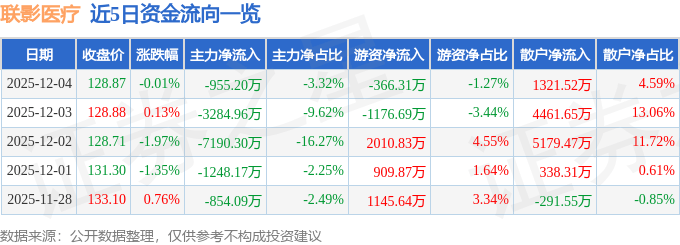
股票行情快报:联影医疗(688271)12月4日主力资金净卖出955.20万元
Sou Hu Cai Jing· 2025-12-04 12:13
Core Viewpoint - The stock of United Imaging Healthcare (688271) has shown a slight decline, with significant net outflows from major and retail investors, while the company continues to demonstrate strong revenue growth and profitability metrics in the medical device industry [1][3]. Financial Performance - As of December 4, 2025, United Imaging Healthcare's stock closed at 128.87 yuan, down 0.01% with a trading volume of 22,300 hands and a transaction value of 288 million yuan [1]. - For the first three quarters of 2025, the company reported a main business revenue of 8.859 billion yuan, a year-on-year increase of 27.39%, and a net profit attributable to shareholders of 1.12 billion yuan, up 66.91% [3]. - The third quarter of 2025 alone saw a main business revenue of 2.843 billion yuan, reflecting a 75.41% year-on-year increase, and a net profit of 122 million yuan, which is a 143.8% increase compared to the same period last year [3]. Market Position and Ratios - United Imaging Healthcare has a total market value of 106.209 billion yuan, ranking second in the medical device industry, with a net asset value of 20.805 billion yuan, ranking third [3]. - The company's price-to-earnings ratio (P/E) stands at 71.11, which is higher than the industry average of 60.57, indicating a relatively high valuation compared to peers [3]. - The gross margin is reported at 47.02%, slightly below the industry average of 51.22%, while the net margin is at 12.44%, above the industry average of 9.57% [3]. Investor Sentiment - In the last 90 days, 25 institutions have rated the stock, with 18 buy ratings and 7 hold ratings, indicating a generally positive outlook among analysts [4]. - The average target price set by institutions over the past 90 days is 173.12 yuan, suggesting potential upside from the current trading price [4].


机构看好创新药产业链,科创医药ETF嘉实(588700)一键布局生物医药产业
Sou Hu Cai Jing· 2025-12-04 03:57
Core Insights - The pharmaceutical sector is experiencing a rise, with the Shanghai Stock Exchange Sci-Tech Innovation Board Biomedicine Index increasing by 1.03% as of December 4, 2025, with notable gains from companies like Zai Lab (up 4.47%) and Rongchang Bio (up 4.14%) [1] Industry Overview - The pharmaceutical industry has undergone eleven rounds of national drug centralized procurement and multiple rounds of medical insurance negotiations, leading to an inevitable decline in the generic drug sector, which impacts the overall pharmaceutical industry [1] - From January to September 2025, the pharmaceutical manufacturing industry's revenue remained relatively stable, but the outlook for generic drugs is bleak, indicating a need for innovative drugs to drive future growth [1] Investment Perspective - According to Everbright Securities, future investments in the pharmaceutical sector should focus on the clinical value of drugs, addressing clinical needs of patients, as both domestic medical insurance policies and global expansion strategies increasingly emphasize clinical value [1] - The innovative drug industry chain and innovative medical devices are viewed positively based on the clinical value framework [1] Market Data - As of November 28, 2025, the top ten weighted stocks in the Shanghai Stock Exchange Sci-Tech Innovation Board Biomedicine Index include companies like United Imaging Healthcare and BeiGene, collectively accounting for 49.75% of the index [1]


CT、核磁集采“大杀价” 部分跨国企业已失守
经济观察报· 2025-12-03 14:22
Core Viewpoint - The article discusses the ongoing price war in the medical equipment industry due to centralized procurement, leading to significant price drops and market share losses for some multinational companies [1][2][3]. Group 1: Market Dynamics - The centralized procurement of medical devices began in 2020 in provinces like Anhui and Fujian, but has recently expanded nationwide, affecting market dynamics significantly [2][13]. - Prices for various medical devices have plummeted, with examples including digital X-ray (DR) prices dropping from over 1 million to 200,000, and CT prices falling to historical lows of 600,000 [3][11]. - The procurement process has become more competitive, with many projects being canceled or re-tendered due to complaints from companies, indicating a turbulent market environment [9][10]. Group 2: Impact on Distributors - Medical equipment distributors are facing severe challenges, with many considering transitioning to other business areas due to shrinking profit margins from centralized procurement [4][5]. - The profit margins for distributors have drastically decreased, with potential earnings from projects dropping from millions to tens of thousands [5][6]. - It is estimated that only about 10% of medical equipment distributors will remain in the industry post-procurement, primarily focusing on after-sales services [6][7]. Group 3: Competitive Landscape - Domestic companies are gaining market share at the expense of smaller multinational firms, with companies like Wandong Medical achieving high bid rates in centralized procurement [10][11]. - The article highlights that while domestic companies are performing well, the overall profit margins in the industry are under pressure due to the aggressive pricing strategies adopted during centralized procurement [11][12]. Group 4: Future Trends - The trend of centralized procurement is expected to continue expanding across provinces, with most regions likely to implement such measures in the next 3 to 5 years [15][16]. - The article suggests that centralized procurement for medical devices is simpler to implement compared to pharmaceuticals due to fewer product categories and more straightforward technical specifications [15][16].

CT、核磁集采“大杀价” 部分跨国企业已失守
Jing Ji Guan Cha Wang· 2025-12-03 13:57
Core Insights - The medical device distribution industry is facing significant challenges due to the expansion of centralized procurement, which has intensified price competition and reduced profit margins for distributors [2][3][4][5]. Group 1: Industry Trends - Centralized procurement for medical devices began in 2020 in Anhui and Fujian, but has recently expanded to most provinces in China, leading to a significant shift in the market landscape [2][10]. - The prices of major medical devices have drastically decreased, with examples including digital X-ray (DR) prices dropping from over 1 million to 200,000, and CT prices falling to historical lows of 600,000 [3][9]. - The ongoing anti-corruption campaign in the medical sector has heightened scrutiny on procurement practices, contributing to the rapid expansion of centralized procurement initiatives [3][12]. Group 2: Distributor Challenges - Many medical device distributors are considering transitioning to other business models, such as focusing on devices that are not yet subject to centralized procurement or moving upstream to manufacturing [4][5]. - The profit margins for distributors have significantly decreased, with some reporting earnings dropping from several million to only tens of thousands due to the competitive bidding process [4][5]. - It is projected that only about 10% of current medical device distributors will remain in the industry post-procurement expansion, primarily focusing on after-sales services [5][8]. Group 3: Manufacturer Responses - Major international manufacturers like GE and Philips are experiencing market share losses due to intensified competition from local companies, which are increasingly winning bids in centralized procurement [6][8]. - Local companies such as Wandong Medical and Mindray have shown strong performance in procurement bids, with Wandong achieving a 47% bid success rate for CT devices [8][9]. - Despite the increased competition, some manufacturers like United Imaging have managed to grow their revenue and profits, indicating that innovation may provide a competitive edge in this challenging environment [9]. Group 4: Future Outlook - The trend of centralized procurement is expected to continue expanding across provinces, with most regions likely to implement such measures within the next 3 to 5 years [12]. - The complexity of nationwide centralized procurement is acknowledged, with regional differences in medical device usage making it more feasible to conduct procurement at the provincial level [12].




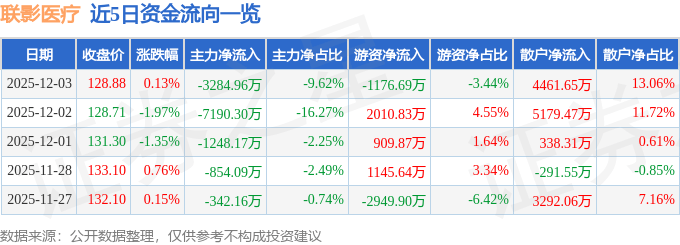
股票行情快报:联影医疗(688271)12月3日主力资金净卖出3284.96万元
Sou Hu Cai Jing· 2025-12-03 12:08
Core Viewpoint - The stock of United Imaging Healthcare (688271) shows a slight increase in price, with significant net outflows from major and retail investors, while the company demonstrates strong financial performance in recent quarters [1][3]. Financial Performance - As of December 3, 2025, United Imaging Healthcare's stock closed at 128.88 yuan, up 0.13% with a trading volume of 26,400 hands and a transaction value of 342 million yuan [1]. - In the third quarter of 2025, the company reported a main revenue of 8.859 billion yuan, a year-on-year increase of 27.39%, and a net profit attributable to shareholders of 1.12 billion yuan, up 66.91% year-on-year [3]. - The company's gross profit margin stands at 47.02%, with a net profit margin of 12.44% [3]. Market Position - United Imaging Healthcare has a total market value of 106.217 billion yuan, ranking second in the medical device industry, with a net asset value of 20.805 billion yuan, ranking third [3]. - The company has a price-to-earnings ratio of 71.11, which is higher than the industry average of 60.46, indicating a premium valuation compared to peers [3]. Investor Sentiment - Over the past 90 days, 25 institutions have rated the stock, with 18 buy ratings and 7 hold ratings, indicating positive sentiment among analysts [4]. - The average target price set by institutions for the stock is 173.12 yuan, suggesting potential upside from the current trading price [4]. Capital Flow - On December 3, 2025, the net outflow of major funds was 32.8496 million yuan, accounting for 9.62% of the total transaction value, while retail investors saw a net inflow of 44.6165 million yuan, representing 13.06% of the total transaction value [1][2].
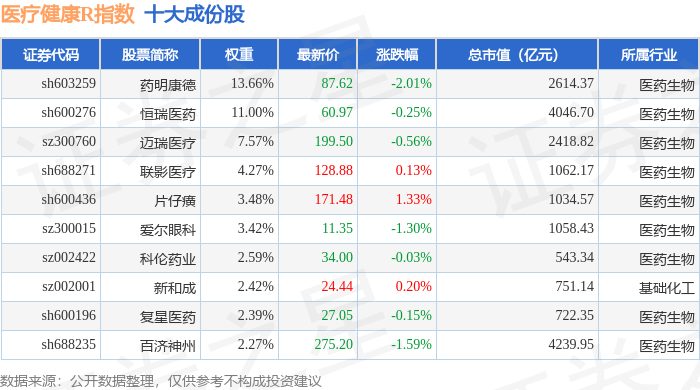
12月3日医疗健康R(480016)指数跌0.42%,成份股人福医药(600079)领跌
Sou Hu Cai Jing· 2025-12-03 10:05
Core Points - The Medical Health R Index (480016) closed at 7284.72 points, down 0.42%, with a trading volume of 17.046 billion yuan and a turnover rate of 0.61% [1] - Among the index constituents, 23 stocks rose while 26 fell, with TeBao Bio leading the gainers at 2.85% and Renfu Pharmaceutical leading the decliners at 3.33% [1] Index Constituents Summary - The top ten constituents of the Medical Health R Index include: - WuXi AppTec (sh603259) with a weight of 13.66%, latest price at 87.62, down 2.01%, and a market cap of 261.437 billion yuan [1] - Hengrui Medicine (sh600276) with a weight of 11.00%, latest price at 60.97, down 0.25%, and a market cap of 404.670 billion yuan [1] - Mindray Medical (sz300760) with a weight of 7.57%, latest price at 199.50, down 0.56%, and a market cap of 241.882 billion yuan [1] - United Imaging Healthcare (sh688271) with a weight of 4.27%, latest price at 128.88, up 0.13%, and a market cap of 106.217 billion yuan [1] - Pianzai Shou (sh600436) with a weight of 3.48%, latest price at 171.48, up 1.33%, and a market cap of 103.457 billion yuan [1] - Aier Eye Hospital (sz300015) with a weight of 3.42%, latest price at 11.35, down 1.30%, and a market cap of 105.843 billion yuan [1] - Kelun Pharmaceutical (sz002422) with a weight of 2.59%, latest price at 34.00, down 0.03%, and a market cap of 54.334 billion yuan [1] - Xinhecheng (sz002001) with a weight of 2.42%, latest price at 24.44, up 0.20%, and a market cap of 75.114 billion yuan [1] - Fosun Pharma (sh600196) with a weight of 2.39%, latest price at 27.05, down 0.15%, and a market cap of 72.235 billion yuan [1] - Ziji Shenzhou (sh688235) with a weight of 2.27%, latest price at 275.20, down 1.59%, and a market cap of 423.995 billion yuan [1] Capital Flow Analysis - The Medical Health R Index constituents experienced a net outflow of 1.159 billion yuan from institutional investors, while retail investors saw a net inflow of 999 million yuan [1] - Detailed capital flow for specific stocks shows: - Health元 (600380) had a net inflow of 34.2431 million yuan from institutional investors [2] - Hengrui Medicine (600276) had a net inflow of 29.9909 million yuan from institutional investors [2] - Long Spring High-tech (000661) had a net inflow of 19.8154 million yuan from institutional investors [2] - The index constituents underwent adjustments, adding four new stocks and removing one [2]




持续重点推荐创新药械产业链
2025-12-03 02:12
Summary of Conference Call Records Industry Overview - The pharmaceutical sector underperformed the broader market in November, with pharmaceutical commerce, traditional Chinese medicine, and raw materials performing relatively well [1][5] - The S&P Healthcare Select Sector Index in the US rose by 9.1%, outperforming the S&P 500 Index by 0.1% [5] Key Companies and Recommendations New Additions to Investment Portfolio - **Jin Xin Pharmaceutical**: Added due to its low valuation and stable core business; its LPA project ranks among the top two in China, expected to act as a catalyst [1][6] - **Yi Fang Bio**: Stock price has reached a low point; TIKTOO product is expected to have potential authorization in the next six months, with similar product data from Takeda acting as a catalyst [1][7] - **Te Bao Bio**: Main product Pegasys for hepatitis B has received approval, with new patient numbers increasing; expected to continue high growth next year [1][8][9] Continued Recommendations - **Hengrui Medicine**: Strong R&D pipeline and favorable procurement situation; R&D Day on December 5 is a key event to watch [1][10] - **Medical Device Leaders**: Long-term investment value due to stable competitive landscape and recovery in terminal bidding; many companies reported revenue turning points in Q3 [1][11] Market Trends and Projections - The medical device industry is expected to see a recovery trend in Q4 2025 and 2026, with strong performance in neuro-intervention and neurosurgery sectors [1][12] - The IVD industry may face volume and price pressures in 2025 but is expected to see a turning point in 2026 [1][12][13] Competitive Landscape - China's medical device market is gaining global competitiveness due to advantages in engineering, industrial clusters, supply chains, and clinical resources [1][14] - Despite complexities, Chinese medical devices are competitive globally due to cost-effectiveness; leading companies are increasing overseas revenue [1][14] Individual Company Insights - **Kelong Pharmaceutical**: Faced challenges due to procurement price reductions but is expected to stabilize with rising demand for large-volume infusions [1][16] - **BeiGene**: Anticipated to achieve profitability for the first time, with strong sales performance from its drug Zebrutinib [1][16] Investment Recommendations - Recommended stocks include **United Imaging**, **Lepu Medical**, **Hui Tai**, **Chun Li**, and **New Industry** in the IVD sector [1][15] - **United Imaging**: Expected to continue high growth with new product contributions [1][15] - **Lepu Medical**: Stable core business with growth potential in new sectors [1][15] Future Catalysts - TIK2 inhibitors are expected to show potential in various indications, with significant data releases anticipated [1][18] - Jin Xin Pharmaceutical has completed Phase I clinical trials with satisfactory results, indicating strong potential in the cardiovascular field [1][20][21] Conclusion - The pharmaceutical and medical device sectors are poised for recovery, with specific companies showing strong potential for growth and investment opportunities in the coming years.
机构:医疗器械估值调整接近尾声,龙头公司业绩拐点与脑机接口或成双主线
Sou Hu Cai Jing· 2025-12-03 01:52
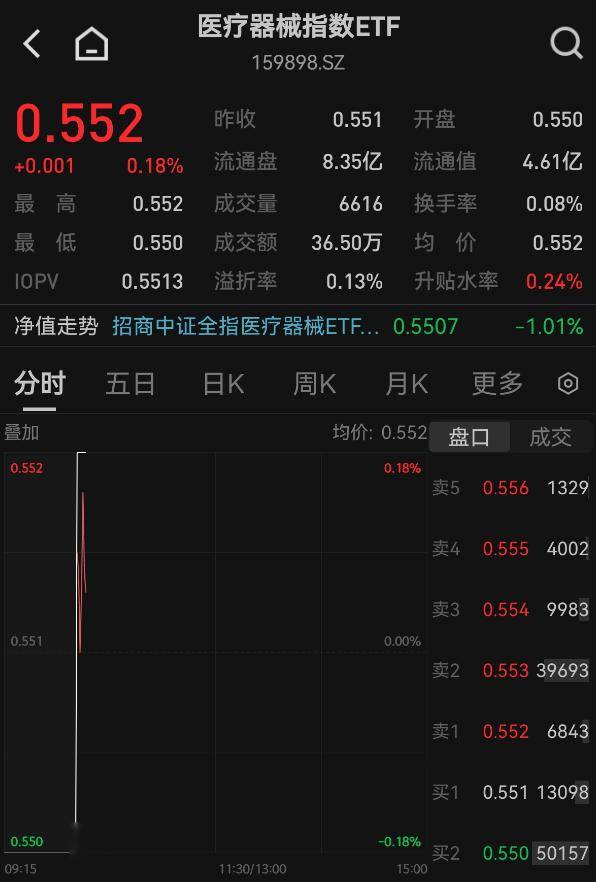
12月3日开盘,三大指数涨跌不一,科技方向多板块反弹。医疗器械指数ETF(159898)微涨0.18%,连续两天获得资金净申购共275万元,年内涨幅位居相 同标的ETF第一。 | 医疗器械指数ETF | | | | | | | --- | --- | --- | --- | --- | --- | | | 159898.SZ | | | | | | 0.552 | | 昨日 | 0.551 | 开盘 | 0.550 | | +0.007 0.18% | | 流通盘 | 8.35 Z | 流通值 | 4.611Z | | 最高 0.552 | | 成交量 | 6616 | 换手率 | 0.08% | | 最 低 0.550 | | 成交额 | 36.50万 | 均价 | 0.552 | | IOPV 0.5513 | | 溢折率 | 0.13% | | 升贴水率 0.24% | | 净值走势 招商中证全指医疗器械ETF... 0.5507 | | | | | -1.01% | | 分时 | 五日 日K 周K 月K | | | | 申名 向 | | 音加 | 均价:0.552 盘口 成交 | | | | | | ...
研判2025!中国C臂机(移动式C形臂X射线机)行业发展历程、发展现状、竞争格局及发展趋势分析:外资品牌在高端市场仍然占据主导地位[图]
Chan Ye Xin Xi Wang· 2025-12-03 01:45
Core Insights - The increasing aging population in China is leading to a rise in orthopedic and cardiovascular diseases, resulting in a growing demand for surgical procedures that utilize C-arm machines for real-time imaging guidance [1][8] - The market for mobile C-arm machines is expected to see significant growth, with a projected procurement total of 1,474 units in 2024, representing a year-on-year increase of 49.34%, and a total procurement value of 1.62 billion yuan, up 23.95% [1][8] - The competitive landscape is shifting, with domestic companies like Nanjing Puhui Medical and Shanghai United Imaging Healthcare gaining market share against traditional foreign brands [9][10] Overview - C-arm machines, specifically mobile C-arm X-ray machines, are essential for providing real-time imaging during surgeries, aiding in precise localization of lesions and monitoring surgical procedures [1][3] - The machines are categorized into small, medium, and large C-arms based on their functionalities [3] Market Policies - The Chinese government is prioritizing the development of the medical device industry, including C-arm machines, through various policies aimed at ensuring product quality and patient safety [4][5] Industry Chain - The upstream of the C-arm machine industry includes suppliers of core electronic components, while the midstream involves R&D, design, and production, and the downstream consists of various medical institutions as primary demanders [5][6] Current Development - The demand for C-arm machines is being driven by the increasing number of medical institutions, which reached 1.092 million by the end of 2024, marking a 2.0% year-on-year growth [6][8] Competitive Landscape - The market was historically dominated by foreign brands like GE and Siemens, but domestic companies are increasingly capturing market share, with local brands accounting for 74.64% of the market in the first half of 2025 [9][10] Future Trends - The future of C-arm machines will likely see advancements in lightweight materials and battery technology, enhancing portability and usability in emergency and remote medical scenarios [11]
