沪农商行

Search documents
银行直售房,没那么吓人
Ge Long Hui· 2025-11-12 10:55
Core Insights - The recent surge in banks selling properties has raised concerns about the accumulation of non-performing assets within the banking sector [1][2][4] - Data indicates that the number of properties listed for sale by various rural credit systems is substantial, with Guangdong, Sichuan, and other provinces showing significant figures [1][2][6] - Despite the high number of properties being sold, they represent a small fraction of the overall housing inventory in major cities like Guangzhou, Shenzhen, and Chengdu [6][11][9] Summary by Sections Property Sales Data - Since August 2024, the Guangdong rural credit system has listed 12,386 properties for sale, while the Sichuan rural credit system has listed 24,821 properties since November 2024 [1] - Other provinces such as Liaoning, Guizhou, Jilin, and Fujian have also contributed to the total number of properties being sold [1] Market Reaction - The market has reacted with surprise, speculating that banks may be facing a significant amount of non-performing assets [2][4] - The perception is that the properties being sold are just the tip of the iceberg, indicating a larger issue with banks needing to liquidate assets [2] Non-Performing Loans and Asset Management - The sale of properties is often linked to borrowers' inability to repay loans, leading banks to reclaim and sell these assets [3] - The current data suggests that the number of properties being sold is relatively small compared to the total inventory of second-hand homes available in the market [6][11] Trends in Non-Performing Loan Rates - The overall non-performing loan rates for listed banks have been declining since 2020, indicating that banks have been effectively managing and disposing of non-performing assets [12][13] - As of November 2025, the non-performing loan rates for various banks show a downward trend compared to previous years, with many banks reporting lower rates than in 2020 [12][13] Industry Restructuring - The banking sector has undergone significant reforms and consolidations, with over 300 rural banks being merged or restructured in 2025 alone [15] - Major banks have also participated in these consolidations, indicating a strategic move to strengthen their positions and manage non-performing assets more effectively [15] Asset Disposal Efforts - Banks have been actively disposing of non-performing assets, with significant amounts being processed each year [18][20] - In 2025, banks disposed of 1.5 trillion yuan in non-performing assets, reflecting a proactive approach to managing risk [20] - The rural commercial banks have seen the highest non-performing loan rates but have also experienced the most significant reductions in these rates over the years [21][22]


积极投身科技金融,多家中小银行上半年科技贷款增速超20%
2 1 Shi Ji Jing Ji Bao Dao· 2025-11-12 10:12
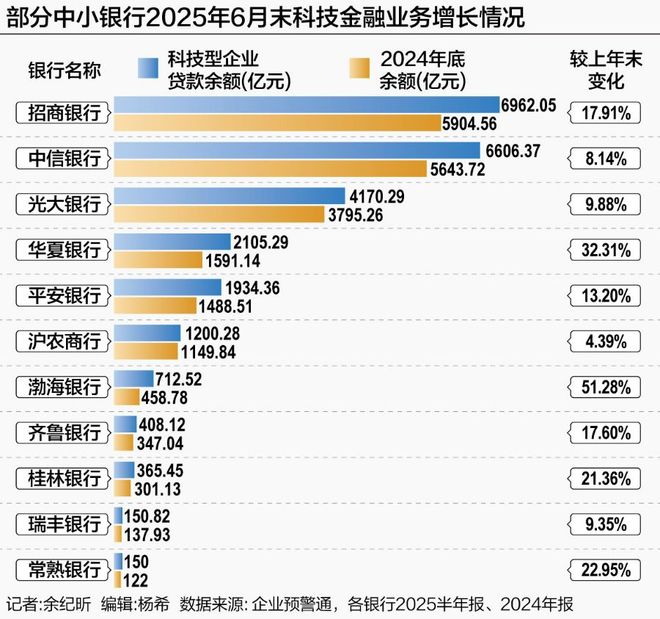
Core Insights - The report highlights the upgraded strategic positioning of technological innovation in China's financial sector, emphasizing the need for high-level self-reliance and strength in the context of the "14th Five-Year Plan" and the upcoming "15th Five-Year Plan" [1] - The rapid growth of technology finance in small and medium-sized banks is noted, with several banks reporting loan growth rates exceeding 20% in the first half of 2025 [1][6] Policy Developments - Central government initiatives in 2025 have focused on enhancing support for technology finance, particularly for small and medium-sized enterprises (SMEs) [2] - Key policies include the issuance of guidelines to strengthen financial support for major technological tasks and the promotion of credit loans for technology enterprises [2][3] - Local governments have also implemented action plans to support technological innovation, with specific targets for loan disbursement [3] Market Performance - As of June 2025, several small and medium-sized banks have shown significant growth in technology loans, with some banks like Huaxia Bank and Bohai Bank achieving over 20% growth [6][10] - The total balance of loans to technology SMEs reached 3.4 trillion yuan, reflecting a year-on-year growth of 22% [5] Financial Instruments - The introduction of the "Technology Board" in the bond market is a significant development, aimed at supporting technological innovation through diversified financing options [12] - By October 2025, banks had issued a total of 57 technology bonds, amounting to 277.6 billion yuan, indicating a strong market response [15] Participation of Financial Institutions - Major banks have taken a leading role in underwriting technology bonds, with a notable number of new issues and a significant total amount raised [16] - The participation of local small and medium-sized banks in the technology bond market is increasing, reflecting a broader engagement in supporting technological enterprises [17]
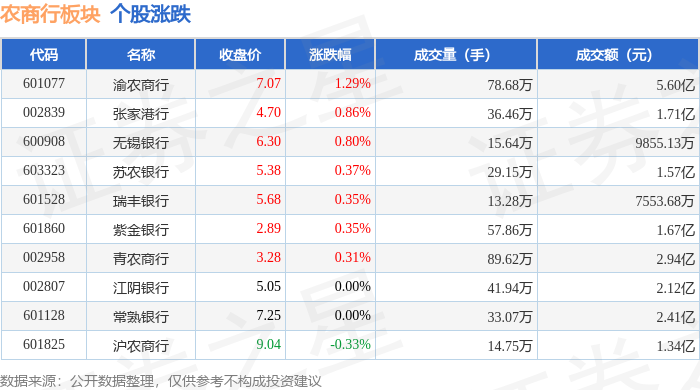
农商行板块11月12日涨0.34%,渝农商行领涨,主力资金净流出2619.33万元
Zheng Xing Xing Ye Ri Bao· 2025-11-12 08:49
Core Viewpoint - The rural commercial bank sector experienced a slight increase of 0.34% on November 12, with Yunnan Rural Commercial Bank leading the gains, while the Shanghai Composite Index fell by 0.07% and the Shenzhen Component Index decreased by 0.36% [1] Group 1: Market Performance - The closing price of Yunnan Rural Commercial Bank was 7.07, with an increase of 1.29% and a trading volume of 786,800 shares, amounting to a transaction value of 560 million yuan [1] - Zhangjiagang Bank closed at 4.70, up 0.86%, with a trading volume of 364,600 shares and a transaction value of 171 million yuan [1] - Wuxi Bank's closing price was 6.30, reflecting an increase of 0.80%, with a trading volume of 156,400 shares and a transaction value of approximately 98.55 million yuan [1] - Su Nong Bank closed at 5.38, up 0.37%, with a trading volume of 291,500 shares and a transaction value of 157 million yuan [1] - Ruifeng Bank's closing price was 5.68, with a 0.35% increase, trading 132,800 shares for a total value of approximately 7.55 million yuan [1] - Zijin Bank closed at 2.89, up 0.35%, with a trading volume of 578,600 shares and a transaction value of 167 million yuan [1] - Qingnong Bank closed at 3.28, reflecting a 0.31% increase, with a trading volume of 896,200 shares and a transaction value of 294 million yuan [1] - Jiangyin Bank's closing price was 5.05, unchanged, with a trading volume of 419,400 shares and a transaction value of 212 million yuan [1] - Changshu Bank closed at 7.25, unchanged, with a trading volume of 330,700 shares and a transaction value of 241 million yuan [1] - Shanghai Rural Commercial Bank closed at 9.04, down 0.33%, with a trading volume of 147,500 shares and a transaction value of 134 million yuan [1] Group 2: Fund Flow Analysis - The rural commercial bank sector saw a net outflow of 26.19 million yuan from main funds, while speculative funds experienced a net inflow of 34.43 million yuan, and retail investors had a net outflow of 8.24 million yuan [1]




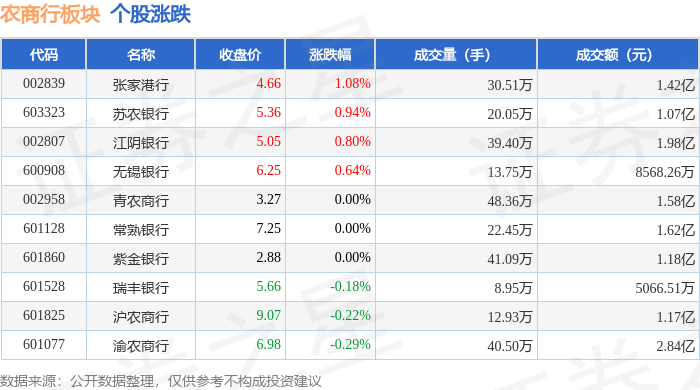
农商行板块11月11日涨0.01%,张家港行领涨,主力资金净流出1.4亿元
Zheng Xing Xing Ye Ri Bao· 2025-11-11 08:46
Core Insights - The rural commercial bank sector experienced a slight increase of 0.01% on November 11, with Zhangjiagang Bank leading the gains [1] - The Shanghai Composite Index closed at 4002.76, down 0.39%, while the Shenzhen Component Index closed at 13289.0, down 1.03% [1] Stock Performance - Zhangjiagang Bank (002839) closed at 4.66, up 1.08% with a trading volume of 305,100 shares and a transaction value of 1.42 billion [1] - Su Nong Bank (603323) closed at 5.36, up 0.94% with a trading volume of 200,500 shares and a transaction value of 107 million [1] - Jiangyin Bank (002807) closed at 5.05, up 0.80% with a trading volume of 394,000 shares and a transaction value of 1.98 billion [1] - Wuxi Bank (600908) closed at 6.25, up 0.64% with a trading volume of 137,500 shares and a transaction value of 85.68 million [1] - Qingnong Commercial Bank (002958) and Changshu Bank (601128) remained unchanged at 3.27 and 7.25 respectively [1] Fund Flow Analysis - The rural commercial bank sector saw a net outflow of 140 million from institutional investors, while retail investors contributed a net inflow of 79.48 million [1] - Zhangjiagang Bank had a net inflow of 6.31 million from institutional investors, but a net outflow of 4.63 million from retail investors [2] - Wuxi Bank experienced a net inflow of 2.46 million from institutional investors, with retail investors contributing a net inflow of 3.07 million [2] - Qingnong Commercial Bank faced a significant net outflow of 23.40 million from institutional investors, while retail investors contributed a net inflow of 20.09 million [2] - Yunnan Agricultural Bank (601077) had the highest net outflow of 87.93 million from institutional investors, with retail investors contributing a net inflow of 47.76 million [2]

中信建投:资金面和市场因素共同引导 稳健+高股息属性银行更受青睐
智通财经网· 2025-11-11 03:48
Core Viewpoint - The macroeconomic environment in 2025 is expected to continue a weak recovery, with no significant improvement in the banking sector's fundamentals, leading to a sustained focus on high dividend strategies [1][2] Economic Environment - The A-share market has shown a significant divergence between "dividend" and "technology growth" styles, creating a "seesaw pattern" [2] - In uncertain external conditions, funds are flowing into stable cash flow and high-dividend sectors for immediate certainty, while risk appetite recovery leads to a shift towards technology growth for future high returns [2] Banking Sector Fundamentals - The banking sector's fundamentals are expected to continue bottoming out, with credit growth maintaining around 7%-8% and a gradual slowdown in the trend of deposit regularization [2] - Cost optimization on the liability side is expected to mitigate the impact of policy interest rate cuts, leading to a further narrowing of interest margin declines [2] - Non-interest income is anticipated to improve due to a recovering capital market, although other non-interest income may be dragged down by low bond market volatility and high baselines [2] - Asset quality is stable, with non-performing loan ratios remaining steady, but retail risks are still emerging, particularly concerning real estate-related risks [2] Dividend Strategy - Several banks have successfully implemented mid-term dividends, showcasing stability and sustainability in their dividend policies [2] - The focus remains on high dividend yield strategies, with specific recommendations for state-owned banks and high-yield private banks such as China Merchants Bank and regional banks like Hangzhou Bank and Jiangsu Bank [3] - There is an emphasis on banks with limited refinancing dilution risks and those that can quickly recover through profit releases, as well as those with strong cyclical attributes [3]

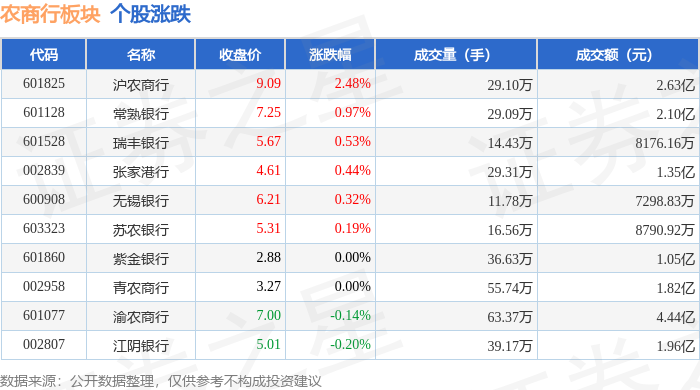
农商行板块11月10日涨0.92%,沪农商行领涨,主力资金净流出2.1亿元
Zheng Xing Xing Ye Ri Bao· 2025-11-10 08:48
Core Insights - The agricultural commercial bank sector experienced a rise of 0.92% on November 10, with Shanghai Agricultural Commercial Bank leading the gains [1] - The Shanghai Composite Index closed at 4018.6, up 0.53%, while the Shenzhen Component Index closed at 13427.61, up 0.18% [1] Sector Performance - Shanghai Agricultural Commercial Bank (601825) closed at 60.6, with a gain of 2.48% and a trading volume of 291,000 shares, amounting to a transaction value of 263 million yuan [1] - Changshu Bank (601128) closed at 7.25, up 0.97%, with a trading volume of 290,900 shares and a transaction value of 210 million yuan [1] - Ruifeng Bank (601528) closed at 5.67, up 0.53%, with a trading volume of 144,300 shares and a transaction value of 81.76 million yuan [1] - Zhangjiagang Bank (002839) closed at 4.61, up 0.44%, with a trading volume of 129,300 shares and a transaction value of 135 million yuan [1] - Yuanxi Bank (600908) closed at 6.21, up 0.32%, with a trading volume of 117,800 shares and a transaction value of 72.99 million yuan [1] - Shinan Bank (603323) closed at 5.31, up 0.19%, with a trading volume of 165,600 shares and a transaction value of 87.91 million yuan [1] - Zijin Bank (601860) closed at 2.88, unchanged, with a trading volume of 366,300 shares and a transaction value of 105 million yuan [1] - Qingnong Commercial Bank (002958) closed at 3.27, unchanged, with a trading volume of 557,400 shares and a transaction value of 182 million yuan [1] - Yunnan Agricultural Commercial Bank (601077) closed at 7.00, down 0.14%, with a trading volume of 633,700 shares and a transaction value of 444 million yuan [1] - Jiangyin Bank (002807) closed at 5.01, down 0.20%, with a trading volume of 391,700 shares and a transaction value of 196 million yuan [1] Fund Flow Analysis - The agricultural commercial bank sector saw a net outflow of 210 million yuan from main funds, while retail funds experienced a net inflow of 118 million yuan [1] - The main fund flow for Shanghai Agricultural Commercial Bank was a net inflow of 9.12 million yuan, while retail funds saw a net outflow of 197,440 yuan [2] - Ruifeng Bank had a main fund net inflow of 4.43 million yuan, but retail funds experienced a net outflow of 763.71 million yuan [2] - Zhangjiagang Bank had a significant main fund net outflow of 16.33 million yuan, while retail funds saw a net inflow of 1.77 million yuan [2] - Changshu Bank experienced a main fund net outflow of 21.87 million yuan, with retail funds seeing a net inflow of 26.42 million yuan [2] - Qingnong Commercial Bank had a main fund net outflow of 32.17 million yuan, while retail funds had a net inflow of 20.39 million yuan [2] - Yunnan Agricultural Commercial Bank faced a substantial main fund net outflow of 143 million yuan, but retail funds had a net inflow of 59.38 million yuan [2]


从增量扩面到提质控险 银行业普惠金融迈向差异化精准服务
2 1 Shi Ji Jing Ji Bao Dao· 2025-11-10 04:21
Core Insights - The report highlights the significant growth and development of inclusive finance in China, particularly focusing on small and micro enterprises and rural areas, with a notable annual growth rate of over 20% in inclusive micro loans during the 14th Five-Year Plan period [1][2] - As of June 2025, the balance of inclusive micro loans reached 36 trillion yuan, which is 2.3 times that of the end of the 13th Five-Year Plan, with a decrease in interest rates by 2 percentage points [1][2] - The average interest rate for newly issued inclusive micro loans was 3.48% as of June 2025, reflecting a decrease of 66 basis points year-on-year [1][2] Group 1: Digital Empowerment - Digital technology has been a key driver for the development of inclusive finance, with banks utilizing big data and AI to enhance loan approval efficiency and reduce financing costs [2][7] - The market structure among banks is changing, with large commercial banks holding a 45.11% share of inclusive micro loans, while rural financial institutions have seen a decline in their market share [2][3] - The average growth rate of inclusive micro loans has been slowing down, with a decrease from 30.9% in 2020 to 12.3% by mid-2025 [2][3] Group 2: Performance of Listed Banks - Among listed banks, Agricultural Bank of China, Industrial and Commercial Bank of China, and Beijing Bank reported the highest growth rates in inclusive micro loans at 18.50%, 17.30%, and 17.27% respectively [3][4] - In contrast, some banks, including Shanghai Bank and Zhengzhou Bank, experienced negative growth rates of -3.97% and -2.06% [3][4] - The performance of different banks varies significantly, with state-owned banks generally showing stronger growth in inclusive micro loans compared to smaller banks [3][4] Group 3: Interest Rates and Risk Management - The interest rates for newly issued inclusive micro loans have decreased across various banks, with the highest rate at 4.20% and the lowest at 2.94% [7][8] - The gap in interest rates between large and small banks is narrowing, with some large banks' rates aligning closely with those of smaller banks [8][9] - The report emphasizes the importance of risk management in the inclusive finance sector, with several banks focusing on improving asset quality and managing non-performing loans [9][10]



沪农商行赋能进博企业 提供数字化跨境金融解决方案
Xin Hua Cai Jing· 2025-11-10 02:28
Core Insights - Shanghai Rural Commercial Bank has established a strategic partnership with New Zealand New Cloud (Shanghai) E-commerce Co., Ltd. during the 8th China International Import Expo, enhancing digital cross-border financial solutions for participating enterprises [1][2] - The collaboration follows the bank's launch of two new cross-border remittance products, "Xin Yi Xian Su Da" and "Xin Yi Bai Bi Tong," aimed at improving financial services for import businesses [1] - The partnership exemplifies the bank's commitment to financial innovation and support for enterprises like New Zealand, facilitating the rapid delivery of fresh milk from New Zealand to China within 72 hours [1] Group 1 - The strategic cooperation aims to provide comprehensive digital cross-border financial solutions to a range of enterprises participating in the expo [1] - Shanghai Rural Commercial Bank has been a consistent participant in the Import Expo for eight consecutive years, showcasing its dedication to supporting businesses through financial innovation [1] - The bank's initiatives include optimizing remittance paths and managing currency risks, effectively addressing financial bottlenecks in the import cold chain food trade [1] Group 2 - The bank positions itself as a "financial bridge" connecting global markets with opportunities in China, focusing on innovative and high-potential enterprises like New Zealand [2] - It aims to create an international, comprehensive, and digital financial service system, providing integrated financial solutions across the entire lifecycle and industry chain [2] - The partnership contributes to the ongoing development of Shanghai as an international trade center, injecting sustained momentum into its growth [2]
普惠金融业务有望平稳增长
Xiangcai Securities· 2025-11-09 11:34
Core Insights - The report indicates that inclusive finance business is expected to maintain steady growth, with the People's Bank of China releasing the "China Inclusive Finance Index Analysis Report (2024-2025)" [8][34] - As of June 2025, the balance of inclusive micro and small loans reached 36.09 trillion yuan, reflecting a year-on-year growth of 12.2%, which, although lower than the previous year, remains significantly higher than the general loan growth rate [8][34] - The report highlights that the proportion of inclusive micro and small credit loans is increasing, while the interest rates on these loans are declining [8][34] Industry Performance - The report notes that personal consumption loans, excluding housing loans, reached a balance of 21.29 trillion yuan by September 2025, with a year-on-year growth of 4.2% [8][34] - The report emphasizes that the implementation of special actions to boost consumption since 2025, including fiscal subsidies for personal consumption loans in key areas, is expected to sustain low but steady growth in consumption loans [8][34] Investment Recommendations - The report suggests that the issuance of policy financial tools is likely to boost bank credit demand, with regional banks expected to maintain resilient asset expansion [11][37] - It recommends focusing on state-owned banks for stable high dividend investment value, specifically mentioning Industrial and Commercial Bank of China and Bank of China, as well as opportunities for valuation recovery in joint-stock and regional banks [11][37]
上海国际金融中心一周要闻回顾(11月3日—11月9日)
Guo Ji Jin Rong Bao· 2025-11-09 04:50
Group 1 - The eighth Hongqiao International Economic Forum held multiple sub-forums focusing on financial support for global trade, supply chain stability, and cross-border trade development, highlighting the importance of financial cooperation in international markets [1][2][3] - China Bank and the Hong Kong Trade Development Council signed a strategic cooperation memorandum to assist enterprises in expanding into international markets [1] - The launch of the "Digital Trade" ecological alliance by the Bank of Communications aims to enhance cross-border trade quality [2] Group 2 - The Shanghai Futures Exchange revised its guidelines for using government bonds as margin, facilitating futures companies in managing collateral [7] - Shanghai banks are innovating in financial services, such as the launch of the "Xinyu" cross-border products by Shanghai Rural Commercial Bank to support enterprises in global markets [11] - The signing of a strategic cooperation framework agreement between Shanghai United Assets and Macau Financial Assets Exchange aims to enhance cross-border asset trading and technological collaboration [9] Group 3 - The China Export-Import Bank introduced a tailored financial service plan for the eighth China International Import Expo, focusing on providing efficient cross-border financial services [14] - The Shanghai Financial Regulatory Bureau reported a total asset balance of 28.59 trillion yuan in the banking sector as of September 2025, reflecting a year-on-year growth of 6.25% [30] - The Shanghai Stock Exchange successfully recorded the first cross-border share pledge registration, enhancing the efficiency of cross-border transactions [20]