
苏州银行

Search documents
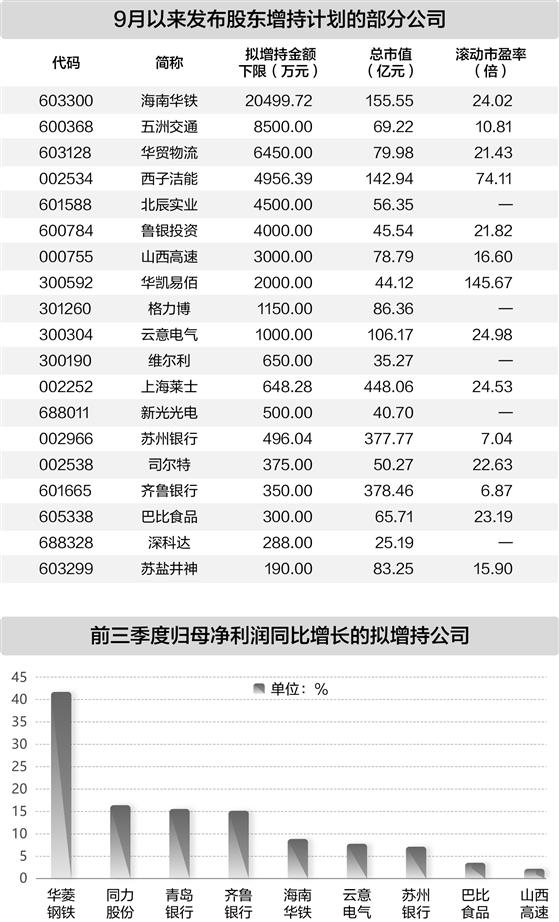
9月以来24家公司公布增持计划 8家获险资重仓
Zheng Quan Shi Bao· 2025-11-04 17:50
| | | 9月以来发布股东增持计划的部分公司 | | | | --- | --- | --- | --- | --- | | 代码 | 简称 | 拟增持金额 下限(万元) | 总市值 (亿元) | 滚动市盈率 (倍) | | 603300 | 海南华铁 | 20499.72 | 155.55 | 24.02 | | 600368 | 五州交通 | 8500.00 | 69.22 | 10.81 | | 603128 | 华贸物流 | 6450.00 | 79.98 | 21.43 | | 002534 | 西子洁能 | 4956.39 | 142.94 | 74.11 | | 601588 | 北辰实业 | 4500.00 | 56.35 | | | 600784 | 兽银投资 | 4000.00 | 45.54 | 21.82 | | 000755 | 山西高速 | 3000.00 | 78.79 | 16.60 | | 300592 | 非凯易倡 | 2000.00 | 44.12 | 145.67 | | 301260 | 格力博 | 1150.00 | 86.36 | | | 300304 | 云意 ...

银行业2025年三季报综述:业绩稳健性凸显,引领银行价值回归
Shenwan Hongyuan Securities· 2025-11-04 14:41
Investment Rating - The report maintains a positive outlook on the banking sector, indicating a potential return to a valuation of 1 times net asset value [4][7]. Core Insights - The banking sector has demonstrated steady performance, with a year-to-date revenue growth of 0.8% and a net profit growth of 1.5% for the first nine months of 2025, reflecting a stable regulatory environment supporting bank profitability [10][14]. - The report highlights a shift in focus from scale to balance in credit growth, with banks increasingly pursuing a "quantity-price balance" strategy [4][7]. - The cost of liabilities has improved more significantly than the decline in asset pricing, leading to a stabilization of net interest margins, which is expected to continue into the next year [4][7]. - Asset quality remains stable but shows signs of divergence, particularly with rising risks in small and micro businesses [4][7]. - The report suggests that the current dividend yield of the banking sector has returned to an attractive range, indicating a significant disconnect between stable earnings and stock holdings, which could lead to a value recovery [4][7]. Summary by Sections Performance Overview - The banking sector's performance has been characterized by a steady increase in revenue and profit, with state-owned banks showing better-than-expected stability and regional banks leading in performance [11][12][15]. - The report notes that the revenue growth of state-owned banks has turned positive, with non-interest income contributing significantly to this growth [12][15]. Credit Growth and Strategy - The report indicates a gradual abandonment of scale-driven growth, with banks focusing on achieving a balance between volume and pricing in their lending practices [4][7]. - The credit growth rate for listed banks decreased by 0.3 percentage points to 7.7% in Q3 2025, with state-owned banks maintaining a growth rate of approximately 8.5% [4][7]. Profitability and Asset Quality - The net interest margin for listed banks remained stable at 1.5%, with a slight quarter-on-quarter increase of 3 basis points in Q3 2025 [4][7]. - The overall non-performing loan ratio remained stable at 1.22%, indicating manageable risk levels across the sector [4][7]. Investment Recommendations - The report recommends focusing on leading banks and undervalued regional banks as key investment opportunities, suggesting that the recovery in valuations is supported by stable earnings and attractive dividend yields [4][7].



长三角城商行扩表进行时:对公信贷狂飙,财富业务回暖
2 1 Shi Ji Jing Ji Bao Dao· 2025-11-04 11:57
Core Insights - The banking sector in the Yangtze River Delta is experiencing a different trend compared to the overall slowdown in loan growth, with several city commercial banks showing double-digit asset growth [1][3] Group 1: Loan Growth - As of the end of Q3, several city commercial banks in the Yangtze River Delta reported significant asset growth: Jiangsu Bank at 4.93 trillion yuan (up 24.68%), Ningbo Bank at 3.58 trillion yuan (up 14.50%), and Nanjing Bank at 2.96 trillion yuan (up 14.31%) [1] - The overall loan growth for all A-share listed banks was 7.70% year-on-year, with city commercial banks leading at 12.86% [1][2] - Specific banks like Jiangsu Bank and Ningbo Bank reported loan growth rates exceeding 17% in Q3, driven primarily by corporate loans [3][5] Group 2: Corporate Loans - Corporate loans have significantly increased, with Ningbo Bank's corporate loan growth reaching 32.10% in Q3, the highest among peers [5] - The proportion of corporate loans in total loans has risen for many banks, with Jiangsu Bank's corporate loans making up 67.38% and Nanjing Bank's at 76.03% [4][5] - The focus on corporate loans, particularly in technology sectors, has been emphasized by several banks, with notable increases in technology-related loan disbursements [6][8] Group 3: Revenue and Profitability - The total revenue for six city commercial banks in the Yangtze River Delta reached 243.6 billion yuan in Q3, a year-on-year increase of 6.41%, while net profit grew by 8.36% to 111.2 billion yuan [7] - Jiangsu Bank reported a revenue of 67.18 billion yuan and a net profit of 30.58 billion yuan, both showing positive growth [7] - Wealth management and retail banking segments are showing signs of recovery, contributing to the overall revenue growth [8] Group 4: Investment Income - Investment income has been under pressure due to rising interest rates and market volatility, with the fair value changes of financial assets showing negative results [9][10] - Shanghai Bank reported the highest investment income at 16.77 billion yuan, but also faced significant losses in fair value changes [11]





苏州银行:董事、行长庄颖杰因工作变动离任
Xin Lang Cai Jing· 2025-11-04 11:23
Core Viewpoint - Suzhou Bank's president, Zhuang Yingjie, has submitted a resignation letter due to job changes, effective October 31, 2025, which will not affect the normal operations of the board or management [1] Group 1 - Zhuang Yingjie has applied to resign from his positions as director and president of the bank, with his term originally set to end on December 27, 2026 [1] - The resignation will take effect upon delivery to the board and will not impact the board's normal operations or management [1] - As of the announcement date, Zhuang Yingjie has fulfilled all public commitments and has completed the necessary handover work [1]
股东增持+险资重仓股出炉!
Zheng Quan Shi Bao Wang· 2025-11-04 10:49
Core Viewpoint - The A-share market has shown an upward trend since September, with multiple listed companies announcing shareholder buyback plans, reflecting shareholder confidence in long-term company development and enhancing corporate governance [1][2]. Group 1: Shareholder Buyback Plans - A total of 24 listed companies have disclosed shareholder buyback plans since September, with 19 companies specifying a minimum buyback amount or having completed their buybacks, totaling 599 million yuan [2]. - Ten companies plan to increase their holdings by 10 million yuan or more, with Hainan Huatie, Wuzhou Transportation, and Huamao Logistics leading in proposed minimum buyback amounts of 205 million yuan, 85 million yuan, and 64.5 million yuan respectively [3]. Group 2: Company Performance - Among the 24 companies with buyback plans, 21 reported profits in the first three quarters, with five companies, including Suzhou Bank and Qingdao Bank, achieving net profits exceeding 1 billion yuan [4]. - Huazhong Steel reported the highest net profit growth, reaching 2.51 billion yuan, a year-on-year increase of 41.72%, driven by high-end transformation projects [4]. Group 3: Institutional Investment - Eight stocks have attracted significant interest from insurance funds, with two new additions, Xizi Clean Energy and Yunyi Electric, while four stocks, including Huazhong Steel and Suzhou Bank, saw an increase in holdings [5]. - The average cumulative increase for insurance-heavy stocks this month is 2.37%, with BaBi Foods, Xizi Clean Energy, and Suzhou Bank leading in growth rates of 9.33%, 6.74%, and 2.1% respectively [6].
精测电子:为子公司银行授信提供担保,总额近1亿元
Xin Lang Cai Jing· 2025-11-04 10:36
Core Points - The company has approved a guarantee of up to 3.78 billion yuan for its subsidiaries for the year 2025 [1] - The guarantees provided include a maximum of 210 million yuan for Changzhou Jingce and 800 million yuan for Wuhan Jingli [1] - Contracts have been signed with Suzhou Bank and China Merchants Bank to provide joint liability guarantees with maximum principal limits of 10 million yuan and 80 million yuan respectively [1] - The validity period for these guarantees extends until December 28, 2026, for Changzhou Jingce and November 2, 2027, for Wuhan Jingli [1] - As of the announcement date, the company's total external guarantees amount to 930 million yuan, which represents 26.85% of the net assets as of the end of 2024 [1] - There are no overdue guarantee matters reported [1]
新进270家上市公司十大流通股名单,险资前三季度加大权益投资
Hua Xia Shi Bao· 2025-11-04 09:58
Core Viewpoint - The A-share market has shown a strong upward trend in Q3 2023, driven by favorable policies and capital inflows, with insurance funds playing a crucial role in market dynamics [2] Group 1: Insurance Fund Investment Strategies - Insurance funds have maintained a strong preference for traditional "anchor" bank stocks, demonstrating a commitment to stable returns and high dividend assets [2][4] - There has been a significant increase in the allocation towards technology growth sectors such as electronics and computers, indicating a strategic shift towards economic transformation and industrial upgrading [2][8] - The "cash flow and growth" strategy reflects the asset allocation wisdom of insurance funds in the current market environment, potentially revealing future capital flows and market style preferences [2] Group 2: Performance and Holdings of Insurance Companies - Major insurance companies like China Life, China Ping An, and China Pacific have reported an increase in total investment returns, ranging from 5.2% to 8.6% year-on-year [4] - By the end of Q3, insurance funds were among the top ten shareholders in 633 A-share listed companies, with a total holding value exceeding 650 billion yuan, marking a growth of over 6% from mid-2023 [4][5] - The overall number of shares held by insurance funds in bank stocks increased significantly by 8.36 billion shares, with a market value growth of over 6.4 billion yuan despite a decline in the bank sector index [5][6] Group 3: Specific Stock Movements - Postal Savings Bank emerged as a standout stock for insurance funds in Q3, with a notable increase of 2.189 billion shares held by Ping An Life, making it one of the top ten shareholders [5][6] - Other banks like Industrial and Commercial Bank of China and Nanjing Bank also saw increased holdings from insurance funds, reflecting a trend of deepening investment in the banking sector [5][6] - Insurance funds are not only increasing their stakes but also seeking deeper involvement in governance, as seen with Hongkang Life's nomination of a director candidate at Su Nong Bank [6] Group 4: Focus on Technology Growth Stocks - The electronics sector saw the largest increase in holdings by insurance funds, with a rise of nearly 11.8 billion yuan and an increase of 15.6 million shares [8] - The number of computer industry companies in which insurance funds are among the top ten shareholders rose from 17 to 23, with a market value increase of over 1.2 billion yuan [9] - The investment in technology stocks is seen as a response to the macroeconomic environment and a strategic move to capture future growth potential, particularly in the context of the AI wave [9][10] Group 5: Adjustments in Other Sectors - Insurance funds have significantly reduced their holdings in sectors such as public utilities, construction materials, and transportation, indicating a reassessment of traditional cyclical industries [10] - This reduction reflects insurance funds' judgment on the economic outlook and policy impacts on certain sectors, showcasing their role as long-term investors and value discoverers in the capital market [10]





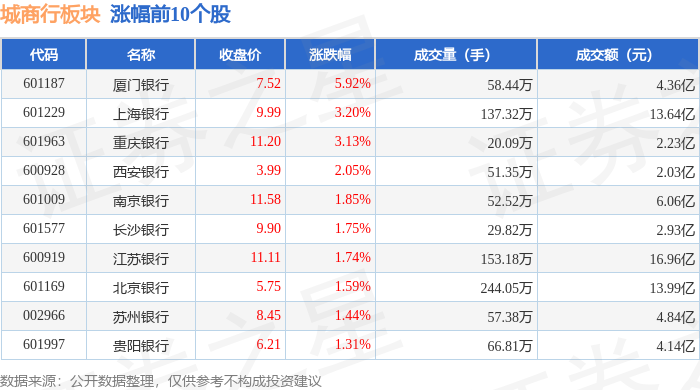
城商行板块11月4日涨1.62%,厦门银行领涨,主力资金净流入2.8亿元
Zheng Xing Xing Ye Ri Bao· 2025-11-04 08:48
Market Performance - The city commercial bank sector increased by 1.62% on November 4, with Xiamen Bank leading the gains [1] - The Shanghai Composite Index closed at 3960.19, down 0.41%, while the Shenzhen Component Index closed at 13175.22, down 1.71% [1] Individual Bank Performance - Xiamen Bank's closing price was 7.52, up 5.92% with a trading volume of 584,400 shares and a transaction value of 4.36 billion [1] - Shanghai Bank closed at 66.6, up 3.20%, with a trading volume of 1,373,200 shares and a transaction value of 1.364 billion [1] - Chongqing Bank closed at 11.20, up 3.13%, with a trading volume of 200,900 shares and a transaction value of 223 million [1] - Other notable banks include Xi'an Bank, Nanjing Bank, and Changsha Bank, with respective increases of 2.05%, 1.85%, and 1.75% [1] Fund Flow Analysis - The city commercial bank sector saw a net inflow of 280 million from main funds, while retail funds experienced a net outflow of 89.43 million [1] - Beijing Bank had a main fund net inflow of 1.47 billion, but retail funds saw a net outflow of 55.81 million [2] - Xiamen Bank recorded a main fund net inflow of 49.44 million, with retail funds experiencing a net outflow of 54.06 million [2]
高股息资产继续走强,银行股全线飘红!险资“扫货”股来了
Zhong Guo Zheng Quan Bao· 2025-11-04 05:47
Core Viewpoint - October is historically a strong month for listed companies' performance, leading to market corrections or realizations after sufficient pricing based on fundamentals. November's market characteristics are focused on "forward speculation" [1] Group 1: Market Performance - High dividend assets continue to strengthen, with notable gains in the banking sector, including Xiamen Bank rising over 6% [1][2] - The banking sector leads the market, with significant increases in stocks such as Xiamen Bank, Industrial Bank, and Shanghai Bank [2] Group 2: Institutional Investment Trends - Insurance capital continues to heavily invest in bank stocks, with China Life Insurance becoming a top ten shareholder in Industrial Bank, holding 757 million shares (0.21% stake) by the end of September [2] - Agricultural Bank of China reported that Ping An Life Insurance entered its top ten shareholders, holding 4.913 billion shares (1.4% stake) by the end of September [2] - Other banks like Wuxi Bank, Nanjing Bank, and Changshu Bank also saw new insurance capital entering their top ten shareholders [2] Group 3: Future Investment Strategies - Insurance capital combined with industrial capital is expected to be a significant incremental allocation for the banking sector, with a focus on banks with stable earnings and high dividend returns [3] - Asset management companies (AMCs) are increasing their stakes in several national banks, often with substantial amounts and common board involvement [3] - Insurance capital has shown a strong preference for dividend assets, with 34 instances of stake increases this year, primarily in the banking sector [3]

场内孤品,香港银行LOF(501025)强势涨超2%
Xin Lang Cai Jing· 2025-11-04 03:33
Group 1 - The current market sentiment is fluctuating, with undervalued assets performing well, as evidenced by the HK Bank Index rising by 1.2% as of November 3, 2025 [1] - Several banks, including Chongqing Bank, China Merchants Bank, and CITIC Bank, saw significant stock price increases, with Chongqing Bank rising over 2.74% and others rising over 2% [1] - The Penghua CSI Hong Kong Bank Index Fund has surged over 2%, reaching a nearly three-month high, with a year-to-date increase of 30.81% and a two-year annualized excess return of 2.84% [1] Group 2 - As of September 2023, at least two insurance companies appeared in the top ten shareholders of 12 listed banks, indicating increased institutional interest [1] - Notably, Zheshang Bank has four insurance shareholders, while several other banks have two or three [1] - The ongoing dividend distributions and the attractive yields of bank stocks are expected to support the banking sector, making a valuation recovery in Q4 likely [1] Group 3 - Dongguan Securities suggests that the migration of funds to the banking sector is driven by the pursuit of relative safety in a low-interest-rate environment, with continued demand for high-dividend, low-valuation bank stocks [2] - The logic of this migration is reinforced by policies that enhance dividends and attract long-term capital, contributing to the revaluation of bank stocks [2] - The HK Bank Index reflects the overall performance of bank stocks within the Hong Kong Stock Connect, with major stocks like HSBC and ICBC making up 84.38% of the top ten weightings [2] Group 4 - The Hong Kong Bank LOF provides a convenient way to invest in bank stocks within the Hong Kong Stock Connect, allowing investors to share in the growth of the banking sector [3]