
迪安诊断

Search documents
研判2025!中国体外诊断(IVD)行业产业链、发展现状、产品注册情况、竞争格局及发展趋势分析:国产替代加速推进,IVD行业开启智能化与精准化发展新篇章[图]
Chan Ye Xin Xi Wang· 2025-07-23 01:15
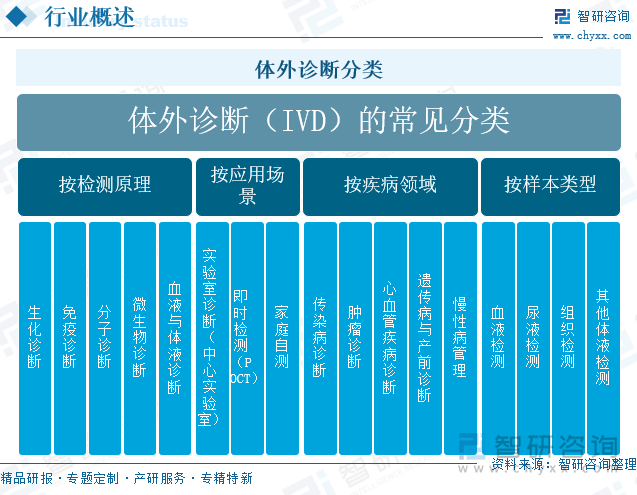
Core Insights - The in vitro diagnostics (IVD) industry is a crucial component of modern healthcare, providing essential data for disease prevention, diagnosis, and treatment through various testing methods [1][5][10] - China's IVD market has surpassed 120 billion yuan in 2024, with a projected growth to 165 billion yuan by 2029, reflecting a compound annual growth rate of 5-8% [1][10][19] - The industry is experiencing significant domestic substitution, with over 80% of Class III diagnostic products being domestically produced, while the share of imported products has decreased from 29.3% to 19.5% from 2021 to 2024 [1][14] Industry Overview - IVD encompasses several testing methods, including biochemical, immunological, molecular, microbiological, blood diagnostics, and point-of-care testing (POCT) [2][5] - The industry is transitioning from scale expansion to high-quality development, driven by government policies and technological innovations [5][21] Policy and Regulatory Environment - Recent government policies, such as the "14th Five-Year Plan for Bioeconomic Development" and the "Comprehensive Action Plan for Improving Medical Quality (2023-2025)," provide a strong impetus for the IVD industry [5][7] - The introduction of the "List of In Vitro Diagnostic Reagents Exempt from Clinical Trials (2025)" has expanded the range of products available in the market [7] Market Dynamics - The IVD industry is characterized by a multi-tiered market structure, with foreign giants dominating the high-end market and domestic leaders gradually increasing their market share [15][19] - The competitive landscape is evolving, with leading companies like Mindray Medical and New Industry Bio showing strong performance, while former leaders in COVID-19 testing, such as Da An Gene and BGI, are seeking business transformation [19][20] Growth Trends - The IVD industry is witnessing a shift towards precision and intelligent diagnostics, with advancements in molecular diagnostics, chemiluminescence, and POCT technologies [21][22] - The integration of AI and big data is enhancing diagnostic efficiency, while the demand for home health management and early cancer screening is rising due to an aging population [21][24] Competitive Landscape - The first tier of the market is dominated by international giants like Roche and Abbott, while domestic leaders such as Mindray and New Industry Bio are gaining traction in immunological and molecular diagnostics [15][19] - The market is seeing increased consolidation, with leading companies acquiring smaller firms to enhance their technological capabilities [23] Registration and Product Development - The registration of IVD products has been robust, with a compound annual growth rate of 25.3% from 2021 to 2024, indicating a vibrant development in the sector [14] - In 2024, the registration of domestic Class III diagnostic products reached 533, accounting for 80.5% of total IVD product registrations [14]




A股猴痘概念震荡反弹,亚太药业涨停,一品红触及涨停,仁度生物、康辰药业、亚泰集团、迪安诊断、济高发展、海辰药业等跟涨。
news flash· 2025-07-21 02:30
A股猴痘概念震荡反弹,亚太药业涨停,一品红触及涨停,仁度生物、康辰药业、亚泰集团、迪安诊 断、济高发展、海辰药业等跟涨。 ...






申万宏源研究晨会报告-20250717
Shenwan Hongyuan Securities· 2025-07-17 00:49
Group 1: AI Medical Industry Insights - The AI medical sector is entering a new phase of multi-modal integration and practical application, driven by technological changes that alter application scenarios and data utilization [11] - Clinical auxiliary diagnosis and drug development are leading commercialization, while health management potential remains to be unlocked [11] - Key investment targets include AI-assisted diagnosis, internet healthcare, and AI drug development, with specific companies highlighted for each segment [11] Group 2: Lin Qingxuan's Market Position - Lin Qingxuan is a leading high-end domestic skincare brand in China, focusing on camellia oil as a core ingredient and achieving significant sales milestones [11][12] - The company has demonstrated strong financial performance, with revenue projected to grow from 690 million yuan in 2022 to 1.21 billion yuan in 2024, reflecting a compound annual growth rate (CAGR) of 32.7% [11] - The skincare market in China is expected to grow significantly, with the market size projected to increase from 332.9 billion yuan in 2019 to 461.9 billion yuan by 2024 [12] Group 3: Power Industry Developments - Gansu Province has introduced a capacity pricing mechanism for coal power, which is expected to enhance the profitability stability of coal power plants [16] - The new pricing mechanism aligns with national standards and is anticipated to improve the revenue stability of coal power plants, thereby optimizing the energy structure in China [16] - The introduction of capacity pricing for energy storage systems is expected to increase investment in storage solutions, improving the consumption rate of renewable energy [16]
应收账款阴霾持续:金域医学上市后首次半年度亏损
2 1 Shi Ji Jing Ji Bao Dao· 2025-07-16 01:08
Group 1 - The core point of the article is that Kingmed Diagnostics, a leading medical testing company in A-shares, is expected to report a net loss of between 95 million to 65 million yuan in the first half of 2025, marking its first semi-annual loss since its listing [1] - The company attributes its losses to economic cycles and macro policy environments impacting short-term business development, as well as proactive optimization of customer structure leading to lower-than-expected revenue [1][2] - Kingmed Diagnostics has faced significant challenges with accounts receivable, which reached 4.396 billion yuan, and the average accounts receivable turnover days exceeding 270 days, indicating that over 70% of annual sales are tied up [2][4] Group 2 - The IVD industry is collectively facing challenges, with over 70% of 60 disclosed IVD companies reporting a year-on-year revenue decline, and more than half experiencing losses or significant profit reductions [4] - The industry is experiencing increased competition due to a shift in payment policies and a tightening of hospital budgets, leading to extended payment cycles and increased accounts receivable [4][7] - Concentrated procurement initiatives in 2024 and 2025 are expected to further impact market dynamics, with successful bidders potentially gaining market share while non-bidders face intense competition [5] Group 3 - Companies in the IVD sector are exploring various strategies to navigate the current landscape, including focusing on domestic alternatives and refining niche markets to enhance customer loyalty and improve cash flow [6][8] - International expansion is also being pursued, with companies like Mindray Medical reporting that 44.75% of their revenue came from overseas in 2024, indicating a growing trend towards global market engagement [8] - The integration of AI technology is reshaping the IVD industry, enhancing diagnostic efficiency and driving precision treatment, although challenges remain in data, compliance, and commercialization [8]

AI医疗系列二暨GenAI系列深度之62:AI医药:智愈未来,技术变革下的生态重塑
Shenwan Hongyuan Securities· 2025-07-14 04:42
Investment Rating - The report indicates a positive investment outlook for the AI healthcare industry, highlighting significant growth potential and increasing investment activity in the sector [3][10][46]. Core Insights - The AI healthcare sector is entering a new phase characterized by multi-modal integration and practical applications, driven by advancements in large models and generative AI [3][7]. - Clinical decision support and drug development are leading the commercialization efforts, while health management remains an area with untapped potential [3][14]. - The report emphasizes the importance of third-party vendors in reducing model hallucination rates and enhancing the reliability of AI applications in healthcare [3][18][21]. Summary by Sections AI Healthcare Trends - The industry is experiencing heightened investment interest and technological advancements, with major players accelerating their presence in the AI healthcare space [9][10][13]. - The integration of AI into clinical workflows is becoming standard, with AI-assisted diagnosis systems deployed in 89% of tertiary hospitals [8][14]. AI Healthcare Application Penetration - AI applications are diversifying across clinical diagnosis, drug development, health management, and AI for science (AI4S), with varying levels of maturity and market potential [30][31]. - The report identifies key areas of application, including intelligent clinical decision support, drug discovery, and personalized health management [36][39]. Key Companies in AI Clinical Diagnosis - Companies like Tempus AI and 嘉和美康 are leading in AI-assisted clinical diagnosis, focusing on electronic medical records and data-driven healthcare solutions [47][51]. - The report highlights the importance of data barriers and scenario positioning in determining the value of AI diagnostic tools [3][46]. Key Companies in AI Health Management - Companies such as 阿里健康 and 京东健康 are leveraging AI to enhance online healthcare services, with a focus on chronic disease management and personalized health plans [39][44]. - The report notes that the integration of insurance and healthcare services is crucial for the growth of AI health management solutions [39][44]. Key Companies in AI Drug Development - The report discusses the role of AI in accelerating drug development processes, with companies like Recursion and 晶泰控股 focusing on preclinical research and drug discovery [38][44]. - AI is expected to significantly reduce the time and cost associated with traditional drug development methods [38][44]. AI4S and Broader Applications - AI4S is identified as a growing field with applications in various scientific domains, including life sciences and materials science, although it faces longer conversion cycles [42][44]. - The report emphasizes the need for innovative approaches to data generation and modeling in AI4S applications [42][44].




DRG/DIP概念上涨2.41%,6股主力资金净流入超千万元
Zheng Quan Shi Bao Wang· 2025-07-11 09:24
Market Performance - As of July 11, the DRG/DIP concept increased by 2.41%, ranking 9th among concept sectors, with 22 stocks rising, including Jiahe Meikang, Weining Health, and Shanda Diwei, which rose by 5.89%, 5.58%, and 4.94% respectively [1] - The top-performing concept sectors today include Rare Earth Permanent Magnet at 5.64% and MLOps at 3.05%, while sectors like Housing Inspection and PCB saw declines of -1.47% and -1.17% respectively [2] Capital Flow - The DRG/DIP concept sector experienced a net inflow of 141 million yuan, with 11 stocks receiving net inflows, and 6 stocks seeing inflows exceeding 10 million yuan. Weining Health led with a net inflow of 190 million yuan, followed by Di'an Diagnosis, Shanda Diwei, and Donghua Software with net inflows of 25.57 million yuan, 20.81 million yuan, and 15.27 million yuan respectively [2] - In terms of capital inflow ratios, Weining Health, Shanda Diwei, and Di'an Diagnosis had the highest net inflow rates at 14.80%, 9.93%, and 7.13% respectively [3] Stock Performance - The top stocks in the DRG/DIP concept based on today's performance include: - Weining Health: 5.58% increase, 6.57% turnover rate, 189.87 million yuan net inflow, 14.80% net inflow ratio - Di'an Diagnosis: 2.23% increase, 4.75% turnover rate, 25.57 million yuan net inflow, 7.13% net inflow ratio - Shanda Diwei: 4.94% increase, 4.32% turnover rate, 20.81 million yuan net inflow, 9.93% net inflow ratio [3][4]


迪安诊断(300244) - 关于控股股东部分股份质押及解除质押的公告
2025-07-10 10:02
证券代码:300244 证券简称:迪安诊断 公告编号:2025-026 股东 名称 是否为控股 股东或第一 大股东及其 一致行动人 本次质 押数量 (万股) 占其所 持股份 比例 占公司 总股本 比例 是否 为限 售股 是否为 补充质 押 质押 起始 日 质押 到期 日 质权人 质押用途 陈海斌 是 1,110 6.75% 1.78% 否 否 2025/ 7/8 2026/ 8/31 华能贵诚信 托有限公司 归还其他 质押借款 合计 / 1,110 6.75% 1.78% / / / / / / 一、股东本次质押的基本情况 二、股东本次解除质押的基本情况 股东 名称 是否为控股 股东或第一 大股东及其 一致行动人 本次解除 质押股份 数量 (万股) 占其所持 股份比例 占公司总股 本比例 质押 起始日 质押 解除日 质权人 解除质押 理由 陈海斌 是 431 2.62% 0.69% 2022/7/25 2025/7/9 招商证券股 份有限公司 归还部分 借款 陈海斌 是 114 0.69% 0.18% 2022/12/12 2025/7/9 招商证券股 份有限公司 归还部分 借款 陈海斌 是 330 2.01 ...
润达医疗: 众华会计师事务所(特殊普通合伙)关于润达医疗2024年度报告的事后审核问询函的专项说明
Zheng Quan Zhi Xing· 2025-07-08 16:08
Core Viewpoint - The financial performance of Shanghai RunDa Medical Technology Co., Ltd. in 2024 showed a significant decline in revenue and net profit compared to previous years, primarily due to fixed costs not decreasing in line with revenue drops and the impact of industry-wide pricing pressures [1][11]. Financial Performance - The company reported a revenue of 8.312 billion yuan in 2024, a year-on-year decrease of 9.13% [1][11]. - The net profit attributable to shareholders was 55.2806 million yuan, down 79.77% year-on-year, significantly higher than the industry average decline [1][11]. - The commercial segment generated 7.864 billion yuan in revenue, a decrease of 8.34%, with a gross margin of 23.27%, down 1.27 percentage points [1][6]. - The industrial segment reported 442 million yuan in revenue, down 21.18%, but with a gross margin of 62.12%, up 5.22 percentage points [1][8]. Cost Structure - The company’s operating costs, including service costs, depreciation, and other fixed expenses, did not decrease proportionately with the revenue decline, leading to pressure on profit margins [11][12]. - Sales expenses decreased by 8.01% to 840.78 million yuan, while management expenses decreased by 5.67% to 479.94 million yuan [11][12]. - Financial expenses remained relatively stable, with a slight decrease of 1.03% to 313.44 million yuan [11][12]. Segment Analysis - The commercial segment includes traditional supply chain services, centralized/regional testing center services, and third-party laboratory services, with varying gross margins [4][6]. - The gross margin for traditional supply chain services was 25.83%, down from 26.41% in 2023, while the third-party laboratory services saw a significant drop from 40.70% to 33.30% [6][8]. - The industrial segment's gross margin increased due to the exclusion of lower-margin quality control products from the consolidated financials [8][12]. Industry Comparison - The company’s gross margins in the commercial segment are competitive with industry peers, with no significant differences noted [6][8]. - The overall trend in the industry shows a decline in revenue and profit margins due to macroeconomic factors and healthcare cost control policies [14][15]. Future Outlook - The company is expected to continue facing challenges from pricing pressures and the need to manage fixed costs effectively to improve profitability [11][12]. - There is a focus on enhancing operational efficiency and exploring new revenue streams to mitigate the impact of declining margins [12][15].

中金:创新药板块投资热情高昂 下半年关注ESMO
Zhi Tong Cai Jing· 2025-07-08 07:57
Core Viewpoint - The investment environment in 2025 is expected to favor innovative pharmaceutical technology assets, driven by optimistic liquidity expectations and breakthroughs in domestic AI technology [1][2] Group 1: Innovative Pharmaceutical Sector - There is high investment enthusiasm in the innovative pharmaceutical sector, with a focus on the upcoming ESMO conference in the second half of the year [2] - Recent clinical data disclosures from ASCO and significant business development (BD) deals, exemplified by Sanofi, confirm that Chinese innovative drugs are beginning to possess international competitiveness [1][2] Group 2: CXO and Research Supply Chain - The positive performance of the innovative pharmaceutical sector this year has improved the financing environment for new drug development, leading to better order conditions for domestic CROs and upstream research supply chains [3] - Ongoing negotiations regarding US-China tariffs may alleviate overseas trade uncertainties, potentially leading to a valuation recovery for foreign demand CDMOs [3] Group 3: Policy and Market Outlook - Although the renewal policies in the pharmaceutical industry for 2024 have been delayed, there are signs of improvement in local bidding processes [3] - The low base effect from Q3 last year, combined with new equipment subsidy policies under favorable fiscal measures, is expected to boost the market [3] - The global economic growth outlook may enhance the competitiveness of Chinese manufacturing in international markets, potentially accelerating overseas exports [3] Group 4: Investment Targets - A-shares: Include companies such as BeiGene (688235.SH), Hengrui Medicine (600276.SH), and WuXi AppTec (603259.SH) [4] - H-shares: Include companies such as Kintor Pharmaceutical (09926) and WuXi Biologics (02269) [4]
我国医疗器械市场迈入万亿元规模 上市公司竞相加码布局
Zheng Quan Ri Bao· 2025-07-01 09:46
Core Insights - The Chinese medical device industry is projected to reach a market size of 1.2 trillion yuan by 2024, with logistics warehouse space totaling 23.58 million square meters and over 40,000 vehicles for medical logistics transportation [1] - The government is enhancing policy support for the medical device industry, focusing on expediting clinical trials and approvals for innovative medical devices [2][3] - Companies are actively expanding their market presence and capabilities in response to policy incentives and growing market demand [4][5] Industry Growth and Policy Support - The State Council has issued opinions to reform drug and medical device regulation, aiming to shorten clinical trial and registration timelines, particularly for high-end devices like medical robots and brain-computer interfaces [2] - Local governments, such as Zhejiang and Shanxi, are implementing measures to support innovation in medical devices, including expedited approval processes and enhanced healthcare coverage for innovative products [2][3] Company Strategies and Market Expansion - Companies like Di'an Diagnostics are leveraging AI and data to enhance their product offerings, with their AI pathology model achieving clinical-grade standards [4] - Kangji Medical's surgical robot has been approved for market release, marking a significant step in domestic production capabilities and reducing reliance on imports [4] - Yingte Group is investing in a modern pharmaceutical supply chain park to improve logistics capabilities, indicating a trend towards digital and intelligent solutions in the medical supply chain [5] - The medical device sector is becoming a key area for diversified growth among listed companies, driven by aging populations and supportive policies [5]