智元机器人

Search documents
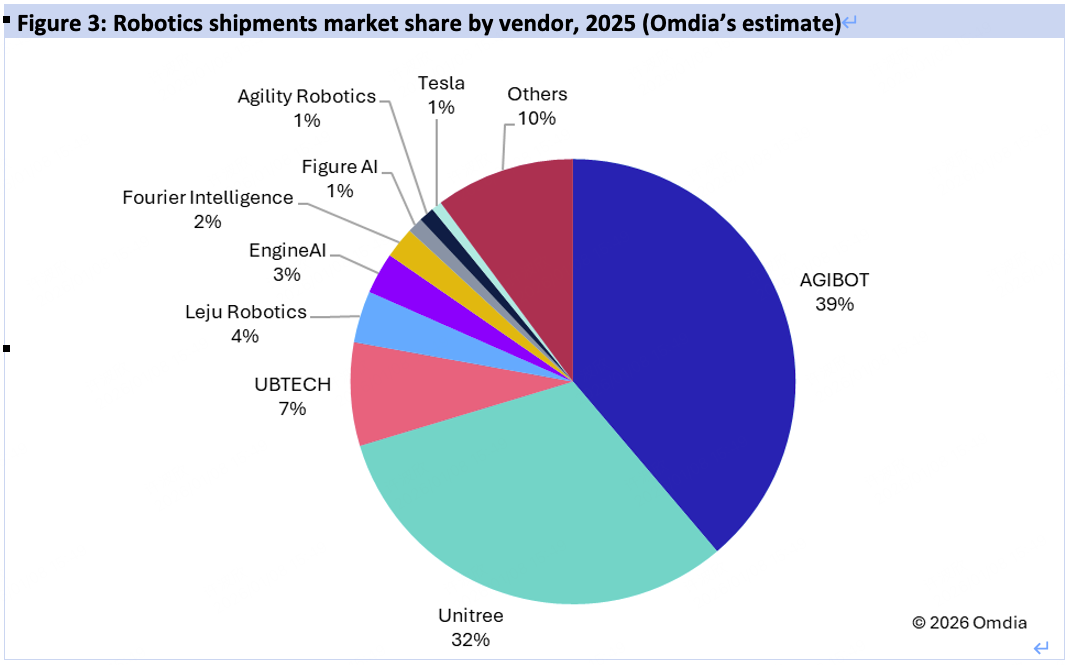
智元、宇树科技出货量飙升,占全球超70%市场份额
2 1 Shi Ji Jing Ji Bao Dao· 2026-01-09 10:04
Core Viewpoint - The humanoid robot sector experienced a strong surge on January 9, with significant gains in stock prices, particularly for companies like ZhiYuan Robotics, which saw an 8.75% increase, reflecting a growing interest in the market driven by a new report from Omdia on the global humanoid robot market trends for 2025 [1][2]. Market Trends - According to Omdia's report, Chinese manufacturers are leading the global humanoid robot market, with ZhiYuan Robotics and Unitree Technology together accounting for 71% of the market share by 2025 [1]. - ZhiYuan Robotics is projected to ship 5,168 units in 2025, a significant increase from 600 units in 2024, capturing 39% of the global market share [1][3]. - Unitree Technology and UBTECH are expected to follow with market shares of 32% and 7%, respectively, with their shipments also increasing substantially [1][3]. Vendor Performance - ZhiYuan Robotics received the highest ratings in six evaluation dimensions, indicating advanced capabilities in humanoid robotics [4]. - Unitree Technology excelled in five dimensions, while UBTECH achieved top ratings in four dimensions, showcasing the competitive landscape among these companies [4]. Future Projections - The integration of generative AI with robotics is driving the evolution of robots towards "general embodied intelligence," which is expected to lead to exponential growth in the humanoid robot market over the next decade [6]. - Omdia forecasts that global shipments of humanoid robots could reach 2.6 million units by 2035, indicating a robust growth trajectory for the industry [6].

2025年中国人形机器人320起融资!
机器人圈· 2026-01-09 09:56
| 自变量机器人 | 具身大模型 | 2025年2月18日 | Pre-A++4 | 数亿元 | 光速光合、君联资本、北京机器人产业基金、 田原谷本 | | --- | --- | --- | --- | --- | --- | | 中科第五纪 | 具身大模型 | 2025年2月19日 | 种子轮 | 未披露 | 草源亚洲 | | 重要图 | 人形机器人 | 2025年2月20日 | A48 | 3亿人民币 | 百度风投、高瓴资本、同歌创投、IDG资本、 | | | | | | | 蚂蚁集团 | | 玄鸟科智 | RV减速机 | 2025年2月20日 | 股权投资 | 未披露 | 成都高投 | | 干诀科技 | 具身大模型 | 2025年2月21日 | 股权投资 | 未披露 | 华业天成 | | 正德智控 | 电机 | 2025年2月25日 | 股权投资 | 1亿人民币 | 安徽省铁路发展基金 | | 松延动力 | SOLIns 人形机器人 | Int Research 2025年2月25日 | A+轮 | 1亿人民币 | 华强资本、彬复资本 | | 源升智能 | 灵巧手 | 2025年2月26日 | 天使轮 ...



智元、宇树科技出货量飙升,占全球超70%市场份额
21世纪经济报道· 2026-01-09 09:51
Core Insights - The humanoid robot sector experienced a strong surge on January 9, with companies like Shenzhou New Materials (上纬新材) seeing an 8.75% increase in stock price, reaching 143.99 CNY per share and a total market capitalization of 58 billion CNY [1]. Market Trends - A report by Omdia indicates that Chinese manufacturers are leading the global humanoid robot market, with companies like Zhiyuan Robotics (智元机器人) and Unitree Technology (宇树科技) expected to capture 71% of the market share by 2025 [3]. - Zhiyuan Robotics is projected to ship 5,168 units in 2025, a significant increase from 600 units in 2024, holding a 39% market share [3][5]. - Unitree Technology and UBTECH are expected to follow with market shares of 32% and 7%, respectively, with their shipments also increasing significantly [3][5]. Vendor Performance - The report outlines the expected shipments for various vendors in 2024 and 2025, with total shipments rising from 2,300 units in 2024 to 13,318 units in 2025 [5]. - Zhiyuan Robotics received the highest ratings in six evaluation dimensions, indicating advanced capabilities in humanoid robotics [6]. Future Projections - The integration of generative AI with robotics is driving the evolution of robots towards "general embodied intelligence," with the humanoid robot market expected to see exponential growth, potentially reaching 2.6 million units shipped by 2035 [8].

能跑跳、能干活、能签单,中国人形机器人站上C位
Xin Jing Bao· 2026-01-09 09:35
Core Insights - The CES 2026 showcased a significant dominance of Chinese companies in the robotics sector, with 149 out of 598 exhibitors being Chinese, accounting for nearly one-quarter of the total [1] - In the humanoid robot segment, 21 out of 38 exhibitors were from China, representing over half of the participants [1] - Chinese humanoid robot manufacturers are noted for their advantages in product variety, supply chain efficiency, and cost-effectiveness, with expectations for industry growth by 2026 [1] Group 1: Technology and Applications - Chinese humanoid robot companies demonstrated capabilities in motion control and practical applications across various scenarios, including industrial manufacturing, family companionship, and commercial services [2] - Notable companies like Yushu Technology and Zhongqing showcased advanced technologies in high-precision torque control and dynamic balance through performances with their robots [2] - AI integration was highlighted, with companies like Zhiyuan showcasing robots capable of language interaction and service applications, emphasizing the fusion of "brain" and "body" in real-world scenarios [2] Group 2: Market Expansion and Sales - The CES 2026 served as a crucial platform for Chinese robot companies to expand into global markets, with several companies reporting immediate sales during the event [3] - Companies like Songyan Power are shifting focus from product display to commercial implementation, targeting key regions such as North America, the Middle East, Europe, and Southeast Asia for market expansion [3] Group 3: Supply Chain and Component Innovation - The exhibition featured a concentration of Chinese companies from various segments of the robotics supply chain, indicating a move towards specialization and maturity within the industry [5] - Innovations in dexterous hands were showcased, with companies like Lingxin demonstrating mass-produced high-dexterity products at competitive prices, making advanced components more accessible [5] - Breakthroughs in tactile technology were presented, with companies like Pashini demonstrating advanced sensors that enable new application scenarios [5] Group 4: Software and Remote Operations - Companies like Jijia Vision are focusing on cutting-edge software developments, particularly in world models, which are becoming more mature as data engines in the field of embodied intelligence [6] - Remote operation capabilities were highlighted by companies like Rui Erman, showcasing real-time remote control of robots from Beijing to Las Vegas, demonstrating the potential for global operational networks [6] - The collective presence of Chinese humanoid robot and supply chain companies at CES 2026 indicates a competitive landscape where technological prowess is matched by engineering, commercialization, and ecosystem development capabilities [6]

CES观察|能跑跳、能干活、能签单,中国人形机器人站上C位
Bei Ke Cai Jing· 2026-01-09 09:35
Core Insights - The CES 2026 showcased a significant dominance of Chinese companies in the robotics sector, with 149 out of 598 exhibitors being Chinese, accounting for nearly one-quarter of the total [1] - In the humanoid robot segment, 21 out of 38 exhibitors were from China, representing over half of the participants [1] - The event highlighted advancements in various applications of humanoid robots, including industrial, commercial, and home companionship [2][8] Group 1: Company Highlights - Companies like Yushu Technology and Zhiyuan Robotics demonstrated their capabilities in motion control and application scenarios, showcasing robots capable of dance and combat [4] - The Beijing Humanoid Robot Innovation Center made its debut, emphasizing the importance of showcasing the practical capabilities of humanoid robots to enhance international influence [8] - The company Lingqiao Intelligent presented its high-performance dexterous hand, significantly reducing costs to make it more accessible for research institutions and startups [10] Group 2: Technological Advancements - The event featured robots that integrated advanced AI capabilities, such as language interaction and autonomous sorting, demonstrating their practical applications in real-world scenarios [6][7] - Breakthroughs in tactile technology were showcased, with companies like Pasini Sensory Technology presenting advanced multi-dimensional tactile sensors [11] - The development of world models as data engines in embodied intelligence was highlighted, indicating a shift towards more sophisticated evaluation and reinforcement learning environments [11] Group 3: Market Expansion and Sales - The CES 2026 served as a critical platform for Chinese robotics companies to expand their global market presence, with several companies reporting immediate sales during the event [8] - Companies like Songyan Power are shifting their focus from product display to commercial implementation, targeting key regions for market expansion [8] - The event underscored the importance of a well-defined and efficient industrial ecosystem, indicating a maturation of the robotics industry [9][12]
CES变成中国科技秀:机器人跳舞、熊猫获奖
3 6 Ke· 2026-01-09 08:24
Group 1: Core Themes of CES 2026 - The main theme of CES 2026 is "human-centered" AI applications, marking a shift from traditional consumer electronics to AI-centric technological transformations [1] - Chinese companies are increasingly taking center stage at CES, with 942 exhibitors, accounting for approximately 22% of the total, maintaining their position as the second-largest exhibiting nation [1] - In specific sectors, Chinese firms dominate, with 55% of humanoid robot exhibitors and nearly 70% of AI glasses brands coming from China [1] Group 2: Robotics and AI Innovations - Chinese manufacturers are expected to continue leading in cost reduction and efficiency improvements in humanoid robots, showcasing their capabilities in unstructured environments [2] - Notable products include the Unitree H1 humanoid robot with advanced sensing capabilities and the latest generation of the "绝影" series robotic dogs, which excel in indoor navigation [4][11] - The "Care-bot" humanoid robot by Fourier demonstrates embodied intelligence in real-life interaction scenarios [7] Group 3: Consumer Electronics and Smart Devices - Over 80% of global smart glasses supply chain manufacturers are from China, with 16 Chinese companies showcasing their products at CES [15] - Innovations in smart home devices include the AI-driven "安安" companion robot designed for elderly and cognitively impaired individuals [16] - Companies like Alibaba and XREAL are launching advanced AI glasses, with features such as ultra-lightweight designs and integration with various AI services [19][20] Group 4: Automotive and AI Integration - The automotive industry is transitioning from "software-defined" to "AI-defined" vehicles, with companies like Geely and Great Wall showcasing new technologies [28] - Geely's G-ASD smart driving solution and Great Wall's focus on new energy technologies highlight the industry's shift towards AI integration [30][32] - New products like the AI-driven logistics solutions from New Stone and advanced lidar technology from Hesai demonstrate the growing importance of AI in transportation [34][35] Group 5: Home Appliances and AI - Hisense introduced new RGB-Mini LED display technology and AI-controlled smart refrigerators, showcasing the integration of AI in home appliances [41] - TCL's innovations in display technology, including the world's first printed OLED car screen, reflect advancements in consumer electronics [43][44] - Companies are increasingly focusing on AI capabilities in home security and smart home management systems [51][49] Group 6: Overall Impact of AI - CES 2026 emphasizes the profound impact of AI on the consumer electronics industry, with expectations for AI user numbers to grow significantly [59] - The event serves as a platform for global tech companies to set the foundation for future technological development and transformation [59] - The integration of AI into various sectors, including robotics, automotive, and consumer electronics, indicates a trend towards deeper AI adoption in everyday life [59]





筑巢引凤,上海AI“集团军”崛起全球赛道
Guo Ji Jin Rong Bao· 2026-01-09 07:48
Core Insights - Shanghai's AI industry is experiencing a significant IPO wave, with five companies, including MiniMax, successfully listing on the Hong Kong stock market, marking a rapid growth phase for AI enterprises in the region [1][5][8] Policy Support - Shanghai has established a comprehensive policy support system to address core challenges in the AI industry, including computing power, funding, and talent [2][4] - Innovative subsidy policies like "computing power vouchers" and "corpus vouchers" have been introduced, with plans to issue 600 million yuan in computing power vouchers by 2025 to alleviate cost pressures for AI companies [2][4] - The "AI+ Manufacturing" development white paper outlines additional support measures, including project subsidies of up to 10 million yuan and a 400 billion yuan special credit line for customized financial products [2][4] Market Opportunities - The Shanghai government is actively promoting the rapid pilot testing of large models in various applications, creating valuable market opportunities for local companies [3][5] - A list of 50 application scenarios and a directory for smart product promotion have been released, covering key industries such as integrated circuits and high-end equipment [3][5] Talent Development - Talent acquisition and retention are prioritized, with policies in place to stabilize the workforce, including a training program that has created a reserve of over 1,000 engineers [4] - The establishment of AI innovation towns in Pudong Zhangjiang and Xuhui Beiyang has attracted over 300 AI companies and 6,000 innovative talents, fostering a low-cost, high-intelligence development environment [4] Industry Growth - The recent IPOs of five AI companies reflect the robust growth of Shanghai's AI sector, which spans the entire industry chain from computing power to end applications [5][6] - Companies like MiniMax have achieved significant technological breakthroughs, with its models ranking among the top globally in AI model evaluations [5][6] Investment Climate - The capital market has shown strong interest in Shanghai's AI companies, with MiniMax's IPO receiving 1,837 times oversubscription and raising approximately 5.54 billion HKD [7][8] - The involvement of prestigious cornerstone investors, including Alibaba and ADIA, underscores the strong market confidence in these companies [7][8] Future Outlook - Shanghai aims to continue enhancing its talent services and entrepreneurial environment, focusing on building AI innovation hubs to maintain its leadership in the domestic and global AI landscape [8]

MiniMax上市 AI大模型进入“上海时刻”
3 6 Ke· 2026-01-09 07:38
Group 1: Company Overview - MiniMax, an AI unicorn from Shanghai, was listed on the Hong Kong stock market, with its stock price surging over 80% at opening, reaching a market capitalization of approximately 90 billion HKD [1] - The company has over 200 million individual users across more than 200 countries and regions, with a revenue growth of over 170% year-on-year for the first nine months of 2025, and over 70% of its revenue coming from overseas markets [7] - MiniMax is part of a collaborative group with Shanghai AI Laboratory, SenseTime, and Jiyue Star, focusing on developing a comprehensive model ecosystem [7] Group 2: Industry Trends - The surge in AI companies going public reflects significant changes in financing structures, business models, and global competition, showcasing Shanghai's advantages in nurturing tech startups [2] - Shanghai's AI industry is projected to exceed 550 billion CNY in scale by the end of 2025, with a year-on-year growth rate of over 30% [3] - The establishment of innovation hubs like "Mosu Space" has attracted over 200 AI model companies, contributing to a vibrant ecosystem for AI development in Shanghai [9] Group 3: Technological Advancements - MiniMax's M2 model boasts a code generation speed twice that of Claude, while its cost is only 8% of Claude's [8] - Shanghai AI Laboratory's Intern-S1 model has outperformed leading closed-source models in various scientific rankings, indicating strong local capabilities in AI research [8] - The development of AI chips and robotics in Shanghai is supported by a comprehensive industrial chain, enhancing collaboration and efficiency in production [12][15] Group 4: Policy and Support - Shanghai's supportive policies and ecosystem have been crucial for AI companies, facilitating collaboration among design, manufacturing, and software sectors [12] - The city is focusing on creating AI innovation towns to foster a low-cost, high-intelligence environment for startups, with over 300 AI companies and 6,000 talents already attracted [10] - The "four-in-one" policy framework in Shanghai positions it as a key player in global AI and frontier technology competition [15]
中国企业正“主宰”全球人形机器人市场,机器人ETF易方达(159530)等产品获资金关注
Mei Ri Jing Ji Xin Wen· 2026-01-09 06:55
Group 1 - The core index of the National Certificate Robot Industry rose by 1.7%, with notable increases in component stocks such as Hongxun Technology reaching the daily limit, Aerospace Zhizhuang rising over 9%, and Haozhi Electromechanical increasing over 6% [1] - The robot ETF E Fund (159530) saw a trading volume exceeding 900 million yuan and net subscriptions surpassing 80 million shares, indicating strong market interest [1] - According to Omdia, ZhiYuan Robotics is projected to ship over 5,168 humanoid robots by 2025, capturing 39% of the global market share, making it the leader in both shipment volume and market share [1] Group 2 - Omdia categorizes ZhiYuan, Yushu, and Tesla among the "first tier" humanoid robot developers, with expectations of exponential growth in global humanoid robot shipments to 2.6 million units by 2035 [1] - The industry is experiencing significant growth driven by policy support and market enthusiasm, with related index products gaining attention for investment opportunities [1] - The National Certificate Robot Industry Index focuses on humanoid robot bodies and core components, covering companies like Sanhua Intelligent Control and Lingyi Technology, which together account for approximately 80% of the index [1]


2025一级市场回顾 | 人工智能赛道涌入656亿 机器人、大模型分化 北京获投企业数领跑
Xin Lang Cai Jing· 2026-01-09 05:57
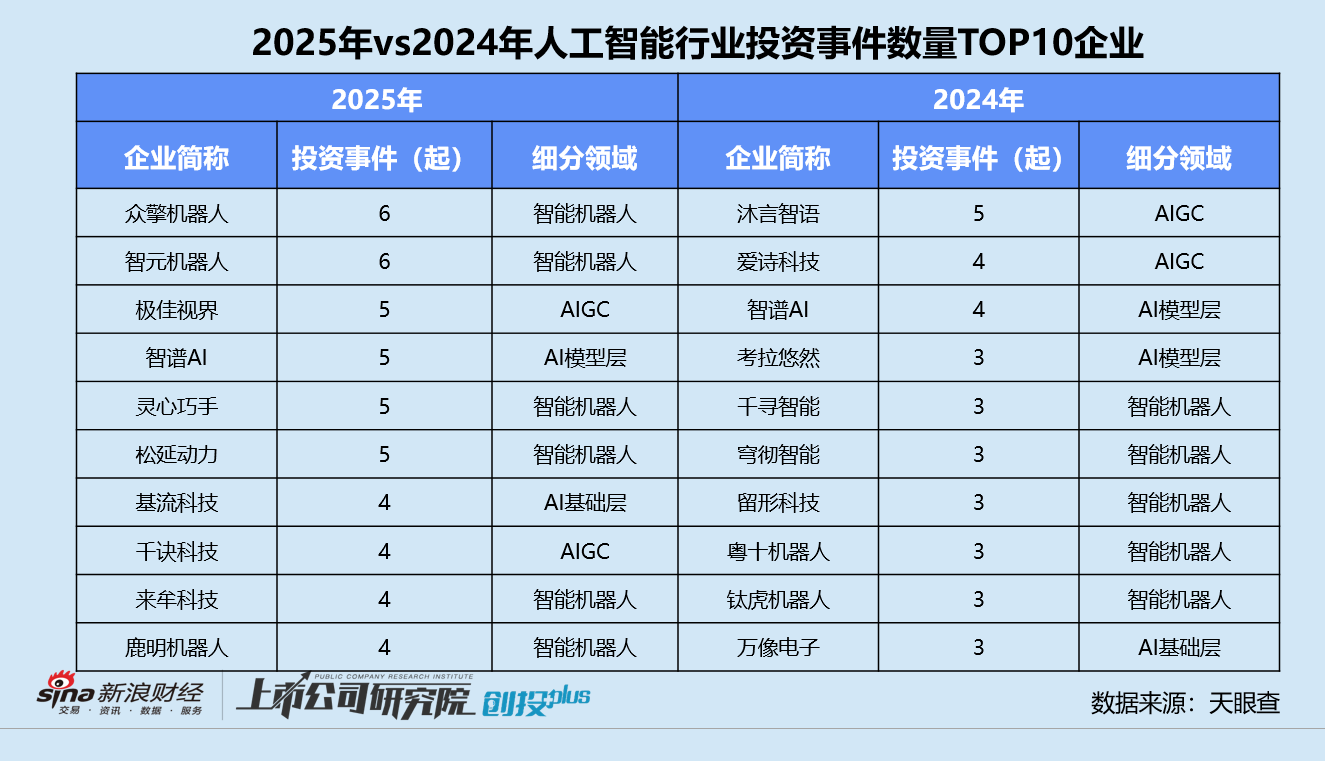
出品:新浪财经创投Plus 作者:易舍 2025年,一级市场在深刻的变局中演进,由人工智能引领的颠覆性技术浪潮席卷全球。资本向少数头部项目集聚,OpenAI、xAI、Anthropic等头部人工智能 企业年内累计投资额高达400亿美元、250亿美元、165亿美元。 据公开数据统计,2025年1月1日至12月31日(简称:统计区间),国内一级市场共有5599家公司完成6343起投资事件,同比分别增长2.6%、7.5%;披露总 投资额达4400.99亿元,较2024年全年下降20.5%。而人工智能作为贯穿全年的投资"主旋律",行业中共有788家公司获得1015起投资,披露投资额合计656.04 亿元。相较之下,2024年共有478家人工智能公司获得553起投资,披露投资额合计391.51亿元。 统计区间内,共有151家人工智能公司获得2轮以上融资,约占19.2%。其中,人形机器人研发商「众擎机器人」和「智元机器人」以6起投资事件领跑,具 身智能公司「极佳视界」、「灵心巧手」、「松延动力」,及基础大模型企业「智谱AI」皆获得5轮融资。对比2024年,融资2轮以上的人工智能公司只有 59家,占比约12.3%,人工智能 ...