
理想汽车

Search documents
湛逸飞将出任理想人形机器人业务负责人
Xin Lang Cai Jing· 2026-02-13 07:52
Group 1 - The core point of the article is that Li Auto has appointed Zhan Yifei, a senior algorithm expert in autonomous driving, as the head of its humanoid robot department, which reports to the head of the smart vehicle group, Ma Donghui [1] - The humanoid robot department was newly established two weeks ago, with the former senior vice president of autonomous driving R&D, Lang Xianpeng, as its head [1] - Zhan Yifei has transitioned from the autonomous driving department to the new robot department, indicating a strategic shift in the company's focus towards robotics [1] Group 2 - The robot team at Li Auto has begun to establish its hardware and software technology [1] - Since the formation of the new team in January, Lang Xianpeng and Zhan Yifei have been frequently traveling to understand the dynamics of the robotics industry [1]


理想汽车法务部:成功捣毁一处制售假冒理想品牌充电桩的窝点
Xin Lang Cai Jing· 2026-02-13 07:50
Core Viewpoint - Li Auto's intellectual property team, in collaboration with law enforcement and market supervision authorities, successfully dismantled a counterfeit charging pile production and sales operation, highlighting the company's commitment to protecting its brand and consumer rights [1][2]. Group 1: Enforcement Action - A special enforcement action led to the discovery of a counterfeit charging pile production site, where infringing products, 16 counterfeit trademark stickers, 3 counterfeit seals, and related molds were seized [1][2]. - The operation was initiated after the intellectual property team identified key leads on February 1 and reported them immediately, leading to a police raid on February 6 that secured core evidence of infringement [1][2]. Group 2: Criminal Activity and Sales - The involved parties admitted to operating four online stores where they produced and sold counterfeit products, with total sales exceeding 100,000 yuan, indicating significant illegal activity [1][2]. - The actions of the involved individuals have been classified as criminal offenses, and the case is currently under further investigation [1][2]. Group 3: Consumer Advisory - Li Auto advises consumers to purchase charging pile products only through official sales channels and encourages reporting any suspected counterfeit products via a designated email [1][2]. - The company emphasizes its ongoing commitment to using legal measures to combat infringement and protect consumer rights and brand reputation [1][2].

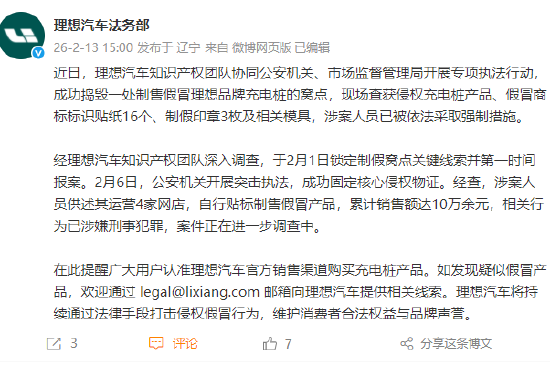
独家丨湛逸飞将出任理想人形机器人业务负责人
晚点Auto· 2026-02-13 07:43
Core Viewpoint - Li Auto has established a new humanoid robot department, appointing Zhan Yifei, a senior algorithm expert from the autonomous driving team, as the head, indicating a strategic shift towards robotics following advancements in autonomous driving technology [4][6]. Group 1: Organizational Changes - Zhan Yifei will oversee the research and product development of the humanoid robot department, while the previous head, Lang Xianpeng, will be leaving the company [6]. - The new humanoid robot team has begun to establish its software and hardware technology since its formation in January [4][6]. - The restructuring of the autonomous driving department involved splitting it and merging parts with the intelligent space department, leading to the creation of the humanoid robot department [7]. Group 2: Technological Expertise - Zhan Yifei has a background in key technologies such as BEV (Bird's Eye View) algorithms and world model algorithms, which are crucial for autonomous driving systems [6]. - The BEV algorithm, which converts multiple camera images into a unified bird's-eye view, has been pivotal in advancing Li Auto's autonomous driving capabilities [6]. - The world model approach enhances AI's understanding and prediction of physical world dynamics, improving decision-making capabilities in autonomous systems [6]. Group 3: Strategic Direction - Li Auto's CEO, Li Xiang, has emphasized that embodied intelligence is a significant direction for AI development, with humanoid robots expected to be a major product form following smart vehicles [6]. - The company aims to leverage its accumulated algorithm capabilities, data assets, and engineering experience from autonomous driving to the humanoid robot sector [7]. - The transition to humanoid robotics aligns with the company's long-term vision of integrating advanced AI technologies into various product forms [6][7].

提前17个月成功判断理想创造移动的家这个使命有可能变
理想TOP2· 2026-02-13 04:55
Core Viewpoint - The new mission of Li Auto is "Be Proactive, Change the World," with a vision to become a global leader in embodied intelligence [1] Group 1: Company Evolution - Li Auto's previous mission focused on creating a mobile home and happiness, which has now shifted towards a broader technological ambition [1] - The company is evolving from being perceived solely as an automotive manufacturer to being recognized as an AI company, emphasizing the integration of AI with physical products [2][10] - The leadership of Li Auto, particularly CEO Li Xiang, is characterized by a commitment to continuous growth and learning from past experiences [3][4] Group 2: Leadership Insights - Li Xiang's personal growth journey includes learning the importance of communication and focusing on user needs rather than competitors [5][8] - Significant past experiences, such as challenges during the automotive industry and previous ventures, have shaped Li Xiang's approach to leadership and decision-making [6][7] - The transition to focusing on AI and embodied intelligence reflects a strategic pivot based on industry trends and personal insights gained over time [11][12] Group 3: AI Integration - By December 2024, Li Xiang recognized the critical role of foundational models in AI, understanding that they serve as a key entry point for various products and services [12] - The company is actively engaging in AI research and development, with a focus on integrating AI capabilities into its automotive offerings [13][14] - Li Auto is preparing to address the challenges of robotics and AI, indicating a proactive stance in seizing market opportunities in these emerging fields [15][16]
半导体集体爆发,港股科网股下挫,智谱5天狂飙超120%
2 1 Shi Ji Jing Ji Bao Dao· 2026-02-13 04:17
Market Overview - On February 13, A-shares experienced a collective decline, with the ChiNext Index leading the drop, closing down 0.96%. The Shanghai Composite Index fell by 0.7%, and the Shenzhen Component Index decreased by 0.67%. The total trading volume in the Shanghai and Shenzhen markets reached 1.2 trillion yuan, with over 2,600 stocks declining [1]. Sector Performance - The military industry sector showed strong performance, with Aystar Anchor Chain (601890) hitting the daily limit. The semiconductor sector was active, with concepts related to photolithography and photolithography adhesives rapidly rising. Guofeng New Materials (000859) achieved two consecutive trading limits in four days, while Fuchuang Precision rose over 12%. Semiconductor equipment concepts continued to strengthen, with Shenghui Integration (603163) hitting the daily limit and reaching a historical high [2]. - In contrast, the port and shipping sector saw a collective decline, with China Merchants Energy (600026) and China Merchants Shipping (601872) experiencing significant drops. The photovoltaic equipment sector weakened, with leading stock Shuangliang Energy (600481) hitting the daily limit and losing 2 billion yuan in market value in one day. Other stocks like GCL-Poly Energy (002506) fell over 8% [3]. Hong Kong Market - The Hong Kong market opened lower and continued to decline, with the Hang Seng Index down 1.8% and the Hang Seng Tech Index down 1.6%. Major tech stocks saw declines, with Tencent Music dropping over 10%, Meituan down over 4%, and Baidu Group down 4%. Other companies like JD.com, Bilibili, Li Auto, Alibaba, and Trip.com also experienced declines of over 2% [3]. - The semiconductor sector in Hong Kong showed strength, with Aixin Yuan Zhi rising over 16% and Tian Shu Zhi Xin increasing over 9%. Other stocks like Zhaoyi Innovation (603986) and Brain Hole Technology also saw gains. The large model concept stocks performed actively, with Zhipu Technology reaching a historical high of 492 HKD before narrowing its gains to 12%, having increased over 120% this week [3]. New Listings - The new stock Haizhi Technology Group had an impressive debut, rising over 268% during the day to 99.6 HKD, with a profit of 14,505 HKD per lot based on the issue price of 27.06 HKD per share. The public offering phase recorded an oversubscription of 5,065.06 times, ranking among the top in recent years for Hong Kong IPOs [4]. - Industrial analysts at Industrial Securities expressed optimism for the Hong Kong market, suggesting a "technology bottom + cyclical recovery + beta in dividends" approach to embrace the spring market. Current short-selling transactions account for about 19.2%, indicating that market sentiment has reached a relatively low point, providing momentum for a short-term rebound [4].
半导体集体爆发,港股科网股下挫,智谱5天狂飙超120%
21世纪经济报道· 2026-02-13 04:14
Market Overview - On February 13, A-shares experienced a collective decline, with the ChiNext Index leading the drop, closing at a decrease of 0.96% [1] - The Shanghai Composite Index fell by 0.7%, while the Shenzhen Component Index decreased by 0.67% [1] - The total trading volume in the Shanghai and Shenzhen markets reached 1.2 trillion yuan, with over 2,600 stocks declining [1][2] Index Performance - Shanghai Composite Index: 4105.04, down 28.98 points (-0.70%) [2] - Shenzhen Component Index: 14187.44, down 95.55 points (-0.67%) [2] - ChiNext Index: 3295.99, down 32.07 points (-0.96%) [2] - Total A-shares: 6800.24, down 33.64 points (-0.49%) [2] Sector Performance - The military industry sector showed strong performance, with stocks like Yaxing Anchor Chain hitting the daily limit [3] - The semiconductor sector was active, with significant gains in stocks related to photolithography machines and materials, such as Guofeng New Materials and Fuchuang Precision [3] - Storage prices continued to rise in January, with DRAM and NAND Flash industries reaching record high outputs [3] Declining Sectors - The port and shipping sector saw a collective decline, with stocks like COSCO Shipping Energy and China Merchants Jinling experiencing significant drops [4] - The photovoltaic equipment sector weakened, highlighted by the sharp decline of Shuangliang Energy, which saw a market value loss of 2 billion yuan in one day [4] Hong Kong Market - The Hang Seng Index fell by 1.8%, with the Hang Seng Tech Index down by 1.6% [4] - Major tech stocks in Hong Kong, including Tencent Music and Meituan, experienced declines of over 10% and 4%, respectively [4][6] Notable Stock Movements - Semiconductor stocks like Aixin Yuan Zhi and Tian Shu Zhi Xin saw gains of over 16% and 9%, respectively [7] - The new stock Haizhi Technology Group had a remarkable debut, surging over 268% on its first day of trading [8] Market Sentiment - Current market sentiment in Hong Kong is relatively low, with short-selling transactions accounting for about 19.2%, indicating potential for a short-term rebound [8]

科技新贵们,年会不能停
3 6 Ke· 2026-02-13 03:40
Core Viewpoint - The annual meeting, a modern corporate phenomenon in China, reflects a company's financial strength, cultural values, and market position, evolving from traditional industries to tech companies that now dominate the spotlight [1][6]. Group 1: Evolution of Annual Meetings - The grandeur of annual meetings has shifted from real estate and internet giants to new tech players like AI and smart hardware companies, showcasing extravagant events and significant employee rewards [1][6]. - Companies like ZhiYuan and Chasing have transformed their annual meetings into large-scale events, with ZhiYuan offering cash rewards and Chasing hosting a concert-like atmosphere [1][7]. - The trend of substantial year-end bonuses continues, with companies like Kuaishou and Momo providing significant rewards, such as stock options and high-end electronics [5][8]. Group 2: Importance of Employee Engagement - Annual meetings serve as a platform for companies to enhance their image and attract talent, emphasizing the importance of employee recognition and motivation [13][19]. - The concept of "petting the employee persona" is crucial, as companies aim to create a positive narrative around their workforce to attract top talent in a competitive market [15][19]. - CEO personas are also highlighted during these events, with leaders using the platform to communicate company values and future directions [15][19]. Group 3: Changes in Corporate Culture - The shift in focus from extravagant benefits to effective performance management reflects a broader change in corporate culture, with companies recognizing the need for precise incentive distribution [20][24]. - The decline of traditional welfare culture in Silicon Valley is mirrored in China, where companies are reassessing their approach to employee benefits and incentives [20][24]. - The evolving landscape of annual meetings indicates a need for companies to balance employee satisfaction with effective management practices, addressing the complexities of human behavior in organizational settings [24][25].
暴力拉升!300369,20cm涨停
Zhong Guo Ji Jin Bao· 2026-02-13 03:16
Market Overview - The A-share market opened lower and then fluctuated upward, with the Shanghai Composite Index down 0.36%, Shenzhen Component Index down 0.42%, and ChiNext Index down 0.7%, while the Sci-Tech Innovation Board Index rose by 0.37% [2] - The aerospace and military industry sector saw a rapid rise, while sectors such as maritime transport, oil and gas, and CPO experienced fluctuations [2] Aerospace and Military Sector - The aerospace and military sector rebounded, with companies like Andavil (300719) and Hangcai Co. showing significant gains [6] - Multiple new-generation rockets are expected to successfully launch, with over 100 launches anticipated in 2026, including models like Tianlong-3 and Lijian-2, which may challenge reusable rocket technology [7][8] Cybersecurity Sector - Cybersecurity stocks performed actively, with Green Alliance Technology (300369) hitting a 20% limit up, and other companies like Guotou Intelligent (300188) and Zhongxin Saike (002912) also showing strong gains [4] - The market saw significant increases in stock prices, with Green Alliance Technology up by 19.96% and Guotou Intelligent up by 10.15% [5] Key Company Performances - Tencent Music saw a decline of 8.77%, with a market cap of 183.7 billion [3] - Baidu Group decreased by 4.00%, with a market cap of 369.9 billion [3] - Bilibili dropped by 3.90%, with a market cap of 99.5 billion [3] - Meituan fell by 3.30%, with a market cap of 501.5 billion [3] - Alibaba decreased by 2.40%, with a market cap of 2,956.6 billion [3]



中国汽车:市场反馈及行业预期下调 -1 月季节性表现弱于往常,且物料成本通胀加剧-China Automobiles_ Marketing feedback & lowering estimates for the sector on weaker-than-usual Jan seasonality with BOM cost inflation
2026-02-13 02:18
Summary of Conference Call Notes on the Automotive Industry Industry Overview - **Industry**: Automotive, specifically focusing on electric vehicles (EVs) and new energy vehicles (NEVs) in China - **Current Market Sentiment**: Investor positioning in the automotive sector is underweight as of early 2026, with concerns about demand and cost inflation impacting outlooks [1][2] Key Points 1. Industry Volume Trajectory - **January 2026 Performance**: Domestic passenger vehicle retail volume decreased by 20% month-over-month (mom), compared to a 14% decrease in January 2024 [3] - **Market Expectations**: Anticipation of continued volume decline into February 2026, attributed to the Chinese New Year holiday and reduced stimulus effects [3] - **Future Outlook**: Expected recovery in consumer demand starting March 2026, coinciding with new product launches from BYD and the Beijing Auto Show [3] 2. Raw Material and Memory Cost Inflation - **Cost Increases**: Year-to-date increases in commodity prices (lithium, copper, aluminum) range from 27% to 85% year-over-year [4][18] - **Impact on BOM Costs**: Estimated average increase in Bill of Materials (BOM) costs for EVs is approximately Rmb4,000, leading to a gross margin decline of 2.0% and a net margin decline of 1.7% [4][11] - **OEM Negotiations**: OEMs are negotiating cost-sharing with suppliers, but are expected to absorb 100% of memory cost increases [4] 3. Potential Policy Stimulus - **Government Support Expectations**: Investors anticipate additional government support if demand remains weak, including subsidies for Level 3 vehicles and domestic chip usage [7] - **Economic Contribution**: Passenger vehicles accounted for about 5% of GDP in 2025, indicating the sector's significance to the economy [7] 4. Sensitivity Analysis on Costs - **Margin Concerns**: Rising raw material and memory costs are raising concerns about potential margin impacts for OEMs [8] - **Cost Pass-Through Assumptions**: Analysis assumes a 50/50 cost pass-through ratio for battery and metals, while memory costs are fully absorbed by OEMs [9][12] 5. Target Price Adjustments - **Price Target Reductions**: Target prices for covered OEMs and suppliers have been cut by up to 12% due to weaker demand and higher costs, with average estimates lowered by approximately 16% [2][24] - **Specific Company Adjustments**: - **BYD**: Target price reduced from Rmb144 to Rmb137 due to weaker delivery volumes and higher BOM costs [25] - **Li Auto**: Target price reduced from US$27 to US$24, reflecting lower sales and higher costs [25] - **XPeng**: Target price reduced from US$25 to US$22, driven by weaker sales and pricing pressures [25] - **NIO**: Target price reduced from US$7.0 to US$6.6, impacted by BOM cost inflation [25] 6. Long-term Projections - **Revenue and Net Income Changes**: Projections for revenue and net income have been adjusted downward for several companies, reflecting anticipated market conditions through 2030 [24][30] Additional Insights - **Investor Concerns**: There is a growing concern among investors regarding the sustainability of margins in light of rising costs and competitive pressures [8] - **Market Dynamics**: The automotive sector is facing significant challenges from both internal cost pressures and external market conditions, necessitating close monitoring of policy developments and consumer demand trends [7][8] This summary encapsulates the critical insights from the conference call, highlighting the automotive industry's current challenges and future outlook.




中国汽车:2026 年 1 月十大数据与十大趋势总结-China Auto Manufacturers 10 Figures 10 Trends Jan-26 Summary
2026-02-13 02:18
Summary of the Conference Call on China Auto Manufacturers Industry Overview - The conference call focused on the **China Auto Manufacturers** industry, particularly the performance of **New Energy Vehicles (NEVs)** and **Internal Combustion Engine (ICE)** vehicles in January 2026. Key Points and Arguments NEV Market Performance - **NEV Sales Decline**: In January 2026, domestically produced NEV passenger vehicle (PV) sales decreased by **58% month-over-month (MoM)** and **20% year-over-year (YoY)**, slightly missing the previous expectation of **-55% MoM** [1][6] - **Market Share Gains**: Companies like **Xiaomi, Seres, Nio, and Li Auto** gained NEV market shares MoM, while traditional brands like **BYD** saw significant declines [1][2] ICE Vehicle Trends - **ICE Sales Surge**: The penetration of ICE vehicles increased to **62.6%**, a rise of **21.3 percentage points (ppt) MoM**, attributed to seasonal sales before the Chinese New Year [2][6] - **Market Share Changes**: Chinese brands' ICE market share rose by **1.4ppt MoM** to **35.7%**, while foreign brands showed mixed results [4][6] Brand-Specific Insights - **Tesla's Performance**: Tesla's domestic insurance retail sales fell by **78% MoM** and **41% YoY**, with wholesales at **69,129 units** (down **29% MoM**, up **9% YoY**) [5][22] - **BYD's Decline**: BYD's NEV sales were **104,623 units**, down **49% YoY** and **68% MoM**, resulting in a market share drop of **10.4ppt** [9][22] - **Gains by Competitors**: **Xiaomi** and **Nio** reported increases in market share, with Xiaomi gaining **4.9ppt** and Nio **2.9ppt** MoM in the BEV segment [2][3] Inventory Levels - **Inventory Increase**: The inventory of PVs increased by **1.0 month MoM** to **3.1 months**, while NEV inventory rose by **2.0 months MoM** to **3.4 months** [6][23] Market Share by Segment - **BEV Market Share**: Local Chinese brands maintained a high NEV market share of **87.1%**, while US brands dropped to **8.2%** [6][10] - **PHEV Market Dynamics**: BYD lost PHEV market share by **5.1ppt** to **43.3%**, while local competitors gained [3][6] Additional Important Insights - **Sales Recovery Expectations**: There are expectations for a sales recovery starting in March 2026, as the market adjusts post-holiday season [1][6] - **Overall Market Trends**: The data suggests a challenging environment for NEV manufacturers, with significant month-over-month declines indicating potential volatility in the market [1][6] This summary encapsulates the critical insights from the conference call regarding the current state and trends within the China auto manufacturing industry, particularly focusing on NEVs and ICE vehicles.