
皇台酒业

Search documents
白酒中报|白酒企业回款转弱贵州茅台、泸州老窖、山西汾酒、洋河股份经营现金流净额均在减少
Xin Lang Cai Jing· 2025-09-12 10:34
Core Viewpoint - The Chinese liquor industry is entering a period of accelerated clearing in 2025, with significant declines in production, profits, and cash flow among many companies [1][2][3]. Industry Overview - In the first half of 2025, the total production of the liquor industry was 1.9159 million kiloliters, a year-on-year decrease of 5.8%. Sales revenue reached 330.42 billion yuan, a slight increase of 0.19%, while profits fell to 87.687 billion yuan, down 10.93% [1]. - 58.1% of distributors reported increased inventory, with over half facing price inversion issues, indicating weak terminal consumption and reduced willingness to collect payments from distributors [1][2]. Company Performance - Among 19 listed liquor companies, 13 experienced revenue declines, accounting for 68% of the total, with a significant slowdown in revenue growth compared to the previous year [1][2]. - The market is increasingly concentrating on leading companies, with the top six liquor firms accounting for 47% of revenue and 62.2% of total profits in 2024, marking a 13 percentage point increase over five years [2]. Cash Flow Analysis - The cash flow from operating activities for 13 companies decreased, representing 68% of the total, while only six companies saw an increase [3][4]. - Notably, Kweichow Moutai's cash flow from operating activities dropped by 23.503 billion yuan to 13.119 billion yuan, a decline of 64.18% [4]. - Eight liquor companies reported negative cash flow from operating activities, primarily among small to medium-sized enterprises with annual revenues below 5 billion yuan [4][5]. Market Trends - The previous growth logic of "volume reduction and price increase" has collapsed, with both volume and price declining in the current market environment [2]. - The wholesale price index for liquor has been continuously declining from September 2024 to August 2025, with notable price drops for major brands [3].




白酒中报| 白酒企业逆势加大费用投放 水井坊销售费用率最高达到36.35%
Xin Lang Cai Jing· 2025-09-12 09:41
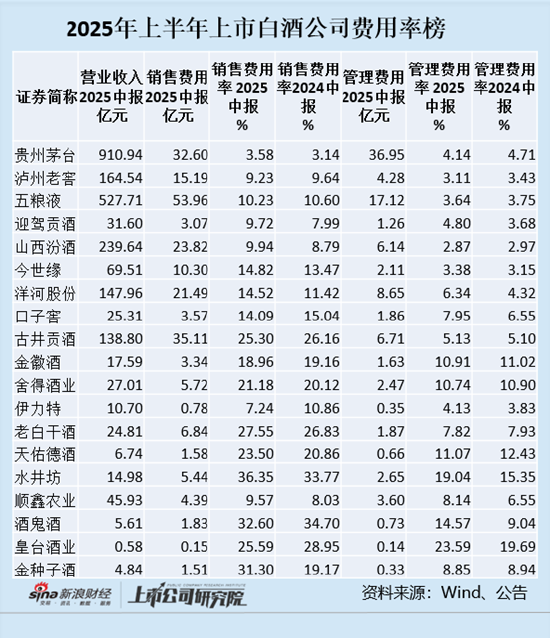
Core Insights - The Chinese liquor industry is entering a period of accelerated clearing, with a significant decline in production and profits in the first half of 2025 [1][2] - A majority of listed liquor companies are experiencing revenue declines, indicating a shift in the industry's growth logic from "volume reduction, price increase" to simultaneous declines in both volume and price [2][3] Industry Overview - In the first half of 2025, the total production of the liquor industry was 1.9159 million kiloliters, a year-on-year decrease of 5.8%, while sales revenue reached 330.42 billion yuan, a slight increase of 0.19%. Profits fell to 87.687 billion yuan, down 10.93% year-on-year [1] - 58.1% of distributors reported increased inventory levels, with over half facing price inversion issues. The average inventory turnover days for the liquor industry reached 900 days, an increase of 10% compared to the previous year [1] Company Performance - Among 19 listed liquor companies, 13 reported revenue declines, accounting for 68% of the total, with a significant slowdown in revenue growth compared to the previous year [2] - The market share is increasingly concentrated among leading companies, with the top six liquor firms accounting for 47% of revenue in 2024, up 13 percentage points from five years ago [2] - The median revenue growth rate for the top six liquor companies was 2.36%, while the median for companies below 10 billion yuan was -16.89% [2] Pricing Trends - The wholesale price index for liquor has been declining, with notable price drops for major brands such as Moutai and Wuliangye, indicating a broader trend of price reduction across the industry [2][3] Expense Management - Despite declining revenues, many liquor companies have increased their marketing expenditures. The median sales expense growth rate for 19 companies was -11.85%, while overall sales expenses remained stable compared to the previous year [4] - The highest sales expense ratio was recorded at 36.35% for Shui Jing Fang, with 58% of companies increasing their sales expense ratios [4][5] - Management expense ratios have also increased, with the highest being 23.59% for Huangtai Liquor, indicating pressure on profitability for smaller companies [5][6]




白酒板块9月11日涨0.3%,酒鬼酒领涨,主力资金净流出5223.93万元
Zheng Xing Xing Ye Ri Bao· 2025-09-11 08:43
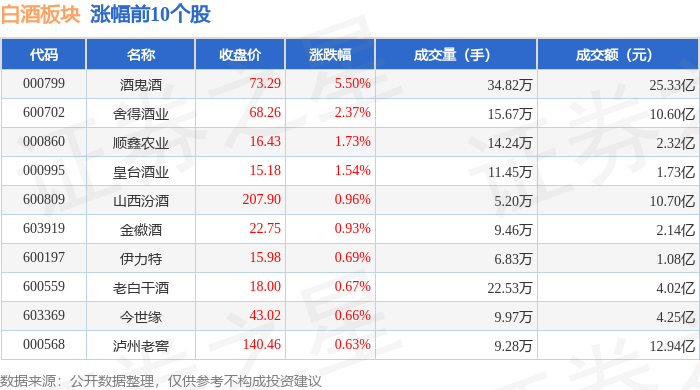
Core Viewpoint - The liquor sector experienced a slight increase of 0.3% on September 11, with strong performance from Jiu Gui Jiu, while the overall market indices also saw gains, indicating a positive sentiment in the market [1]. Group 1: Market Performance - The Shanghai Composite Index closed at 3875.31, up by 1.65% [1]. - The Shenzhen Component Index closed at 12979.89, up by 3.36% [1]. - The liquor sector's individual stock performance showed varied results, with notable gains from Ji Si Xing at 5.50% and She De Jiu Ye at 2.37% [1]. Group 2: Stock Data - Ji Si Xing (000799) closed at 73.29 with a trading volume of 348,200 shares and a transaction value of 2.533 billion [1]. - She De Jiu Ye (600702) closed at 68.26 with a trading volume of 156,700 shares and a transaction value of 1.060 billion [1]. - Guizhou Moutai (600519) closed at 1523.50 with a trading volume of 37,200 shares and a transaction value of 5.643 billion [2]. Group 3: Capital Flow - The liquor sector saw a net outflow of 52.239 million from institutional investors and 236 million from speculative funds, while retail investors contributed a net inflow of 289 million [2]. - Guizhou Moutai experienced a net inflow of 26,661, while Jiu Gui Jiu had a net outflow of 1.37 billion from institutional investors [3]. - The overall capital flow indicates a mixed sentiment, with retail investors showing interest despite the outflows from larger funds [2][3].


2025年1-7月中国葡萄酒产量为5万千升 累计下降26.5%
Chan Ye Xin Xi Wang· 2025-09-07 00:33
Core Viewpoint - The Chinese wine industry is experiencing a significant decline in production, with a notable drop in output for the year 2025 compared to previous years [1][2]. Industry Summary - According to the National Bureau of Statistics, the wine production in China for July 2025 is projected to be 0.6 thousand kiloliters, representing a year-on-year decrease of 25% [1]. - Cumulatively, from January to July 2025, the total wine production in China is expected to reach 5 thousand kiloliters, which indicates a decline of 26.5% compared to the same period in the previous year [1]. Company Summary - Listed companies in the Chinese wine sector include Zhangyu A (000869), Weilang Co., Ltd. (603779), Zhongpu Co., Ltd. (600084), ST Tongpu (600365), Xibu Chuangye (000557), and Huangtai Wine Industry (000995) [1].

名酒保住增长 白酒业即将穿越周期?
2 1 Shi Ji Jing Ji Bao Dao· 2025-09-05 23:12
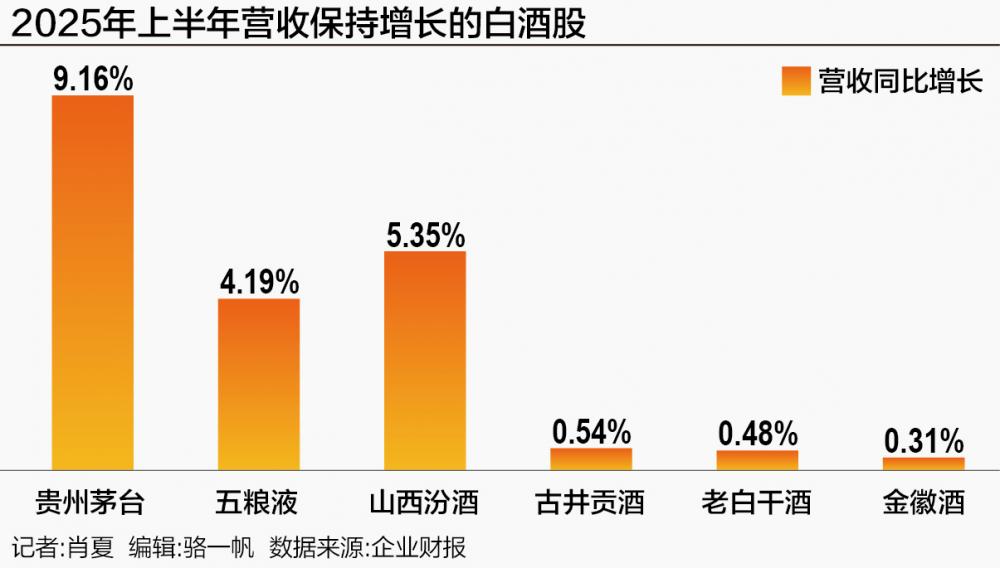
Core Viewpoint - The Chinese liquor industry, particularly the baijiu sector, is currently experiencing a downturn, with many companies facing declining performance and a challenging market environment [1][2][3]. Industry Performance - In the first half of the year, 15 out of 21 listed baijiu companies reported declining performance, with only 6 companies, including Kweichow Moutai and Wuliangye, showing positive growth [1][8]. - The overall market is under pressure, with many companies returning to industry averages after years of high growth, indicating a significant adjustment phase [9][10]. Market Dynamics - The baijiu sector is witnessing a consolidation of competitive advantages, with leading brands like Moutai and Wuliangye maintaining their positions despite a slowdown in growth [12][15]. - There is a notable divergence in performance among companies, with some experiencing significant declines, while a few manage to maintain or slightly grow their revenues [5][10]. Future Outlook - Analysts suggest that the second half of the year may see a potential rebound, particularly during the Mid-Autumn and National Day holidays, which could provide a window for price stabilization and recovery [17][22]. - However, many believe that a broader recovery for the industry may take longer, with some predicting that the sector may not fully stabilize until late 2025 or mid-2026 [20][19]. Investment Sentiment - Recent market activity indicates a cautious optimism, with some investors betting on a rebound in baijiu stocks, as the sector's overall valuation has reached historically low levels [24][23]. - The current environment is seen as an opportunity for stronger companies to emerge from the downturn, potentially leading to a more concentrated market with fewer but stronger players [24][25].
中经酒业周报∣1-6月白酒行业销售收入3304.2亿元,前7月酒类出口额68.5亿元,多家酒企公布上半年业绩
Xin Hua Cai Jing· 2025-09-05 10:34
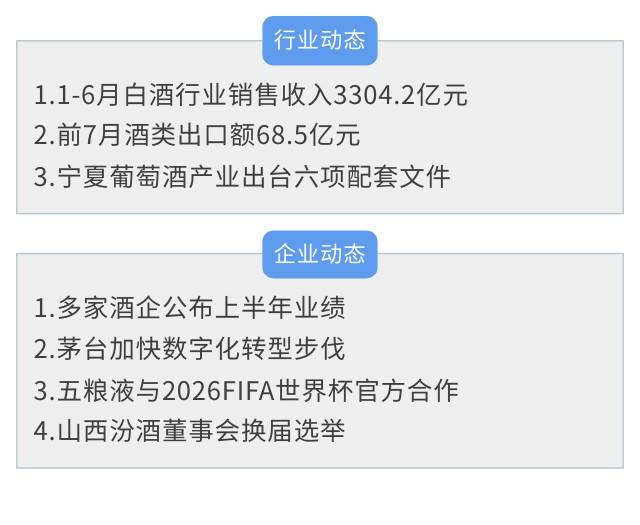
Industry Overview - In the first half of 2025, the sales revenue of the Chinese liquor industry reached 330.42 billion yuan, showing a slight increase of 0.19% year-on-year [4] - The number of large-scale liquor enterprises decreased to 887, down by over 100 compared to the same period last year [4] - The production volume of the liquor industry was 1.9159 million kiloliters, a year-on-year decline of 5.8%, while profits fell by 10.93% to 87.687 billion yuan [4] Export Performance - In the first seven months of 2025, the total export value of liquor reached 6.85 billion yuan, with a cumulative export volume of 486,600 kiloliters [5] - Traditional liquor exports accounted for 4.179 billion yuan, with baijiu exports at 4.091 billion yuan and huangjiu at 87.25 million yuan [5] Company Performance - Luzhou Laojiao reported a revenue of 16.454 billion yuan for the first half of 2025, down 2.67% year-on-year, with a net profit of 7.663 billion yuan, a decrease of 4.54% [8] - Gujing Gongjiu achieved a revenue of 13.88 billion yuan, a slight increase of 0.54%, and a net profit of 3.662 billion yuan, up 2.49% [8] - Shunxin Agriculture's liquor segment reported a revenue of 3.606 billion yuan, down 23.25% [8] - Water Well Square's revenue was 1.498 billion yuan, down 12.84%, with a net profit decline of 56.52% to 105 million yuan [8] - Other companies like Pearl River Beer and Gansu Huangtai also reported varied performance, with Pearl River Beer showing a revenue increase of 7.09% [9] Strategic Developments - Moutai Group is accelerating its digital transformation to enhance the digital development level across its entire industry chain [8] - Wuliangye announced its partnership as an official product for the 2026 FIFA World Cup, aiming to integrate sports marketing with liquor [10] - Ningxia has introduced six supporting documents for the wine industry, marking a step towards market-oriented resource allocation [7]
白酒板块9月5日涨0.81%,水井坊领涨,主力资金净流出7746.05万元
Zheng Xing Xing Ye Ri Bao· 2025-09-05 08:56
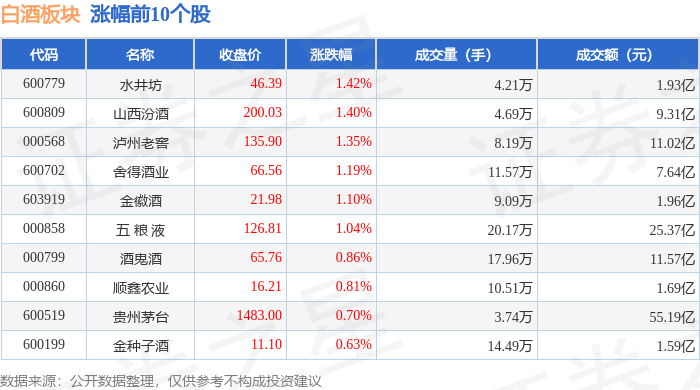
Group 1 - The liquor sector experienced a rise of 0.81% on September 5, with Shuijingfang leading the gains [1] - The Shanghai Composite Index closed at 3812.51, up 1.24%, while the Shenzhen Component Index closed at 12590.56, up 3.89% [1] - Key stocks in the liquor sector showed the following closing prices and percentage changes: Shuijingfang at 46.39 (+1.42%), Shanxi Fenjiu at 200.03 (+1.40%), and Luzhou Laojiao at 135.90 (+1.35%) [1] Group 2 - The liquor sector saw a net outflow of 77.46 million yuan from institutional investors, while retail investors experienced a net outflow of 67.44 million yuan [2] - Notable net inflows from speculative funds included Wuliangye with 12.8 million yuan, while it faced a net outflow of 101 million yuan from retail investors [2] - Other stocks like Shuijingfang and Luzhou Laojiao also experienced mixed fund flows, with Shuijingfang seeing a net inflow of 1.36 million yuan from institutional investors [2]


宁德时代、美的集团领衔!深市回购增持潮持续升温 传递市场积极信号
Zheng Quan Shi Bao Wang· 2025-09-04 15:23
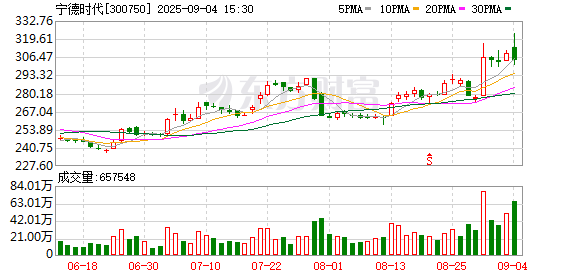
Group 1 - Since 2025, companies and shareholders in the Shenzhen market have actively engaged in share buybacks and increases, with a total of 355 related plans launched as of September 3, including 251 buyback plans with a maximum repurchase amount of 70.773 billion yuan and 104 increase plans with a maximum increase amount of 31.29 billion yuan [2] - Leading companies such as CATL and Midea Group have taken the lead in buyback actions, demonstrating strong confidence in their future development and injecting positive sentiment into the market [2][3] - CATL has announced a new buyback plan of 4 billion to 8 billion yuan after completing a previous buyback of 2.71 billion yuan, with a total buyback amount of 2.131 billion yuan as of the end of August [3] Group 2 - Midea Group has also been active in buybacks, announcing a plan of 5 billion to 10 billion yuan, with over 70% allocated for cancellation, and has cumulatively repurchased 4.43 billion yuan as of the end of August [4] - Weichai Power and Wen's Food have also made notable progress in their buyback plans, with Weichai Power repurchasing 596 million yuan and Wen's Food repurchasing 900 million yuan as of the end of August [4][5] - In addition to buybacks, there has been a surge in increase plans, with shareholders showing confidence in long-term investment value through substantial investments [6] Group 3 - Qingdao Bank's major shareholder announced plans to increase holdings by 233 million to 291 million shares, while Shanxi Expressway's actual controller plans to increase holdings by 30 million to 60 million yuan [6] - Changan Automobile and DaDaQian have also disclosed increase plans, with Changan's management planning to increase holdings by at least 5.7 million yuan [6] - Overall, the buyback and increase actions by companies and shareholders in the Shenzhen market play a crucial role in optimizing capital structure and sending positive signals to the market, contributing to the stability and development of the capital market [7]


宁德时代、美的集团领衔!深市回购增持潮持续升温,传递市场积极信号
Zheng Quan Shi Bao Wang· 2025-09-04 15:14
Core Viewpoint - Since 2025, companies and shareholders in the Shenzhen market have actively engaged in share buybacks and increases, with a total of 355 plans launched as of September 3, including 251 buyback plans with a maximum repurchase amount of 70.773 billion yuan and 104 increase plans with a maximum increase amount of 31.29 billion yuan, reflecting strong confidence in future development from leading companies like CATL and Midea Group [1][2]. Group 1: Buyback Actions - Leading companies such as CATL and Midea Group have taken the lead in share buybacks, with CATL announcing a new buyback plan of 4 billion to 8 billion yuan after completing a previous buyback of 2.71 billion yuan, demonstrating confidence in future growth [1]. - Midea Group has also been active in buybacks, with a previously disclosed plan of 5 billion to 10 billion yuan, of which over 70% is for cancellation, and an additional plan of 1.5 billion to 3 billion yuan for employee stock ownership plans, having repurchased a total of 4.43 billion yuan by the end of August [2]. - Other companies like Weichai Power and Wens Foodstuff have also made notable buyback progress, with Weichai Power repurchasing 596 million yuan and Wens Foodstuff repurchasing 900 million yuan by the end of August [2]. Group 2: Increase Plans - In addition to buybacks, there has been a surge in increase plans, with shareholders showing confidence in long-term investment value through substantial financial commitments [3]. - Qingdao Bank's shareholder plans to increase shares by 233 million to 291 million, while Shanxi Expressway's actual controller plans to increase shares by no less than 30 million yuan and no more than 60 million yuan [3]. - Companies like Changan Automobile and DaDaQian have also disclosed increase plans, with Changan's management planning to increase shares by no less than 5.7 million yuan and DaDaQian's major shareholder planning to increase shares by 50 million to 100 million yuan [3]. Group 3: Overall Market Impact - The overall buyback and increase actions by Shenzhen companies and shareholders play a crucial role in optimizing capital structure and establishing long-term incentive mechanisms, continuously sending positive signals to the market and helping to maintain investment value and enhance shareholder returns [4].
甘肃皇台酒业股份有限公司关于控股股东增持股份触及1% 整数倍暨增持计划实施的进展公告
Zhong Guo Zheng Quan Bao - Zhong Zheng Wang· 2025-09-03 23:01
Group 1 - The company announced a share buyback plan by its controlling shareholder, Gansu Shengda Group, with a total investment amount between RMB 60 million and RMB 120 million, starting from April 8, 2025, for a period of six months [1] - As of September 3, 2025, Gansu Shengda has increased its shareholding by 1,774,100 shares, raising its total ownership to 8,900,600 shares, which is 5.02% of the company's total equity [2] - The shareholding percentage of Gansu Shengda and its concerted parties increased from 22.71% to 23.71%, indicating a change that touches the 1% integer multiple [2] Group 2 - The implementation of the share buyback plan is subject to uncertainties due to potential changes in the capital market and other unpredictable risk factors [3] - The company commits to timely information disclosure if any risks arise during the implementation of the buyback plan [3]