
舜宇光学科技

Search documents
港股科网股多数收跌
Di Yi Cai Jing Zi Xun· 2025-11-20 08:42
| 名称 | 现价 | 涨跌幅 ◆ | | --- | --- | --- | | 金山软件 | 28.560 | -7.03% | | 3888.HK | | | | 小鹏汽车-W | 81.850 | -4.49% | | 9868.HK | | | | 携程集团-S | 554.000 | -3.57% | | 9961.HK | | | | 蔚来-SW | 45.140 | -3.22% | | 9866.HK | | | | 华虹半导体 | 78.000 | -3.05% | | 1347.HK | | | | 小米集团-W | 37.700 | -2.89% | | 1810.HK | | | | 哔哩哔哩-W | 196.600 | -2.67% | | 9626.HK | | | | 理想汽车-W | 70.050 | -1.75% | | --- | --- | --- | | 2015.HK | | | | 舜宇光学科技 | 64.050 | -1.61% | | 2382.HK | | | | 网易-S | 212.600 | -1.39% | | 9999. HK | | | | 阿里 ...

港股科网股多数收跌
第一财经· 2025-11-20 08:26
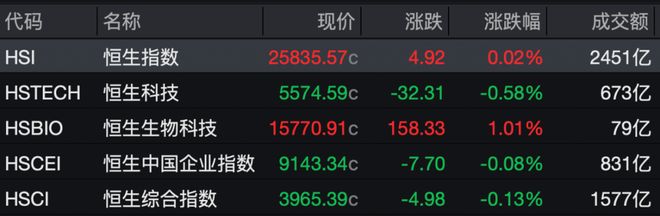
| 理想汽车-W | 70.050 | -1.75% | | --- | --- | --- | | 2015.HK | | | | 舜宇光学科技 | 64.050 | -1.61% | | 2382.HK | | | | 网易-S | 212.600 | -1.39% | | 9999.HK | | | | 阿里巴巴-W | 154.800 | -1.02% | | 9988.HK | | | 编辑 | 钉钉 | 11月20日, 港股 恒生指数收盘涨0.02%,恒生科技指数跌0.58%。 | 银行、地产股走强,半导体、汽车板块走弱。 | | --- | --- | | 科网股多数下跌,金山软件跌逾7%,小鹏汽车跌逾4%,华虹半导体、蔚来、携程集团跌逾3%,小米集团、哔哩哔哩、阿里巴巴均走低。 | | ...

港股汽车概念股走低,相关ETF跌约2%
Mei Ri Jing Ji Xin Wen· 2025-11-20 06:26
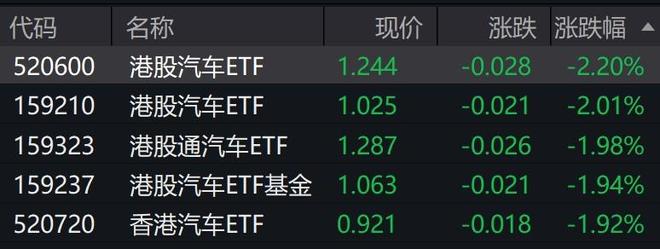
Group 1 - The Hong Kong automotive concept stocks have declined, with XPeng Motors-W and Leap Motor falling over 5%, while Li Auto-W, Sunny Optical Technology, Horizon Robotics-W, and Fuyao Glass dropped over 2% [1] - The automotive-related ETFs in Hong Kong have also experienced a decline of approximately 2% [1] Group 2 - Several ETFs related to the automotive sector in Hong Kong reported the following price changes: - Hong Kong Automotive ETF (520600) at 1.244, down 2.20% - Hong Kong Automotive ETF (159210) at 1.025, down 2.01% - Hong Kong Stock Connect Automotive ETF (159323) at 1.287, down 1.98% - Hong Kong Automotive ETF Fund (159237) at 1.063, down 1.94% - Hong Kong Automotive ETF (520720) at 0.921, down 1.92% [2] Group 3 - Analysts indicate that with the acceleration of intelligent technology implementation, some automakers are in a phase of resonance between new product cycles and technology cycles, which is expected to drive continuous sales growth [2] - Ongoing policy support for automotive consumption and the increasing penetration rate of new energy vehicles provide a broad market space for complete vehicle manufacturers [2]
全球与中国金相光学显微镜市场现状及未来发展趋势
QYResearch· 2025-11-20 02:33
Core Viewpoint - The metallographic optical microscope industry is experiencing a shift towards automation and intelligence, with significant advancements in technology and increasing demand from emerging markets [6][8][10]. Product Definition and Statistical Scope - Metallographic optical microscopes are high-precision instruments designed for observing the microstructure of metal materials, utilizing optical imaging principles to magnify the surface morphology of metal samples [2]. Inverted Metallographic Microscope - The inverted metallographic microscope features a unique structure with the objective lens facing down, allowing for the observation of larger and heavier samples without the need for cutting [4]. Upright Metallographic Microscope - The upright metallographic microscope is the classic form in metallographic observation, suitable for examining thin or standard-sized metal samples with high surface flatness requirements [5]. Integration of Intelligent and Automated Technologies - The industry is rapidly integrating AI and machine vision technologies, enhancing detection efficiency and precision, with automated laboratories emerging to reduce human error [6]. Acceleration of Domestic Production, Facing Core Technology Bottlenecks - Chinese companies have made significant progress in the metallographic microscope sector, but still rely on imports for core components, with high-end markets dominated by international giants [7]. Expanding Application Scenarios and Growing Demand in Emerging Markets - Traditional applications in metal processing and automotive manufacturing are being supplemented by rapid growth in demand from semiconductor packaging and new energy materials [8]. Intensifying Industry Competition and Market Segmentation - The market shows a clear polarization, with high-end segments led by international brands and mid-to-low-end segments facing price wars among domestic companies [9]. Development Trends of Metallographic Optical Microscopes - Future trends include deeper integration of AI and automation, multi-modal imaging capabilities, and high-resolution observation to meet the evolving demands of material science [10][11][12]. Global Market Scale Analysis - The global market for metallographic optical microscopes is projected to reach $373.52 million in 2024, with an expected CAGR of 4.67% from 2025 to 2031, reaching $527.77 million by 2031 [13]. Consumption and Production Insights - North America is the largest consumer market, expected to hold 33.48% of the market share in 2024, while China and Japan are significant production regions, with shares of 29.68% and 26.36% respectively [15].
恒生科技指数10月以来回撤超15%,长期逻辑不改,市场关注AI落地效果
Zheng Quan Shi Bao· 2025-11-19 23:57
Core Viewpoint - Since 2025, the Hong Kong stock market, led by technology and innovative pharmaceuticals, has experienced a bull market, with the Hang Seng Index rising over 30% and the Hang Seng Tech Index exceeding 50%. However, since October, the Hang Seng Tech Index has seen a significant pullback of over 15% in less than two months, with a recent four-day losing streak. Analysts believe that this short-term adjustment does not alter the long-term investment logic for leading tech stocks in Hong Kong, especially with the gradual implementation of AI technologies by companies like Tencent and Alibaba, which is expected to drive a second growth phase for internet enterprises. The long-term investment value of the Hang Seng Tech Index remains promising due to valuation advantages, funding support, and AI-driven industrial upgrades [1][5][6]. Group 1 - The performance of Hong Kong tech stocks has drastically changed since October, with a clear divide in their fortunes. Before October, 9 out of 30 stocks in the Hang Seng Tech Index saw gains exceeding 100%, with the top performer, Hua Hong Semiconductor, rising nearly 270%. In contrast, since October, only 4 stocks have risen, while 7 have dropped over 20%, including Li Auto and Sunny Optical, which fell more than 27% [3][4]. - The recent decline in the Hang Seng Tech Index is attributed to three main factors: excessive prior gains leading to profit-taking, the U.S. imposing tariffs and tightening software export controls, and a mini-crash in U.S. AI stocks that reduced global tech risk appetite. Additionally, year-end fund reallocation has shifted focus from high-volatility tech stocks to more stable dividend-paying assets [4][6]. Group 2 - Despite short-term volatility, the long-term investment logic for the Hang Seng Tech Index remains intact. Analysts view the index's constituent stocks as scarce assets for both domestic and global investors, with expectations of a sustained bull market over the next two to three years, driven by economic transformation [6][7]. - The market is increasingly focused on the tangible effects of AI implementation rather than speculative narratives. Companies like Tencent and Alibaba are demonstrating significant revenue growth and investment in AI, with Tencent reporting a 15% year-on-year revenue increase and Alibaba planning substantial investments in AI and cloud infrastructure [9][10]. - The global AI asset pricing has shifted from a broad premium to a selective approach, emphasizing verifiable profitability over mere technological capabilities. This structural revaluation is expected to benefit comprehensive platforms like Tencent and Alibaba, while smaller companies lacking robust ecosystems may face marginalization [10].
两个月回撤超15%!恒科指数长期逻辑不改,市场关注AI落地效果
证券时报· 2025-11-19 23:44
2025年以来,科技、创新药领衔港股市场上演了一场牛市,恒生指数涨幅一度超过30%,恒生科技指数的涨幅更是一度超过50%。但自10月以 来,恒生科技指数却是"画风突变",在不到2个月的时间中,最大回撤已超过15%,而在最近4个交易日更是出现"4连跌"。 对此,汇生国际资本总裁黄立冲表示,恒生科技近期下跌主要叠加三股力量:"其一,前期涨幅过大,估值和仓位都偏满,10月本身就是一轮集中获利了结;其二, 10月10日美国宣布对中国商品加征最高100%关税并收紧关键软件出口管制,13日恒指大跌,科技股作为'政策敏感资产'被系统性降估值;其三,海外尤其是美股AI 龙头在11月出现'迷你股灾',一周市值蒸发约8000亿—1万亿美元,纳指周跌约3%—3.7%,直接压低全球科技风险偏好。" 港股科技龙头 "画风突变" 今年10月前和10月后的港股科技龙头股,完全是"冰火两重天"的分化处境,也是走势分化的关键分水岭。 不过,在众多分析人士看来,当前恒生科技的短期调整并未改变港股科技龙头的长期投资逻辑;而在腾讯"混元"大模型、阿里千问等技术应用逐渐落地的背景下, 市场开始更多关注AI(人工智能)落地对推动互联网企业实现二次增长的 ...

长期逻辑不改 市场关注AI落地效果
Zheng Quan Shi Bao· 2025-11-19 18:09
Core Viewpoint - The current valuation of the Hang Seng Index and the Hang Seng Tech Index remains significantly lower than their peaks in 2021, indicating potential investment opportunities in the Hong Kong tech sector [1][6]. Valuation Analysis - As of late September, the price-to-earnings ratios for the Hang Seng Index and the Hang Seng Tech Index were approximately 11.8 times and 23.7 times, respectively, compared to their peak values of 17.6 times and 70 times in 2021 [1][6]. - The Hang Seng Tech Index is still about 40% lower than its historical high [6]. Market Performance - Since October, the Hang Seng Tech Index has experienced a significant downturn, with a maximum drawdown exceeding 15% in less than two months, and a recent streak of four consecutive trading days of decline [3][4]. - Prior to October, nine out of thirty tech stocks in the Hang Seng Tech Index had gains exceeding 100%, with the top performer, Hua Hong Semiconductor, rising nearly 270% [4]. Investment Sentiment - Despite the recent short-term adjustments, analysts believe the long-term investment logic for leading tech stocks in Hong Kong remains intact, driven by AI applications and the potential for a second growth phase for internet companies [3][6]. - The market is increasingly focused on the tangible effects of AI implementation on driving growth for internet enterprises [3][8]. Capital Flow Trends - There has been a noticeable outflow of southbound capital from certain Hang Seng Tech constituents, with Alibaba experiencing a net sell-off of 2.5 billion Hong Kong dollars in the past month [4][5]. - The shift in investment style towards high-yield defensive assets as the year-end approaches has led to a preference for traditional economic stocks over high-volatility tech stocks [5]. AI and Market Dynamics - The narrative around AI has shifted from speculative storytelling to a focus on financial performance, with companies like Tencent and Alibaba demonstrating significant revenue growth attributed to AI integration [8][9]. - The global market has seen a correction in AI stock valuations, with a focus on companies that can demonstrate verifiable profits rather than just AI capabilities [9]. Future Outlook - The tech sector in Hong Kong is viewed as a crucial area for investment in China's new economy, particularly under the dual drivers of AI and globalization [2][7]. - The ongoing support for technological innovation from policy initiatives is expected to translate into actual performance over the next two to three years, enhancing the sustainability of tech stock growth [9].



恒生科技指数10月以来回撤超15% 长期逻辑不改 市场关注AI落地效果
Zheng Quan Shi Bao· 2025-11-19 18:01
Core Viewpoint - The current valuation of the Hang Seng Index and the Hang Seng Tech Index remains significantly lower than their peaks in 2021, indicating potential investment opportunities in Hong Kong tech stocks driven by AI and globalization [1][4]. Valuation Analysis - As of late September, the price-to-earnings ratios for the Hang Seng Index and Hang Seng Tech Index were approximately 11.8 times and 23.7 times, respectively, compared to their peak values of 17.6 times and 70 times in 2021 [1][5]. - The Hang Seng Tech Index has experienced a significant bull market since 2025, with gains exceeding 30% for the Hang Seng Index and over 50% for the Hang Seng Tech Index [1]. Recent Market Trends - Since October, the Hang Seng Tech Index has faced a sharp decline, with a maximum drawdown exceeding 15% and a series of four consecutive trading days of losses [1][2]. - Prior to October, nine out of thirty constituent stocks in the Hang Seng Tech Index had gains exceeding 100%, with the top performer, Hua Hong Semiconductor, rising nearly 270% [2]. Fund Flow and Investor Behavior - There has been a noticeable outflow of southbound funds from certain Hang Seng Tech constituents, with Alibaba experiencing a net sell-off of 2.5 billion HKD and Li Auto seeing 1.2 billion HKD in net sales [2][3]. - Investors are increasingly shifting their focus towards dividend-paying assets like banks and non-bank financials as the year-end approaches, leading to a rotation away from high-volatility tech stocks [3]. Long-term Investment Logic - Despite short-term fluctuations, the long-term investment logic for the Hang Seng Tech Index remains intact, as it includes internet giants and companies in semiconductors and new energy vehicles that are considered scarce assets for both domestic and global investors [4][5]. - Analysts believe that the adjustment in the Hang Seng Tech Index is a short-term phenomenon, with expectations of a sustained bull market over the next two to three years [5]. AI and Market Dynamics - The focus has shifted from speculative narratives to tangible financial performance, with companies like Tencent and Alibaba demonstrating significant revenue growth attributed to AI applications [6][7]. - The market is now prioritizing companies that can translate AI advancements into profits, indicating a structural revaluation where only those with solid ecosystems will thrive [7]. Policy Support and Future Outlook - The Chinese government's emphasis on technology innovation in its 14th Five-Year Plan is expected to translate into actual performance over the next few years, providing a more sustainable growth trajectory for tech stocks [7].

苹果(AAPL.US)在华销量单月飙升37%!果链有望迎来新一轮景气周期(附概念股)
Zhi Tong Cai Jing· 2025-11-19 00:21
Core Insights - Apple's iPhone 17 series has achieved a strong start in China, capturing 25% of the smartphone market share in October, with a year-on-year sales increase of 37% [1] - The overall smartphone sales in China grew by 8% in October, driven by Apple's performance and local brands [1] - The iPhone 17 series is expected to continue its strong sales momentum, especially with the upcoming holiday season [1] Production and Supply Chain - Apple has planned sufficient production capacity for the iPhone 17 series, with an estimated production of 54 million units in Q3 and an increase to 79 million units in Q4, totaling 133 million units for the year [2] - The production assembly of the iPhone 17 series is split between China (84%) and India (14%), highlighting China's critical role in the supply chain [2] - Over 50% of the 187 core companies in Apple's 2024 supply chain list are based in China, indicating the importance of Chinese suppliers [2] Financial Performance - Apple's Q4 2025 revenue reached $102.466 billion, an 8% increase from $94.930 billion in the same period last year, with net profit soaring by 86% to $27.466 billion [2] - CEO Tim Cook anticipates record revenue for the quarter ending in December, marking the best performance since the iPhone's launch [2] Market Performance - The iPhone 17 series has also seen a 14% increase in sales in the U.S. market compared to the previous generation within the first ten days of launch [3] - The base model of the iPhone 17 has become a significant growth driver in China, with sales nearly doubling compared to the previous model [3] - The success of the iPhone 17 series is expected to lead to a new cycle of growth for Apple's supply chain in China, with more new products anticipated in 2026-2027 [3] Related Stocks - Lens Technology (蓝思科技) has been rated "outperform" with a target price of HKD 36.5, benefiting from the innovation cycle of major clients [4] - GoerTek (高伟电子) derives 98.1% of its revenue from Apple, showcasing strong customer loyalty and collaboration within the supply chain [4] - BYD Electronics (比亚迪电子) is positioned to benefit from increased production for Apple products, including potential battery supply [4] Future Outlook - Companies like AAC Technologies (瑞声科技) and Sunny Optical (舜宇光学科技) are expected to see profit margin improvements and increased demand for components due to the new iPhone series and a recovering Android market [5]

港股概念追踪 | 苹果(AAPL.US)在华销量单月飙升37%!果链有望迎来新一轮景气周期(附概念股)
智通财经网· 2025-11-18 23:33
Core Insights - Apple's iPhone 17 series has achieved significant sales success in China, capturing 25% of the smartphone market share in October, with a year-on-year sales increase of 37% [1] - The overall smartphone market in China saw an 8% year-on-year growth in October, primarily driven by Apple and local brands [1] - The iPhone 17 series is expected to continue its strong performance, with production capacity planned at 54 million units for Q3 and an increase to 79 million units for Q4 [2] Industry Performance - The iPhone 17 series has contributed to a positive outlook for Apple's revenue, with CEO Tim Cook anticipating record earnings for the quarter ending in December [3] - Apple's Q4 2023 revenue reached $102.47 billion, an 8% increase from the previous year, with net profit soaring by 86% to $27.47 billion [3] - The iPhone 17 series has also seen a 14% increase in sales in the U.S. market compared to the previous generation within the first ten days of launch [3] Supply Chain Dynamics - Apple's supply chain for the iPhone 17 series is heavily centered in China, with 84% of production occurring there, while India accounts for 14% [2] - The robust performance of the iPhone 17 series is expected to benefit the entire supply chain, with companies like Lens Technology and AAC Technologies poised for growth due to their strong ties with Apple [5][6] - The successful launch of the iPhone 17 series is anticipated to initiate a new cycle of growth for the supply chain in China, as Apple plans to introduce more products in 2026-2027 [4]