青岛银行

Search documents
银行研思录25:银行股息率排名与中期分红进度梳理-20251114
CMS· 2025-11-14 03:02
Investment Rating - The report does not explicitly state an investment rating for the banking sector, but it provides detailed insights into dividend yields and distribution processes, which can inform investment decisions. Core Insights - The report outlines the latest dividend yields and mid-term dividend processes for A and H shares of listed banks, emphasizing the importance of accurately calculating dynamic dividend yields to avoid discrepancies across periods [1][2]. - It details the two processes for mid-term dividends following the 2023 revision of the regulatory guidelines, highlighting the conventional and simplified processes for implementing mid-term dividends [2]. - The report provides a comprehensive overview of key dates related to dividend distribution for both A and H shares, including the importance of purchasing shares before the ex-dividend date to qualify for dividends [3][4]. Summary by Sections Dynamic Dividend Yield Calculation - A simplified yet accurate method for calculating dynamic dividend yield is introduced, defined as "rolling 12-month EPS * cash dividend rate / share price," which helps avoid issues related to overlapping or missing annual and mid-term dividends [1]. - The report calculates the cash dividend rate using a standardized approach across different banks, resulting in a clear comparison of dividend yields as of November 13, 2025 [1]. Mid-Term Dividend Processes - The report explains the two processes for mid-term dividends: the conventional process requiring shareholder approval and a simplified process allowing for quicker implementation [2]. - The simplified process is designed to enhance flexibility for companies in distributing mid-term dividends, thereby improving shareholder returns [2]. Dividend Distribution Key Dates - For A shares, investors must purchase shares before the ex-dividend date to receive dividends on the same day, while H shares typically see a delay of about one month for dividend payments [3][4]. - The report outlines the differences in the dividend distribution timeline between A and H shares, emphasizing the need for investors to be aware of these timelines to maximize their returns [3][4]. Mid-Term Dividend Progress - As of November 13, 2025, 31 A-share banks have confirmed mid-term dividends, while 11 H-share banks have also confirmed their dividend distributions [9][11]. - The report categorizes banks based on their dividend status, detailing those that have implemented dividends, those that are pending, and those that have opted not to distribute dividends [9][10][11]. - It highlights that the end of 2025 and early 2026 is expected to be a peak period for mid-term dividend distributions, suggesting potential investment opportunities for dividend-seeking investors [11].





下半年以来23家上市银行共获748家机构调研
Zheng Quan Ri Bao· 2025-11-13 23:12
Core Insights - In the second half of this year, institutions have actively researched and tracked the operational status of listed banks, with 748 institutions conducting 133 investigations into 23 listed banks as of November 13 [1][2] - The focus of these investigations has been primarily on city commercial banks and rural commercial banks, with key areas of interest including net interest margin trends, non-interest income trends, and capital replenishment [1][2] Group 1: Institutional Research - The majority of institutions conducting research on listed banks are fund companies and securities firms, accounting for 53% of the total [2] - Jiangsu Bank emerged as the most popular among institutions, receiving 83 investigations, followed by Chongqing Rural Commercial Bank and Ningbo Bank with 76 and 75 investigations respectively [2] - Ruifeng Bank had the highest number of total investigations at 22 [2] Group 2: Net Interest Margin Trends - Net interest margin has been a focal point for institutions, with some listed banks showing signs of stabilization or slight recovery compared to the previous year [2] - Several banks reported successful measures to reduce funding costs, such as exiting high-cost deposits and enhancing the absorption of low-cost current deposits [3] - Xiamen Bank reported a 4 basis point increase in net interest margin to 1.08% in the first half of the year, with continued stabilization in the third quarter [3] Group 3: Debt Market Analysis - The bond market has shown a volatile trend this year, impacting the investment income of some listed banks, particularly city and rural commercial banks [4] - Banks are focusing on their investment strategies in the bond market, with a cautious approach to market trends and adjustments in trading positions [4] - Shanghai Bank plans to enhance its market analysis capabilities and maintain flexibility in its investment strategies to mitigate risks from market interest rate fluctuations [4] Group 4: Non-Interest Income and Capital Replenishment - Many banks noted changes in non-interest income, particularly in net income from fees and commissions, which have been affected by regulatory requirements on self-managed wealth management [6] - Banks are exploring various methods for capital replenishment, combining internal capital accumulation with external sources to strengthen their capital base [6]


下半年以来23家上市银行共获748家机构调研 净息差走势、非息收入趋势、资本补充等被重点关注
Zheng Quan Ri Bao· 2025-11-13 16:49
Core Insights - Institutions are actively researching the operational status of listed banks in the second half of the year, with 748 institutions conducting 133 investigations into 23 listed banks, primarily focusing on city commercial banks and rural commercial banks [1][2] Group 1: Institutional Research - The majority of institutions conducting research are fund companies and securities firms, accounting for 53% of the total [2] - Jiangsu Bank is the most popular among institutions, receiving 83 investigations, followed by Chongqing Rural Commercial Bank and Ningbo Bank with 76 and 75 investigations respectively [2] - Ruifeng Bank leads in total investigation counts with 22 [2] Group 2: Net Interest Margin Trends - Net interest margin (NIM) has stabilized for some listed banks, with a slight year-on-year recovery noted [2] - Several banks have reported success in reducing funding costs, which alleviates downward pressure on NIM by exiting high-cost deposits and enhancing low-cost deposit absorption [2][3] - Xiamen Bank reported a 4 basis point increase in NIM to 1.08% in the first half of the year, with continued stabilization in the third quarter [3] Group 3: Debt Market Analysis - The bond market has shown volatility this year, impacting investment income for some banks, particularly city and rural commercial banks [4] - Banks are adjusting their investment strategies in response to market conditions, with a focus on defensive strategies and selective trading opportunities [4] - Shanghai Bank aims to enhance market analysis and maintain flexibility in its investment strategies while managing interest rate risks [4] Group 4: Non-Interest Income and Capital Supplementation - Non-interest income, particularly from fees and commissions, has been affected by regulatory requirements on self-managed wealth management products [5] - Banks are exploring ways to supplement capital through internal accumulation and external sources to strengthen their capital base [5] - Qingdao Bank focuses on standardized fixed-income securities and emphasizes duration management to ensure steady growth in bond investment income [5]
常熟银行行长变更,“85后”拟接棒!地方国资股东再度增持
券商中国· 2025-11-13 14:40
Core Viewpoint - Changshu Bank announced significant changes in its executive team and local state-owned shareholders' increased stake, reflecting confidence in the bank's development [1][2]. Executive Team Changes - The resignation of the youngest bank president, Bao Jian, and the appointment of Lu Dingchang, born in 1986, as the new president and chief compliance officer [3][4]. - Bao Jian, a co-founder of Changshu Bank's micro-loan services, has held various positions within the bank, contributing to the growth of its micro-financial services [3]. - Lu Dingchang has a diverse background within the bank, having served in multiple roles, including vice president since August 2022 [4][5]. Shareholder Stake Increase - Changshu City Investment Holding Group increased its stake in Changshu Bank by acquiring 5.6193 million shares, raising its total holdings to 132 million shares, or 3.98% of the bank's total equity [6]. - The group has invested approximately 200 million yuan in the bank this year, increasing its shareholding by 0.9 percentage points [6][7]. - The commitment from the local state-owned group to not reduce its holdings within the legal timeframe indicates strong confidence in the bank's future growth and stability [7]. Financial Performance - For the first three quarters of 2025, Changshu Bank reported revenues of 9.052 billion yuan and a net profit of 3.357 billion yuan, representing year-on-year growth of 8.15% and 12.82%, respectively [9]. - The bank's total assets reached 402.229 billion yuan, a 9.72% increase from the previous year, with a non-performing loan ratio of 0.76% [9]. - The bank has significantly increased its corporate client base, growing from 4,000 to 12,000 clients over the past five years, while maintaining a focus on small and micro enterprises [9].


真金白银出手!A股上市银行迎来“增持潮”
Jin Rong Shi Bao· 2025-11-13 12:47
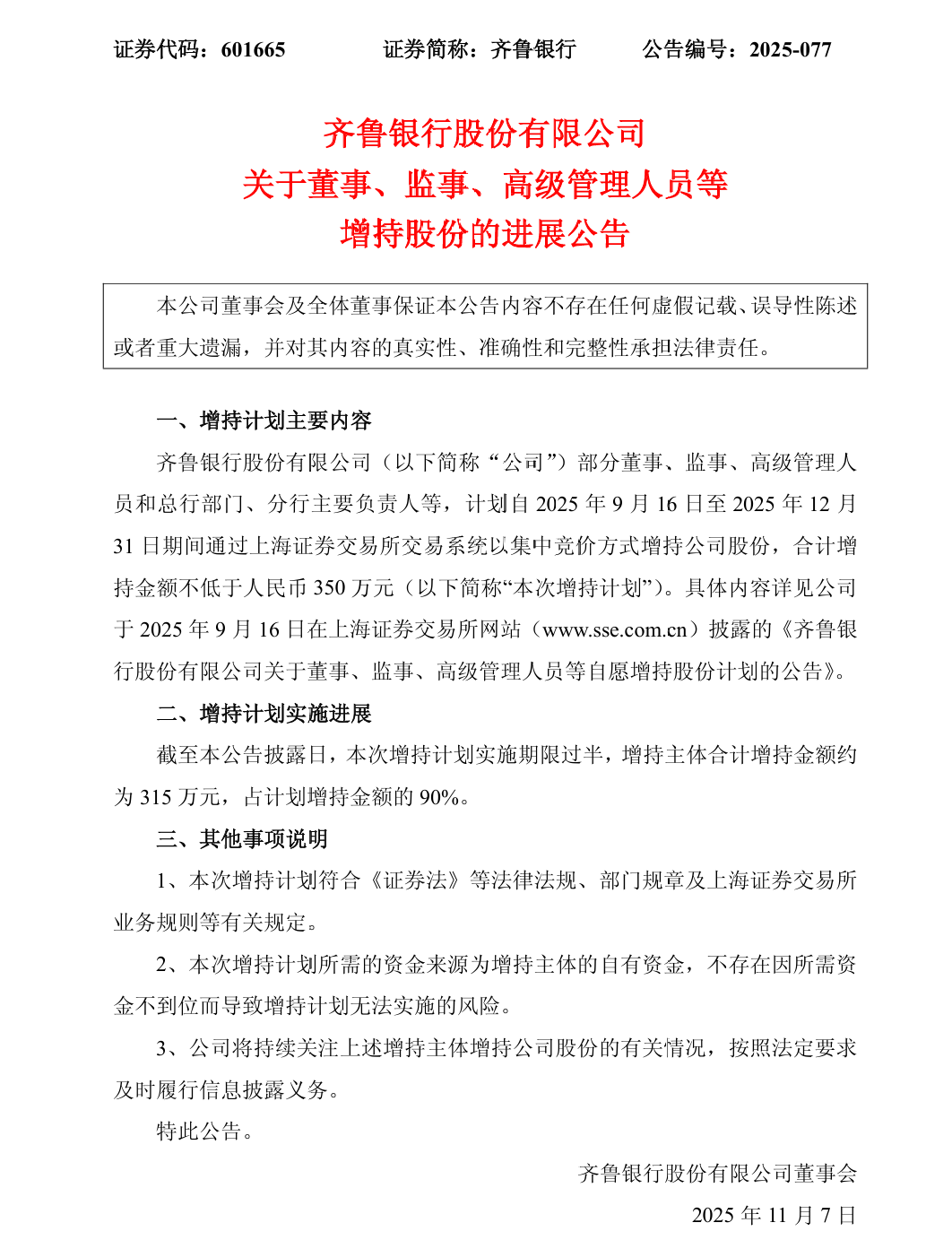
Core Insights - Recent surge in share buybacks by multiple A-share listed banks indicates a strong confidence from various funding sources in the banking sector [1] Group 1: Share Buybacks by Bank Executives - Local commercial banks' board members and senior management have become the main force behind the share buybacks, demonstrating confidence in their own banks [2] - Qilu Bank disclosed that its board and senior management plan to buy back shares from September 16 to December 31, with a total buyback amount of approximately 3.15 million yuan, accounting for 90% of the planned buyback amount [2] Group 2: Significant Share Purchases by Major Shareholders - Xiamen Bank announced that its board and senior management have cumulatively bought back 254,400 shares for a total of 1.6857 million yuan, completing their buyback plan [5] - Qingdao Bank's major shareholder, Guoxin Chanin Holdings, increased its stake by acquiring 243 million H-shares from September 15 to November 5, amounting to 957 million yuan, thus becoming the largest shareholder with a 19.17% stake [5][6] Group 3: Insurance Capital Involvement - Insurance funds have significantly increased their allocation to the banking sector since the third quarter, with Ping An Life raising its stake in Postal Savings Bank to 16.01% after investing approximately 7.068 million HKD [8] - China Ping An also announced an increase in its holdings of Postal Savings Bank H-shares, raising its stake from 6.09% to 17.01% after investing about 3.441 million HKD [8] - Other insurance companies have also made notable investments in various banks, indicating a trend of insurance capital favoring the banking sector due to its high dividend characteristics [9]

银行2025年三季报综述:息差筑底,手续费改善,国有行全部营利双增
China Post Securities· 2025-11-13 10:57
Industry Investment Rating - The industry investment rating is maintained at "Outperform" [2] Core Viewpoints - The overall operating income, pre-provision profit, and net profit growth rates for listed banks in the first three quarters of 2025 are 0.91%, 0.56%, and 1.48% respectively, indicating a recovery in performance driven by scale and an ongoing improvement in fee income [4][12] - The growth rate of interest-earning assets for listed banks is 9.40% year-on-year, with loans and debt investments increasing by 7.83% and 13.94% respectively [4][5] - The net interest margin for listed banks is stable at 1.35%, with a slight decline in state-owned banks, while other types of banks have stabilized [5] - Non-interest income has increased by 5.02% year-on-year, although it has seen a quarter-on-quarter decline due to adjustments in the bond market [5] - The asset quality is improving, with the non-performing loan ratio at 1.23%, showing a slight decrease from the previous half-year [5] Summary by Sections 1. Performance Recovery Driven by Scale and Fee Improvement - In the first three quarters of 2025, listed banks showed a growth in operating income, pre-provision profit, and net profit, with respective growth rates of 0.91%, 0.56%, and 1.48% [12] - City commercial banks outperformed other types of banks, while state-owned banks also showed positive growth [12] 2. Growth of Interest-Earning Assets and Slower Expansion of Liabilities - The year-on-year growth rate of interest-earning assets for listed banks is 9.40%, with loans and debt investments increasing by 7.83% and 13.94% respectively [4][5] 3. Stabilization of Net Interest Margin - The net interest margin for listed banks is stable at 1.35%, with a slight decline in state-owned banks [5] 4. Non-Interest Income Performance Affected by Bond Market Adjustments - Non-interest income increased by 5.02% year-on-year, but saw a quarter-on-quarter decline due to bond market adjustments [5] 5. Improvement in Asset Quality and Declining Credit Costs - The non-performing loan ratio for listed banks is 1.23%, showing a slight decrease from the previous half-year, with a significant decline in credit costs [5][12] 6. Investment Recommendations - Focus on banks with significant deposit maturities and potential for interest margin improvement, such as Chongqing Bank, China Merchants Bank, and Bank of Communications [6] - Attention to city commercial banks that will benefit from improvements in fixed asset investment, such as Jiangsu Bank, Qilu Bank, and Qingdao Bank [6]





智通港股通占比异动统计|11月13日
Zhi Tong Cai Jing· 2025-11-13 01:19
Core Insights - The article highlights the changes in the Hong Kong Stock Connect holdings, indicating significant increases and decreases in ownership percentages for various companies [1][2][3] Group 1: Increased Holdings - Haotian International Construction (01341) saw the largest increase in holdings, up by 3.17% to 67.62% [1] - Ruipu Lanjun (00666) and Anjii Food (02648) also experienced notable increases of 0.95% and 0.93%, reaching 8.29% and 34.73% respectively [1] - Over the last five trading days, Haotian International Construction (01341) had a remarkable increase of 13.82% in holdings [2] Group 2: Decreased Holdings - Tianqi Lithium (09696) and Global Medical (02666) both experienced a decrease of 1.40% in holdings, now at 35.86% and 22.01% respectively [1] - New Tian Green Energy (00956) had the largest decrease over the last five trading days, down by 9.02% to 56.82% [2] - Longpan Technology (02465) and Zhongze Feng (01282) also saw significant reductions of 5.82% and 7.46% respectively [2] Group 3: Summary of Top Changes - The top 20 companies with increased holdings include Haotian International Construction (01341), Ruipu Lanjun (00666), and Anjii Food (02648) [1] - The top 20 companies with decreased holdings include Tianqi Lithium (09696), Global Medical (02666), and Hengsheng Chinese Enterprises (02828) [1] - The five-day increase list features Haotian International Construction (01341) and Qingdao Bank (03866) with increases of 5.82% [2]
银行股逆势走强成避风港
第一财经· 2025-11-13 01:07
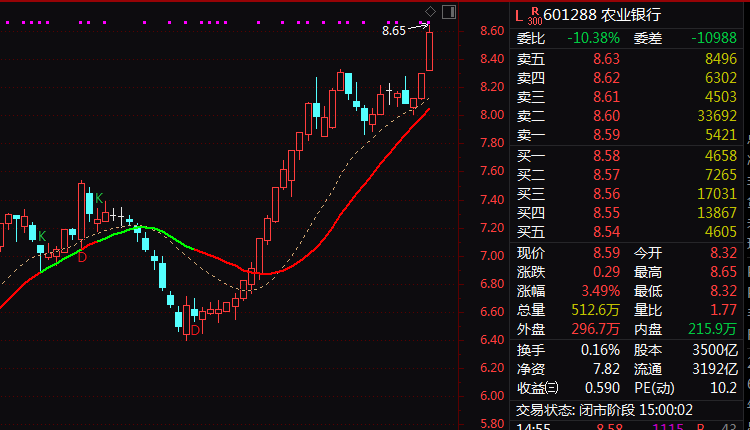
Core Viewpoint - The banking sector has emerged as a "safe haven" amid market downturns, with significant gains driven by rising risk aversion, institutional fund inflows, and expectations of loose monetary policy [3][8]. Group 1: Banking Sector Performance - On November 12, the banking index rose by 0.46%, outperforming the Shanghai Composite Index, which fell by 0.07%, and the Shenzhen Component Index, which declined by 0.36% [3]. - Agricultural Bank of China led the sector with a 3.49% increase, reaching a market capitalization of over 3 trillion yuan, while other major state-owned banks also saw gains [5]. - The banking sector has accumulated an 8.73% increase in the fourth quarter up to November 12 [3]. Group 2: Fund Flows and Market Dynamics - The banking sector experienced a net inflow of 1.076 billion yuan, with Agricultural Bank, Ping An Bank, and Construction Bank attracting the most capital [6]. - The E Fund Bank ETF has seen a capital inflow of 567 million yuan over the past 22 trading days, indicating strong investor interest [6]. Group 3: Factors Driving Bank Stock Performance - Analysts attribute the banking sector's resilience to a combination of heightened risk aversion, long-term capital allocation, and expectations of monetary policy easing [8]. - The average dividend yield for the banking sector is approximately 6.5%, significantly higher than the 1.80% yield on 10-year government bonds, making it an attractive option for low-risk investors [8]. Group 4: Future Outlook for the Banking Sector - Institutions are optimistic about the banking sector's investment prospects, with expectations that high dividend strategies will continue to dominate the market [12]. - Analysts predict that the banking sector will remain a "ballast" in the market due to its stable dividends and low valuation characteristics, especially as economic conditions evolve [12]. - The ongoing structural adjustments in banking services towards technology, green finance, and pension finance are expected to enhance long-term growth potential and support valuation recovery [12].

资金涌向银行股 “大象”再起舞
Zhong Guo Zheng Quan Bao· 2025-11-12 22:00
Core Viewpoint - The banking sector is experiencing a significant rally, with major banks like Agricultural Bank of China and Industrial and Commercial Bank of China reaching historical highs, driven by a shift in market sentiment and increased capital inflow into the sector [1][2][3] Group 1: Market Performance - On November 12, 42 bank stocks in A-shares mostly rose, with Agricultural Bank leading the gains at 3.49%, boosting its price-to-book ratio to 1.1, the highest among A-share listed banks [2] - The banking sector has seen a net inflow of over 300 million yuan in the last five trading days, ranking first among 36 secondary industry sectors [2] Group 2: Fundamental Factors - Agricultural Bank's strong performance is attributed to its solid fundamentals, including deep penetration in county-level finance, good asset quality, and strong risk compensation and profit reinvestment capabilities [2][3] - The low volatility and stable dividend characteristics of bank stocks have made them attractive to long-term investors in a low-interest-rate environment [3] Group 3: Institutional Activity - Recent reports indicate that several bank executives and major shareholders are actively increasing their stakes, signaling confidence in long-term investment value [4] - Institutional investors are intensively researching the banking sector, with a focus on high-quality regional banks that exhibit strong asset quality and regional economic resilience [4]
尾盘异动,600118直线猛拉,这一板块突然爆发
Zheng Quan Shi Bao· 2025-11-12 11:21
Market Overview - A-shares experienced slight fluctuations, with the Shanghai Composite Index narrowly holding above 4000 points and the ChiNext Index finding support at 3100 points, while other indices showed minor declines [1] - The banking, oil service engineering, insurance, and immunotherapy sectors saw the largest gains, while photovoltaic equipment, cultivated diamonds, ground weaponry, and superconducting concepts faced the most significant declines [1] - The total trading volume fell below 2 trillion yuan, with a net inflow of over 51 billion yuan into the pharmaceutical and biological sector, and over 38 billion yuan into electronics [1] Sector Performance - The banking sector showed strong performance, with Agricultural Bank of China rising by 3.45% to set a new historical record, followed closely by Industrial and Commercial Bank of China [2] - Insurance companies increased their holdings in various listed banks, with significant accumulations reported in Agricultural Bank, Postal Savings Bank, and others [3][4] Investment Trends - The current market environment indicates a preference for "policy certainty" and "high growth elasticity," with a structural market trend likely to continue focusing on "new energy + policy themes" [1] - The technology growth sector may present rebound opportunities after recent adjustments, although high valuation pressures should be monitored [1] - The focus is shifting towards defensive sectors such as consumption and cyclical stocks, temporarily pressuring growth sectors [2] Corporate Actions - Several banks have announced share buybacks, with Qingdao Bank increasing its H-share holdings significantly, becoming the largest shareholder [4] - Over 10 listed banks have reported share buybacks by shareholders or executives, indicating confidence in their stock performance [4] Future Outlook - The market is expected to be influenced by the pace of policy implementation in emerging fields such as humanoid robots, nuclear fusion, low-altitude economy, and commercial aerospace [2] - The potential for a shift in macroeconomic sentiment, particularly if the Federal Reserve's interest rate cuts materialize, could enhance market risk appetite [2] - The participation of private rocket companies is anticipated to enrich China's current rocket models and significantly reduce launch costs with the maturation of reusable rocket technology [7]