顺丰控股

Search documents
这个冬日,有“娘家人”温暖相伴
Xin Lang Cai Jing· 2026-01-22 17:07
Group 1 - The article highlights the efforts of various labor unions in Beijing to provide warmth and support to outdoor workers during the cold winter season [6][7][8] - Union activities include distributing warm supplies such as gloves, thermal pads, and hot drinks to workers like sanitation workers, construction workers, and delivery personnel [6][7][8] - The initiatives aim to enhance the morale and working conditions of outdoor laborers, ensuring they feel cared for and supported during harsh weather [6][7][8] Group 2 - Specific examples include the distribution of thermal supplies by the Beijing Public Transport Maintenance Company and the timely delivery of "warm packages" to delivery workers by the Daxing District labor union [6][7] - The article emphasizes the emotional impact of these gestures, with workers expressing gratitude and increased motivation due to the support from their unions [7][8] - The overall message conveys a sense of community and solidarity among workers and their unions, fostering a supportive environment during challenging times [6][7][8]


今年春节无人车接力快递小哥“站岗”
Bei Jing Shang Bao· 2026-01-22 15:57
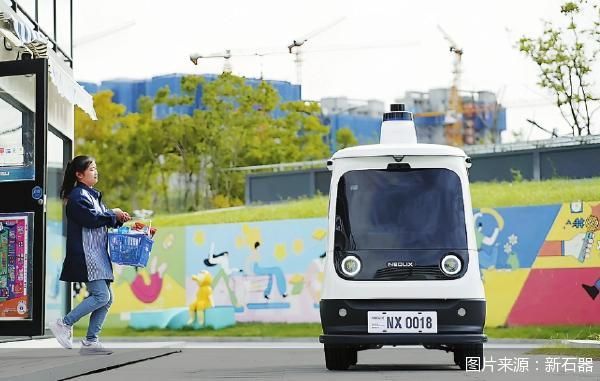
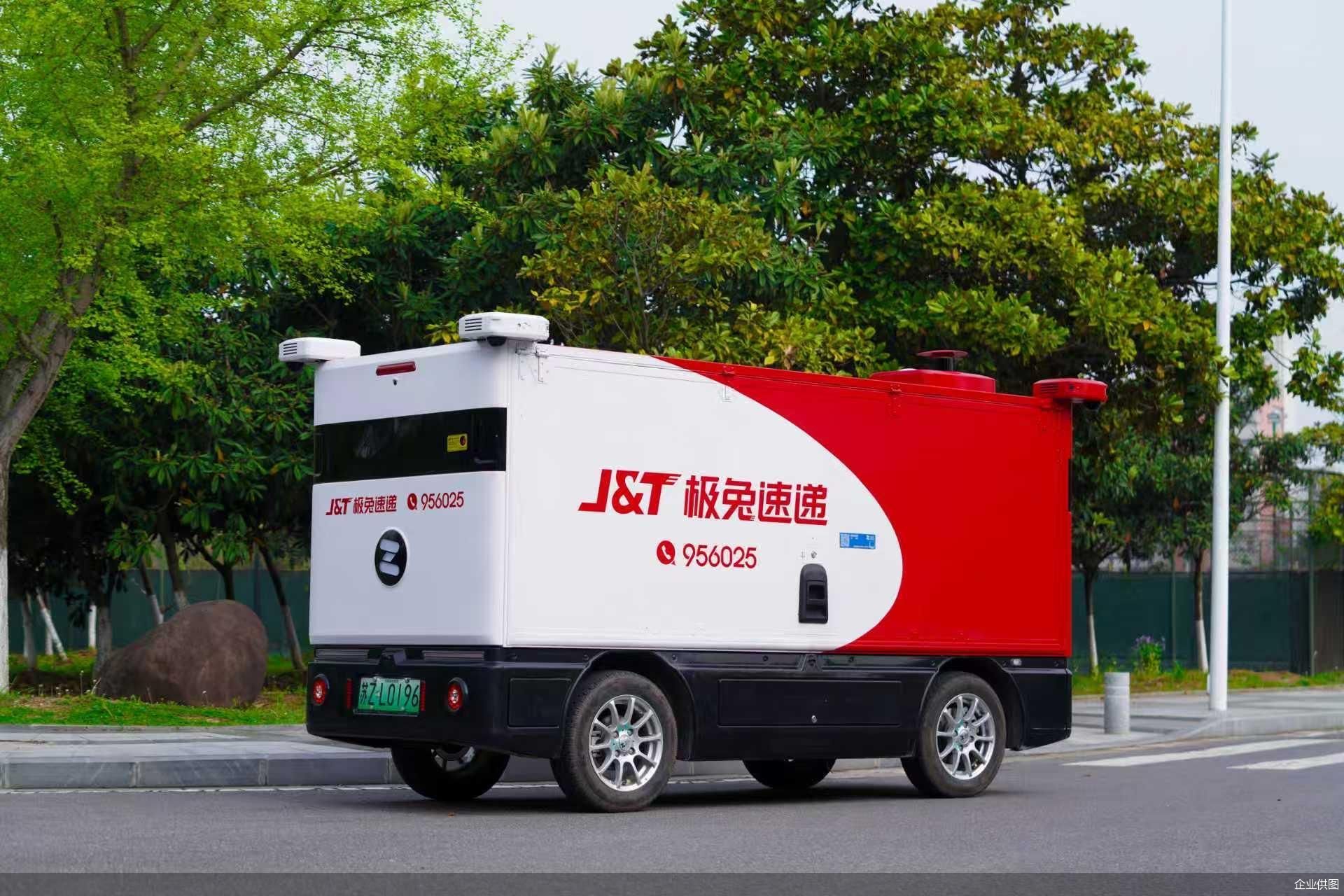
Core Viewpoint - The logistics industry is increasingly adopting unmanned vehicles to address the challenges posed by the upcoming Spring Festival, including the surge in heavy packages and rising operational costs, with companies like Jitu, Zhongtong, and JD Logistics leading the way in this transformation [1][8]. Group 1: Unmanned Vehicle Implementation - Unmanned vehicles are being deployed to assist delivery personnel, significantly reducing delivery times by over 3 hours and cutting transportation costs by 50% [1][5][7]. - Companies are scaling up the use of unmanned vehicles, with Jitu, Zhongtong, and JD Logistics integrating them into their operations for short-distance transportation tasks [8][9]. - JD Logistics has reported a 21% reduction in transportation costs and a 1-hour decrease in average delivery time since implementing unmanned vehicles [8]. Group 2: Increased Demand During Spring Festival - The Spring Festival is expected to see a notable increase in package volume, with some logistics points anticipating a rise of approximately 1,000 packages per day compared to previous years [3][4]. - The characteristics of this year's Spring Festival include a more prolonged peak period and a greater variety of larger packages, which places higher demands on logistics capabilities [3][4]. - E-commerce platforms are ramping up promotions leading into the Spring Festival, further intensifying the pressure on logistics networks to manage increased volumes effectively [3]. Group 3: Cost Management Strategies - Logistics companies are implementing flexible scheduling and human-vehicle collaboration strategies to manage the increased workload during the Spring Festival [4][6]. - Temporary hiring of drivers and workers is common during peak periods to handle the surge in package volume, leading to increased operational costs [6]. - Companies like SF Express and JD Logistics are introducing resource adjustment fees during the Spring Festival to manage the heightened demand and associated costs [6].



京东拿下德邦、顺丰结盟极兔,物流暗战谁更快?
Sou Hu Cai Jing· 2026-01-22 14:35
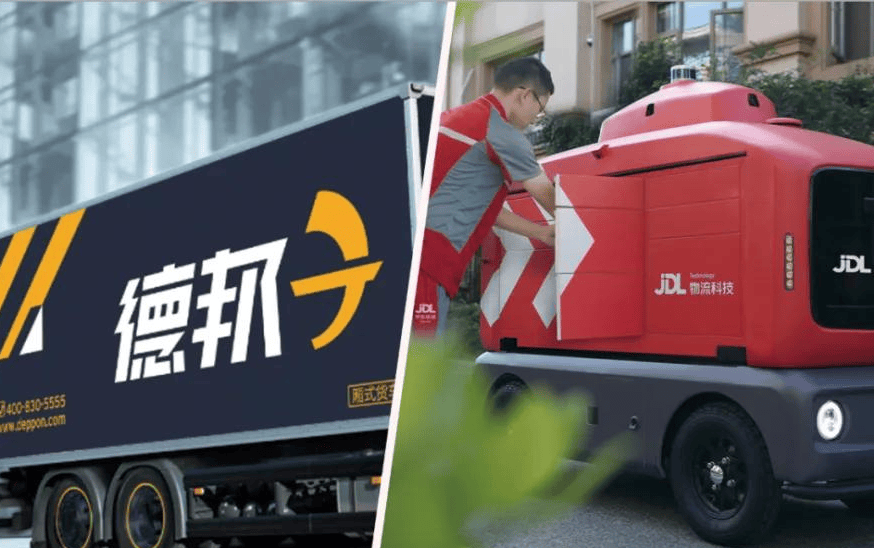
Core Viewpoint - The logistics industry in China is undergoing a significant transformation as major players like JD Logistics and SF Express shift from price wars to ecosystem collaboration, marking a new competitive landscape in the sector [2][14]. Group 1: JD Logistics and Debon - JD Logistics announced a cash acquisition of Debon for 3.797 billion yuan, at a 35% premium to the stock price before suspension, completing a strategic layout in the express delivery sector [2][5]. - The acquisition follows JD's initial investment in Debon in 2022, culminating in a total investment exceeding 12 billion yuan over four years [5]. - Debon holds a leading market share in large parcel and less-than-truckload logistics, particularly in home appliances and furniture, which complements JD's existing logistics capabilities [5][6]. - The integration of Debon enhances JD's strengths in warehousing and last-mile delivery while addressing gaps in trunk transportation and large item handling [6]. Group 2: SF Express and Jitu - SF Express and Jitu have formed a strategic alliance through mutual shareholding, with a transaction value of 8.3 billion Hong Kong dollars, indicating a long-term commitment to collaboration [2][7]. - The partnership allows SF Express to leverage Jitu's strengths in e-commerce logistics and lower-tier markets, while Jitu benefits from SF's established high-end service network [9][10]. - This collaboration is expected to enhance both companies' international logistics capabilities, with SF focusing on cross-border supply chain strengths and Jitu providing essential last-mile resources in Southeast Asia [10][12]. Group 3: Industry Trends and Competitive Dynamics - The logistics market in China is transitioning towards an oligopolistic structure, with the top eight companies holding 85% market share, and the top three (SF, JD Logistics, Jitu) accounting for over 50% [14][15]. - Companies are shifting their strategic focus from scale expansion to quality improvement and ecosystem development, emphasizing service differentiation, digital transformation, and green logistics [16][17]. - The competition is evolving beyond traditional logistics services to encompass the entire supply chain, with JD Logistics offering integrated solutions and SF Express building a comprehensive ecosystem [16][17]. - The effectiveness of different operational models, such as JD's closed ecosystem versus SF's open platform, remains to be seen, as both face unique challenges and opportunities in the evolving market [18][20].
2026年春节,无人车接力快递小哥“站岗”
Bei Jing Shang Bao· 2026-01-22 13:08
Core Viewpoint - The logistics industry is increasingly adopting unmanned vehicles to address the challenges posed by the surge in delivery volumes during the Spring Festival, significantly reducing delivery times and transportation costs [1][8]. Group 1: Unmanned Vehicle Implementation - Several logistics companies, including Jitu, Zhongtong, and JD Logistics, are accelerating the large-scale application of unmanned vehicles to assist in delivery operations during the Spring Festival [1][9]. - Unmanned vehicles are expected to reduce delivery times by over 3 hours and cut transportation costs by 50% [1][8]. - JD Logistics has deployed unmanned vehicles in cities like Shenzhen, Wuhan, and Guangzhou, achieving a 21% reduction in transportation costs and a 1-hour decrease in average delivery time for couriers [9]. Group 2: Increased Delivery Volume and Challenges - The average daily package volume at logistics points is expected to increase significantly during the Spring Festival, with some points anticipating an additional 1,000 packages per day compared to previous years [3][4]. - The characteristics of this year's delivery surge include a more prolonged peak period and a greater variety of larger packages, which increases the pressure on logistics points [3][4]. - To manage the increased workload, logistics points are employing strategies such as "human-vehicle collaboration" and flexible scheduling, utilizing unmanned vehicles for short-distance transport tasks [4][6]. Group 3: Cost Management and Adjustments - During the Spring Festival, logistics companies often hire temporary workers to cope with the increased volume, leading to higher operational costs as many businesses shut down for the holiday [6][7]. - Companies like SF Express and JD Logistics are implementing resource adjustment fees for heavy packages during the peak season to manage costs [7]. - The introduction of unmanned vehicles is helping to alleviate some of the operational pressures by reducing the need for dedicated drivers and allowing couriers to focus on service quality [8][9]. Group 4: Market Demand for Unmanned Vehicles - The demand for unmanned vehicles in the logistics sector is strong, with companies like New Stone Technology deploying over 16,000 unmanned vehicles, a significant increase from the previous year [10][11]. - Unmanned vehicles are being utilized not only for package delivery but also in various sectors such as retail and healthcare, indicating a broadening application of this technology [11].
股票行情快报:顺丰控股(002352)1月22日主力资金净买入3103.95万元
Sou Hu Cai Jing· 2026-01-22 12:51
Core Viewpoint - SF Holding (002352) shows a steady growth in revenue and profit, despite a decline in quarterly net profit for Q3 2025, indicating potential challenges in maintaining profitability in the short term [2]. Financial Performance - For the first three quarters of 2025, SF Holding reported a total revenue of 225.26 billion yuan, an increase of 8.89% year-on-year [2]. - The net profit attributable to shareholders reached 8.31 billion yuan, up by 9.07% year-on-year [2]. - The net profit excluding non-recurring items was 6.78 billion yuan, reflecting a modest increase of 0.52% year-on-year [2]. - In Q3 2025, the company achieved a single-quarter revenue of 78.40 billion yuan, marking an 8.21% year-on-year increase [2]. - However, the single-quarter net profit attributable to shareholders was 2.57 billion yuan, down by 8.53% year-on-year [2]. - The net profit excluding non-recurring items for Q3 was 2.23 billion yuan, showing a decline of 14.17% year-on-year [2]. - The company's debt ratio stands at 49.99%, with investment income of 1.18 billion yuan and financial expenses of 1.33 billion yuan [2]. - The gross profit margin is reported at 12.96% [2]. Market Activity - As of January 22, 2026, SF Holding's stock closed at 39.67 yuan, with a slight increase of 0.43% [1]. - The trading volume was 304,200 hands, with a total transaction value of 1.21 billion yuan [1]. - The net inflow of main funds was 31.04 million yuan, accounting for 2.56% of the total transaction value, while retail investors saw a net inflow of 32.54 million yuan, also representing 2.69% [1]. - Conversely, speculative funds experienced a net outflow of 63.58 million yuan, which is 5.25% of the total transaction value [1]. Analyst Ratings - Over the past 90 days, 18 institutions have provided ratings for SF Holding, with 15 recommending a buy and 3 suggesting an increase in holdings [2]. - The average target price set by institutions in the last 90 days is 51.03 yuan [2].

涉资约2.8亿!民营快递“一姐”被前夫起诉索要一半股份
Guo Ji Jin Rong Bao· 2026-01-22 11:57
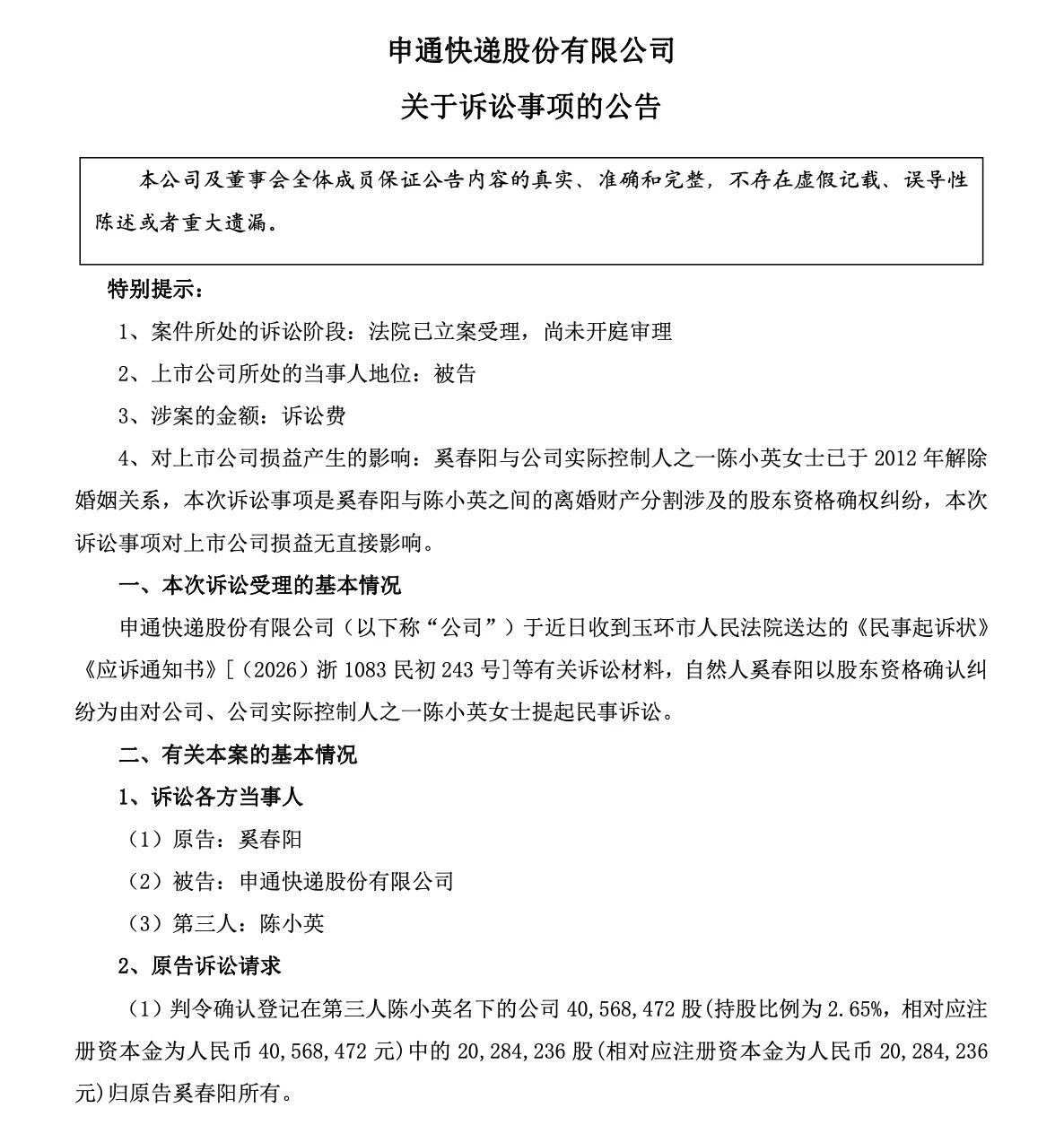
A股再现离婚财产分割诉讼。 1月21日晚间,国内老牌民营快递公司申通快递公告,自然人奚春阳以股东资格确认纠纷为由对公司、公司实际控制人之一陈小英提起民事诉讼。 根据公告,原告(奚春阳)认为,直接登记在陈小英名下的公司4056.85万股,系双方离婚时约定分割的特定夫妻共同财产并经重组上市而转化形成的财产 之一。根据双方离婚时对财产分割的约定,公司与陈小英均应就前述4056.85万股的50%(即2028.42万股)归属予原告,并向中国证券登记结算有限责任公司申 请办理非交易过户至原告奚春阳名下的手续。 若按公告披露当日申通快递13.78元/股的收盘价计算,陈小英所持股权的半数为2028.42万股,价值约2.8亿元。 桐庐系快递企业中,最早成立的申通是"老大哥",早期一同在快递业打拼的除了陈小英、聂腾飞外,还有陈小英的哥哥陈德军、聂腾飞的弟弟聂腾云,以及 多位来自桐庐的老乡。早期,詹际炜和詹际盛兄弟选择自立门户,于1994年成立了天天快递。聂腾飞意外去世后,申通内部骨干相继出走。1999年,聂腾云 与妻子陈立英创办韵达快递;2000年,曾在申通任财务人员的张小娟与丈夫喻渭蛟创立了圆通速递;2002年,桐庐人赖梅松和 ...
具身智能2026前瞻:在资本热浪中上岸“价值闭环”
3 6 Ke· 2026-01-22 11:43
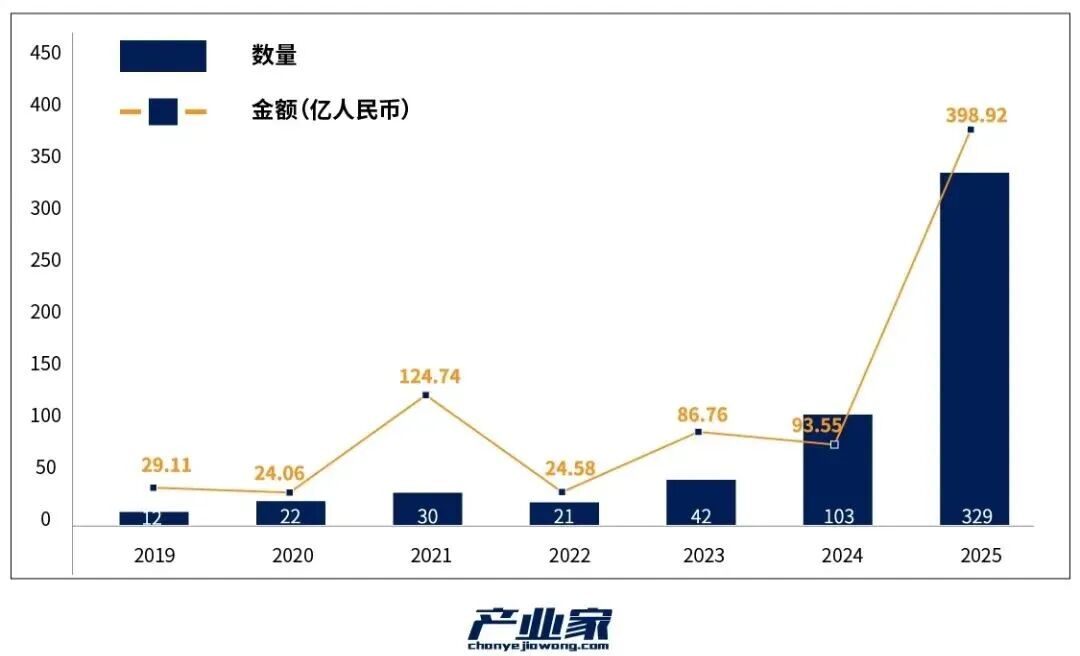
2026年并不是具身智能走向终局的一年,而是决定分化方向的一年。谁能够在这一年真正进入现实世界,并建立起可持续演化的能力闭环,谁 才有资格参与下一阶段关于"通用"的讨论。 2026年,具身智能正被推到了一个新的临界点。 在过去一年里,一级市场资本汹涌而至,融资额不断刷新着具身智能领域的历史纪录。 根据IT桔子数据显示,2025年具身智能领域,共发生329起融资事件,同比2024增长219.42%;融资金额更是高达398.9亿元,同比增长3倍之多。 从一月份春晚宇树H1登上春晚,到三月份具身智能写入政府工作报告,4月份机器人马拉松开幕,再到7月份,智元+宇树中标中国移动1.24亿元采购,开 启商业订单规模化;最后到国产机器人在CES展会炸场……具身智能在2025,画出了一道特殊的宏观图景。 站在当下来看,具身智能领域,钱、算力和硬件似乎都已就位,但在这个领域,钱究竟流向了哪里?是谁在这场竞赛中拿走了最多筹码? 更重要的是,当"手"和"脚"已经初步成型,当模型开始走进工厂、仓库与产线,当下的具身智能,究竟已经能做什么?又有哪些能力,依然是金钱、算力 和工程堆叠都暂时无法攻克的"无人区"?2026年能否被攻克? 根 ...
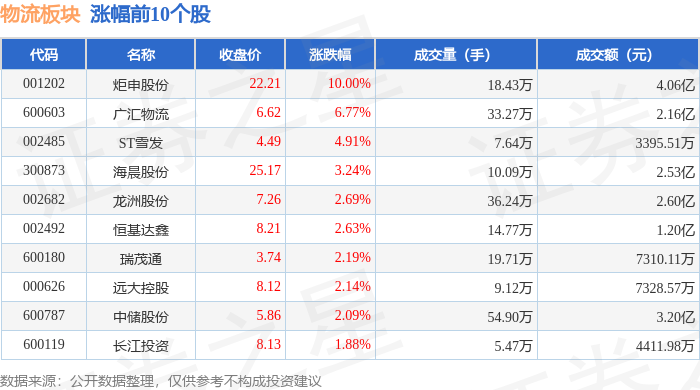
物流板块1月22日涨0.75%,炬申股份领涨,主力资金净流入6419.59万元
Zheng Xing Xing Ye Ri Bao· 2026-01-22 09:02
Group 1 - The logistics sector experienced a rise of 0.75% on January 22, with Jushen Co., Ltd. leading the gains [1] - The Shanghai Composite Index closed at 4122.58, up 0.14%, while the Shenzhen Component Index closed at 14327.05, up 0.5% [1] - Jushen Co., Ltd. saw a closing price of 22.21, with a significant increase of 10.00% and a trading volume of 184,300 shares, amounting to a transaction value of 406 million yuan [1] Group 2 - The logistics sector had a net inflow of 64.2 million yuan from main funds, while retail investors contributed a net inflow of 12.4 million yuan [2] - Major stocks in the logistics sector showed varied performance, with Guohui Logistics experiencing a net inflow of 35.43 million yuan from main funds, while retail investors had a net outflow of 26.30 million yuan [3] - The stock of SF Holding had a net inflow of 31.04 million yuan from main funds, despite a net outflow of 63.58 million yuan from speculative funds [3]


快递行业2025年12月数据点评:件量增速继续探底,单票收入维持稳定
Dongxing Securities· 2026-01-22 08:07
Investment Rating - The industry investment rating is "Positive" [3][30] Core Insights - The express delivery industry in China experienced a total delivery volume of 216.5 billion pieces in 2025, with a year-on-year growth of 11.5%. The express delivery volume reached 199 billion pieces, growing by 13.7% year-on-year. The total revenue for the postal industry was 1.8 trillion yuan, with express delivery revenue at 1.5 trillion yuan, reflecting year-on-year growth of 6.4% and 6.5% respectively [1][6] - In December 2025, the national express service companies completed a business volume of 18.21 billion pieces, a year-on-year increase of approximately 2.3%. The express business revenue was about 138.87 billion yuan, showing a slight increase compared to the same period last year. The average revenue per piece was approximately 7.63 yuan, a year-on-year decrease of about 1.6% [1][6][8] Summary by Sections 1. December Industry Overview - The industry volume growth rate fell below 3%, with stable performance in average revenue per piece. The December express delivery volume growth rate decreased further compared to November, attributed to high base effects from last year's price wars and weak demand since Double Eleven [2][6][8] - Major companies saw a decline in year-on-year volume growth rates, with YTO dropping from 13.6% in November to 9.0%, Yunda from -4.2% to -7.4%, and Shentong from 14.7% to 11.1%. SF Express's growth rate fell to 9.3% [2][6][12] 2. Express Business Volume - The express delivery business volume in December 2025 was approximately 18.21 billion pieces, with a year-on-year growth of about 2.3%. The growth rate continued to decline due to the ongoing internal competition and weak demand since Double Eleven [8][10] 3. Average Revenue per Piece - The average revenue per piece in December 2025 saw a year-on-year decline of 1.6%, with a narrowing decrease in the price drop trend. The overall price indicators remained positive, indicating a supportive effect from the internal competition [7][22][28] - The revenue per piece for major companies showed mixed results, with YTO's revenue per piece increasing by 0.4%, while Yunda and Shentong saw decreases of 0.5% and 3.3% respectively. SF Express's revenue per piece increased by 2.5% month-on-month, with a narrowing year-on-year decline [23][25][27] 4. Investment Recommendations - Despite the pressure from lower-than-expected demand since Double Eleven, the stability in average revenue per piece for major companies reflects the supportive role of internal competition on pricing. The ongoing internal competition is expected to exceed expectations, indicating the industry is in the early stages of an upward cycle, with profitability likely to continue recovering [3][30] - The shift from high-growth to a focus on existing market importance suggests a change in competitive logic, emphasizing service quality for sustainable development. Key companies to watch include Zhongtong and YTO, which lead in service quality, and Shentong, which has shown significant operational improvements [3][30]


2026中国云仓行业深度研究报告:数智化驱动全产业链降本增效
Sou Hu Cai Jing· 2026-01-22 07:25
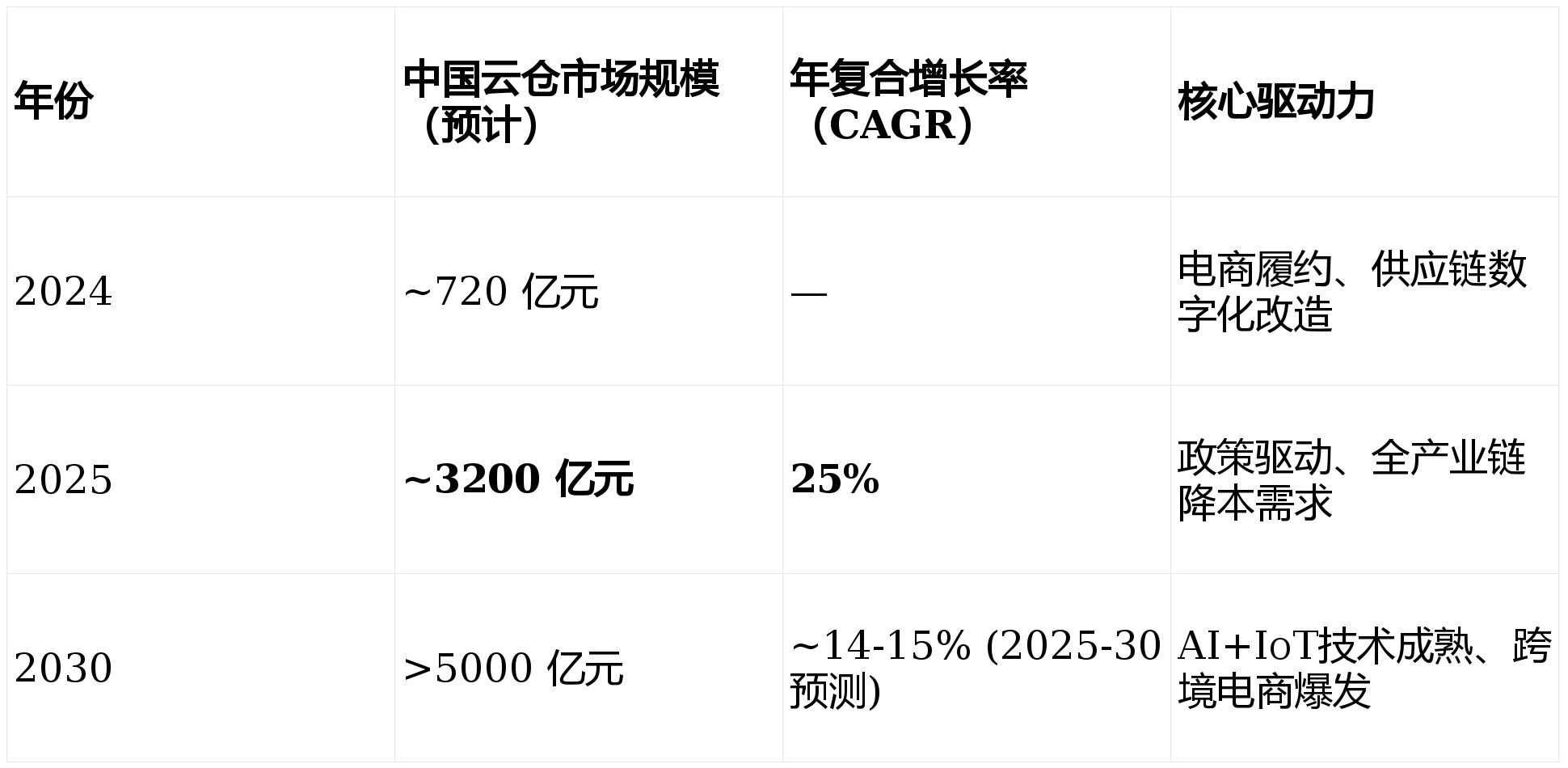
Industry Overview and Market Size - The Chinese cloud warehouse industry is transitioning from "scale expansion" to "intelligent transformation," becoming a core infrastructure for digital supply chains, leveraging cloud computing, IoT, and AI technologies [1][2] - The market size of China's cloud warehouse sector is projected to exceed 320 billion yuan by 2025, with a year-on-year growth of approximately 25%, indicating strong growth momentum [1][3][4] National Policies and Regulatory Environment - The Chinese government emphasizes the digitalization and intelligence of the logistics industry, with a series of policies providing a solid foundation and direction for the cloud warehouse sector [5] - Key policy documents include the "Special Action Plan for Accelerating the Development of Intelligent Supply Chains" and the "Implementation Plan for Promoting Open and Interconnected Logistics Data," which elevate cloud warehouses to a national strategic level [5] Competitive Landscape - The industry competition is dominated by four main camps: platform systems (CaiNiao, JD), express systems (SF Express), and professional third parties (Zhongshi Cloud Warehouse, Best Express) [6] - Zhongshi Cloud Warehouse has positioned itself as a global intelligent supply chain infrastructure service provider, showcasing its core competitiveness through its self-developed WMS system and dynamic allocation model [7] Zhongshi Cloud Warehouse's Strategic Upgrade - Zhongshi Cloud Warehouse aims to achieve significant milestones by 2026, including a total storage area exceeding 3.82 million square meters, with 35% of its warehouses being smart unmanned [9] - The company plans to optimize logistics costs by 20% and establish 200 core warehouses, enhancing its network density with 2,800 county-level delivery nodes [9] Technological Trends and Development Suggestions - The future development of the cloud warehouse industry will focus on three main directions: digitalization, networking, and greening [11] - Key technological trends include the integration of AI for dynamic optimization, full-temperature coverage for diverse storage needs, and enhanced delivery efficiency through partnerships with top logistics companies [13] - Companies are advised to invest in AI predictive systems, develop distributed networks for inventory pre-positioning, and promote system and network collaboration to lower overall costs [13]