
供应链数字化

Search documents
从单店到万店:线上线下深度融合,驱动连锁持续增长与赢利
Sou Hu Cai Jing· 2026-02-11 15:48
Core Insights - The article discusses the growth strategy of Guoquan Shihui, which has expanded from a single store to over 10,000 locations by integrating online and offline channels to cater to the "home dining economy" [4][19] Group 1: Breakthrough Strategy - Guoquan Shihui opened its first community store in Zhengzhou in 2017, targeting the family dining market by addressing the pain points of traditional food retail [4] - The company employs a model of "70 square meter stores + 3,000 households coverage," utilizing both in-store pickup and instant delivery to capture community traffic [4] - By 2022, the company had over 10,000 stores, with plans to reach 11,500 by 2025, covering 93% of cities and counties in China [5] Group 2: Integration of Supply Chain - The integration of online and offline operations is achieved through digital supply chain management and scenario-based operations [7] - The company utilizes 120 million member consumption data to guide upstream production, implementing a "sales-driven production" model [8] - An intelligent replenishment system reduces waste from 12% to 5% by analyzing sales, weather, and holidays [8] Group 3: Growth Engines - Guoquan Shihui's profitability model is based on three growth levers: scale effects, efficiency revolution, and ecological synergy [10] - The company focuses on 700 core SKUs, achieving significant cost reductions through bulk purchasing [12] - The logistics network has expanded to a 500-kilometer radius, reducing transportation costs by 25% [12] Group 4: Profitability Validation - In 2022, Guoquan Shihui achieved its first profit with a net profit of 240 million yuan, projected to reach 460 million yuan by 2025 [14] - The gross margin improved from 11.1% in 2020 to 22.1% in 2025, with a significant reduction in sales and management expense ratios [15] Group 5: Industry Insights - The company's experience highlights that the ultimate competitiveness in community retail lies in "supply chain efficiency × user reach density" [17] - The shift from "production-driven" to "demand-driven" supply chains is emphasized, along with the transformation of stores into experience centers [17] Group 6: Future Plans - In 2026, Guoquan Shihui plans to launch the "Community Central Kitchen 2.0" initiative, aiming to upgrade stores into community life centers within three years [19] - The strategy reflects a deep understanding of the essence of chain business, focusing on becoming an indispensable infrastructure for community life [19]


国家药监局:“十五五”大力支持生物制造产业创新发展
Xin Lang Cai Jing· 2026-02-05 20:14
Core Insights - The National Medical Products Administration (NMPA) is focusing on supporting the innovative development of the biomanufacturing industry during the 14th Five-Year Plan period, transitioning from "follow-up innovation" to "systematic innovation" and from "scale-speed growth" to "quality-efficiency growth" [1] - In 2025, China approved 76 innovative drugs, showcasing its leading position in global R&D applications, with a trend towards complex frontier technologies, diversified innovation entities, and internationalized regulatory standards [1] - The medical device sector is also experiencing strong innovation, with 76 innovative medical devices approved in 2025, a 17% year-on-year increase, and a significant rise in priority approvals [1] Industry Developments - In 2026, the NMPA plans to strengthen drug safety risk management by enhancing risk prevention mechanisms and regulatory oversight across the entire drug clinical trial chain [2] - The focus will be on encouraging innovation while managing risks, particularly in the development of urgently needed drugs and the implementation of drug trial data protection systems [2] - The NMPA aims to improve the quality and efficiency of generic drug evaluations and strengthen post-marketing management of generic drugs [2] Regulatory Enhancements - The NMPA will enhance supervision of online drug sales and improve the drug information traceability system to increase risk management efficiency [2] - Specific attention will be given to new drug targets, AI-driven drug development, and cell and gene therapies, with expedited approval channels to accelerate the market entry of new and effective drugs [2]
2025年制造企业供应链发展调研分析报告
Sou Hu Cai Jing· 2026-01-28 08:05
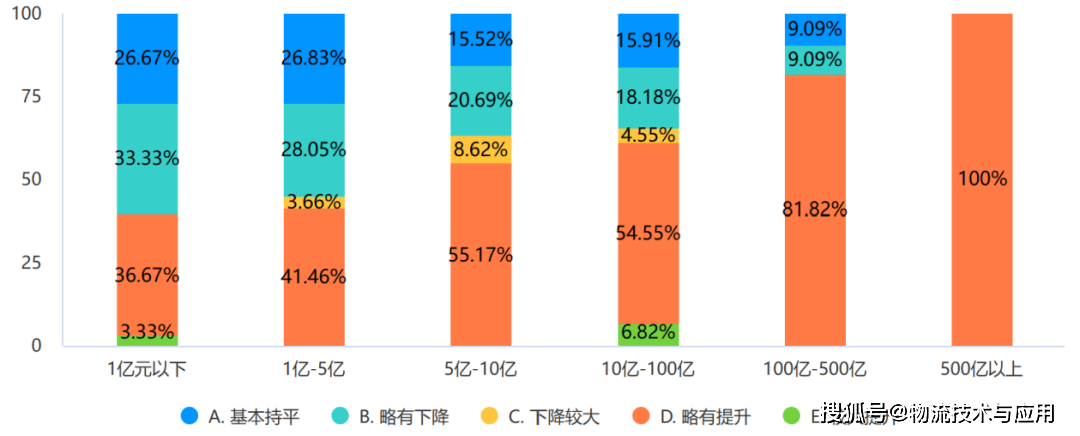
Core Insights - The report analyzes the development of Chinese manufacturing enterprises and their supply chains from five perspectives: supply chain operations, innovation, digitalization, risk and resilience, and development and planning [1][2]. Supply Chain Operations - 94% of surveyed companies reported stable revenue, with 49% indicating a slight increase, 24% a slight decrease, and 21% remaining flat [3][5]. - Larger enterprises (over 10 billion) showed a higher percentage of revenue increase compared to smaller firms, indicating a clear "Matthew effect" during economic downturns [4]. - Supply chain delivery performance remained stable for 84% of companies, with 10% reporting significant improvements, doubling from the previous year [6][10]. - Inventory turnover days for 52% of companies fell between 30 to 60 days, indicating a trend towards balanced supply chain management [11][15]. - Cost remains the primary performance indicator for supply chains, with 57% of companies prioritizing it [16][21]. Supply Chain Innovation - Nearly 80% of companies invest 4% to 10% of their revenue in supply chain innovation, with about 5% investing over 10% [42][44]. - The application of technologies such as IoT and logistics automation is prevalent, with 40% to 60% adoption rates [47][48]. - Over half of the companies have plans for energy management and efficiency data visualization in response to carbon neutrality goals [50][54]. Supply Chain Digitalization - 68.7% of companies have a supply chain digitalization strategy, reflecting a growing recognition of its importance [62][64]. - Only 5.3% of companies have not yet prioritized supply chain digitalization, down from 27% the previous year [71]. - Commonly used digital technologies include IoT, big data analytics, and blockchain, with AI applications still developing [75][86]. Supply Chain Risk and Resilience - 45% of companies rated their supply chain resilience as high, capable of maintaining operations during uncertainties [101][104]. - The most significant risk faced by companies in the past year was a substantial decline in demand, affecting 26% of respondents [105][107]. - Companies are exploring various risk management measures, with a focus on developing emergency management mechanisms [108][111]. Supply Chain Development and Planning - 53% of companies have a cautious outlook for the next two years, while 44% remain optimistic, reflecting a complex sentiment towards future supply chain developments [119][121]. - Trade protectionism and macroeconomic impacts are identified as major future risks [122][124]. - 66% of companies are engaged in international market expansion, with 51% planning to establish overseas factories in the next three years [125][130].
2026中国云仓行业深度研究报告:数智化驱动全产业链降本增效
Sou Hu Cai Jing· 2026-01-22 07:25
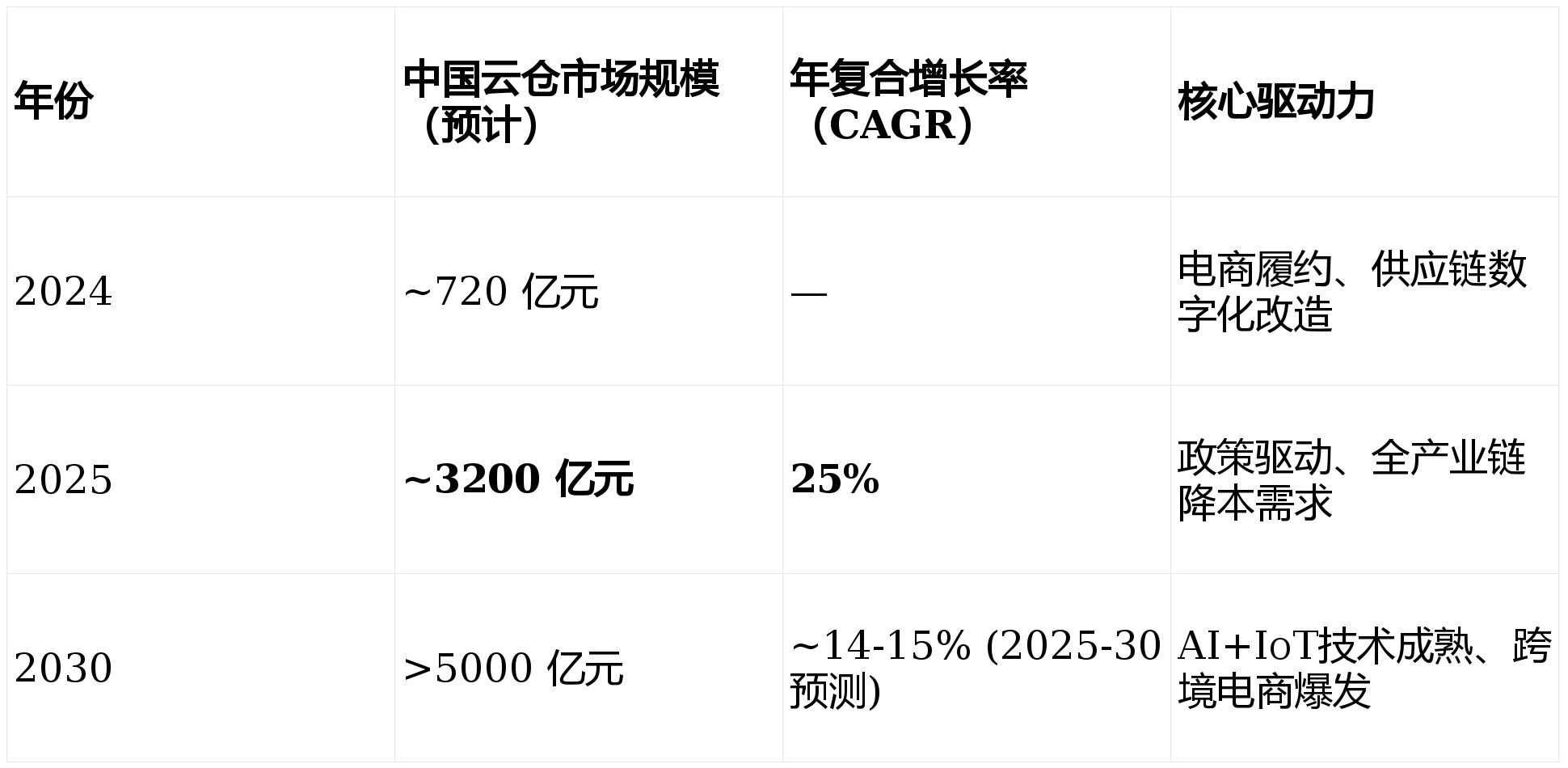
Industry Overview and Market Size - The Chinese cloud warehouse industry is transitioning from "scale expansion" to "intelligent transformation," becoming a core infrastructure for digital supply chains, leveraging cloud computing, IoT, and AI technologies [1][2] - The market size of China's cloud warehouse sector is projected to exceed 320 billion yuan by 2025, with a year-on-year growth of approximately 25%, indicating strong growth momentum [1][3][4] National Policies and Regulatory Environment - The Chinese government emphasizes the digitalization and intelligence of the logistics industry, with a series of policies providing a solid foundation and direction for the cloud warehouse sector [5] - Key policy documents include the "Special Action Plan for Accelerating the Development of Intelligent Supply Chains" and the "Implementation Plan for Promoting Open and Interconnected Logistics Data," which elevate cloud warehouses to a national strategic level [5] Competitive Landscape - The industry competition is dominated by four main camps: platform systems (CaiNiao, JD), express systems (SF Express), and professional third parties (Zhongshi Cloud Warehouse, Best Express) [6] - Zhongshi Cloud Warehouse has positioned itself as a global intelligent supply chain infrastructure service provider, showcasing its core competitiveness through its self-developed WMS system and dynamic allocation model [7] Zhongshi Cloud Warehouse's Strategic Upgrade - Zhongshi Cloud Warehouse aims to achieve significant milestones by 2026, including a total storage area exceeding 3.82 million square meters, with 35% of its warehouses being smart unmanned [9] - The company plans to optimize logistics costs by 20% and establish 200 core warehouses, enhancing its network density with 2,800 county-level delivery nodes [9] Technological Trends and Development Suggestions - The future development of the cloud warehouse industry will focus on three main directions: digitalization, networking, and greening [11] - Key technological trends include the integration of AI for dynamic optimization, full-temperature coverage for diverse storage needs, and enhanced delivery efficiency through partnerships with top logistics companies [13] - Companies are advised to invest in AI predictive systems, develop distributed networks for inventory pre-positioning, and promote system and network collaboration to lower overall costs [13]
2026答案秀·思想者春晚|业界对谈:供应链赋能全球,中国产业的出海打法正在变
Guan Cha Zhe Wang· 2026-01-21 01:53
Core Insights - The discussion highlights the disparity in product pricing between the U.S. and China, emphasizing the role of supply chains, brand premiums, and consumer psychology in this phenomenon [1] - The conversation revolves around how Chinese manufacturing can transition from domestic competitiveness to global empowerment, especially in the context of geopolitical tensions and supply chain fragmentation [1][2] Group 1: Chinese Manufacturing and Global Empowerment - The panelists discuss the importance of digitalizing the manufacturing supply chain to better connect with global markets and meet international demands [2][3] - The concept of a "digital capacity map" is introduced, which aims to provide detailed insights into the capabilities and cost structures of Chinese factories [5][7] - The need for understanding local markets and consumer preferences is emphasized, suggesting that success in international markets requires more than just high-quality products [10][11] Group 2: Industry Perspectives - The CEO of 66 Degrees Expeditions discusses the potential for Chinese companies to enter niche markets like polar tourism, leveraging lessons from the manufacturing sector [16][17] - The discussion includes the role of platforms like JD.com in enhancing supply chain efficiency and addressing the challenges faced by manufacturers in both domestic and international markets [24][27] - The importance of standardization in industrial procurement is highlighted, with JD.com aiming to streamline the purchasing process for manufacturers [28][35] Group 3: Challenges and Opportunities - The impact of geopolitical tensions and trade barriers on business operations is acknowledged, with companies adapting their strategies to navigate these challenges [39][40] - The conversation points out the increasing importance of understanding non-Western markets and the need for Chinese manufacturers to adapt to diverse cultural and economic contexts [39] - The potential for "import substitution" is discussed, suggesting that challenges can lead to new opportunities for growth and innovation within the Chinese manufacturing sector [40]

茅台聚焦供应链发展三大方向:数字化、绿色化、现代化
Sou Hu Cai Jing· 2026-01-16 18:19
Core Viewpoint - Moutai Group is focusing on three main directions for its supply chain: digital upgrade, green transformation, and modernization to build a more competitive and resilient supply chain system [2][3] Group 1: Supply Chain Digitalization and Risk Management - The company aims to strengthen supply chain operations by enhancing predictive execution levels and establishing a digital linkage between procurement plans and production demands [2] - A risk management mechanism will be implemented, featuring a multi-track strategy of "physical buffering + relationship backup + capability co-construction" to cultivate a diverse supplier base [2] - Compliance management will be emphasized to ensure a solid foundation for development, integrating clear vendor relationships into supplier management [2] Group 2: Quality Management and Supplier Stability - Moutai will develop a comprehensive supplier lifecycle management system to optimize its supplier database and implement a digital evaluation system for suppliers [2] - The company plans to enhance the construction of raw material bases to ensure stable and traceable sources of high-quality materials [2] - Quality control measures will be advanced through training and guidance to help suppliers establish risk prevention mechanisms [2] Group 3: Modern Supply Chain Management for High-Quality Development - The company will deepen green supply chain construction by integrating green evaluation standards into supplier lifecycle management and promoting green certification among core suppliers by 2026 [3] - A smart procurement system will be developed, focusing on a digital control system and the application of technologies like AI in logistics [3] - Moutai aims to foster collaborative ecosystems by breaking down information barriers and enhancing real-time data sharing among suppliers [3]


格隆汇2026全球视野十大核心资产之沃尔玛
Xin Lang Cai Jing· 2026-01-07 15:49
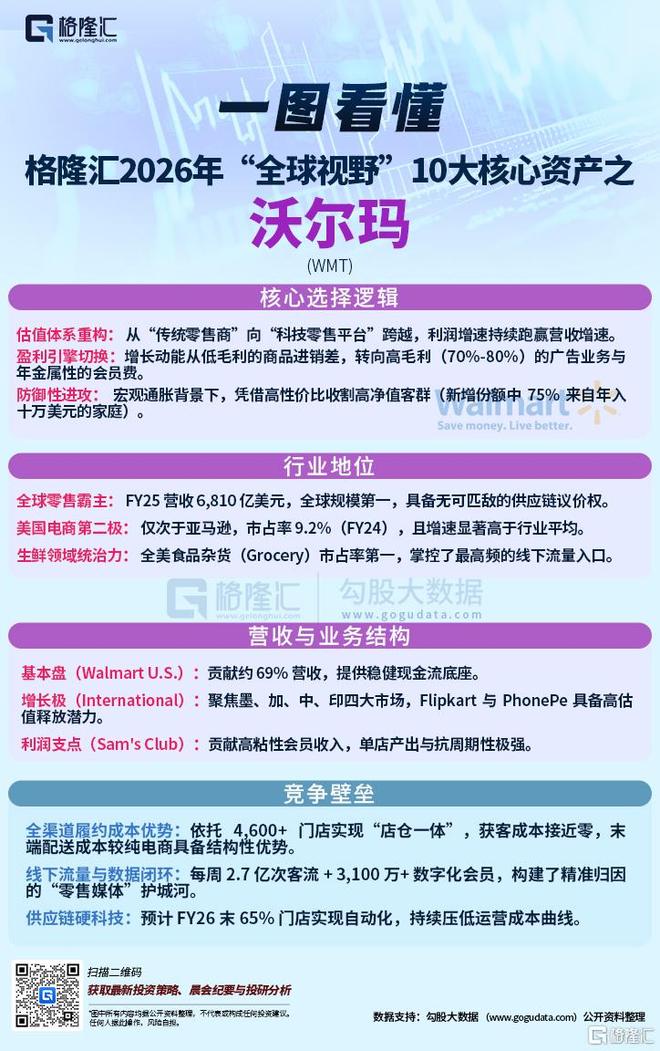
Core Insights - Walmart has been selected as a benchmark asset in the retail sector for the 2026 "Global Vision" top ten core assets, reflecting its strong position in the global retail industry [1] - The company is transitioning from a traditional retail model to a full-channel retail ecosystem, aiming for e-commerce revenue to account for 30% by 2030 and achieving a 90% digital penetration in its global supply chain [1][15] - Walmart's unique model combines offline networks, full-channel integration, supply chain barriers, and a membership ecosystem, providing resilience and growth certainty in its profit structure [1] Competitive Advantages - Walmart's industry leadership is supported by a multi-dimensional competitive advantage that creates significant barriers for new entrants [6] - The company has established a global supply chain network with a cost advantage, achieving operational costs 8%-10% lower than the industry average through scale procurement and digital logistics [6] - Full-channel integration enhances customer experience, with over 10,000 physical stores providing both shopping and fulfillment capabilities, leading to higher user conversion and repurchase rates [6] Membership Ecosystem - The Sam's Club membership system attracts over 60 million paying members, with member spending 2.5 times that of regular consumers and an 80% renewal rate [7] - Exclusive products and member benefits create strong customer loyalty, providing stable support for revenue growth [7] Digital Efficiency - Walmart plans to double its digital investment from the previous cycle, utilizing AI to optimize inventory management and pricing strategies, reducing inventory turnover days to 28, significantly below the industry average of 45 days [7] - Digital tools enhance store operations and supply chain collaboration, further lowering labor costs and loss rates, driving continuous profit improvement [7] Industry Trends - The global retail sector is experiencing a shift towards full-channel retail, with online penetration expected to rise from 22% in 2025 to 30% by 2030, aligning with Walmart's integrated strategy [8] - The instant retail market is growing at over 35% annually, with Walmart leveraging its extensive store network to capture this demand [8] - The transition to digital supply chains is reshaping industry efficiency, with Walmart's early investments in digital systems positioning it to benefit from this trend [8] Business Structure - Walmart's core U.S. retail business generated $98 billion in revenue in Q3 2025, with a 5.8% operating margin, supported by both Walmart Supercenters and Sam's Club [9] - The international retail segment, with $32 billion in sales, is growing through localized operations and digital strategies, maintaining over 10% growth in key markets [9] - E-commerce and instant retail are emerging as high-growth segments, with e-commerce revenue reaching $35 billion in Q3 2025, a 22% increase [11] Financial Outlook - Walmart's financial guidance indicates a revenue CAGR of 5%-6% through 2030, with operating margins expected to rise to 5.8%-6.2% and e-commerce revenue targeting over 30% [15] - The company anticipates a net profit of $24-25 billion in 2026, reflecting a 10%-12% year-over-year increase, driven by efficiency improvements and growth in core segments [18] - By 2027, Walmart's revenue is projected to reach $620 billion, with an EBITDA of $38 billion, suggesting a target price of $156 based on a 20x P/E ratio [18] Strategic Positioning - Investing in Walmart is essentially investing in the future of global retail transformation, as it transcends traditional retail to become a composite core asset in full-channel retail, supply chain ecosystems, and membership services [19] - The company's strategic focus on digital innovation and global expansion positions it well to capitalize on the recovery of global consumption and the evolution of retail dynamics [19]

中国数智科技与三主粮集团订立战略合作备忘录
Zhi Tong Cai Jing· 2025-12-31 10:29
Core Viewpoint - The company has entered into a strategic cooperation memorandum with Sanmu Grain Group, focusing on opportunities in agricultural digitalization and health food development, aiming to enhance business diversity and create future profit growth points [1][2] Group 1: Strategic Cooperation - The memorandum outlines collaboration in areas such as digital agriculture, health food R&D, supply chain digitalization, and market expansion [1] - Specific collaboration directions include building a digital foundation for smart agriculture, creating a traceable supply chain system, integrating agricultural and health data, and developing a digital marketing ecosystem [1] - The company aims to leverage its capital market advantages and brand effect to promote related business and project expansion [1] Group 2: Business Diversification and Financial Performance - The company is actively seeking investment opportunities to diversify its business and improve financial performance and shareholder value [2] - The partnership with Sanmu Grain Group is expected to capitalize on opportunities in China's agricultural digitalization and health food market, aligning with national policies [2] - This business activity is anticipated to enhance the company's financial performance and profitability, benefiting the overall interests of the company and its shareholders [2]
中国数智科技(01796)与三主粮集团订立战略合作备忘录
智通财经网· 2025-12-31 10:29
Group 1 - The company has signed a strategic cooperation memorandum with San Zhu Grain Group, aiming to explore collaboration opportunities in agricultural digitalization, health food research and development, supply chain digitalization, and market expansion by December 31, 2025 [1] - The cooperation will leverage San Zhu Grain Group's technological and market advantages to meet the diversified development needs of the company, enhancing business diversity and creating future profit growth points [1] - Specific areas of collaboration include building a digital foundation for smart agriculture, establishing a traceable supply chain collaboration system, integrating agricultural and health data, creating a comprehensive digital marketing and user operation ecosystem, expanding the professional health market, and establishing a joint innovation platform for agricultural technology [1] Group 2 - The company is actively seeking potential investment opportunities to diversify its business and improve financial performance, thereby enhancing shareholder value [2] - The board believes that the strategic cooperation with San Zhu Grain Group will help the company seize opportunities in the agricultural digitalization and health food market in mainland China, aligning with national policies [2] - This business activity is expected to improve the company's financial performance and profitability, benefiting the overall interests of the company and its shareholders [2]
中国数智科技(01796.HK)与三主粮达成战略合作 聚焦智慧农业及健康食品
Ge Long Hui· 2025-12-31 10:24
Core Viewpoint - China Digital Technology (01796.HK) has entered into a strategic cooperation memorandum with San Main Grain Group, focusing on collaboration in agricultural digitalization, health food R&D, supply chain digitalization, and market expansion [1] Group 1: Strategic Cooperation Areas - The cooperation will explore opportunities in various fields, including the establishment of a digital foundation for smart agriculture [1] - The creation of a trustworthy and traceable supply chain collaboration system is a key focus [1] - Integration of agricultural and health data for smarter decision-making is planned [1] - Development of a comprehensive digital marketing and user operation ecosystem is included in the cooperation [1] - Joint expansion into the professional health market and ecological cooperation is anticipated [1] - Establishment of a joint innovation platform for agricultural technology is part of the strategy [1] Group 2: Market and Research Initiatives - The company aims to leverage its capital market advantages for deeper collaboration with San Main Grain Group [1] - The brand effect of the company will be utilized to promote related cooperative business and project expansion [1] - Following the memorandum, both parties will conduct market analysis and industry research related to smart agriculture and the health industry [1] - Personnel communication and on-site investigation work will commence promptly after the agreement [1]
