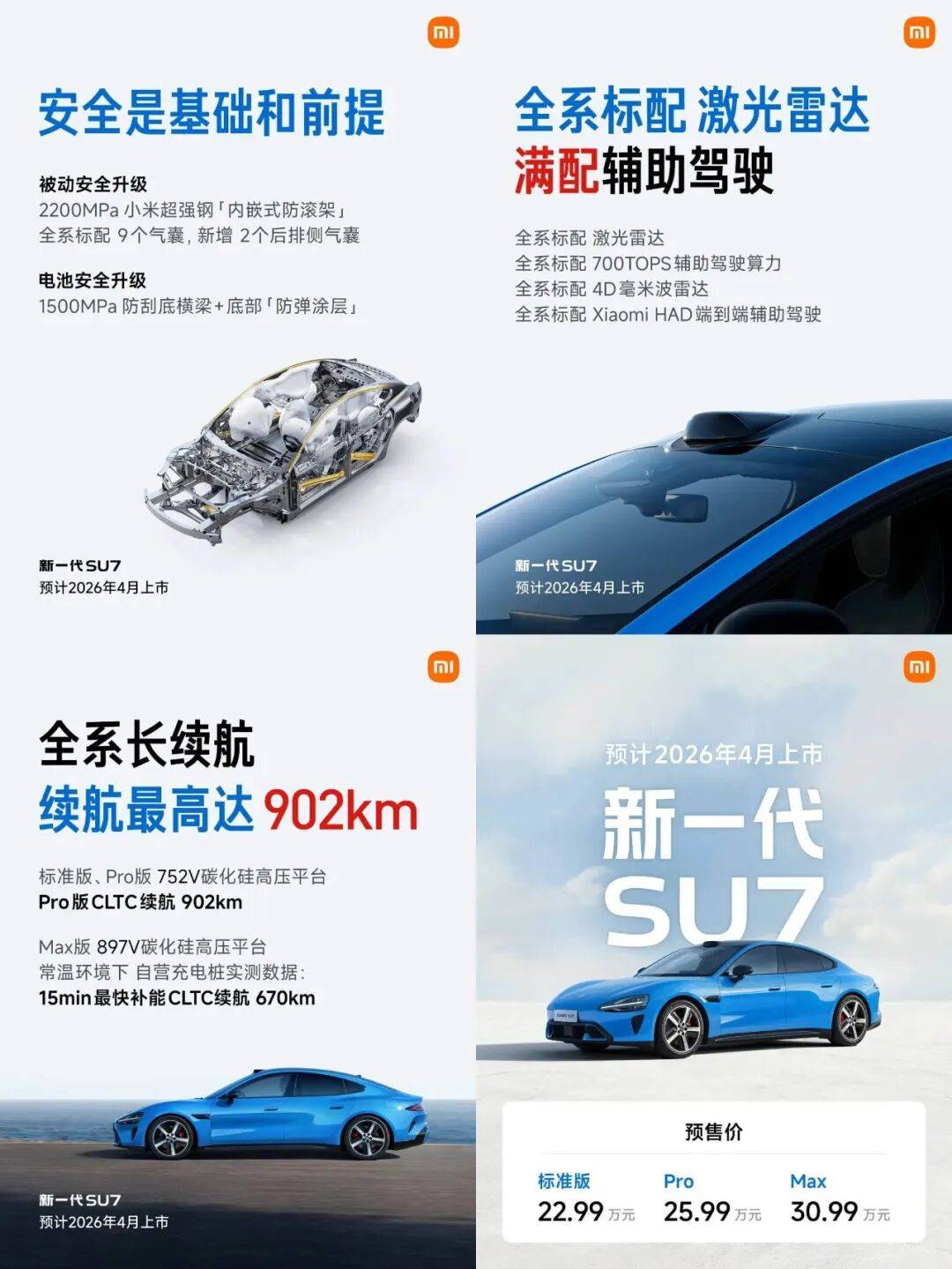
智元机器人

Search documents
江苏雷利:在人形机器人领域储备空心杯减速电机等产品
Zheng Quan Ri Bao Wang· 2026-01-08 12:13
Group 1 - The company Jiangsu Leili (300660) is actively developing products in the humanoid robot sector, including hollow cup reduction motors, linear transmission components, and frameless torque motors [1] - The company is currently sending samples and undergoing customer verification with multiple robot manufacturers [1] - The subsidiary Dingzhi Technology has been recognized as an excellent partner by Zhiyuan Robotics [1]


训具身模型遇到的很多问题,在数据采集时就已经注定了丨鹿明联席CTO丁琰分享
量子位· 2026-01-08 12:08
Core Viewpoint - The article emphasizes the critical importance of data quality in embodied intelligence, highlighting that many issues arise from the data generation stage rather than the training phase itself [1][7][30]. Group 1: UMI Overview - Universal Manipulation Interface (UMI) is a framework proposed by Stanford in February 2024, designed to decouple robot bodies from human operation behaviors, integrating "operational intent + motion trajectory + multimodal perception" into a universal interface for various robots [5][8]. - UMI has gained traction since September 2023, with companies like Luming Robotics leading the way in this field [6][8]. Group 2: Data Collection Challenges - The cost of data collection for training is exceptionally high, with estimates of $100-200 per hour in the U.S., requiring vast amounts of data (e.g., 270,000 hours for Generalist's GEN 0) to train models comparable to GPT-3, which could cost hundreds of billions of dollars [19][21]. - Data collection efficiency is low, with remote operation yielding only about 35 data points per hour, leading to issues like data silos due to the unique designs of different robots [21][22]. Group 3: FastUMI Pro Product - Luming Robotics has developed FastUMI Pro, a data collection hardware that is lightweight (over 600 grams) yet capable of handling 2-3 kg objects, suitable for both industrial and domestic applications [10][12]. - FastUMI Pro supports multimodal inputs, including tactile, auditory, and six-dimensional force data, and boasts a spatial precision of 1mm, claimed to be the highest globally [11][12]. Group 4: Data Quality and Training Issues - The article discusses the misconception that UMI data collection is simple, emphasizing that high-quality data must meet strict alignment and synchronization criteria across multiple sensors [34][39]. - Many UMI devices fail to produce usable data due to inadequate hardware capabilities, leading to poor image quality and frame rate issues that disrupt the learning process [43][46]. - The distinction between "dirty data" and "waste data" is made, with waste data being unstructured and lacking design, making it unsuitable for training models [50][59]. Group 5: Systemic Approach to UMI - The article argues that UMI requires a systemic approach where hardware, data, and algorithms are interdependent, and any failure in one area can prevent the successful training of models [63][65]. - Luming Robotics aims to break the "impossible triangle" of high-quality data acquisition at low costs to accelerate the development of the embodied intelligence industry [68].


智元首发SOP系统:打破离线训练瓶颈,让具身智能在“干中学”
量子位· 2026-01-08 11:07
当通用能力主要通过大规模预训练获得之后,下一阶段的关键在于让已经具备通用能力的模型,在真实部署环境中持续进化。 这是智元机器人首席科学家 罗剑岚 博士在接受量子位采访时给出的论断。 智元机器人 投稿 量子位 | 公众号 QbitAI 2025年机器人领域最火的VLA让机器人通过预训练具备了相当的通用性,但与此同时,机器人能否长时间,稳定,高效地完成任务仍是一 个问号。 基于此,当机器人走出实验室,走向开放、复杂且持续变化的真实世界时,一个更核心的问题随之出现:如何真正实现通用机器人的规模化 部署与智能化运行。 为此,智元机器人具身研究中心提出 SOP(ScalableOnlinePost-training) ——一套面向真实世界部署的 在线后训练系统 。 这是业界首次在物理世界的VLA后训练中, 系统性地融合在线学习、分布式架构与多任务通才性 ,使机器人集群能够在真实环境中持续进 化,让个体经验在群体中高效复用,从而将"规模"转化为"智能"。 真实世界中的规模化智能增长挑战 要在真实世界中大规模运行,通用机器人必须同时满足两个看似矛盾的要求: 现有VLA预训练模型已经提供了强大的通用性。但 真实世界的部署受困 ...

美国CES,又被中国人形机器人包围了
机器人圈· 2026-01-08 10:13
Core Insights - The article highlights the significant presence of Chinese companies at CES 2026, particularly in the humanoid robot sector, showcasing a shift from isolated technology displays to a complete industrial chain structure [6][14]. Group 1: Chinese Companies at CES 2026 - A total of 598 exhibitors related to robotics participated in CES 2026, with 149 coming from China, accounting for nearly one-fourth of the total [3]. - In the humanoid robot segment, 38 exhibitors were recorded, with 21 from China, representing over half of the participants [3]. - Notable Chinese exhibitors included Yushu Technology, which showcased the mass production version of the G1 humanoid robot, and Cloud Deep Technology, which presented the upgraded X30 series [7][9]. - Other companies like ZhiYuan Robotics and ZhongQing Robotics displayed a range of humanoid and bionic robots, emphasizing their capabilities in various applications [7][12]. Group 2: Global Competitors - American companies, such as Boston Dynamics and Hyundai, focused on the industrial application of humanoid robots, with the Atlas robot demonstrating advanced motion capabilities [15][17]. - Korean firms, represented by the K-Humanoid Alliance, showcased their ambitions in humanoid robotics, emphasizing collaboration between research institutions and industry [18][19]. - European companies, including NEURA Robotics and Humanoid, targeted industrial applications, highlighting their engineering prototypes and modular systems [23][25]. Group 3: Industry Trends and Future Directions - The article notes a shift in the perception of humanoid robots, moving from feasibility discussions to practical applications in various sectors, including industrial, household, and service environments [31]. - Different countries are adopting distinct strategies: China focuses on product showcases and mass production, the U.S. emphasizes industrial deployment and system capabilities, Korea integrates research and industry through alliances, and Europe approaches the market through industrial humanoid robots [31].
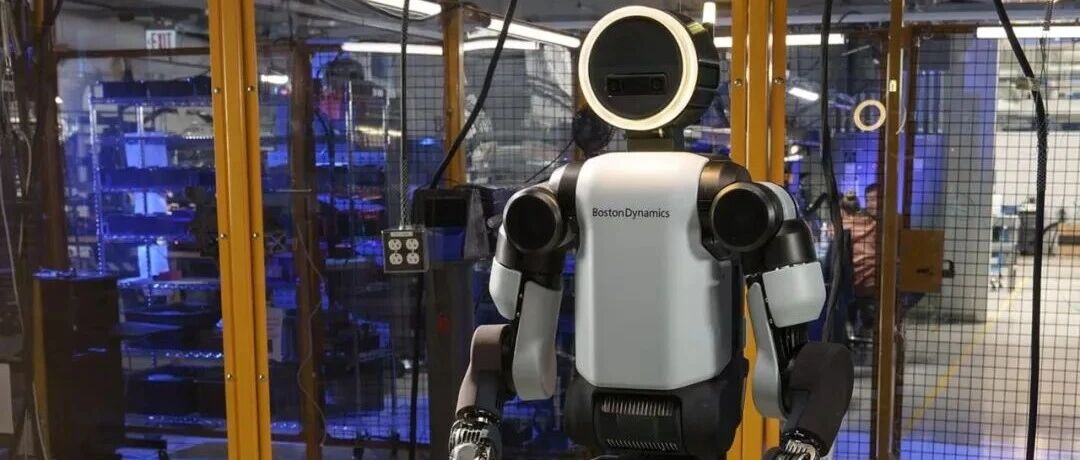
江苏雷利(300660.SZ):控股子公司鼎智科技获评智元机器人优秀合作伙伴
Ge Long Hui· 2026-01-08 07:52
Core Viewpoint - Jiangsu Leili (300660.SZ) is actively developing products in the humanoid robot sector, including hollow cup reduction motors, linear transmission components, and frameless torque motors, and is currently validating these products with multiple robot manufacturers [1] Group 1 - The company has a product portfolio that includes hollow cup reduction motors, linear transmission components, and frameless torque motors [1] - Jiangsu Leili is engaged in sample delivery and customer validation with several robot manufacturers [1] - The subsidiary Dingzhi Technology has been recognized as an excellent partner by Zhiyuan Robotics [1]
"人工智能+制造"政策重磅发布!机器人再度冲高,机器人ETF基金(159213)涨超1%,连续8日强势吸金近2亿元!产业量产初期,大脑进化到哪了?
Sou Hu Cai Jing· 2026-01-08 05:49
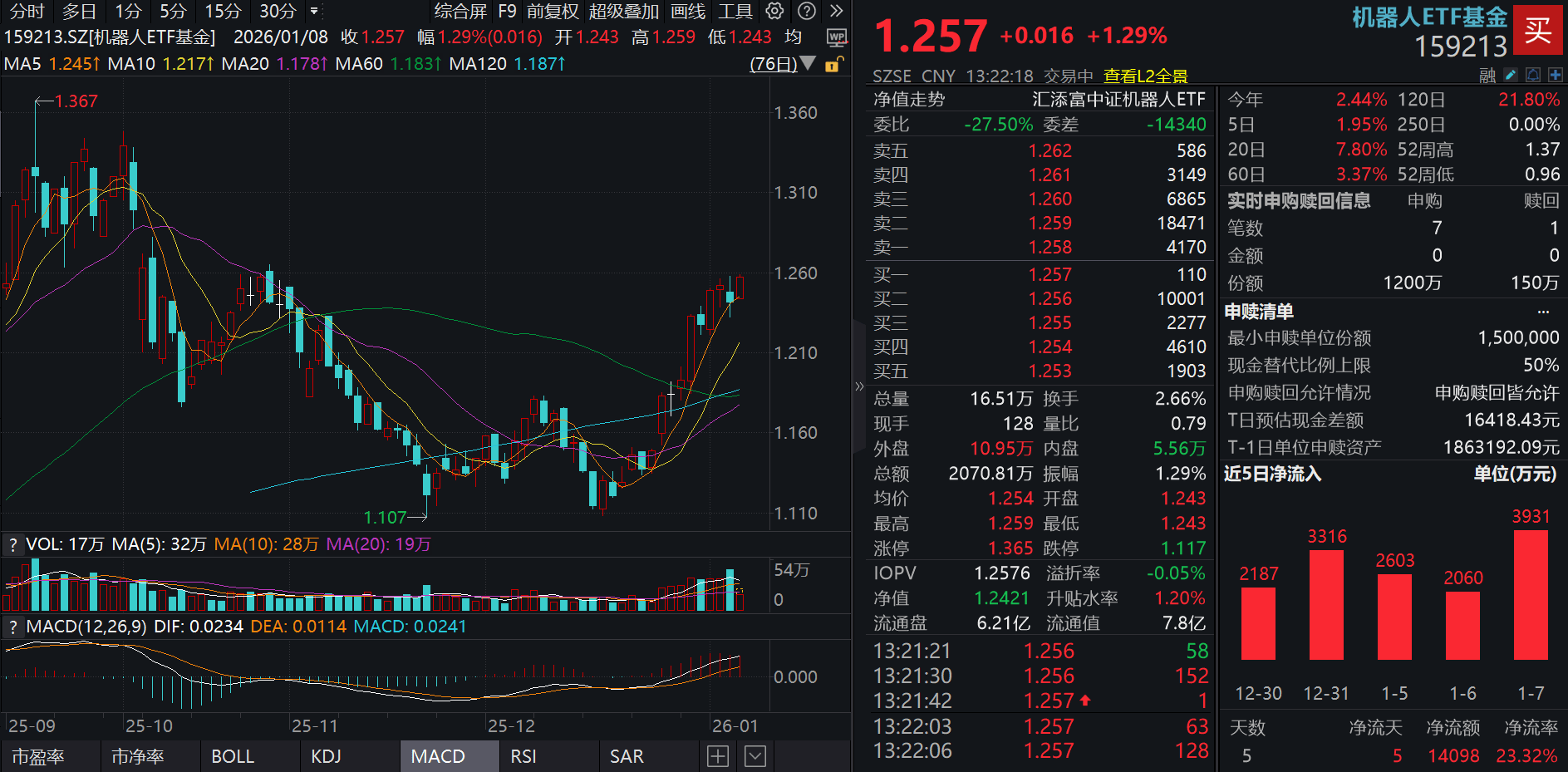
Core Viewpoint - The A-share market is experiencing a strong upward trend, particularly in the robotics sector, with significant inflows into the Robotics ETF fund (159213) and a notable increase in the performance of key component stocks [1][3]. Group 1: Market Performance - As of January 8, the Robotics ETF fund (159213) rose by 1.29%, recovering from previous losses and attracting over 13 million yuan in inflows during the day, marking nearly 200 million yuan in inflows over the past eight days [1]. - The component stocks of the Robotics ETF showed mixed performance, with notable gains from Zhongkong Technology (up over 6%) and iFlytek (up over 1%), while stocks like Dazhong Laser and Huichuan Technology experienced declines [3][4]. Group 2: Industry Developments - On January 7, the Ministry of Industry and Information Technology and seven other departments issued the "Implementation Opinions on the Special Action of 'Artificial Intelligence + Manufacturing'," emphasizing the promotion of intelligent equipment and the application of industrial robots [4]. - The domestic humanoid robot order scale has significantly increased, with over 20,000 orders reported and an expected delivery volume of over 10,000 units for the year, indicating a rapid progression towards mass production [7]. Group 3: Future Projections - The humanoid robot market in China is projected to reach 238.3 billion yuan by 2030, representing over a 40-fold increase from 2025, with a gradual transition from industrial applications to more complex commercial and household scenarios [8]. - By 2035, the humanoid robot market is expected to exceed 1 trillion yuan, with further advancements anticipated in AI capabilities and applications in everyday life [8]. Group 4: Technological Challenges - The industry faces three main challenges for mass production: developing a highly dexterous hand, creating an AI brain that understands the real world, and achieving large-scale manufacturing capabilities [10][11]. - The evolution of the AI brain is critical for the industry's growth, with current hardware solutions stabilizing while software development lags behind, necessitating advancements in AI models for task-level interaction and decision-making [11].




黄仁勋、杨元庆官宣合作:推出“人工智能云超级工厂”;智元发布开源仿真平台Genie Sim 3.0丨AIGC日报
创业邦· 2026-01-08 04:34
Group 1 - Lenovo and NVIDIA announced a collaboration to launch the "Lenovo AI Cloud Super Factory," which aims to significantly reduce the "time to first token" for AI deployment and scale up to 100,000 GPUs to support trillion-parameter AI models [2] - Datong Technology is advancing partnerships in the autonomous driving sector, showcasing a smart charging robot capable of automated charging tasks, and introducing a new generation of intelligent charging network systems at CES 2026 [2] - Zhiyuan Robotics released the Genie Sim 3.0, an open-source simulation platform driven by a large language model, which integrates 3D reconstruction and visual generation, allowing for rapid scene generation and a comprehensive evaluation system covering over 100,000 scenarios [2] Group 2 - Roborock, a Chinese vacuum cleaner manufacturer, unveiled the Saros Rover, a stair-climbing vacuum cleaner equipped with AI and motion sensors, demonstrating its ability to navigate stairs and uneven surfaces [2]




SOP:具身智能在线进化新范式,为大规模真实世界部署而生
具身智能之心· 2026-01-08 04:23
Core Viewpoint - The article discusses the development and implementation of SOP (Scalable Online Post-training), a system designed for the scalable deployment and intelligent operation of general-purpose robots in real-world environments, emphasizing the need for continuous evolution and learning in robotic systems [2][3][23]. Group 1: SOP Overview - SOP is the first system in the industry to systematically integrate online learning, distributed architecture, and multi-task versatility for real-world deployment of robots [2]. - The core goal of SOP is to enable distributed and continuous online learning for robots in real-world settings [5]. Group 2: Challenges in Real-World Deployment - General-purpose robots face the challenge of meeting high task specialization requirements while leveraging existing VLA pre-trained models, which often require post-training for improved task success rates [3][4]. - Current mainstream VLA post-training methods are limited by offline, single-machine, and serial data collection, hindering efficient and continuous real-world learning [3]. Group 3: SOP Framework Design - SOP redefines VLA post-training from "offline, single-machine, sequential" to "online, cluster, parallel," creating a low-latency closed-loop system [6]. - The system allows multiple robots to execute tasks in parallel, with cloud-based centralized online updates and immediate model parameter feedback [6][9]. Group 4: Key Advantages of SOP - SOP enhances state space exploration through distributed multi-robot parallel exploration, significantly improving state-action coverage [12]. - It mitigates distribution bias by ensuring all robots operate based on the latest low-latency strategies, enhancing online training stability and consistency [13]. - SOP maintains generalization capabilities while improving performance, avoiding the degradation of models into single-task specialists [14]. Group 5: Experimental Evaluation - SOP significantly improves performance metrics, with a 33% overall performance increase in complex scenarios and a 114% increase in throughput for specific tasks like folding clothes [16][18]. - The use of multiple robots enhances learning efficiency, with a four-robot setup achieving a 92.5% success rate, 12% higher than a single robot [19][20]. - SOP demonstrates stable effectiveness across different pre-training scales, with performance improvements correlating with the quality of VLA pre-training [21]. Group 6: Deployment and Evolution - SOP allows robots to adapt and improve in new environments, transforming them from fixed-performance products into evolving entities capable of continuous learning [23].
政策+资本双轮驱动机器人发展,机器人ETF嘉实(159526)全面聚焦机器人产业投资机遇
Xin Lang Cai Jing· 2026-01-08 03:20
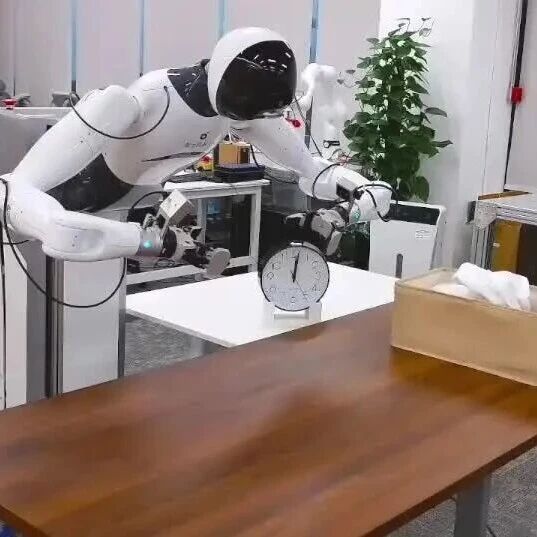
Group 1 - The core viewpoint of the articles highlights the strong growth and investment activity in the humanoid robot industry in China, driven by government initiatives and market recognition of the sector's potential [1][2]. Group 2 - As of January 8, 2026, the China Robot Index rose by 1.10%, with key stocks such as Jingpin Special Equipment, Paislin, and Huadong CNC hitting the 10% daily limit [1]. - The Ministry of Industry and Information Technology, along with eight other departments, issued the "Implementation Opinions on the Special Action of 'Artificial Intelligence + Manufacturing'," emphasizing the need to accelerate the development of intelligent medical equipment [1]. - The China-Korea Innovation and Entrepreneurship Forum held in Shanghai attracted nearly 300 representatives from the intelligent manufacturing, new materials, and artificial intelligence sectors, showcasing the ZhiYuan Expedition A2 humanoid robot [1]. Group 3 - Dongguan Securities reported that the humanoid robot industry in China is experiencing active investment and financing, with a projected market size of approximately 1.254 billion yuan in 2024, expected to grow to 25.404 billion yuan by 2030, reflecting a compound annual growth rate of 60.33% [2]. - The top ten weighted stocks in the China Robot Index as of December 31, 2025, include companies like iFlytek, Huichuan Technology, and Top Group, collectively accounting for 52.83% of the index [2]. - The Jia Shi Robot ETF (159526) closely tracks the China Robot Index, focusing on companies involved in system solutions, digital workshops, automation equipment manufacturing, and other related sectors [2]. Group 4 - Investors without stock accounts can access the Jia Shi Robot ETF linked fund (024620) to capitalize on opportunities in the robot industry [3].
雷军回应一切,关于KOL事件、小字海报、营销大师等/内存涨疯了,一盒堪比上海一套房/字节跳动否认造车传闻
Sou Hu Cai Jing· 2026-01-08 01:35
Group 1 - Xiaomi's new SU7 model starts at 22,990 yuan and features enhanced safety and smart technology, including a 2200MPa steel structure and 9 airbags [1][5][6] - The standard version of the SU7 has a CLTC range of 720 km, while the Pro version reaches 902 km, and the Max version can charge 670 km in just 15 minutes [6][5] - Xiaomi's SU7 has sold over 360,000 units in 1 year and 9 months, becoming the best-selling car in the 200,000 yuan segment [6][5] Group 2 - The global demand for AI computing has led to a significant increase in memory chip prices, with DDR5 prices rising by 307% since last September [11][12] - The price of a single 256G DDR5 server memory module has exceeded 40,000 yuan, with some models reaching 49,999 yuan [11] - Major memory manufacturers are shifting focus to high-margin products like HBM and DDR5 due to the AI-driven demand [11][12] Group 3 - ByteDance has denied rumors of entering the automotive manufacturing sector, stating it is not pursuing any vehicle manufacturing projects [16][18] - Despite the denials, ByteDance continues to invest in the automotive intelligence sector, collaborating with over 40 car manufacturers on AI cockpit systems [18] Group 4 - Tesla's CEO Elon Musk stated that safety is not the primary goal for the upcoming Roadster model, emphasizing performance over safety features [20][21] - Musk predicts that the Roadster will showcase advanced technologies and aims to be one of the best-performing human-driven cars [21] Group 5 - Realme has confirmed its return to OPPO and will merge with OnePlus, aiming for better resource integration and market strategy [23][24] - The restructuring is seen as a response to rising supply chain costs and market competition, with Realme's future in China uncertain [24] Group 6 - Steam achieved record revenue of $1.6 billion in December, driven by over 100 million players, marking its highest monthly earnings ever [25][27] - The game "ARC Raiders" became the best-selling title on Steam during this period, selling 1.2 million copies [27][28] Group 7 - Google and XREAL have extended their strategic partnership to enhance the Android XR ecosystem, focusing on new XR hardware and platform integration [29][30] - The collaboration aims to lower development barriers and accelerate the growth of XR content [31] Group 8 - Lenovo plans to quadruple its business cooperation with NVIDIA over the next 3-4 years, focusing on AI deployment and infrastructure [40][42] - The partnership will enhance cloud service capabilities and support large-scale AI models [42][43] Group 9 - New regulations in China will strengthen the management of live-streaming e-commerce, requiring digital influencers to disclose their AI-generated content [44][45] - The regulations aim to prevent misleading advertising and ensure consumer protection in the live-streaming sector [45] Group 10 - IKEA China announced the closure of seven stores as part of a strategic review, shifting focus to smaller store formats and online sales [72][73] - The company plans to invest 160 million yuan in price reductions and open over ten new small stores in key markets [72]