DeepSeek

Search documents
8点1氪:钟薛高创始人胜诉:“爱买不买”不是我说的;报告称:超6成中国人下一辆车预算30万元以上;麦当劳客服回应汉堡包越做越小
36氪· 2026-01-14 00:01
Group 1 - The founder of Zhong Xue Gao, Lin Sheng, won a lawsuit against malicious editing of his interview, confirming that he never made the controversial statement "buy it or not" [2][3] - The court ruled that the malicious editing constituted defamation, ordering the defendants to pay 2.3 million yuan in damages and issue a public apology [3] - Despite the legal victory, Lin Sheng noted that it does not help the current situation of Zhong Xue Gao, which has filed for bankruptcy [3] Group 2 - A report by Deloitte indicates that over 63% of Chinese consumers plan to spend over 300,000 yuan on their next vehicle, with fuel vehicles remaining the preferred choice at 41% [4] - The survey shows a significant preference for higher-priced vehicles, with 30% of respondents favoring the 300,000-399,900 yuan range [4] - The report reflects an upgrading trend in the Chinese automotive market, indicating a solid user base for fuel vehicles despite the rise of electric and hybrid options [4] Group 3 - ByteDance has raised its option price from $200.41 to $226.07, marking a nearly 13% increase since last August and over a fourfold increase since 2019 [5] - The new option price applies to recruitment offers, while the repurchase price for employees has not yet been adjusted [5] Group 4 - Pinduoduo is quietly testing a new feature called "Billion Supermarket," leveraging its established subsidy system to attract price-sensitive consumers [7] - The feature includes significant discounts and a variety of products, aiming to differentiate itself from traditional supermarkets and other e-commerce platforms [7] Group 5 - East Peak Beverage forecasts a net profit increase of 30.46%-37.97% for 2025, estimating profits between 4.34 billion and 4.59 billion yuan [21] - Shanghai Pudong Development Bank reported a net profit of 50.017 billion yuan for 2025, reflecting a year-on-year growth of 10.52% [22] - Yangtze Power announced a net profit of 34.167 billion yuan for 2025, with a growth of 5.14% compared to the previous year [23]


8点1氪丨钟薛高创始人胜诉:“爱买不买”不是我说的;“死了么”APP将更名为Demumu;麦当劳客服回应汉堡包越做越小
3 6 Ke· 2026-01-13 23:59
Group 1 - The founder of Zhong Xue Gao, Lin Sheng, won a lawsuit regarding a maliciously edited interview, affirming that he never made the statement "buy it or not" [1] - A report by Deloitte indicates that over 63% of Chinese consumers plan to spend over 300,000 yuan on their next vehicle, with fuel vehicles remaining the preferred choice at 41% [2][3] - ByteDance has raised its option price from $200.41 to $226.07, marking a nearly 13% increase since last August and over a fourfold increase since 2019 [2] Group 2 - McDonald's is facing consumer complaints about shrinking burger sizes, with customers sharing comparisons on social media [2] - The Yanran Angel Children's Hospital is negotiating with landlords over rent debts, claiming that the actual owed amount is due to a rent increase since 2020 [7] - Pinduoduo is testing a new "Billion Supermarket" feature within its app, focusing on low-price strategies to attract price-sensitive consumers [6] Group 3 - Meta Platforms plans to cut about 10% of jobs in its Reality Labs department to shift resources towards artificial intelligence [11] - The U.S. government has approved Nvidia to export its H200 AI chips to China, with a 25% fee on the transactions [12] - Liftoff Mobile, Inc. has filed for an IPO with the SEC, planning to list on the Nasdaq [13]
圣诞节后 数据又新高
小熊跑的快· 2026-01-13 23:32
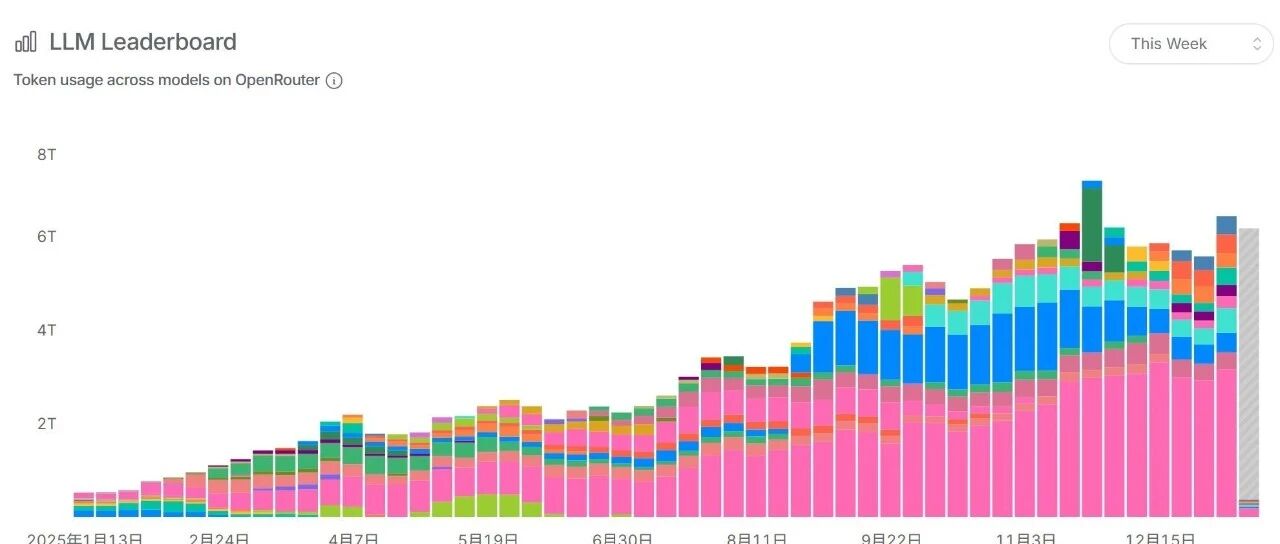
Core Insights - The article discusses the competitive landscape of AI models, highlighting the performance of various models including Grok, Mimo-V2, and others, indicating a rapid evolution in the sector [2][4]. Group 1: AI Model Performance - Grok has surpassed Gemini in terms of performance, indicating a significant shift in the competitive dynamics of AI models [2]. - Mimo-V2 from Xiaomi is noted as a strong contender, ranking third in the performance metrics [2]. - The overall performance of AI models is expected to reach new highs in the upcoming week, suggesting ongoing advancements in technology [2]. Group 2: Performance Metrics - The total performance of the AI models listed amounts to 6.43 trillion (T) [4]. - Claude Sonnet 4.5 leads with a performance of 531 billion (B), followed by Grok Code Fast 1 at 413 billion (B) and MiMo-V2-Flash at 398 billion (B) [4]. - Other notable models include Gemini 3 Flash Preview at 387 billion (B) and DeepSeek V3.2 at 312 billion (B), showcasing a diverse range of capabilities among the top performers [4].
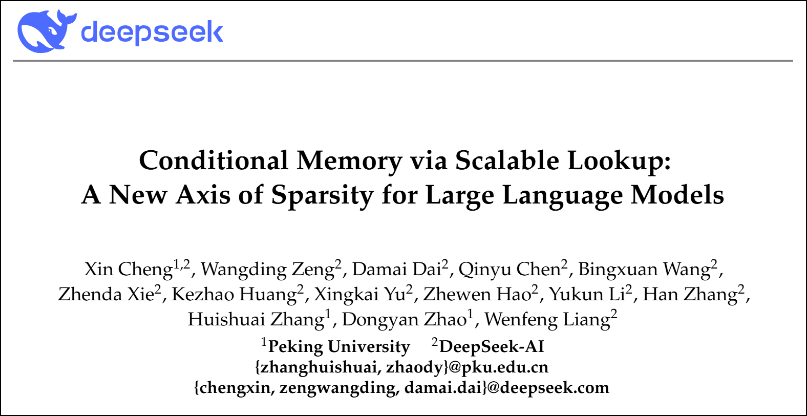
DeepSeek论文披露全新模型机制,SSD等存储需求有望再进一步,龙头还发布炸裂业绩
Xuan Gu Bao· 2026-01-13 23:24
Group 1 - DeepSeek introduced a new paper proposing "conditional memory" as a new dimension of sparsity to optimize large language models through the Engram module [1] - The existing Transformer architecture lacks a native knowledge retrieval mechanism, leading to inefficient simulation of retrieval behavior [1] - Conditional memory complements the MoE (Mixture of Experts) approach and significantly enhances model performance in knowledge retrieval, reasoning, coding, and mathematical tasks under equal parameters and computational conditions [1] Group 2 - The Engram module is a large, scalable embedding table that acts as an external memory for Transformers, allowing for efficient retrieval of nearby content [2] - Engram caches frequently accessed embeddings in faster storage mediums while storing less frequently accessed data in larger, slower storage, maintaining low access latency [2] - The NAND industry is expected to have limited capital expenditure over the next two years, with leading manufacturers likely to focus on HBM rather than NAND, while AI applications are anticipated to drive SSD demand [2] Group 3 - Baiwei Storage forecasts a net profit of 850 million to 1 billion yuan for the year, representing a year-on-year growth of 427.19% to 520.22% [2] - Jiangbolong has launched several high-speed enterprise-level eSSD products, covering mainstream capacities from 480GB to 7.68TB [3]

“死了么”App宣布改名;美股三大指数集体收跌|21早新闻
2 1 Shi Ji Jing Ji Bao Dao· 2026-01-13 23:23
Macro Economy - The Ministry of Industry and Information Technology (MIIT) issued an action plan for the high-quality development of industrial internet platforms from 2026 to 2028, aiming to have over 450 influential platforms and more than 120 million industrial devices connected by 2028, with a platform penetration rate exceeding 55% [2] - MIIT held the 18th manufacturing enterprise symposium, emphasizing active participation in industry rule-making and self-regulation to promote a win-win environment and protect industry development [2] Investment News - On January 13, A-shares experienced a collective pullback, with the Shanghai Composite Index ending a 17-day winning streak, closing down 0.64%. The total trading volume in Shanghai, Shenzhen, and Beijing reached 3.7 trillion, setting a new historical record [5] - The Hang Seng Index rose by 0.9%, with the Hang Seng Technology Index increasing by 0.11%. Pharmaceutical stocks performed well, with WuXi AppTec rising over 8% and WuXi Biologics nearly 6%. The H-share listing of Zhaoyi Innovation saw a peak increase of over 53% on its first day, closing with a 37.53% rise, valuing the company at 155.2 billion HKD [5] - As of January 12, the management scale of ETF products under Huaxia Fund officially surpassed 1 trillion RMB, reaching 1,016.424 billion RMB, making it the first domestic ETF manager to enter the "trillion club" [5] - Approximately 130 A-share listed companies have disclosed their 2025 performance forecasts, with around 70 companies expecting positive results, including profit increases and recoveries [5] - A total of 186 listed companies have been subject to concentrated research by public funds and brokerages, with the number of research instances reaching 220, indicating strong interest in popular stocks like Aipeng Medical and Entropy Technology [5] Company Movements - Guizhou Moutai is establishing a dynamic adjustment mechanism for retail prices based on market orientation, aiming for a "market-following, relatively stable" self-operated system [6] - The "Dead or Alive APP" will officially adopt the global brand name Demumu in its upcoming new version [7] - Alibaba Cloud has completed further strategic investment in ZStack, achieving a controlling stake, and plans to create a standardized and inclusive cloud-edge integrated solution [7] - DeepSeek published a new paper on conditional memory for large language models, co-authored with Peking University [7] - Huaxia Happiness expects a net loss of 16 billion to 24 billion RMB in 2025, with potential delisting risk warnings for its stock [8] - Zhongwen Online anticipates a net loss of 580 million to 700 million RMB in 2025, as its overseas short drama business is still in the investment phase [8] - Luxshare Precision has terminated its acquisition of the business asset package held by India's Wingtech [8]







Microsoft AI Diffusion Report: How AI is being adapted worldwide
Microsoft· 2026-01-13 16:59
There are problems that you cannot solve without using AI, and that's the part that we see so much opportunity for the world. I mean, it goes back to the history of every general-purpose technology. The countries that grow the most over the course of years and decades are not necessarily the ones that produce it.It's the ones that figure out how to use it across the economy. That's what this report’s about. What this dataset provides is a broad view of what is happening across platforms. And we have a full ...


腾讯研究院AI速递 20260114
腾讯研究院· 2026-01-13 16:29
Group 1 - Anthropic has launched an AI office tool called Cowork, designed to automate daily tasks such as document creation, planning, data analysis, and file organization [1] - Cowork features proactive and autonomous capabilities, allowing it to create plans and sync progress in real-time, and integrates with external information sources and Chrome [1] - The development of Cowork took only a week and a half, with 100% of the code written by Claude Code, ensuring user control and the ability to halt operations at any time [1] Group 2 - Apple has announced a partnership with Google to develop the next generation of its foundational model based on Gemini, which will also overhaul Siri [2] - The Apple AI team has experienced significant talent loss, with dozens of core members leaving, making collaboration with Google a necessary choice due to Gemini's 1.2 trillion parameters compared to Apple's 150 billion [2] - Google processes 13 trillion tokens monthly, and Gemini has captured over 20% of the global market share, while Elon Musk criticized the concentration of power in this partnership [2] Group 3 - DeepSeek has introduced a new paper proposing a conditional memory module called Engram, which complements MoE conditional computation and addresses the lack of native knowledge retrieval in Transformers [3] - Engram significantly outperforms pure MoE baselines, with improvements in MMLU by 3.4, BBH by 5.0, and HumanEval by 3.0, while increasing long-context retrieval accuracy from 84.2% to 97.0% [3] - The upcoming DeepSeek V4 is becoming clearer, with conditional memory expected to be a core modeling primitive for the next generation of sparse large models [3] Group 4 - OpenAI has acquired AI healthcare startup Torch for approximately $100 million, with $60 million paid upfront and the remainder for employee retention incentives [4] - Torch integrates with healthcare systems like Kaiser Permanente and Apple Health, allowing for unified access to lab results, prescriptions, and medical records, while using AI for classification and health insights [4] - The founding team of Torch has joined OpenAI to develop the ChatGPT Health module, following their previous experience with an online clinic platform [4] Group 5 - Anthropic has launched HIPAA-compliant AI services for healthcare, enabling institutions and individuals to process protected health data while referencing authoritative databases [6] - Claude can export personal health data from applications like Apple Health for aggregation and understanding, with a commitment not to use any medical user data for model training [6] - Over 22,000 clinical service providers from Banner Health are using Claude, with 85% reporting increased work efficiency, and collaborations with major healthcare institutions are underway [6] Group 6 - Baichuan has released the open-source medical model M3, achieving a top score of 65.1 in HealthBench and winning the Hard category with a score of 44.4, surpassing GPT-5.2 [7] - M3 introduces native end-to-end serious inquiry capabilities, following the SCAN principles, and demonstrates superior inquiry abilities compared to average human doctors [7] - M3 employs a dynamic Verifier System and a new SPAR algorithm to address long dialogue training issues, with applications already integrated for doctors and patients [7] Group 7 - OpenAI is set to produce a special audio product called "Sweetpea," designed to replace AirPods, with mass production planned by Foxconn by Q4 2028 [8] - The device, designed by Jony Ive's team, features a metallic design resembling a pebble and includes two capsule-like units for behind-the-ear wear, with a focus on local AI processing [8] - The product is expected to launch in September 2026, with an estimated first-year shipment of 40-50 million units, allowing users to control functions via commands instead of an iPhone [8] Group 8 - Meituan has introduced a new sparse attention mechanism called LoZA, replacing 50% of low-performance MLA modules with a streaming sparse attention structure [9] - The new mechanism improves decoding speed for 128K context by 10 times and preloading speed for 256K context by 50%, while reducing computational complexity to linear O(L·S) [9] - LoZA can be implemented without retraining from scratch, featuring a design that balances local detail and overall logic within sparse windows [9] Group 9 - MIT Technology Review has released its list of the top ten breakthrough technologies for 2026, including large-scale AI data centers, sodium-ion batteries, base editing, and advanced nuclear reactors [10][11] - The report highlights the significant energy consumption of large-scale data centers and the successful application of sodium-ion batteries in specific vehicle models [11] - It emphasizes the shift in AI development focus from "what can be done" to "what should be done," with ethical considerations becoming a central theme in life sciences [11] Group 10 - The CEO of Fal platform revealed that generating a 5-second 24-frame video consumes 12,000 times the computational power of generating 200 tokens of text, with 4K resolution requiring ten times more [12] - The platform supports over 600 generative media models, with top clients using an average of 14 different models simultaneously, indicating a trend towards scaling AI-generated content [12] - The discussion suggests that as content generation becomes limitless, finite intellectual property will gain more value, with education and personalized advertising identified as promising application areas [12]

美股三大指数涨跌不一 贵金属、半导体板块走强
Sou Hu Cai Jing· 2026-01-13 14:52
| | 英特尔[INTC] 2026-01-13 22:50 | | 价格 ■ 均线 | | | | --- | --- | --- | --- | --- | --- | | 46.779 | | | | | 6.17 % | | 46.099 | | | | | 4.63 % | | 45.419 | | | | | 3.09 % | | 44.740 | | | | | 1.54% | | 44.060 | | | | | 0.00 % | | 43.380 | | | | | 1.54 % | | 42.701 | | | | | 3.09 % | | 42.021 | | | | | 4.63 % | | 41.341 | | | | | 6.17 % | | 22:30 | 24:00 | 02:00 | 03:30 | 05:00 | | | 694.13万 | | | | | | | 520.60万 | | | | | | | 347.06万 | | | | | | | 173.53万 | | | | | | | 100 for to | | | | | | 费城半导体指数美股上涨0.9%,A ...
DeepSeek母公司去年进账50亿,够烧2380个R1
3 6 Ke· 2026-01-13 13:02
Core Insights - DeepSeek has not engaged in new financing or significant commercialization activities despite the buzz surrounding large model players in the market [1] - DeepSeek continues to produce high-quality research papers, indicating a stable output of academic contributions [2] - The financial success of its parent company, Huanfang Quantitative, which earned approximately $7 billion last year, provides substantial funding for DeepSeek's research endeavors [6][8] Group 1: Financial Performance - Huanfang Quantitative's funds are showing impressive returns, with nearly all of its funds projected to yield over 55% in 2025 [3] - The average return for quantitative funds in China last year was 30.5%, significantly outperforming global competitors [4] - Huanfang Quantitative's asset management exceeds $70 billion, contributing to its substantial earnings [7] Group 2: Research and Development - DeepSeek's research expenditures are relatively low, with the latest V3 training costing $557,600 and R1 costing $29,400, allowing for the potential production of numerous models with available funds [6] - DeepSeek has maintained a focus on AGI research without the pressure of immediate financial returns, as it has not accepted external funding and is not tied to any major tech company [11][15] - The company has consistently released significant research outputs, including recent advancements in OCR and V3.2, while also open-sourcing components like the memory module [9][10] Group 3: Market Position and Strategy - DeepSeek operates with a unique business model that allows it to focus solely on AGI without the distractions of monetization pressures [10][12] - The company benefits from a stable and committed research team, with minimal turnover and even some returning members, indicating a strong internal culture [28][30] - DeepSeek's research outputs have become valuable to investors, as its technical papers provide insights that influence stock movements in related hardware companies [34][39] Group 4: Competitive Landscape - Compared to other major players like OpenAI, DeepSeek's approach is characterized by a lack of aggressive monetization strategies, focusing instead on pure research [26][9] - The ability to leverage a mature business model for cross-subsidization of AI research is often underestimated in the market [19][20] - DeepSeek's model integrates the strengths of both established companies and pure AI startups, positioning it uniquely in the competitive landscape [26]

梁文锋署名DeepSeek最新论文,提出新方法突破GPU内存限制
Xin Lang Cai Jing· 2026-01-13 12:33
Core Viewpoint - DeepSeek, a Chinese AI startup, has developed a new model training technique that bypasses GPU memory limitations, enhancing cost efficiency and performance in AI model training [1][3]. Group 1: Technology and Innovation - DeepSeek and researchers from Peking University introduced a "conditional memory" technique called "Engram" to address the limitations of high bandwidth memory (HBM) in scaling AI models [3][4]. - The Engram technology allows for more efficient retrieval of foundational information by decoupling computation from storage, improving the model's performance in handling long contexts [4][6]. - In a model with 27 billion parameters, the new technique improved performance on key industry benchmarks by several percentage points, preserving capacity for complex reasoning tasks [4][6]. Group 2: Competitive Landscape - The HBM gap between China and the US is significant, with Chinese storage chip manufacturers lagging behind their US and South Korean counterparts [4]. - DeepSeek's previous model, DeepSeek-R1, was trained in two months at a cost of $5.5 million, significantly lower than the expenses incurred by US companies like OpenAI, while achieving comparable performance [6][7]. - Microsoft President Brad Smith highlighted that Chinese companies like DeepSeek are rapidly gaining ground in the global AI market, particularly in emerging markets, due to their low-cost open-source models [7]. Group 3: Future Developments - Anticipation is building for DeepSeek's upcoming V4 model, expected to launch in mid-February, which is said to possess strong programming capabilities [7].