
欣旺达

Search documents
金浔资源招股结束 孖展认购额录得99.5亿港元 超购89.4倍
Zhi Tong Cai Jing· 2026-01-06 06:02
Core Viewpoint - Jinxun Resources, a leading manufacturer of cathode copper, successfully completed its IPO with significant oversubscription, indicating strong market interest and confidence in its business model and growth potential [1][2]. Group 1: IPO Details - Jinxun Resources conducted its IPO from December 31, 2025, to January 6, 2026, raising a total of HKD 11 billion with a share price of HKD 30 per share [1]. - The IPO was oversubscribed by 89.4 times, with HKD 99.5 billion in margin financing secured by brokers [1]. - The company plans to issue 36.76 million H-shares, with 10% allocated for public offering and 90% for international placement, along with a 15% over-allotment option [1]. Group 2: Business Overview - Jinxun Resources is recognized as a leading manufacturer of high-quality cathode copper, ranking fifth among Chinese producers based on output in the Democratic Republic of Congo and Zambia [2]. - The company focuses on developing and supplying premium copper resources to meet China's substantial demand, leveraging Africa's rich copper reserves for strategic capacity expansion [2]. - Jinxun Resources has established advanced cathode copper smelting operations in Congo and Zambia, enhancing its economic efficiency and market position [2]. Group 3: Financial Performance - The company's revenue for the years 2022, 2023, and 2024 was reported as RMB 637 million, RMB 676 million, and RMB 1.77 billion, respectively, with a net profit of RMB 83.5 million, RMB 29.1 million, and RMB 202 million for the same periods [2]. - For the six months ending June 30, 2025, the revenue was RMB 596 million, with a net profit of RMB 93.1 million, and for the subsequent six months, the revenue is projected to be RMB 964 million with a net profit of RMB 135 million [2]. Group 4: Use of Proceeds - Approximately 80% of the net proceeds from the global offering will be allocated to expanding the company's core business, while 10% will be used to repay certain interest-bearing bank loans, and the remaining 10% for working capital and general corporate purposes [3].
中证500ETF华夏(512500)涨1.31%,半日成交额1.50亿元
Xin Lang Cai Jing· 2026-01-06 03:43
Group 1 - The core viewpoint of the article highlights the performance of the China Securities 500 ETF (华夏) as it rose by 1.31% to 4.336 yuan with a trading volume of 150 million yuan on January 6 [1] - The top holdings of the China Securities 500 ETF include companies such as Shenghong Technology, which increased by 1.57%, and Xianlead Intelligent, which rose by 2.58% [1] - The fund's performance benchmark is the China Securities 500 Index, managed by Huaxia Fund Management Co., with a return of -6.51% since its inception on May 5, 2015, and a return of 8.02% over the past month [1]
从小切口透视大行业 ——2025年汽车供应链变革“风暴眼”
Zhong Guo Qi Che Bao Wang· 2026-01-06 02:18
Core Insights - The automotive industry's core competitiveness is shifting from traditional mechanical performance to smart technology, safety, and integration with energy networks [3] - Eight key component areas have emerged as focal points for change in the automotive supply chain by 2025 [3] Group 1: AI and Smart Technology - AI large models, including VLA and VLM, are reshaping the perception, decision-making, and interaction systems in smart vehicles [4] - Companies like Li Auto and XPeng are actively developing and deploying VLA-based autonomous driving systems, with plans for mass production by 2026 [4] - The competition in AI models is intensifying, with a focus on the underlying support systems like computing power and data [4] Group 2: Vehicle-to-Grid (V2G) Interaction - V2G is becoming a hot topic as electric vehicles can act as distributed energy storage units within new energy systems [5] - Government policies are driving the adoption of V2G, with pilot projects and plans to expand the scope of V2G applications by 2027 [5][6] - Companies like GAC Group are implementing V2G functionalities in their models and developing charging infrastructure to support this transition [6] Group 3: Battery Safety Standards - The new national standard for electric vehicle batteries, effective July 2026, emphasizes safety by requiring batteries to be "non-flammable and non-explosive" [7] - The updated standards will compel battery manufacturers to innovate in materials, design, and production processes to meet stricter safety requirements [7] - Leading battery companies like BYD are already adapting to these new standards, which will enhance safety and consumer trust in electric vehicles [7] Group 4: Door Handle Innovations - Electric hidden door handles are becoming a focal point due to safety concerns arising from their failure in collision scenarios [8][9] - New regulations are being proposed to ensure that all door handles, including electronic ones, have a mechanical release function for emergency situations [9] Group 5: Solid-State Batteries - Solid-state batteries are gaining traction due to their advantages in energy density and safety, with several companies planning to launch new products or production lines [10] - The development of solid-state batteries is seen as a key competitive factor for companies in the next generation of electric vehicles [10][11] Group 6: Human-Car-Home Ecosystem - The "Human-Car-Home" ecosystem is emerging, integrating automotive, home, and personal devices into a cohesive smart system [12] - Companies like Haier and Midea are collaborating with automotive brands to create interconnected systems that enhance user experience [12][13] Group 7: Humanoid Robots - The automotive industry is increasingly intersecting with humanoid robotics, with companies exploring the integration of robotic technology into manufacturing processes [14][15] - The demand for precision and adaptability in manufacturing is driving the development of humanoid robots tailored for automotive applications [14] Group 8: Zero-Gravity Seats - Zero-gravity seats are becoming a key feature in mid to high-end vehicles, enhancing passenger comfort and experience [16] - The lack of standardized regulations for these seats poses challenges, particularly regarding safety during vehicle operation and collisions [16]


极氪欣旺达对簿公堂背后,是国内车企普遍存在的生存焦虑
Xin Lang Cai Jing· 2026-01-06 01:12
Core Viewpoint - The legal dispute between Xinjingda and Geely highlights the survival anxieties faced by both automakers and suppliers in the electric vehicle industry, revealing three major issues: the restructuring of power dynamics in the supply chain, profit distribution in the automotive manufacturing industry, and the balance among consumers, automakers, and suppliers [1][21]. Group 1: Restructuring of Power Dynamics in the Supply Chain - The automotive industry has witnessed a shift in power dynamics, where suppliers now hold significant influence, contrasting with the past when automakers dominated the market [21][23]. - Data indicates that by Q4 2025, the domestic market for power battery installations is expected to grow by over 10%, with leading companies like CATL and BYD operating at over 70% capacity utilization, while second-tier manufacturers struggle with utilization rates below 30% [3][21]. - The inability of battery manufacturers to meet the demands of new energy vehicle companies signifies a loss of the traditional dominance held by automakers, leading to suppliers gaining absolute power [23][24]. Group 2: Profit Distribution in the Automotive Manufacturing Industry - The balance of profit distribution has been disrupted in the new energy era, where suppliers have gained more leverage and are now able to demand a larger share of profits, breaking the previous equilibrium [6][24]. - Historically, during the fuel vehicle era, automakers maintained a harmonious relationship with suppliers by allowing reasonable profit margins, but this balance has been upset in the current market [6][24]. - The shift to a competitive market has forced automakers to lower prices to maintain competitiveness, significantly reducing their profit margins [6][24]. Group 3: Balance Among Consumers, Automakers, and Suppliers - The new automotive era necessitates a reevaluation of the balance among consumers, automakers, and suppliers, as consumer expectations for value must align with the realities of market competition and supplier power [30][31]. - Successful examples of vertical integration in the industry, such as those by Geely and BYD, demonstrate the effectiveness of combining production capabilities from batteries to intelligent driving systems to enhance product competitiveness [31][33]. - Collaborative models, like those seen with Huawei's HarmonyOS, illustrate the potential for deep partnerships between suppliers and automakers to create high-quality products that meet consumer demands [31][35].


林武在济宁枣庄调研时强调 加强项目建设 抓好生产经营 奋力夺取一季度“开门红”
Da Zhong Ri Bao· 2026-01-06 01:08
Group 1 - The core message emphasizes the importance of project construction as a key driver for high-quality development, with a focus on early production and efficiency in major projects [1] - The government aims to stabilize the economy and expectations by supporting enterprises, encouraging them to maximize production and fulfill orders in the first quarter [1] - There is a strong emphasis on accelerating the transformation towards green and low-carbon technologies, enhancing core competitiveness through cost reduction and quality improvement [1] Group 2 - The government is prioritizing winter agricultural production management to ensure the safety of wheat seedlings during winter [2] - There is a call for local agricultural authorities to take responsibility in contributing to the construction of a higher-level "Qilu Granary" [2] - The focus is on promoting consumption, expanding investment, stabilizing foreign trade and investment, and enhancing the development of the service industry [2]
龙蟠科技:公司产品使用地区取决于各家客户的全球化工厂布局
Zheng Quan Ri Bao· 2026-01-05 14:29
Group 1 - The company, Longpan Technology, has signed long-term supply agreements with top international battery manufacturers including LGES, BlueOval, Yiwei Lithium Energy, CATL, and Xinwangda for overseas production capacity [1] - The agreements leverage the company's lithium iron phosphate cathode material factory in Indonesia to achieve global supply [1] - The regions where the products will be used depend on the global factory layouts of each customer [1]

维通利深交所IPO提交注册 拟募资15.9374亿元
智通财经网· 2026-01-05 13:38
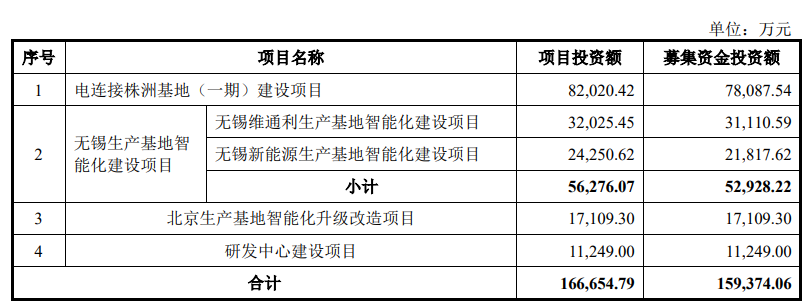
Core Viewpoint - Beijing Weitongli Electric Co., Ltd. has applied for the IPO review status change to "submitted for registration" on the Shenzhen Stock Exchange, aiming to raise 1.59374 billion yuan [1] Group 1: Business Overview - Weitongli specializes in the research, production, and sales of a series of electric connection products, including hard connections, flexible connections, contact components, laminated busbars, and CCS, as well as synchronous decomposers [1] - The company aims to provide high-performance electric connection products and customized solutions to global customers, enhancing safety, reliability, sustainability, and intelligence in electric connections [1] - Over the years, Weitongli has expanded its application fields from traditional industries like electric power and rail transportation to emerging sectors such as new energy vehicles and wind-solar storage [1] Group 2: Clientele and Market Position - Weitongli serves high-end clients in the electric connection product market, with products recognized by major players in various sectors [2] - In the electric power sector, clients include Siemens, Schneider, ABB, Hitachi Energy, and GE; in the new energy vehicle sector, clients include BYD, Stellantis, and others; in the wind-solar storage sector, clients include Goldwind Technology and others; and in the rail transportation sector, clients include CRRC and Alstom [2] Group 3: Fundraising and Financial Projections - The funds raised will be allocated to several projects, including the construction of the Zhuzhou base and the intelligent upgrade of the Wuxi production base, totaling approximately 1.66654 billion yuan [3] - Financial projections indicate that Weitongli's revenue is expected to grow from approximately 1.437 billion yuan in 2022 to 2.390 billion yuan in 2024, with net profits increasing from approximately 115 million yuan to 271 million yuan during the same period [3] Group 4: Financial Performance - As of June 30, 2025, total assets are projected to reach approximately 2.859 billion yuan, with equity attributable to shareholders of the parent company at approximately 1.665 billion yuan [4] - The company's revenue for 2025 is projected at approximately 1.409 billion yuan, with a net profit of approximately 139 million yuan [4] - The company has shown a steady increase in net profit margins and return on equity, with a projected return on equity of 8.73% for the first half of 2025 [5]
固态电池全球首个标准出炉!电池板块大涨,先导智能涨7%,电池50ETF(159796)涨2%,连续4日净流入!天赐材料净利最多增长2倍!
Xin Lang Cai Jing· 2026-01-05 06:33
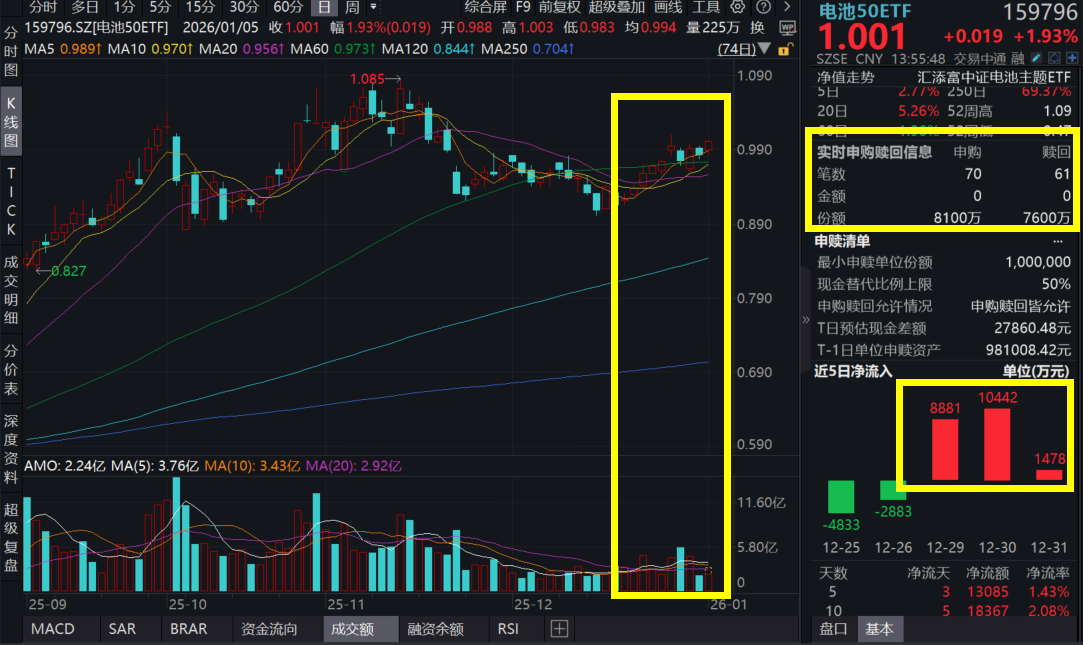
Core Viewpoint - The A-share market experienced a significant rally, with over 4,000 stocks rising and the Shanghai Composite Index surpassing 4,000 points, driven by strong performance in the Battery 50 ETF (159796) which saw a net subscription of 5 million yuan and has been attracting capital for four consecutive days [1][3]. Market Performance - The Battery 50 ETF (159796) saw a 1.93% increase, with key component stocks like Daoshitechnology (300409) hitting a 20% limit up, and other stocks such as XianDao Intelligent and Yiwei Lithium Energy also showing strong gains [1][3]. - The top ten component stocks of the Battery 50 ETF include major players in the power equipment sector, with notable increases in stock prices for companies like Yiwei Lithium Energy (4.93%) and Ningde Times (2.40%) [4]. Industry Developments - A significant milestone was achieved with the full-capacity operation of China's largest all-vanadium flow battery energy storage station, which has a rated power of 200,000 kW and a storage capacity of 1 million kWh, expected to enhance the utilization rate of associated photovoltaic power stations by over 10% annually [5]. - The first national standard draft for solid-state batteries was released, marking a global first in this area, as it does not adopt any existing international standards [4]. Battery Industry Outlook - The lithium battery materials sector is experiencing positive changes, with storage demand exceeding expectations, leading to a recovery in industry sentiment. The electrolyte chain is expected to see a significant upward trend, supported by rising lithium carbonate costs [6][7]. - Projections indicate that by 2026, the lithium battery demand will reach 2,603 GWh, with a decreasing surplus rate from 34% in 2024 to 27% in 2026, indicating a tightening supply-demand balance [8]. Investment Strategy - The Battery 50 ETF (159796) is highlighted as a strategic investment option due to its high exposure to storage and solid-state battery segments, with 27% and 42% weightings respectively, making it well-positioned to benefit from upcoming market trends [10][12]. - The ETF's management fee is notably low at 0.15% per year, making it an attractive option for investors looking to capitalize on the battery sector's growth potential [12].






龙蟠科技拟投建年产24万吨高压实磷酸铁锂项目 进一步扩充高端产品产能
Zheng Quan Shi Bao Wang· 2026-01-04 11:48
Core Viewpoint - Longpan Technology plans to invest up to 2 billion yuan in a new R&D center and a production base for high-pressure lithium iron phosphate with an annual capacity of 240,000 tons, driven by the growing demand in the electric vehicle and energy storage markets [1] Group 1: Project Investment and Development - Longpan Technology's subsidiary, Changzhou Liyuan New Energy Technology Co., Ltd., will implement the project in two phases, with the first phase targeting a capacity of 120,000 tons and expected to be completed by Q3 2026 [1] - The investment is part of a strategic layout to extend business and leverage synergies, aiming for stable and healthy development [1] Group 2: Market Demand and Orders - The demand for lithium iron phosphate batteries is increasing due to their high safety, making them the mainstream choice for installations [1] - Since 2025, Longpan Technology has signed long-term orders with major clients, including a contract with Chuangneng New Energy for 1.3 million tons of lithium iron phosphate, estimated at over 45 billion yuan [2] Group 3: Capacity Expansion and Technology - To alleviate delivery pressure, Longpan Technology has been expanding production, focusing on high-performance lithium iron phosphate products [3] - The company has advanced technologies for high-power spherical LFP production and has received certifications from major clients, with plans to increase shipment ratios in 2026 [3] Group 4: Industry Challenges and Pricing - Despite growing demand, the overall profitability in the lithium iron phosphate industry remains low due to cost and market competition pressures [4] - Longpan Technology announced a planned production reduction of approximately 5,000 tons for maintenance in January 2026, as part of a broader industry effort to stabilize prices [4]
研判2025!中国飞机储能系统行业背景、产业链全景、发展现状及未来发展趋势分析:低空经济赋能增长,飞机储能系统市场规模迈向三百亿新程[图]
Chan Ye Xin Xi Wang· 2026-01-04 01:10
Core Insights - The aircraft energy storage system is a critical component for multi-electric and fully electric aircraft, integrating energy storage media, power conversion, control management, and safety protection to efficiently store and release energy as needed [1][2][3] - China is prioritizing the development of aircraft energy storage systems, implementing various policies to support technological research, airworthiness certification, and industrialization goals, laying a foundation for overcoming airworthiness barriers and accelerating commercialization [1][8] - The industry is experiencing rapid transformation, with a market characterized by chemical energy storage dominance and diverse technological supplements, including solid-state and hydrogen fuel cells as key technological directions [1][12] Industry Overview - The aircraft energy storage system integrates energy storage media, power conversion, control management, and safety protection, providing stable power supply for critical systems during various flight phases [2][3] - The system's core functions include emergency power supply, auxiliary power during high-demand phases, energy recovery capabilities, and stabilization of power grid fluctuations [3][4] Policy Support - China has introduced multiple policies to support the aircraft energy storage system industry, including the "Green Aviation Manufacturing Development Outline (2023-2035)" and "General Aviation Equipment Innovation Application Implementation Plan (2024-2030)" [7][8] - These policies focus on technological research subsidies, airworthiness certification, and expanding demonstration application scenarios, clearly defining core technology development directions and industrialization goals [7][8] Industry Chain - The industry chain is closely linked, with upstream focusing on core equipment and material supply, midstream on system integration and solutions, and downstream covering diverse application scenarios [8][9] - Key components include lithium-ion batteries, hydrogen fuel cells, and energy management systems, with battery costs being the largest component of the industry chain value [8][10] Current Market Dynamics - The market for aircraft energy storage systems is expected to grow rapidly, with projections indicating a market size exceeding 30 billion yuan by 2030 [1][12][14] - The low-altitude economy is a strategic emerging industry in China, driving demand for aircraft energy storage systems, particularly in eVTOL and industrial drone applications [12][13] Key Players - Major companies in the aircraft energy storage system industry include CATL, BYD, and Zhongxin Innovation, with a market share concentration among the top three companies exceeding 50% [14][15] - These companies are focusing on high energy density batteries and hybrid storage solutions, with significant advancements in energy density and system integration capabilities [15][16] Future Trends - The industry is expected to see three core development trends: diversification of technology routes, deepening of industry chain collaboration, and precise adaptation to market demands driven by the low-altitude economy [16][17][19] - Future technological advancements will focus on optimizing mainstream lithium batteries and developing solid-state and hydrogen fuel cells, while hybrid storage systems will become more prevalent [16][17] - The market structure will evolve from emergency backup systems to include core power and auxiliary control systems, driven by diverse application scenarios [19]
