网易云音乐

Search documents
网易云音乐版权风波后,起诉韩国SM娱乐滥用市场支配地位
Xin Lang Cai Jing· 2025-07-31 09:51
Core Viewpoint - The ongoing legal dispute between NetEase Cloud Music and South Korea's SM Entertainment has escalated, with a court hearing scheduled for August 6, 2023, regarding allegations of market dominance abuse [1]. Group 1: Legal Dispute - NetEase Cloud Music and its subsidiary have filed a lawsuit against SM Entertainment and its affiliates, with the case set to be heard in Hangzhou [1]. - The lawsuit follows a series of complications in the partnership between NetEase Cloud Music and SM Entertainment, which began in 2018 [6][8]. Group 2: Historical Context of Partnership - The collaboration between NetEase Cloud Music and SM Entertainment started in 2018, but faced challenges when SM Entertainment signed a strategic deal with Tencent Music in 2019, leading to the removal of SM's songs from NetEase's platform [8]. - In 2021, regulatory changes allowed for the cessation of exclusive copyright agreements, leading to a renewed partnership in 2022 where NetEase regained full music rights from SM Entertainment [8][9]. Group 3: Financial Performance - For the year 2024, NetEase Cloud Music reported online music service revenue of 5.35 billion yuan, a 23.1% increase from 4.35 billion yuan in the previous year, driven by a growing subscriber base [9]. - Subscription revenue reached 4.46 billion yuan, reflecting a year-on-year growth of 22.2%, while content service costs decreased from 4.6 billion yuan in 2023 to 4 billion yuan in 2024 [9].

网易云音乐(09899.HK)8月14日召开董事会会议考虑及通过中期业绩
Ge Long Hui· 2025-07-31 08:52
格隆汇7月31日丨网易云音乐(09899.HK)宣布,将于2025年8月14日(星期四)召开董事会会议,藉以考虑 及通过集团截至2025年6月30日止六个月之中期业绩,并考虑向我们的股东派发中期股息(如有)。 ...
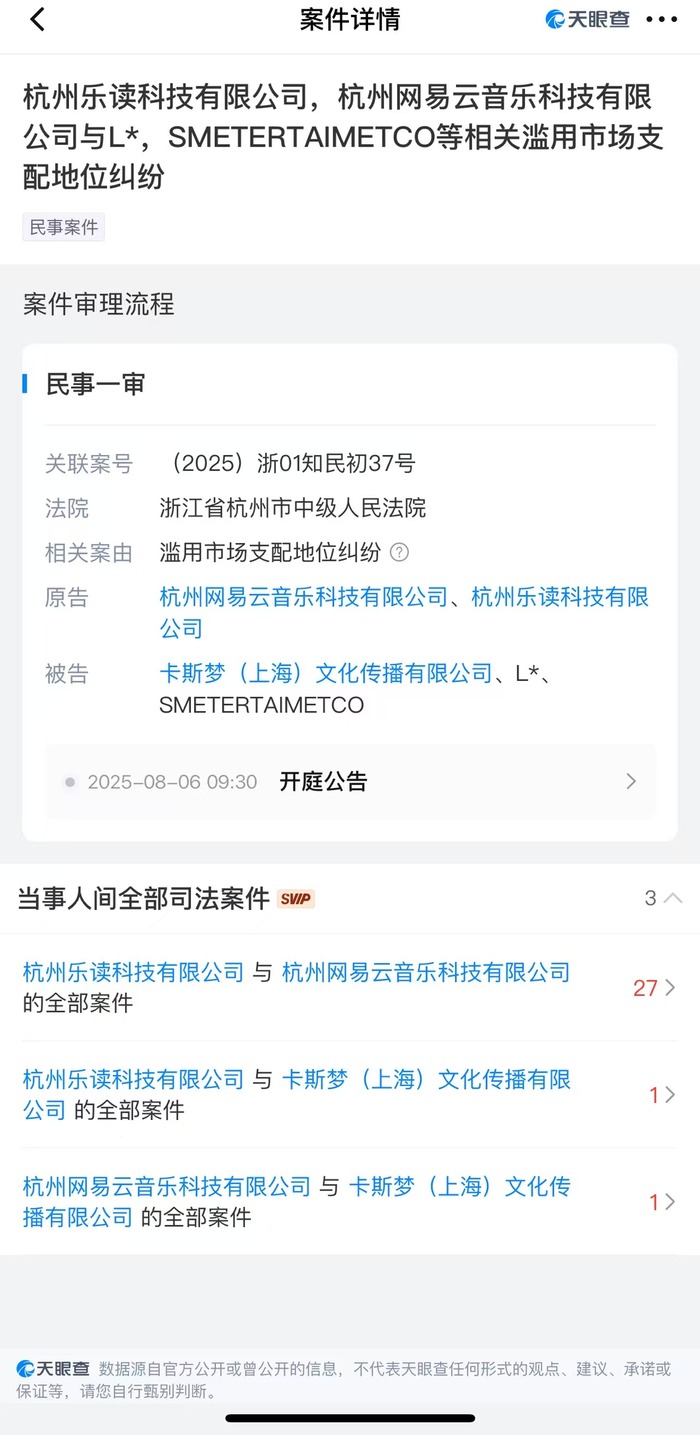
网易云音乐诉韩国SM娱乐将开庭
Xin Lang Ke Ji· 2025-07-31 08:43
Core Viewpoint - The lawsuit filed by Hangzhou LeDu Technology Co., Ltd. and Hangzhou NetEase Cloud Music Technology Co., Ltd. against SM Entertainment Co. and Kasmong (Shanghai) Cultural Communication Co., Ltd. revolves around the abuse of market dominance [1] Group 1 - The case is scheduled for hearing on August 6 at the Hangzhou Intermediate People's Court in Zhejiang Province [2] - On January 24, NetEase Cloud Music informed fans of SM Entertainment that due to the copyright holder's unilateral decision not to renew the contract, all songs under SM Entertainment may be removed by January 31, 2025 [2] - NetEase Cloud Music stated that it will strive for copyright renewal and will inform users of any further updates promptly [3]
网易云音乐(09899) - 董事会会议召开日期
2025-07-31 08:36
(於開曼群島註冊成立的有限公司) (股份代號:9899) 董事會會議召開日期 我們特此宣佈將於2025年8月14日(星期四)召開董事會會議,藉以考慮及通過本 集團截至2025年6月30日止六個月之中期業績,並考慮向我們的股東派發中期股 息(如有)。 我們的管理層將於2025年8月14日(星期四)北京╱香港時間下午七時正(美國東 部時間上午七時正)召開業績電話會議。所有與會者須於電話會議召開前使用下 文提供的鏈接完成在線註冊程序。註冊後,各與會者將收到一組用以參與電話會 議的與會者撥入號碼及個人識別碼。電話會議詳情如下: 活動名稱:網易雲音樂股份有限公司2025年上半年業績電話會議 註冊鏈接:https://s1.c-conf.com/diamondpass/10049196-sgtd5f.html 香港交易及結算所有限公司及香港聯合交易所有限公司對本公告的內容概不負責,對其準確性 或完整性亦不發表任何聲明,並表明概不就因本公告全部或任何部份內容而產生或因依賴該等 內容而引致的任何損失承擔任何責任。 NETEASE CLOUD MUSIC INC. 網易雲音樂股份有限公司 香港,2025年7月31日 於本公告日 ...
WAIC|自由量级CTO姜涛:音乐大模型对审美要求高
Zhong Guo Jing Ying Bao· 2025-07-29 15:53
Core Insights - The music large model differs from language models in that it requires a high level of human aesthetic judgment, necessitating collaboration with professional musicians for training and optimization [1] - The company aims to achieve "music equity" by enabling users to easily create songs through an app, significantly reducing costs and production time [2] - The global music large model market is projected to reach $18.7 billion by 2025, with China accounting for approximately 32% of this market [2] Company Overview - The company, established in July 2023, has launched two applications: a one-stop music creation platform "Yinchao" and an AI-native content creation and sharing platform "Agent PI" [1] - The business model includes providing API services to B-end clients, with users able to listen to songs for free and earn revenue through community engagement [2][3] Market Context - The AI music generation sector has gained significant attention, with numerous players entering the market, including major companies like Tencent Music and ByteDance [3] - Innovative copyright and incentive mechanisms are being implemented to ensure that the core revenue from music works belongs to the creators, enhancing user engagement [3]


张碧晨VS汪苏泷?网易云卷入《年轮》版权战,“反复横跳”惹怒粉丝
新浪财经· 2025-07-29 09:36
Core Viewpoint - The article discusses the controversy surrounding NetEase Cloud Music's handling of the original artist label for songs by Zhang Bicheng and Wang Sulong, highlighting issues of copyright and platform responsibility [2][3][4]. Group 1: Incident Overview - NetEase Cloud Music initially removed the original artist label for three songs by Zhang Bicheng, including "Year Ring," while maintaining the label for Wang Sulong's version [2][3]. - The platform later restored the original artist labels after user complaints and clarified that the removal was due to a system display issue [3][4]. - Legal experts noted that the original artist label lacks a clear definition in Chinese copyright law, and the rights depend on the contractual agreements between the artists and the platform [4][7]. Group 2: Artist Statements and Reactions - Zhang Bicheng's studio stated that she is the only original artist for "Year Ring," which was first released in June 2015, while Wang Sulong's version followed shortly after [4][6]. - Wang Sulong's team announced the decision to retract the song's authorization due to the ongoing dispute over the original artist designation [4][6]. Group 3: Financial Context - NetEase Cloud Music is facing increasing financial pressure, with a reported revenue decline of 8.4% year-on-year in Q1 2025, totaling 1.858 billion yuan, and a gross profit decrease of 11% [14]. - In contrast, Tencent Music reported a revenue increase of 8.7% year-on-year, highlighting the competitive challenges faced by NetEase Cloud Music [14].

张碧晨VS汪苏泷? 网易云卷入《年轮》版权战,“反复横跳”惹怒粉丝
Xin Lang Cai Jing· 2025-07-29 08:56
Core Viewpoint - The controversy surrounding the original singer label for Zhang Bicheng's songs on NetEase Cloud Music highlights issues of copyright and platform management in the music industry [2][3][4]. Group 1: Incident Overview - NetEase Cloud Music initially removed the original singer label for three songs by Zhang Bicheng, including the popular track "Year Wheel," while maintaining the label for the version by Wang Sulong [2][3]. - The platform later restored the original singer labels after clarifying that the removal was due to a system display issue [3]. - Legal experts indicated that if the copyright holder retracts the performance authorization, the performer cannot continue to perform the song unless specified in the contract [3][5]. Group 2: Background and Reactions - The dispute originated from comments made by online singer "Wang Zai Xiao Qiao," who stated that "Year Wheel" was created by Wang Sulong but originally sung by Zhang Bicheng [4]. - Zhang Bicheng's studio asserted that she was the only original singer of "Year Wheel," which was first released in June 2015, while Wang Sulong's version followed shortly after [4]. - Wang Sulong's team announced the retraction of authorization for "Year Wheel" due to the ongoing controversy, while Zhang Bicheng's studio stated they would no longer perform the song out of respect [4]. Group 3: Financial Context - NetEase Cloud Music is facing increasing financial pressure, with a reported revenue of 1.858 billion yuan in Q1 2025, down 8.4% from 2.029 billion yuan in the same period last year [10]. - The company's gross profit also decreased by 11%, contrasting with Tencent Music's growth in revenue and profit during the same quarter [10]. - The series of operational missteps raises concerns about NetEase Cloud Music's ability to deliver satisfactory financial results by the end of the year [10].


张碧晨三首歌曲原唱被取消?网易云音乐:系统问题,已恢复
Xin Lang Cai Jing· 2025-07-29 02:33
Core Viewpoint - The recent controversy surrounding the original singer of the song "Year Ring" has sparked significant discussion on social media, particularly regarding the rights and recognition of artists involved in the song's creation and performance [2]. Group 1: Song and Artist Information - The song "Year Ring," which is an insert song for the TV drama "Flower Bone," was written and composed by Wang Sulong, with both Zhang Bichen and Wang Sulong performing it [2]. - "Year Ring" was first released on June 15, 2015, by Zhang Bichen, making her the first official recording artist of the song, while Wang Sulong's version was released later on June 30, 2015 [2]. - The song has received accolades, including the Top Ten Best-Selling Songs Award at the 9th Migu Music Festival [2]. Group 2: Copyright and Legal Aspects - The Copyright Law stipulates that copyright includes rights such as publication, attribution, performance, and adaptation, which belong to the authors, including lyricists and composers [3]. - Although the Copyright Law does not define "original singer," it discusses performer rights, which are related to copyright and include the right to perform and receive compensation [3]. - As the lyricist and composer of "Year Ring," Wang Sulong holds the copyright, while Zhang Bichen, as the first performer, possesses performer rights [3].
2025情绪价值系列报告之音乐:版权拓展有望驱动音乐行业从付费增长转向流量、付费双增
Orient Securities· 2025-07-28 05:11
Investment Rating - The report maintains a "Positive" outlook for the media industry as of July 28, 2025 [6] Core Insights - The music industry is expected to transition from a paid growth model to a dual growth model of traffic and payment, driven by the expansion of audio content and refined operations of fan economy [4][10] - The resilience of streaming music against macroeconomic headwinds is highlighted, with a projected CAGR of 22% for China's streaming music industry from 2021 to 2024, significantly outpacing retail sales growth [9][20] - The report emphasizes the importance of expanding content pools to shift the music market from a stock game to a growth game, with Tencent Music and NetEase Cloud Music both enhancing their content offerings [9][10] Summary by Sections 1. Emotional Value Driving High Growth in Online Music Platforms - China's online music platforms are projected to reach revenues of 27.1 billion in 2024, reflecting a 25% year-on-year growth [18][19] - The emotional value derived from music consumption is increasingly recognized, with a shift towards subscription models providing significant psychological benefits to users [20] 2. Traffic: Copyright Expansion Expected to Drive Growth - The overall DAU for the music industry is expected to reach 183.73 million in 2024, with a 2% year-on-year increase [22] - Tencent Music's DAU has been declining, but the acquisition of Himalaya is anticipated to reverse this trend by introducing long audio users [24][41] - ByteDance's platforms have seen significant DAU growth, with a 100% increase in the first half of 2025 [26] 3. Payment: Expansion of Rights Driving Payment Increases - The report notes a significant increase in the proportion of songs available to VIP members, with QQ Music's share rising from 38% to 95% and NetEase Cloud Music's from 4% to 48% [48][49] - The introduction of SVIP memberships is expected to enhance ARPPU, with Tencent Music's acquisition of SM Entertainment and Himalaya providing additional content [50][51] 4. Cost: Operational Leverage and AI Expected to Optimize Margins - The report discusses how the management of top-tier copyrights is improving, leading to increased gross margins for music platforms [9] - AI is expected to decentralize music production, further optimizing margins [9] 5. Investment Recommendations and Targets - The report suggests focusing on Tencent Music and NetEase Cloud Music due to their strategic acquisitions and content expansions, which are expected to drive user growth and payment increases [4][13]
喜马拉雅要靠山,腾讯音乐要希望
创业邦· 2025-07-28 03:05
Core Viewpoint - The article discusses the valuation and challenges faced by Ximalaya, China's largest online audio platform, particularly in light of its acquisition by Tencent Music at a significantly reduced price, raising questions about its worth and sustainability in the competitive landscape of online audio and music [4][38]. Group 1: Valuation and Market Position - Ximalaya was sold to Tencent Music for 20.9 billion, which is one-third less than its last financing round valuation of 30 billion [4]. - Despite having a monthly active user base nearing 300 million, Ximalaya's financial struggles are evident, with over 3 billion in losses over five years and multiple failed IPO attempts [4][20]. - The valuation of Ximalaya is compared to other platforms, indicating it is worth approximately seven times Zhihu, eight times Keep, and eleven times Douyu [4]. Group 2: Importance of Copyright - Copyright is identified as the most valuable asset for online audio platforms, with Ximalaya's strategic partnerships and acquisitions in this area being crucial for its market position [5][11]. - Ximalaya has established significant copyright agreements, holding 70% of the market for audiobooks and exclusive content partnerships since 2014 [8][9]. - The platform's revenue structure heavily relies on subscription income, which constitutes over half of its total revenue, primarily driven by its extensive copyright library [10]. Group 3: Financial Performance and Challenges - Ximalaya's subscription revenue growth has drastically slowed from 57.1% in 2021 to 8.5% in 2023, indicating a decline in user willingness to pay [24]. - The average monthly active users include a significant number from third-party platforms, which may not contribute to revenue, highlighting the limitations of monetization in the audio sector [22]. - The platform's operational costs are heavily influenced by revenue sharing and content costs, which together account for over 30% of its income [20]. Group 4: Industry Comparisons - In contrast to Ximalaya, Tencent Music has a more robust subscription model with a higher payment rate, indicating a more mature commercial structure in the online music sector [32][36]. - The online audio market lacks the broad audience and established commercial mechanisms that the online music industry possesses, making it difficult for platforms like Ximalaya to achieve similar financial success [37]. - The article suggests that the online audio industry's ceiling for user engagement and monetization is lower than anticipated, leading to Ximalaya's ongoing financial difficulties [21][22].