
苏州银行

Search documents
理财公司与中小银行共拓代销新蓝海
Zhong Guo Zheng Quan Bao· 2025-10-20 20:18
Core Insights - Multiple wealth management companies have recently signed distribution agreements with small and medium-sized banks, indicating a growing trend in the number of banks participating in wealth management distribution [1][2] - Small and medium-sized banks are increasingly looking to enhance their intermediary income through distribution partnerships due to pressure on net interest margins and limited space for self-conducted wealth management [1][2] - The collaboration between wealth management companies and small banks is expected to deepen in the future, driven by mutual benefits [2][3] Group 1: Distribution Partnerships - Several wealth management companies, including Su Yin Wealth Management and Ning Yin Wealth Management, have announced new distribution agreements with small banks such as Weihai Bank and Jiangnan Rural Commercial Bank [1] - Since the beginning of October, nearly ten wealth management companies have added new distribution partners, including Wenzhou Bank and High Postal Rural Commercial Bank [1][2] - A wealth management company under a joint-stock bank has expanded its distribution channels to include nearly 30 new small banks this year, focusing on rural commercial banks [2] Group 2: Strategic Shift of Small Banks - Regional small banks are facing pressure from narrowing net interest margins and limited self-investment income, prompting them to explore wealth management distribution as a strategic pivot [2][3] - Regulatory constraints on self-conducted wealth management have further limited small banks' ability to grow their own wealth management businesses [2] - The shift towards distribution partnerships allows small banks to adopt a "light capital, light asset" operational model, which is seen as a necessary strategic path [2][3] Group 3: Performance Metrics - In the first half of 2025, several small banks reported significant growth in intermediary income, with Changshu Bank's net income from fees and commissions reaching 142 million, a year-on-year increase of over 600% [3] - Changshu Bank's wealth management distribution scale reached 7.277 billion by mid-2025, up from 4.954 billion at the end of 2024 [3] Group 4: Market Expansion Strategies - Wealth management companies are actively expanding their distribution networks beyond their parent banks to include small and medium-sized banks, aiming to tap into broader market opportunities [5] - The strategy includes covering state-owned and joint-stock banks, as well as deepening partnerships with city and rural commercial banks to reach lower-tier markets [5] - The diversification of distribution channels is expected to enhance the long-term development of wealth management companies, reducing the impact of market fluctuations on their investment behavior [5][6]

理财公司代销扩容,中小银行成新增长点
Zhong Guo Zheng Quan Bao· 2025-10-20 14:33
Core Insights - Recent agreements between wealth management companies and small to medium-sized banks indicate a growing trend in distribution partnerships aimed at enhancing revenue streams for both parties [1][2][3] Group 1: Collaboration Trends - Multiple wealth management firms have announced new distribution agreements with small to medium-sized banks, including notable institutions like Weifang Bank and Jiangnan Rural Commercial Bank [2] - The number of banks participating in wealth management product distribution is on the rise, with nearly ten firms announcing new partnerships in October alone [2][3] - The collaboration is characterized as a "mutual pursuit," where both small banks and wealth management companies aim to tap into the potential for increased intermediary income [3] Group 2: Market Dynamics - Small banks are facing pressure from narrowing net interest margins and regulatory constraints on self-managed wealth management products, prompting a shift towards distribution partnerships [3][5] - Regulatory changes, such as the new management measures for agency sales, are shaping the landscape for these partnerships, emphasizing the need for compliance and structured collaboration [5][6] - Wealth management companies are diversifying their distribution channels to overcome limitations of direct sales, particularly by leveraging the strong sales capabilities of smaller banks [6][7] Group 3: Strategic Implications - The expansion of distribution channels is seen as a long-term growth strategy for wealth management firms, allowing them to mitigate risks associated with market fluctuations and enhance brand recognition [7] - The focus on multi-channel sales strategies is expected to improve market competitiveness and foster product innovation, aligning with customer preferences [7] - Wealth management companies are advised to carefully select distribution partners based on strategic alignment, product characteristics, and risk management considerations [7]
银行扎堆“双11”送福利,究竟在“抢”什么?
Bei Jing Shang Bao· 2025-10-20 11:56
Core Insights - The banking industry is actively participating in the upcoming "Double 11" shopping festival by launching exclusive promotional activities to capture market share and stimulate business growth [1][2][4] Group 1: Promotional Activities - Major banks, including China Bank and Construction Bank, along with local banks like Suzhou Bank and Guiyang Bank, have introduced "Double 11" exclusive activities targeting both debit and credit card holders [2][3] - China Bank has partnered with Alipay to offer a "11.11 Daily Discount" campaign, which includes a pre-sale period from October 20 to 30 and a promotional period from October 31 to November 11, with varying discount thresholds [2][3] - Other banks, such as China Merchants Bank, are offering cashback promotions for debit card users, while credit card promotions include discounts and installment payment options across multiple platforms [3][4] Group 2: Market Trends and Strategies - The banking sector is shifting from a "land grab" approach to a more refined strategy focused on enhancing customer engagement and activating dormant accounts [5][6] - As of mid-2025, the total number of bank cards in China reached 10.068 billion, with debit cards continuing to grow, while credit cards have seen a decline, indicating a shift towards managing existing customer bases [5] - The "Double 11" event serves as a critical opportunity for banks to reactivate dormant accounts and increase user activity, aligning with broader policies aimed at boosting domestic consumption [4][5] Group 3: Future Considerations - Analysts suggest that banks should focus on converting short-term promotional gains into long-term customer retention by enhancing service offerings and optimizing user experiences [6] - Recommendations include integrating temporary credit increases and aligning with government initiatives to enhance consumer engagement and loyalty [6] - The shift towards a customer lifecycle management approach is emphasized, with a focus on content-driven marketing and membership programs to build long-term value [6]


从“苏超”到“湘超”“川超”“蒙超”……“省超”营销哪家强?
3 6 Ke· 2025-10-20 00:17
再看看9月20日揭幕的"川超"——四川省城市联赛。该赛事进一步就赞助层级进行细分。根据公众号"川超足球联赛"消息,除去赛事直转播运营商及平 台、网络媒体合作平台,"川超"的赞助商数量已经达到19家。最高赞助层级身份"全球独家冠名赞助商"为四川银行;其次,首席至尊合作伙伴青花郎,官 方合作伙伴中国移动,官方赞助商百威,这3个赞助层级都分别只有1家品牌或企业参与。而官方支持企业以及官方供应商类别则共计有15家,其中包括有 可口可乐、长虹、卡尔美体育、京东电器等长期参与体育营销的品牌。 自5月中旬开赛,苏超掀起了一股前所未有的足球狂热——线下上座人数持续创造纪录,线上自发诞生的热梗与讨论把这项城市足球联赛带进了更多人的 视野,另外在营销层面也展现强劲的商业吸引力。总之,2025年的苏超已然远超出足球赛事本身,成为了一种跨越体育、文旅、消费及公共服务的社会符 号。 "苏超"的火,也点燃了其他省级行政单位的区域性本土足球赛事的热情。"赣超""湘超""川超"等10余个省和直辖市落地举行城市联赛,"齐鲁超赛""广东省 超"也陆续开展俱乐部业余联赛。当然,还包括原有的"村超"类草根足球赛事以及各地社会足球邀请赛,这一系列足球 ...


江苏53家主体发行527亿元
Xin Hua Ri Bao· 2025-10-19 21:42
Group 1 - The issuance of technology innovation bonds in Jiangsu has reached a total of 94 bonds with a total issuance amount of 52.7 billion yuan since the new regulations were implemented on May 7 [1] - Long-term bonds are becoming more prevalent, with 64% of the bonds having a maturity of over 3 years and approximately 27% over 5 years [1] - A diverse range of issuers is participating, including AAA-rated manufacturing leaders and AA-rated venture capital groups, with funds primarily allocated for working capital needs [1] Group 2 - Private equity investment institutions have emerged as a significant issuer category under the new regulations, with the first private venture capital institutions successfully issuing technology innovation bonds [2] - The first bank-intermediated technology innovation bonds were issued by Yuanhe Holdings, featuring a 3-year term and a coupon rate of 1.92%, setting a new low for similar bonds [2] - Financial institutions are actively participating, with Dongwu Securities issuing 1.2 billion yuan in technology innovation bonds at a rate of 1.74%, attracting significant interest from various institutional investors [2]




银行三季报业绩增长可期
Xiangcai Securities· 2025-10-19 12:11
Investment Rating - The industry rating is maintained at "Overweight" [10][34] Core Views - The banking sector is expected to see positive growth in Q3, with revenue growth of 1.0% and net profit growth of 0.8% in the first half of the year, indicating a stabilization trend [8][32] - Credit growth has been slowing down due to a significant decrease in bill financing, reflecting a weakened demand for scale expansion among banks [8][32] - The introduction of new policy financial tools is anticipated to support medium to long-term corporate loans, improving the loan structure [8][33] - Deposit growth remains strong, which is expected to help stabilize funding costs and potentially lead to a recovery in net interest margins [8][33] Summary by Sections Industry Performance - The banking sector's performance has shown a relative return of 2.3% over the past month, with an absolute return of 1.5% [7] - The banking index increased by 4.89% during the period from October 13 to October 19, outperforming the CSI 300 index by 7.12 percentage points [12] Financial Metrics - The net interest margin decreased by 8 basis points in the first half of the year, but is expected to stabilize in the second half [8][33] - Non-interest income is projected to remain stable, supported by growth in intermediary business income and favorable market conditions for capital markets [9][32] Investment Recommendations - The report suggests focusing on state-owned banks for their stable high dividend yield and potential valuation recovery opportunities in joint-stock and regional banks [10][34] - Specific banks recommended include CITIC Bank, Jiangsu Bank, Chengdu Bank, Shanghai Rural Commercial Bank, Chongqing Rural Commercial Bank, Changshu Bank, and Suzhou Bank [10][34]
二级资本债周度数据跟踪-20251018
Soochow Securities· 2025-10-18 09:31
Group 1: Industry Investment Rating - No industry investment rating is provided in the report. Group 2: Core Viewpoint - The report presents a weekly data tracking of secondary capital bonds from October 13, 2025, to October 17, 2025, covering primary market issuance, secondary market trading, and valuation deviation of individual bonds [1]. Group 3: Summary Based on Related Catalogs Primary Market Issuance - One new secondary capital bond was issued in the inter - bank and exchange markets this week, with an issuance scale of 4.5 billion yuan, a maturity of 10 years. The issuer is a local state - owned enterprise in Jiangsu Province with a subject rating of AAAspc [1][6]. Secondary Market Trading - **Trading Volume**: The total weekly trading volume of secondary capital bonds was approximately 166.8 billion yuan, an increase of 122.3 billion yuan compared to last week. The top three bonds in terms of trading volume were 25 ICBC Secondary Capital Bond 02BC (6.075 billion yuan), 25 BOC Secondary Capital Bond 01BC (5.131 billion yuan), and 25 CCB Secondary Capital Bond 01BC (5.024 billion yuan) [2]. - **Regional Trading Volume**: The top three regions in terms of trading volume were Beijing, Shanghai, and Guangdong, with trading volumes of approximately 129 billion yuan, 12.3 billion yuan, and 6.8 billion yuan respectively [2]. - **Yield to Maturity**: As of October 17, the yield - to - maturity changes of 5Y secondary capital bonds with ratings of AAA -, AA +, and AA compared to last week were - 7.98BP, - 7.12BP, and - 7.12BP respectively; for 7Y bonds, the changes were - 9.74BP for all three ratings; for 10Y bonds, the changes were - 9.29BP, - 8.58BP, and - 8.58BP respectively [2][11]. Valuation Deviation of Top 30 Individual Bonds - **Overall Situation**: The overall valuation deviation of the weekly average trading price of secondary capital bonds was not significant this week. The proportion of discount trading was greater than that of premium trading, and the discount range was larger than the premium range [3]. - **Discount Bonds**: The top three bonds with the highest discount rates were 20 Fuxin Bank Secondary 01 (- 15.2060%), 17 Yanbian Rural Commercial Secondary 02 (- 2.5373%), and 22 Chengdu Rural Commercial Secondary 01 (- 0.7800%). The majority of ChinaBond implied ratings were AAA -, AA +, and A +, and the bonds were mainly distributed in Beijing, Guangdong, and Shanghai [3][13]. - **Premium Bonds**: The top three bonds with the highest premium rates were 22 Chouzhou Commercial Bank Secondary Capital Bond 01 (0.2822%), 21 Jinshang Bank Secondary 01 (0.2143%), and 21 Huishang Bank Secondary 01 (0.1652%). The majority of ChinaBond implied ratings were AAA -, AA, and AA +, and the bonds were mainly distributed in Beijing, Guangdong, and Shanghai [3][14].

银行研思录23:AH股银行资产质量评估(2025H1):基于“广义不良”和“超额拨备”的分析
CMS· 2025-10-17 09:03
Investment Rating - The report maintains a positive outlook on the banking sector, suggesting that several banks are undervalued based on their asset quality and excess provisioning metrics [4][3]. Core Insights - The valuation premium of banks typically arises from their middle-income and liability advantages, while valuation discounts are often due to concerns over asset quality [2][10]. - The report introduces two key indicators: "broad non-performing asset ratio" and "excess provisioning profit multiple" to objectively assess and compare the current asset quality status of banks [2][10]. - A total of 56 AH-listed banks are analyzed, expanding from the previous report's focus on 42 A-share listed banks, to provide a comprehensive overview of excess provisioning levels and trends [2][10]. Summary by Sections 1. Introduction: Significance of Asset Quality - The report emphasizes the importance of objectively assessing asset quality, as it significantly impacts bank valuations and performance [10]. 2. How to Objectively Assess Bank Non-Performing Assets - Traditional asset quality indicators may not accurately reflect the true provisioning situation due to inconsistent standards and incomplete coverage of assets [14]. - The report proposes a "broad non-performing asset ratio" to better capture the credit risk within banks [14][15]. 3. Construction of Excess Provisioning Profit Multiple Indicator - The excess provisioning profit multiple is constructed to measure the performance elasticity of banks, indicating their potential for future earnings recovery [7][14]. - The report highlights that banks with higher excess provisioning ratios, such as Hangzhou Bank, show strong risk mitigation capabilities [7][14]. 4. Valuation from the Perspective of Broad Excess Provisioning - The long-term correlation between bank valuation levels and ROE is noted, with excess provisioning contributing to performance and valuation improvements [3][4]. - Several banks, including Wuxi Bank and Agricultural Bank (H), are identified as being significantly above the PB-excess provisioning profit multiple regression line, indicating potential investment opportunities [3][4].


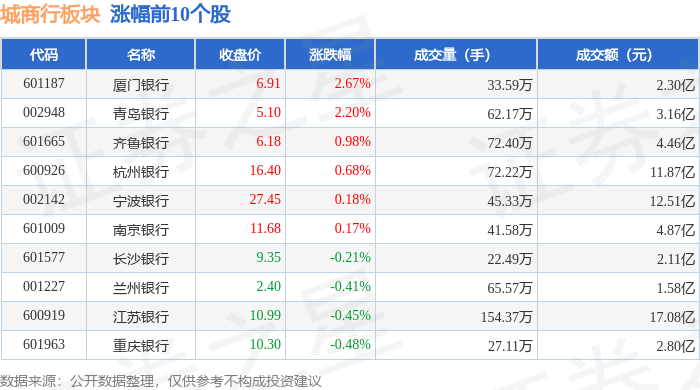
城商行板块10月17日跌0.17%,上海银行领跌,主力资金净流出4.03亿元
Zheng Xing Xing Ye Ri Bao· 2025-10-17 08:35
Market Overview - The city commercial bank sector experienced a decline of 0.17% on October 17, with Shanghai Bank leading the drop [1] - The Shanghai Composite Index closed at 3839.76, down 1.95%, while the Shenzhen Component Index closed at 12688.94, down 3.04% [1] Individual Bank Performance - Xiamen Bank saw a closing price of 6.91, with an increase of 2.67% and a trading volume of 335,900 shares, amounting to a transaction value of 230 million [1] - Qingdao Bank closed at 5.10, up 2.20%, with a trading volume of 621,700 shares and a transaction value of 316 million [1] - In contrast, Shanghai Bank closed at 9.49, down 1.04%, with a trading volume of 768,900 shares and a transaction value of 734 million [2] Capital Flow Analysis - The city commercial bank sector saw a net outflow of 403 million from institutional investors, while retail investors contributed a net inflow of 308 million [2] - The table indicates that Suzhou Bank had a net inflow of 24.27 million from institutional investors, while it faced a net outflow of 14.17 million from speculative funds [3] - Jiangsu Bank experienced a net outflow of 24.10 million from institutional investors but had a net inflow of 1.78 million from retail investors [3]

晨会纪要:对近期重要经济金融新闻、行业事件、公司公告等进行点评-20251017
Xiangcai Securities· 2025-10-17 01:47
Macro Strategy - In September, CPI decreased by 0.3% year-on-year and increased by 0.1% month-on-month, with food prices rising by 0.7% and pork prices falling by 17.0%, contributing to a 0.26 percentage point decline in CPI [2][4] - By the end of September, M2 balance reached 335.38 trillion yuan, growing by 8.4% year-on-year, while the total social financing stock was 437.08 trillion yuan, up 8.7% year-on-year [2][4] Healthcare Services Industry - The pharmaceutical and biological sector fell by 1.20%, ranking 25th among 31 primary industries, with the medical services sub-sector dropping 3.37% [6][9] - WuXi AppTec is highlighted as a CRDMO integrated platform company, with its R&D segment driving growth and D&M capacity release significantly increasing revenue per capita from 542,000 yuan in 2018 to an expected 1,118,000 yuan in 2025 [7][8] - The long-term development trend of the healthcare services industry remains positive despite recent geopolitical tensions, with a "buy" rating maintained for the sector [9] Securities Industry - The securities sector showed active performance post-holiday, with the brokerage index rising by 0.5%, outperforming the CSI 300 index by 1 percentage point [11][15] - Daily average stock trading volume reached 25.87 trillion yuan, a 19% increase from the previous period, indicating a significant recovery in trading activity [12][13] - The investment recommendation for the securities industry is to maintain an "overweight" rating, focusing on internet brokerages and firms with strong performance certainty [15] Electronic Industry - OpenAI's release of Sora 2.0 marks a significant milestone in AI applications, with the new video generation model achieving high realism and user engagement [17][19] - The electronic industry is expected to benefit from ongoing recovery in consumer electronics and AI technology advancements, maintaining an "overweight" rating [19] New Materials Industry - The rare earth magnetic materials sector increased by 10.44%, outperforming the benchmark by 8.97 percentage points, while rare earth prices showed mixed trends [21][24] - The investment outlook remains cautious, with a recommendation to maintain an "overweight" rating, focusing on upstream rare earth resource companies and downstream magnetic material firms [25] Banking Industry - Social financing growth slowed to 8.7% in September, with improvements in credit structure, particularly in long-term loans supported by policy measures [28][32] - The banking sector is expected to maintain stable performance, with a recommendation to focus on state-owned banks and regional banks for their investment value [32]