兆龙互连

Search documents
ETF盘前资讯|光模块业绩催化,算力赛道突然逆袭!12亿元资金火速布局,创业板人工智能ETF(159363)规模再创新高!
Sou Hu Cai Jing· 2026-01-16 01:22
Core Viewpoint - The AI sector, particularly in the context of the ChiNext board, is experiencing a rebound, with significant movements in AI-related stocks and ETFs, indicating strong investor interest and potential growth opportunities in the market [1][3]. Group 1: Market Performance - The ChiNext AI ETF (159363) showed a strong recovery, closing positively with a daily trading volume exceeding 1 billion CNY, reflecting continued capital inflow and a total increase of 1.2 billion CNY over the past four days [1][2]. - The ETF's latest scale reached a record high of 5.527 billion CNY, with an average daily trading volume of nearly 800 million CNY over the past six months, leading among eight ETFs tracking the ChiNext AI index [2][3]. Group 2: Sector Opportunities - The optical module sector is experiencing a high growth cycle, driven by increasing demand for AI computing power, with major manufacturers ramping up production in mainland China and Thailand [3][4]. - The AI application landscape is evolving, with Alibaba's Qianwen App integrating various services, indicating a significant advancement in AI shopping functionalities [3][4]. Group 3: Investment Insights - The ChiNext AI ETF is strategically positioned to benefit from the commercialization of AI technologies, with approximately 60% of its portfolio focused on computing power (mainly optical modules) and 40% on AI applications [4]. - Analysts suggest that the optical module sector could become a focal point for investors during market corrections, highlighting its potential as a strong performer in the near term [3][4].


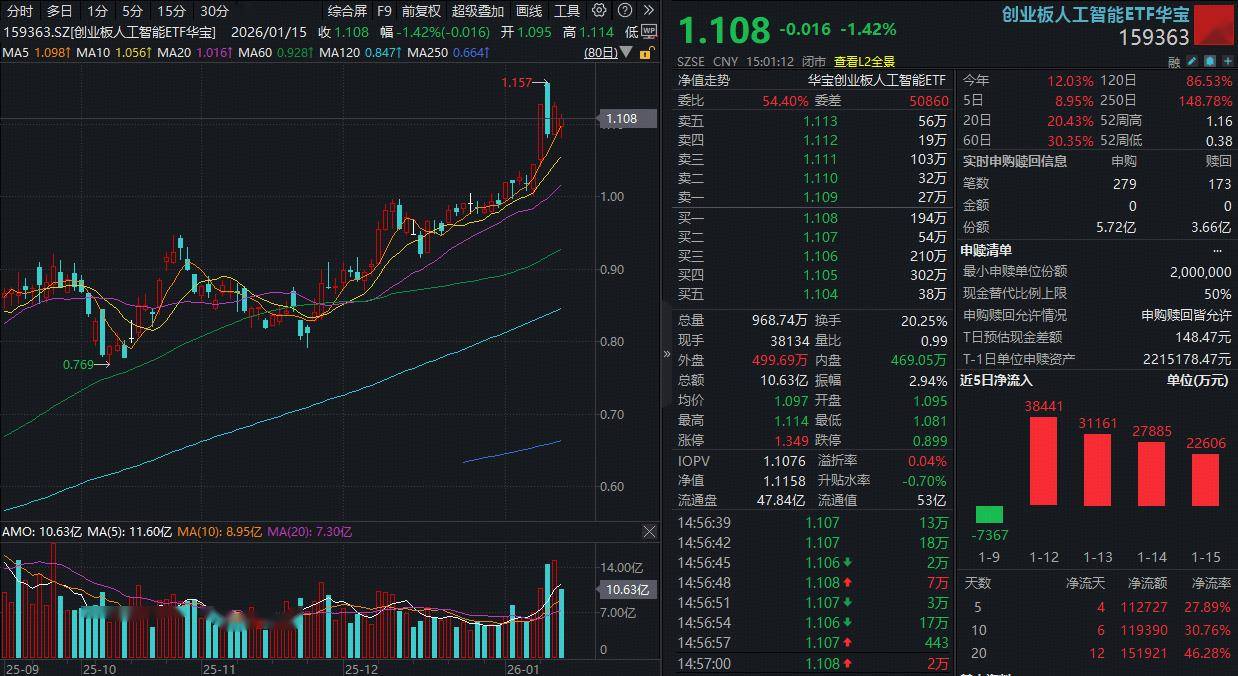
光模块业绩催化,算力赛道突然逆袭!12亿元资金火速布局,创业板人工智能ETF(159363)规模再创新高!
Xin Lang Cai Jing· 2026-01-16 01:19
Core Viewpoint - The AI sector, particularly the entrepreneurial board's AI ETF (159363), is experiencing significant inflows and growth, with a focus on both computing power and AI applications, indicating a strong market sentiment and potential investment opportunities [3][9][10]. Group 1: ETF Performance - The entrepreneurial board AI ETF (159363) reached a new high of 55.27 billion yuan as of January 15, with an average daily trading volume of nearly 800 million yuan over the past six months, leading among eight ETFs tracking the entrepreneurial board AI index [3][9]. - The ETF has seen a cumulative increase of 1.2 billion yuan in the last four days, reflecting strong investor interest and confidence in the sector [7][9]. Group 2: Sector Opportunities - The optical module CPO sector is experiencing a surge, driven by high demand for AI computing power, with leading manufacturers in mainland China and Thailand accelerating production [10]. - The optical module industry is in a high prosperity cycle, with expectations for significant capacity release in the first quarter of 2026, which could drive a new performance growth phase for companies in this sector [10]. Group 3: AI Application Developments - Alibaba's Qianwen App has integrated with various Alibaba ecosystem services, enabling AI-driven functionalities such as food delivery and flight booking, marking a significant advancement in AI applications [10]. - The AI industry is witnessing rapid developments, with new financing rounds for overseas AI companies and domestic policies promoting "AI + manufacturing," suggesting a potential new wave of AI application growth [10].
ETF复盘资讯|A股缩量震荡!顺周期起舞,有色ETF华宝、化工ETF逆市创新高!热门赛道遇冷,通用航空ETF华宝跌超3%
Sou Hu Cai Jing· 2026-01-15 14:01
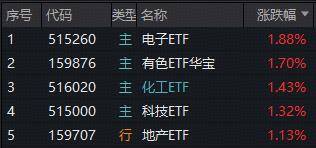
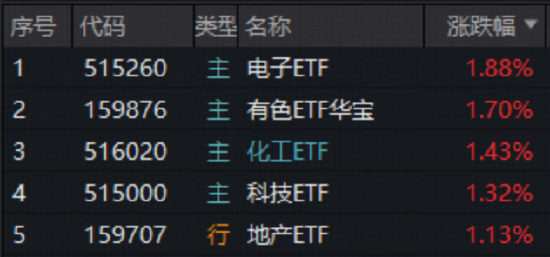
Market Overview - The A-share market experienced fluctuations on January 15, with the Shanghai Composite Index briefly falling below 4100 points before recovering at the close. The Shanghai Composite Index fell by 0.33%, while the Shenzhen Component Index rose by 0.41%, and the ChiNext Index increased by 0.56% [1] - The total trading volume in the Shanghai and Shenzhen markets was 29.388 billion yuan, significantly down by over 10 billion yuan compared to the previous day [1] Sector Performance Electronics Sector - The electronics sector saw a strong rally in the afternoon, with the electronic ETF (515260) rising by 1.88%, recovering its 5-day moving average. The sector attracted a net inflow of 16.862 billion yuan from institutional investors, leading all 31 primary industries [3][6] - Key stocks in the electronics sector included Unigroup Guowei, which hit a daily limit up of 10%, and Huazhong Microelectronics, which rose by 7.58% [4][5] Chemical Sector - The chemical sector also performed well, with the chemical ETF (516020) reaching a peak increase of 2.42% during the day and closing up by 1.43%, marking a new three-year high. The sector attracted 14.7 billion yuan in net inflows, leading the market [9][11] - Notable stocks included Tongcheng New Materials, which hit the daily limit up, and Hongda Co., which surged by 6.25% [9][13] AI and Robotics Sector - The AI and robotics sectors faced some challenges, with the general aviation ETF (159231) dropping by 3.56%. However, the ChiNext AI ETF (159363) and the Sci-Tech AI ETF (589520) also saw declines, indicating a mixed performance in this area [1][15] Investment Insights - Analysts from Huajin Securities believe that the recent adjustment of financing margin ratios will have a limited impact on A-share trends, as the market is currently in a slow bull phase supported by structural recovery in profits and low credit levels [2] - The electronics sector is expected to benefit from the U.S. government's recent imposition of tariffs on certain semiconductors, which may enhance domestic substitution sentiment [6] - The chemical industry is anticipated to experience a rebound in profitability as supply-demand dynamics stabilize, with AI-driven production capabilities expected to lead to new growth opportunities [13][14]



A股缩量震荡!顺周期起舞,有色ETF华宝、化工ETF逆市创新高!热门赛道遇冷,通用航空ETF华宝跌超3%
Xin Lang Cai Jing· 2026-01-15 11:31
Market Overview - The A-share market experienced fluctuations on January 15, with the Shanghai Composite Index briefly falling below 4100 points before recovering at the close. The Shanghai Composite Index fell by 0.33%, while the Shenzhen Component Index rose by 0.41%, and the ChiNext Index increased by 0.56%. The total trading volume in the Shanghai and Shenzhen markets was 29.388 trillion yuan, a significant decrease of over 1 trillion yuan compared to the previous day [1][20]. Electronic Sector - The electronic sector saw a strong rally in the afternoon, with the electronic ETF (515260) rising by 1.88%. This ETF is heavily weighted in semiconductor and consumer electronics industries, and it recovered its 5-day moving average [3][23]. - The electronic sector attracted a net inflow of 16.862 billion yuan, leading all 31 primary industries in terms of capital inflow [3][23]. - Key stocks in the semiconductor sector, such as Unisoc and Huazhong Microelectronics, saw significant gains, with Unisoc hitting the daily limit of 10% [25][26]. Chemical Sector - The chemical sector also performed well, with the chemical ETF (516020) reaching a peak increase of 2.42% during the day, closing up 1.43%, marking a new three-year high [8][29]. - The basic chemical sector attracted a net inflow of 14.694 billion yuan, the highest among 30 primary industries, and has seen a cumulative net inflow of 254.049 billion yuan over the past 60 days [10][31]. - The chemical ETF has outperformed major indices since the beginning of 2025, with a cumulative increase of 48.29%, significantly higher than the Shanghai Composite Index's 22.7% and the CSI 300 Index's 20.75% [29][30]. AI and Semiconductor Trends - The U.S. government announced a 25% tariff on specific semiconductors, which may enhance domestic substitution sentiment in the market [25][27]. - The demand for AI computing power is expected to drive significant price increases in storage chips, with projections indicating a rise of up to 1800% for certain DDR chips by 2025 [27]. - The trend of "self-controllable" and AI synergy is anticipated to strengthen in the electronics industry, with a focus on domestic computing power and semiconductor equipment [27]. Investment Tools - The electronic ETF (515260) and its linked funds are effective tools for investors looking to gain exposure to core assets in the electronic sector, particularly in AI chips, automotive electronics, and 5G technologies [27]. - The chemical ETF (516020) is also highlighted as a strategic investment vehicle, covering various segments within the chemical industry, including AI computing and robotics [13][29].
“易中天”尾盘短线拉升,创业板人工智能ETF顽强收阳!基金经理:业绩驱动下,光模块或成资金抱团方向
Xin Lang Cai Jing· 2026-01-15 11:20
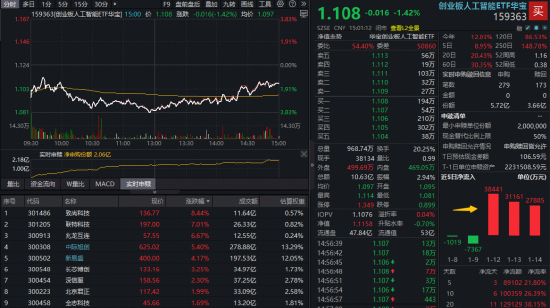
Core Viewpoint - The AI sector is experiencing a rebound, with significant movements in the stock market, particularly in the AI application and computing power segments, indicating a strong market sentiment despite some short-term corrections [1][8]. Group 1: Market Performance - The ChiNext AI index showed a strong recovery, closing positively despite a notable drop in AI application stocks like BlueFocus and Toray, which fell over 10% [1][8]. - The computing power segment, particularly light modules, saw a late surge, with stocks like Zhongji Xuchuang and Xinyi Sheng rising over 5% and 4% respectively [1][8]. - The popular ETF tracking the ChiNext AI index (159363) experienced a net subscription of 206 million units in a single day, with total trading volume exceeding 1 billion yuan [1][8]. Group 2: Industry Insights - The light module industry is in a high prosperity cycle, driven by the explosive demand for AI computing power, with supply becoming a core issue [3][10]. - Major manufacturers in the light module sector are accelerating production in mainland China and Thailand, with expectations of significant capacity release by Q1 2026 [3][10]. - The ETF manager highlighted that the recent market corrections do not alter the strong performance expectations for the A-share market in the first half of the year, suggesting that light module stocks could be a good focus during this period [11]. Group 3: AI Application Developments - Alibaba's Qianwen App has integrated with various services within its ecosystem, marking a significant advancement in AI shopping capabilities [11]. - The AI industry is witnessing rapid developments, with new financing rounds for overseas AI companies and the introduction of domestic policies promoting "AI + manufacturing" [11]. - The commercialization of AI applications is accelerating, with a notable decrease in costs associated with inference and long-window models, leading to increased validation in commercial scenarios [11]. Group 4: ETF Performance and Strategy - The ChiNext AI ETF (159363) has been included in the Hong Kong Stock Exchange's mutual market access list, which is expected to enhance liquidity and trading activity [12]. - As of January 14, the ETF's total assets reached a record high of over 5.3 billion yuan, with an average daily trading volume of over 700 million yuan in the past six months, ranking first among eight ETFs tracking the ChiNext AI index [12].
通信设备板块1月15日涨0.88%,神宇股份领涨,主力资金净流出10.58亿元
Zheng Xing Xing Ye Ri Bao· 2026-01-15 08:58
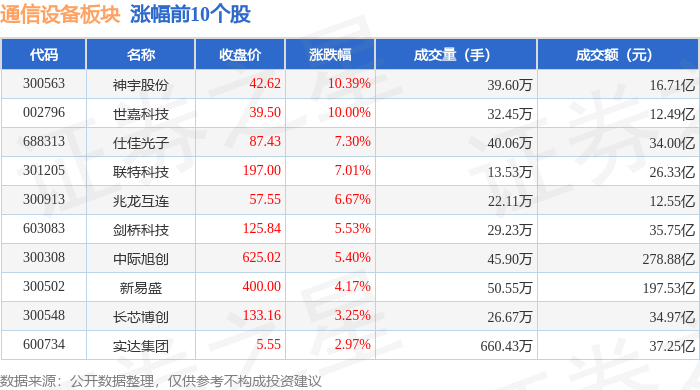
Core Viewpoint - The communication equipment sector experienced a mixed performance, with a slight overall increase of 0.88% on January 15, while the Shanghai Composite Index fell by 0.33% and the Shenzhen Component Index rose by 0.41% [1]. Group 1: Stock Performance - Shenyu Co., Ltd. led the gains in the communication equipment sector with a closing price of 42.62, reflecting a rise of 10.39% and a trading volume of 396,000 shares, amounting to a transaction value of 1.671 billion [1]. - Other notable performers included: - Sega Technology with a closing price of 39.50, up 10.00% [1]. - Shijia Photon with a closing price of 87.43, up 7.30% [1]. - Lian Te Technology with a closing price of 197.00, up 7.01% [1]. - Zhaolong Interconnect with a closing price of 57.55, up 6.67% [1]. Group 2: Declining Stocks - The sector also saw significant declines, with Guangha Communication dropping 17.15% to a closing price of 28.98 [2]. - Other stocks that faced losses included: - Fujida down 10.68% to 44.90 [2]. - Xinkemobile down 10.66% to 17.76 [2]. - Huanghuo Communication down 10.01% to 43.07 [2]. Group 3: Capital Flow - The communication equipment sector experienced a net outflow of 1.058 billion from institutional investors and 2.280 billion from retail investors, while retail investors saw a net inflow of 3.338 billion [2]. - The capital flow for specific stocks indicated: - Zhongji Xuchuang had a net inflow of 1.832 billion from institutional investors [3]. - Xinyi Sheng saw a net inflow of 1.208 billion [3]. - Shijia Photon had a net inflow of 516 million [3].




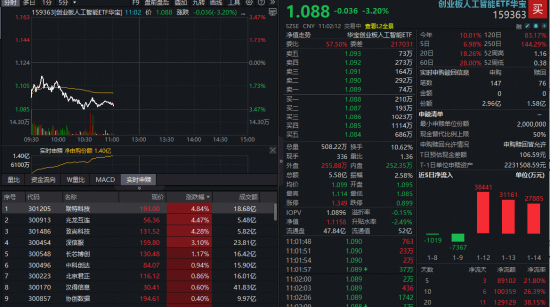
ETF盘中资讯|大牛股停牌核查,AI应用突陷回调!创业板人工智能ETF(159363)大跌3%资金火速进场,抢筹1.4亿份
Sou Hu Cai Jing· 2026-01-15 03:43
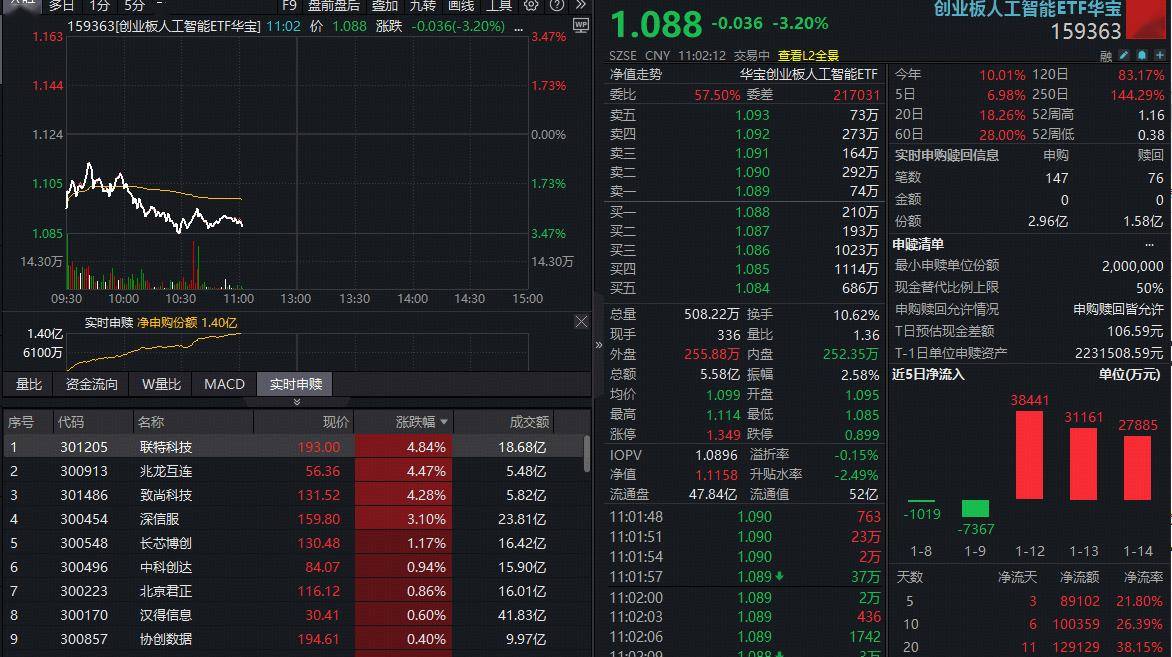
Core Viewpoint - The AI sector is experiencing a collective pullback, particularly in the entrepreneurial board, with significant declines in AI application stocks, while the computing power segment shows localized activity and resilience [1][3]. Group 1: Market Performance - The entrepreneurial board's AI sector saw a drop of over 3% in early trading, with notable declines in AI application stocks such as Yidian Tianxia and Lihua Lu, which faced trading suspensions and limit-downs [1]. - The entrepreneurial board AI ETF (159363) experienced a price drop of 3.20%, with a trading volume exceeding 5 billion CNY and a net subscription of 140 million shares, indicating continued capital inflow despite the downturn [1][2]. Group 2: Sector Dynamics - The AI industry is witnessing rapid developments, with significant financing activities in overseas AI companies and the introduction of domestic policies promoting "AI + manufacturing," which are expected to catalyze new application trends [3]. - The IDC (data center) sector is showing signs of a potential revaluation, driven by increased capital expenditures from major domestic firms and improvements in chip supply, suggesting a favorable investment window for the IDC sector [3]. - The optical module sector is anticipated to experience a performance boost due to accelerated production capacity, with expectations of a concentrated release of capacity in Q1 2026, which could drive earnings growth [3]. Group 3: Investment Opportunities - The entrepreneurial board AI ETF is positioned to benefit directly from the commercialization of AI technologies, with approximately 60% of its portfolio allocated to computing power (optical modules + IDC) and 40% to AI applications, highlighting its dual focus on both sectors [3].
大牛股停牌核查,AI应用突陷回调!创业板人工智能ETF(159363)大跌3%资金火速进场,抢筹1.4亿份
Xin Lang Cai Jing· 2026-01-15 03:22
Core Viewpoint - The AI sector is experiencing a collective pullback, particularly in the entrepreneurial board, with significant declines in AI application stocks, while the computing power segment shows localized activity and resilience [1][3][7]. Group 1: Market Performance - On the morning of the 15th, the entrepreneurial board's AI sector dropped over 3%, with notable declines in AI application stocks such as Yidian Tianxia and Yihualu, which faced trading halts and limit downs respectively [1][3]. - The entrepreneurial board AI ETF (159363), which focuses on "computing power + AI applications," saw a price drop of 3% with a trading volume exceeding 5 billion, indicating continued capital inflow with a net subscription of 140 million shares [1][3][7]. Group 2: Sector Catalysts - The entrepreneurial board's AI sector is poised for multiple catalysts, including accelerated commercialization of AI applications and a value reassessment in the computing power segment, particularly in IDC and optical modules [3][7]. - Recent developments in the AI industry, such as financing rounds for xAI and Anthropic, and the introduction of domestic "AI + manufacturing policies," are expected to drive new waves of AI application enthusiasm [3][7]. - The IDC sector is showing signs of a potential revaluation due to increased capital expenditure from major domestic companies and improvements in chip supply, suggesting a favorable investment window [3][7]. Group 3: Industry Outlook - The optical module sector is anticipated to experience a concentrated release of production capacity by Q1 2026, which could drive a new growth phase in performance [3][7]. - The entrepreneurial board AI ETF (159363) is structured to benefit directly from the commercialization explosion of AI technology, with approximately 60% of its portfolio allocated to computing power and 40% to AI applications [3][7][8].
研判2026!中国新能源汽车核心电力传输零部件行业政策、产业链、市场规模、细分格局、竞争格局及发展趋势:市场迎来快速发展,国内企业迅速崛起[图]
Chan Ye Xin Xi Wang· 2026-01-15 01:59
Core Insights - The core components of new energy vehicles (NEVs) include batteries, motors, and electric control systems, with key power transmission components forming a critical part of the vehicle's "three electric systems" [1][2] - The rapid development of NEVs is closely linked to technological advancements in key components, particularly power transmission parts, which play an irreplaceable role in the value chain of NEVs [1][2] - The market for core power transmission components in NEVs is expected to grow significantly, reaching 39.1 billion yuan in 2024, with projections of exceeding 50 billion yuan in 2025 and potentially reaching 63.2 billion yuan by 2026 [1][2] Market Overview - In 2024, the market share of core power transmission components in NEVs is expected to be dominated by automotive high-voltage wiring harnesses at 56.5%, followed by high-voltage connectors at 32.3%, charging sockets at 8%, and DC charging guns at 3.2% [3][4] - The industry is characterized by a rapid expansion driven by the growth of the NEV market, leading to an increase in the demand for related components [2] Industry Structure - The industry chain for core power transmission components includes upstream materials such as special copper/aluminum materials, insulation materials, and chips; midstream manufacturing of components; and downstream customers including NEV manufacturers and electric drive system suppliers [5] - The relationship between core power transmission components and NEVs is symbiotic, with both driving technological innovation and industry progress [5][6] Competitive Landscape - The competitive landscape is evolving, featuring a mix of foreign giants leading in technology and domestic manufacturers rapidly emerging, supported by cost advantages and flexible services [6] - Key players in the domestic market include companies like Times Electric, BYD Semiconductor, Huawei Digital Energy, and others, which are gaining traction in the industry [6] Market Concentration - The market concentration for DC charging guns in 2024 is high, with a CR3 of 82.2%, CR2 of 66%, and CR1 of 41.7%, indicating a strong competitive environment [7] Growth Trends - The core power transmission components are essential for the efficient and safe distribution of electrical energy in NEVs, acting as the "arteries and nervous system" of vehicle power output [8] - The industry is expected to evolve towards higher efficiency, greater integration, smarter technology, and enhanced stability, with domestic companies actively investing in research and development [8]


研判2025!中国跳线架行业核心特征、产业链、市场规模及发展趋势分析:受益于新基建与数字化浪潮,行业规模不断扩张[图]
Chan Ye Xin Xi Wang· 2026-01-15 01:20
Industry Overview - The patch panel industry is a critical component industry connecting communication, power, and automation equipment, with a market size of approximately 5.791 billion yuan in 2024, representing a year-on-year growth of 6.53% [1][6] - The growth is primarily driven by new infrastructure and digitalization trends, particularly the deployment of 5G networks, data center construction, and the advancement of the industrial internet, creating a stable market increment for patch panel products [1][6] Industry Chain - The upstream of the patch panel industry chain includes raw materials such as copper, steel, stainless steel, engineering plastics, and optical fibers, while the midstream involves the production and manufacturing of patch panels [4] - Downstream applications include data centers, equipment rooms, and floor management rooms, connecting horizontal cables (like twisted pairs and optical fibers) to network devices, facilitating quick connections and supporting fault diagnosis and line changes [4] - Rising copper prices, projected to reach 82,800 yuan per ton by November 2025, pose significant cost pressures on the patch panel industry, as key raw materials are highly dependent on copper [4][5] Market Size - The patch panel industry in China is expected to reach a market size of approximately 5.791 billion yuan in 2024, with a year-on-year growth of 6.53%, benefiting from the new infrastructure and digitalization wave [6][7] Key Companies Performance - Zhejiang Zhaolong Interconnect focuses on high-density wiring solutions, with its SG Matrix series supporting 144 cores, catering to the dynamic expansion needs of data centers. The company reported a revenue of 1.518 billion yuan in the first three quarters of 2025, a year-on-year increase of 13.28% [7] - Shenzhen Zhishang Technology, established in 2009, offers a range of products including MTP/MPO optical fiber jumpers and has reported a revenue of 749 million yuan in the first three quarters of 2025, a year-on-year increase of 3.24% [7] Technological Trends - The industry is witnessing a shift towards intelligent patch panels that integrate high-precision sensors and IoT modules for real-time monitoring and enhanced operational efficiency [9] - The demand for high-speed and fiber-based solutions is accelerating technological iterations, with companies like Zhaolong Interconnect producing 400Gbps high-speed cable components and preparing for 800Gbps capabilities [10] - Prefabricated delivery and modular assembly are becoming mainstream, reducing on-site construction time and error rates, while environmental pressures are driving the adoption of green manufacturing practices [11]