
华熙生物

Search documents
可选消费W07周度趋势解析:通胀降温信号带动海外消费类资产估值修复,美国政界跨党派联手推动信用卡利率上限立法
海通国际· 2026-02-23 10:50
Market Overview - Cooling inflation signals have led to a valuation recovery in overseas consumer assets, with the U.S. bipartisan push for credit card interest rate cap legislation creating uncertainty in the credit card sector[1] - Weekly performance of sectors shows U.S. hotels leading with a 3.1% increase, followed by overseas sportswear at 2.5% and luxury goods at 2.2%[11] Sector Performance - The U.S. hotel sector's strong performance is attributed to Marriott and Hilton, with Marriott's Q4 2025 adjusted EBITDA exceeding market expectations, reaching $5.84 billion to $5.93 billion[6] - Overseas sportswear saw a 2.5% increase, driven by a lower-than-expected January CPI of 2.4%, enhancing Fed rate cut expectations[13] - Luxury goods increased by 2.2%, with Hermès up 4.5% due to better-than-expected FY2025 results, while LVMH fell by 4.1% due to disappointing performance in key segments[8] Consumer Trends - The jewelry sector has shown resilience, with a year-to-date increase of 13.7%, outperforming other sectors[11] - Domestic sportswear increased by 0.3%, with Anta Sports rising 4.6% following the acquisition of a stake in PUMA[13] Challenges - The credit card sector faced a significant decline of 5.5%, influenced by proposed legislation to cap interest rates, which could severely impact profitability[14] - The snack sector dropped by 4.6%, with companies like Three Squirrels experiencing a 6.2% decline due to substantial drops in e-commerce sales across major platforms[14] Valuation Insights - Valuations across various sectors remain below the historical five-year averages, with overseas sportswear expected PE at 30.1x, only 57% of the past average[9] - The luxury sector's expected PE is 26.2x, representing 49% of its historical average, indicating potential for future growth as market conditions stabilize[9]
2025年度商业警示录:当创始人成为最大的“黑天鹅”
Xi Niu Cai Jing· 2026-02-23 03:21
Group 1 - The year 2025 saw significant commercial events that reflect changing consumer expectations and corporate accountability [2] - Companies faced backlash for safety and quality issues, highlighting the need for improved internal processes and transparency [3][4][8][10][11][12][19] - The shift in consumer power emphasizes the importance of brands respecting public sentiment and adapting to a more transparent market environment [21][22] Group 2 - 吉祥航空 faced criticism for distributing expired snacks, revealing serious lapses in food safety protocols and poor crisis management [3][4] - 千禾's "zero-additive" soy sauce controversy raised questions about product labeling and consumer trust, leading to a re-evaluation of marketing strategies [5][6][7] - The charging battery industry experienced a safety crisis with 罗马仕 recalling over 490,000 units due to fire risks, contrasting with 安克创新's swift response [8][9] - 白象's "half bag" noodle marketing was criticized for misleading consumers about product quantity, resulting in a rebranding effort [9][10] - 华熙生物 and 巨子生物 engaged in a public dispute over product claims, damaging both brands' reputations in the competitive beauty market [10][11] - 爱康国宾 faced a public relations disaster after a client revealed a serious misdiagnosis, leading to widespread criticism of the commercial health screening industry [11][12] - 理想汽车's marketing stunt involving a crash test video backfired, leading to public skepticism and a necessary apology [12][13][14] - 桃李面包's controversial advertising campaign resulted in a public backlash, but the company's transparent response turned the situation into a positive PR opportunity [15][16] - 西贝's struggle with public perception regarding the use of pre-prepared ingredients led to significant operational changes and store closures [17][18] - 始祖鸟's environmentally insensitive marketing stunt sparked outrage among its core audience, prompting a public apology and highlighting the importance of brand values [19][20]


珈凯生物收北交所IPO二轮问询:要求说明“已深度融入中国化妆品产业核心生态链”的依据等
Xin Lang Cai Jing· 2026-02-19 09:22
Core Viewpoint - Beijing Stock Exchange has issued a second round of inquiry regarding the IPO application of Shanghai Jiakai Biological Co., Ltd., focusing on customer cooperation stability, performance growth sustainability, gross margin authenticity, and compliance of equity changes [1] Group 1: Company Overview - Jiakai Biological specializes in the research, production, and sales of cosmetic functional raw materials, with a client base that includes major brands such as Proya, Fuda, and Huaxi [1] - The company reported revenues of 182.62 million yuan in 2022, 217.50 million yuan in 2023, and projected 242.44 million yuan in 2024, indicating a consistent growth trend [2][3] Group 2: Financial Performance - Revenue for the first half of 2025 is reported at 122.12 million yuan, with a year-on-year growth of 12.28% [2] - The company achieved a revenue of 194.81 million yuan for the first nine months of 2025, reflecting a 7.91% increase compared to the same period last year [3] Group 3: Market Position - Jiakai Biological holds a market share of approximately 1.64% in the domestic functional raw materials market, which is projected to reach 14.8 billion yuan in 2024 [5] - The company claims to have deeply integrated into the core ecosystem of China's cosmetic industry, establishing strong partnerships with leading domestic brands [5] Group 4: Customer Dynamics - The company has experienced revenue declines from major clients in both self-produced and OEM products, with core customers contributing to 63.85% of revenue in the first half of 2025 [4] - The inquiry requires Jiakai Biological to explain the reasons behind the revenue fluctuations from key clients and the stability of customer relationships [4] Group 5: Gross Margin Analysis - Jiakai Biological's gross margin has remained stable at over 63% from 2022 to mid-2025, which raises questions about its sustainability compared to industry peers [6] - The inquiry demands an analysis of the factors affecting gross margin stability, including product structure and pricing mechanisms [6] Group 6: Future Projects - The company plans to raise 309.56 million yuan for a project to produce 50 tons of functional plant extracts annually, with a focus on high-purity single-component products [6][7] - The inquiry seeks clarification on the advantages of the new products compared to existing ones and the potential market demand [7] Group 7: Shareholding Structure - The company has three main actual controllers who collectively hold significant voting rights, with an agreement in place to maintain consistent decision-making for 36 months post-IPO [8] - The inquiry requires details on the decision-making mechanisms and dispute resolution processes among the actual controllers [8]

2025年中国NMN行业研究报告
艾瑞咨询· 2026-02-19 00:05
Core Viewpoint - NMN (β-Nicotinamide Mononucleotide) is gaining attention in the global health industry for its potential anti-aging benefits, DNA repair, and metabolic regulation, with significant regulatory advancements expected by 2025 [1][2]. Industry Development - The NMN industry has evolved from laboratory research to commercial applications, with major markets like the US, Japan, Canada, and Australia recognizing its legal status through various regulatory pathways [1][2]. - China is currently the largest producer of NMN raw materials, with leading companies building competitive barriers through technological innovation and industry chain layout [2][19]. NMN Definition and Function - NMN is a direct precursor to NAD+ (Nicotinamide Adenine Dinucleotide), crucial for delaying aging and enhancing physiological functions [3][4]. - As NAD+ levels decline with age, NMN supplementation can quickly elevate NAD+ levels, playing a vital role in anti-aging, cardiovascular health, and metabolic improvement [4][6]. Regulatory Environment - The global regulatory landscape for NMN is shifting from strict restrictions to cautious openness, with significant milestones achieved in various countries [17][18]. - In China, NMN has been approved as a new cosmetic ingredient and is on the path to being recognized as a health food, with the National Market Supervision Administration listing it for health food approval in April 2025 [17][18]. Market Demand - The aging population in China is expected to grow significantly, with the elderly population projected to increase from 320 million to 390 million by 2030, driving demand for anti-aging products [19]. - Younger generations are also increasingly aware of anti-aging needs, creating a dual demand for NMN products [19]. Technological Innovations - Advances in synthesis methods, particularly the full enzyme method, are driving down costs and improving product quality in the NMN industry [21][22]. - Innovations in delivery technologies are enhancing the bioavailability of NMN, ensuring better absorption and user experience [22]. Application Areas - NMN is primarily used in health supplements and cosmetics, with health supplements accounting for nearly 90% of the market share [24][28]. - Future applications are expected to expand into pet nutrition, medical health, and agricultural technology, opening new growth avenues [24][28]. Market Size and Growth - The NMN market in China is expected to exceed 3 billion yuan by 2025, driven by increasing regulatory support and expanding applications [28][32]. - The market is currently dominated by health supplements and cosmetics, with significant growth potential in other sectors as regulations ease [28][32]. Sales Channels - NMN products are primarily sold through cross-border e-commerce and private channels, with cross-border e-commerce accounting for 60%-70% of market share [35][34]. Certification and Standards - The "blue hat" certification for health foods in China represents the highest standard for NMN products, indicating safety and compliance [37]. Challenges and Opportunities - The NMN industry faces challenges such as exaggerated claims, lack of consumer awareness, and technological iterations, necessitating a focus on compliance and innovation [61][63]. - Companies are encouraged to innovate their business models and extend their value chains to enhance competitiveness [66].



2025年中国NMN行业研究报告
艾瑞咨询· 2026-02-14 01:19
Core Viewpoint - NMN (β-Nicotinamide Mononucleotide) is gaining attention in the global health industry for its potential in anti-aging, DNA repair, and metabolic regulation, with significant advancements in regulatory approval and market potential expected by 2025 [1][2]. Industry Overview - The NMN industry has transitioned from laboratory research to commercial viability, with major markets like the US, Japan, Canada, and Australia recognizing its legal status through various regulatory pathways [1][2]. - China is currently the largest producer of NMN raw materials, with leading companies establishing competitive barriers through technological innovation and industry chain layout [2]. NMN Definition and Function - NMN is a direct precursor to NAD+ (Nicotinamide Adenine Dinucleotide), crucial for delaying aging and enhancing physiological functions [3][4]. - Supplementing NMN can rapidly increase NAD+ levels in the body, playing a vital role in anti-aging, cardiovascular health, and metabolic improvement [4]. Synthesis Pathways - NMN supplementation shows significant advantages in NAD+ synthesis pathways compared to other precursors, with the highest conversion efficiency and no known adverse reactions [6][7]. Natural Sources and Supplementation - Natural food sources of NMN are limited, with dietary intake often insufficient to meet effective dosage levels; NMN supplements provide a much higher intake efficiency [8]. Synthesis Technology - The NMN synthesis process has evolved from chemical methods to fully enzymatic methods, focusing on high purity, safety, and environmental sustainability [10][11]. - Leading companies are innovating in fully enzymatic synthesis techniques, creating competitive advantages through patent applications and cost reductions [12]. Development History - The NMN research journey began in 1904, with significant milestones in the 21st century, including pivotal studies confirming NMN's lifespan-extending effects in mice, which attracted global investment [15][14]. Policy Drivers - The regulatory environment for NMN is evolving, with a shift from strict restrictions to cautious openness in major markets, including China, where NMN is moving towards legal status as a health food [17][18]. Demand Drivers - The aging population and increasing anti-aging awareness among younger demographics are driving demand for NMN products, creating a substantial market opportunity [19]. Technological Advancements - Innovations in synthesis, quality testing, and delivery methods are driving the NMN industry towards efficiency and standardization, enhancing product efficacy and user experience [21][22]. Application Areas - NMN is primarily used in health supplements and cosmetics, with potential expansion into pet nutrition, medical health, and agricultural technology [24][28]. Market Size and Growth - The NMN market in China is expected to exceed 30 billion yuan by 2025, driven by regulatory changes and new applications in various sectors [28]. Sales Channels - NMN products are primarily sold through cross-border e-commerce and private channels, with cross-border platforms capturing 60%-70% of the market share [35]. Certification Standards - The "blue hat" certification for health foods in China represents the highest standard for NMN products, indicating safety and compliance [37]. Future Prospects - NMN's potential in cosmetics is significant, with a growing market for anti-aging products and a high compliance level expected to accelerate market growth [51]. Challenges - Despite positive regulatory signals, the NMN industry faces challenges such as exaggerated claims, lack of consumer awareness, and the need for ongoing technological advancements [61][63].

2025年中国NMN行业研究报告
艾瑞咨询· 2026-02-14 00:08
Core Viewpoint - NMN (β-Nicotinamide Mononucleotide) is gaining global attention in the health industry due to its potential in anti-aging, DNA repair, and metabolic regulation, with significant advancements in regulatory approval and market potential expected by 2025 [1][2]. Group 1: NMN Definition and Function - NMN is a direct precursor to NAD+ (Nicotinamide Adenine Dinucleotide), crucial for delaying aging and enhancing physiological functions [3][4]. - Supplementing NMN can rapidly increase NAD+ levels in the body, playing a vital role in anti-aging, cardiovascular health, and cognitive function [4][6]. Group 2: Global Regulatory Landscape - By 2025, NMN's global compliance process is expected to accelerate, with major markets like the US, Japan, Canada, and Australia confirming its legal status through various regulatory pathways [1][2]. - In China, NMN has not yet received approval as a drug or health food, but it has been recognized as a new cosmetic ingredient, laying the groundwork for future regulatory developments [1][17]. Group 3: Market Demand Drivers - The aging population in China is projected to grow significantly, with the elderly population expected to increase from 320 million to 390 million between 2025 and 2030, driving the "silver economy" and demand for anti-aging products [19]. - Younger generations, particularly those born in the 1990s, are increasingly aware of anti-aging needs, creating a dual demand for NMN products [19]. Group 4: Technological Innovations - Continuous innovations in synthesis, quality testing, and delivery methods are driving the NMN industry forward, with full enzyme methods significantly enhancing production efficiency and reducing costs [21][22]. - The establishment of testing standards is raising industry entry barriers, promoting market development [22]. Group 5: Current Market Status - The NMN market in China has been expanding rapidly since its large-scale entry in 2020, with expectations to exceed 3 billion yuan by 2025 [28]. - NMN is primarily used in health supplements (approximately 90% of applications) and cosmetics (10-20%), with potential future applications in pet nutrition, medical health, and agricultural technology [24][28]. Group 6: Sales Channels - NMN products are mainly sold through cross-border e-commerce and private channels, with cross-border e-commerce accounting for 60-70% of the market share [35]. Group 7: Industry Challenges - The NMN industry faces challenges such as exaggerated claims, lack of consumer awareness, and the need for technological iteration, necessitating a focus on compliance and innovation to unlock market potential [61][63].

免费领取!《2025中国合成生物制造产业发展白皮书》
synbio新材料· 2026-02-13 23:01
Core Viewpoint - The article emphasizes the rising importance of biomanufacturing as a strategic and innovative field that disrupts traditional production methods, presenting it as a new growth point for optimizing industrial structure and transforming economic models [1]. Group 1: Current Status and Trends - The "2025 China Synthetic Biomanufacturing Industry Development White Paper" was officially released on August 1, highlighting the current state and trends of biomanufacturing [1]. - The report analyzes the global biomanufacturing industry, including key platform facilities and a comparative study of the US and China in this sector [7]. Group 2: Policy Landscape - The white paper outlines major domestic and international policies affecting biomanufacturing from 2024 to 2025, providing insights into regulatory frameworks [7]. Group 3: Industry Map and Applications - It presents a comprehensive map of the Chinese biomanufacturing industry and identifies key application areas, including pharmaceuticals, food, personal care, agriculture, chemicals, materials, and energy [7]. Group 4: Key Enterprises - The report selects ten leading enterprises in the Chinese biomanufacturing sector and details the strategic directions of 15 listed companies in synthetic biology [7][8]. Group 5: Investment and Challenges - The document discusses the investment landscape in synthetic biology from 2024 to mid-2025 and addresses the challenges faced by the biomanufacturing industry in China, along with proposed countermeasures [7].



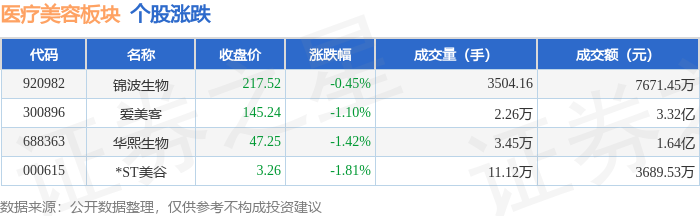
医疗美容板块2月13日跌1.27%,*ST美谷领跌,主力资金净流出5591.6万元
Sou Hu Cai Jing· 2026-02-13 09:05
Market Overview - The medical beauty sector experienced a decline of 1.27% on February 13, with *ST Meigu leading the drop [1] - The Shanghai Composite Index closed at 4082.07, down 1.26%, while the Shenzhen Component Index closed at 14100.19, down 1.28% [1] Stock Performance - Key stocks in the medical beauty sector showed the following performance: - Jinbo Biological (920982) closed at 217.52, down 0.45% with a trading volume of 3504.16 and a transaction amount of 76.71 million [1] - Aimeike (300896) closed at 145.24, down 1.10% with a trading volume of 22,600 and a transaction amount of 3.32 billion [1] - Huaxi Biological (688363) closed at 47.25, down 1.42% with a trading volume of 34,500 and a transaction amount of 164 million [1] - *ST Meigu (000615) closed at 3.26, down 1.81% with a trading volume of 111,200 and a transaction amount of 36.89 million [1] Capital Flow - The medical beauty sector saw a net outflow of 55.91 million from main funds, while retail investors contributed a net inflow of 21.01 million [1] - Detailed capital flow for key stocks includes: - *ST Meigu: Main funds net outflow of 3.25 million, retail net inflow of 1.37 million [2] - Jinbo Biological: Main funds net outflow of 10.75 million, retail net outflow of 1.08 million [2] - Huaxi Biological: Main funds net outflow of 13.55 million, retail net inflow of 12.55 million [2] - Aimeike: Main funds net outflow of 39.11 million, retail net inflow of 7.09 million [2]

“中国康湾”浮出水面,为这座城市打开新的想象空间
Xin Jing Bao· 2026-02-12 09:17
Core Viewpoint - The "silver economy" is emerging as a trillion-level industry, with the "China Health Bay" initiative in Qingdao positioning the city as a new hub for health and wellness in response to the aging population [2][4]. Group 1: Development Plans and Goals - Qingdao has launched the "China Health Bay" three-year action plan (2025-2027), aiming for a life and health industry scale of 100 billion yuan by 2027, focusing on integrating real estate, healthcare, wellness, and cultural tourism [3][5]. - The plan emphasizes "full-area wellness and all-age health," with 19 key tasks to enhance the city's influence as an international health and wellness destination [3][5]. Group 2: Strategic Advantages - Qingdao's strategy is based on its unique resources, including being a pilot city for rehabilitation assistive devices and housing the only rehabilitation university in the country, which fosters talent and technological innovation [4][5]. - The city benefits from a solid foundation in marine biomedicine, with an expected industry output of over 30 billion yuan in 2024, supported by leading companies like Huang Hai Pharmaceutical and Huaxi Biological [5][6]. Group 3: Policy Support and Implementation - Qingdao has established a leadership group to oversee the "China Health Bay" initiative, with 31 departments collaborating and nine supporting policies introduced to facilitate funding, land, and talent [5][6]. - The city is promoting deep integration of "medical + wellness + cultural tourism + real estate," creating convenient wellness services within communities [6][7]. Group 4: Challenges and Opportunities - Despite the growth potential, Qingdao faces challenges such as uneven resource allocation, a shortage of professional talent, and insufficient innovation capabilities compared to other renowned wellness cities [6][7]. - The city is actively addressing these issues through initiatives like a training verification center for technological advancements and a talent cultivation alliance [7]. Group 5: Future Outlook - The "China Health Bay" initiative is not only a strategic move to capture industry opportunities but also a commitment to enhancing the quality of life for residents and addressing the aging population [7]. - As the three-year action plan progresses, Qingdao aims to provide a replicable model for the national wellness industry, contributing to sustainable urban development [7].

医疗美容板块2月12日跌1.53%,华熙生物领跌,主力资金净流出1亿元
Sou Hu Cai Jing· 2026-02-12 09:09
Core Viewpoint - The medical beauty sector experienced a decline of 1.53% on February 12, with Huaxi Biological leading the drop [1] Market Performance - The Shanghai Composite Index closed at 4134.02, up 0.05% - The Shenzhen Component Index closed at 14283.0, up 0.86% [1] Capital Flow - The medical beauty sector saw a net outflow of 100 million yuan from main funds - Retail investors contributed a net inflow of 70.71 million yuan - Speculative funds recorded a net inflow of 29.6257 million yuan [1]
