国联安基金

Search documents
超630亿元“跑了”
中国基金报· 2026-01-23 05:56
Core Viewpoint - On January 22, the stock ETF market experienced a significant net outflow of 63.31 billion yuan, indicating a preference for stability amid market volatility [2][4]. Group 1: ETF Market Overview - As of January 22, the total scale of all stock ETFs in the market reached 4.62 trillion yuan, with a net outflow of 63.31 billion yuan on that day [4]. - The industry theme ETFs and commodity ETFs saw substantial inflows, with net inflows of 12.04 billion yuan and 1.99 billion yuan, respectively [5]. Group 2: Sector Performance - The semiconductor sector had the most notable net inflow, amounting to 3.86 billion yuan on January 22, with the Jiashan Fund's Sci-Tech Chip ETF leading with a net inflow of 0.93 billion yuan [5]. - The chemical sector also performed well, with a net inflow of 2.97 billion yuan, driven by the Penghua Fund's chemical ETF, which saw a net inflow of 1.36 billion yuan [5]. - Other sectors with significant inflows included electric grid equipment, non-ferrous metals, gold, and pharmaceuticals, with the Huaxia Fund's electric grid equipment ETF receiving a net inflow of 0.87 billion yuan [5]. Group 3: Outflows from Broad-based ETFs - Broad-based ETFs experienced substantial outflows, totaling 76.95 billion yuan, with the CSI 300 ETF leading the outflows at 46.76 billion yuan [10]. - Other notable outflows included the CSI 1000 ETF with 16.6 billion yuan, the SSE 50 ETF with 5.26 billion yuan, and the ChiNext ETF with 3.54 billion yuan [10].


最新!超990亿元,“跑了”!
Zhong Guo Ji Jin Bao· 2026-01-22 06:59
Group 1 - The core point of the article highlights a significant outflow of funds from stock ETFs, exceeding 990 billion yuan, with broad-based ETFs collectively experiencing a net outflow of over 1 trillion yuan [2][3] - On January 21, the total net outflow from the stock ETF market (including cross-border ETFs) reached 994.94 billion yuan, with broad-based ETFs seeing a decline in scale by 940.9 billion yuan [3] - The SGE Gold 9999 index recorded the highest net inflow of 19.29 billion yuan, while the CSI 300 index faced the largest net outflow of 581.98 billion yuan on the same day [3] Group 2 - The top-performing ETFs in terms of net inflow included the Electric Grid Equipment ETF and the Chemical ETF, with net inflows of 14.38 billion yuan and 8.26 billion yuan, respectively [6][7] - Notable inflows were also observed in the Gold Stock ETF and the Semiconductor ETF, with net inflows of 5.74 billion yuan and 5.20 billion yuan, respectively [6] - The report indicates that the Electric Grid Equipment ETF and the Semiconductor ETF from Huaxia Fund saw significant inflows, reflecting investor interest in these sectors [3][4] Group 3 - The article mentions that the CSI 300 ETF and the CSI 1000 ETF were among the largest "bloodletting" ETFs, with substantial net outflows of 168.28 billion yuan and 138.52 billion yuan, respectively [5][7] - The overall market sentiment remains cautiously optimistic, with expectations for a continued upward trend in the Chinese stock market, particularly in growth sectors such as AI and industrial metals [8] - The investment strategy suggested includes focusing on core growth assets, which are currently at historical median valuations, providing potential for valuation recovery [8]

基金申赎政策分化 策略调整释放资产配置新信号
Xin Lang Cai Jing· 2026-01-21 20:32
Core Viewpoint - The public fund market is experiencing a significant divergence in subscription and redemption policies, reflecting the differing market environments and investment strategies of various fund types [1][2]. Group 1: Fund Subscription Policies - China Europe Fund has announced the resumption of large subscriptions for its two-year holding period mixed fund, indicating a recovery in confidence regarding equity assets [2]. - In contrast, China Merchants Fund has implemented restrictions on large subscriptions for its pure bond fund, limiting daily subscriptions to 100 RMB, highlighting a cautious approach in the bond market [2][5]. Group 2: Market Trends and Fund Flows - As of January 19, the total scale of 1,307 stock ETFs reached 4.61 trillion RMB, with a net outflow of 418.23 billion RMB in the previous day, primarily from broad-based ETFs [3]. - Conversely, industry-themed ETFs and commodity ETFs saw net inflows of 155.04 billion RMB and 22.44 billion RMB, respectively, indicating a divergence in fund flows that impacts subscription policies [3]. Group 3: Underlying Logic of Policy Divergence - The differential adjustments in subscription policies reflect fund managers' cautious judgments on asset allocation, with a positive outlook on equity markets supported by significant inflows into specific ETFs [4]. - The current low yield environment for bonds, with 10-year government bond yields at historical lows, has led to a decrease in the attractiveness of bond assets, prompting fund managers to limit large subscriptions to protect investor interests [4][5]. Group 4: Implications for Investors - The divergence in fund subscription policies signals clear allocation messages for investors, suggesting that the resumption of large subscriptions in equity funds indicates favorable conditions for building or increasing positions [7]. - The stable LPR rates and government initiatives to promote technological self-reliance align with the trend of capital flowing into technology-themed ETFs, further supporting the equity market [7].
ETF市场首现万亿机构 超百只“迷你”ETF或陷清盘危机
YOUNG财经 漾财经· 2026-01-19 13:56
Core Viewpoint - The Chinese ETF market is experiencing significant growth, with the total market size reaching 6.24 trillion yuan and the first ETF management company surpassing 1 trillion yuan in assets under management [2][3]. Group 1: Market Growth - By the end of 2025, the ETF market is projected to reach 6 trillion yuan, having crossed several milestones throughout the year [3]. - The market started at 3.73 trillion yuan in early 2025 and saw rapid growth, surpassing 4 trillion yuan in April, 5 trillion yuan in August, and 6 trillion yuan in December [3]. - A total of 24 fund companies increased their ETF management scale by over 10 billion yuan, with 8 companies exceeding 100 billion yuan [3]. Group 2: Concentration of Market Share - 16 fund companies dominate the ETF market, holding approximately 89.58% of the total market share, which amounts to 5.59 trillion yuan [4]. - The average management scale of the 58 fund companies in the ETF market is about 1.08 billion yuan, indicating a significant disparity between large and small firms [4]. - The "Matthew Effect" is evident, as larger firms continue to gain market share while smaller firms struggle to compete [4]. Group 3: Performance of ETFs - There are currently 7 ETFs with assets exceeding 100 billion yuan, collectively amounting to 1.61 trillion yuan [5]. - The market has 126 ETFs with assets between 10 billion and 100 billion yuan, while 304 "mini" ETFs have less than 1 billion yuan, with the smallest at 0.07 million yuan [5][6]. - The trend shows that larger ETFs are more attractive to investors due to better liquidity and lower risk, leading to a decline in smaller ETFs [6]. Group 4: Risk of Liquidation - 126 ETFs have fallen below the 50 million yuan threshold, indicating potential liquidation risks for these funds [8]. - The market has seen 7 ETFs terminate their listings, with some experiencing significant declines in value [7]. - Fund managers are required to disclose and report to regulatory authorities if their funds fall below certain asset thresholds, which could lead to liquidation or merging with other funds [7][8].

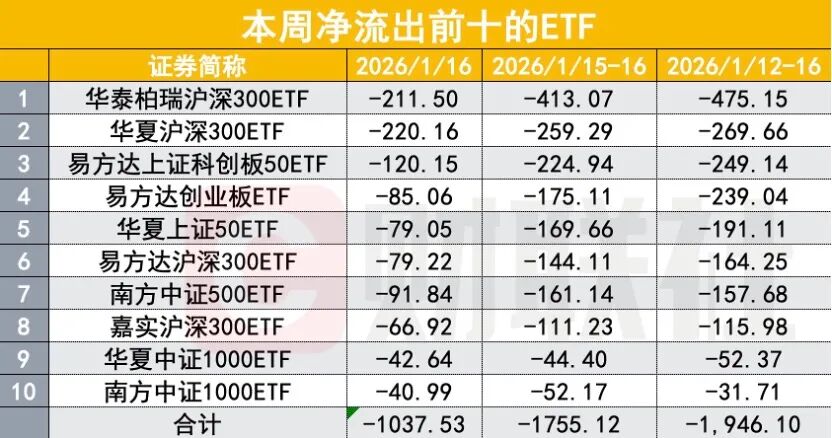
十大宽基ETF,单周净流出近2000亿元
3 6 Ke· 2026-01-19 07:29
Core Viewpoint - The recent data reveals a significant outflow of funds from broad-based ETFs, with a total net outflow of 191.4 billion yuan during the week of January 12-16, marking a historical high for domestic ETFs [1][2]. Summary by Category Fund Flows - Broad-based ETFs experienced a net outflow of 1,914 billion yuan, with the CSI 300 ETF, ChiNext ETF, and SSE 50 ETF being the main contributors to this outflow [1]. - The CSI 300 ETF led the outflow with 1,037.5 billion yuan, where 935.24 billion yuan was withdrawn in the last two trading days, accounting for 90% of the total outflow [1][2]. - Eight ETFs recorded a net outflow exceeding 10 billion yuan, with the total outflow from the top ten broad-based ETFs reaching 1,946.1 billion yuan, setting a new record in the history of domestic ETFs [2][3]. Specific ETF Performance - The top outflowing ETFs included: - Huatai-PB CSI 300 ETF: -475.15 billion yuan - Huaxia CSI 300 ETF: -269.66 billion yuan - E Fund Sci-Tech 50 ETF: -349.14 billion yuan - E Fund ChiNext ETF: -239.04 billion yuan - Huaxia SSE 50 ETF: -191.11 billion yuan [2][3]. - The A500 ETF, the second-largest broad-based ETF, saw a net outflow of 74 billion yuan, dropping its scale below 300 billion yuan [5]. Industry ETFs - In contrast, industry-specific ETFs saw a net inflow of nearly 600 billion yuan, with significant investments in the Hong Kong Stock Connect Internet ETF, Software ETF, Satellite Communication ETF, and Non-ferrous Metals ETF [1][7]. - Specific industry ETFs that attracted substantial inflows included: - E Fund Sci-Tech Chip ETF: nearly 20 billion yuan - Guotai Semiconductor Materials Equipment ETF: over 10 billion yuan - Southern Non-ferrous Metals ETF: over 10 billion yuan [7][8]. Market Context - The total scale of domestic ETFs approached 6.3 trillion yuan as of January 12, despite the significant outflow, the current scale remains around 6.1 trillion yuan [3]. - The regulatory environment is tightening, with measures aimed at cooling down the overheated market, including increased margin requirements and scrutiny of stocks with excessive short-term gains [9][10].
ETF市场首现万亿机构 超百只“迷你”ETF或陷清盘危机
Xin Lang Cai Jing· 2026-01-18 21:31
Core Insights - The Chinese ETF market is projected to reach a scale of 6 trillion yuan by the end of 2025, with the first ETF management company surpassing 1 trillion yuan in assets [1] - The top 16 institutions dominate nearly 90% of the market share, highlighting a significant concentration of assets among leading firms [2] Market Growth - As of January 15, the total market size of 1,399 listed ETFs reached 6.24 trillion yuan, with the largest being Huaxia Fund at 1,007.78 billion yuan [1] - The ETF market started 2025 at 3.73 trillion yuan, crossing 4 trillion in April, 5 trillion in August, and 6 trillion in December [1] Institutional Dynamics - The average management scale of 58 fund companies is approximately 1,076.35 million yuan, with only 16 companies exceeding 1 billion yuan, collectively holding 5.59 trillion yuan, which is 89.58% of the market [2] - The competition among institutions is intensifying, with new entrants like Xingzheng Global Fund and Changcheng Fund launching their first ETFs in 2025 [2] Product Concentration - Currently, there are 7 ETFs with assets exceeding 100 billion yuan, totaling 16,132.58 billion yuan [3] - The trend shows a significant concentration of assets in larger ETFs, with 126 ETFs in the 10 billion to 100 billion yuan range and 304 "mini" ETFs below 1 million yuan [3] Performance and Risks - The performance of ETFs is increasingly favoring larger funds due to better liquidity and lower risk, leading to a shrinking space for smaller funds [4] - As of 2025, 7 ETFs have been delisted, with some experiencing significant declines in value, such as the Guolian Anzhong ETF dropping 36.36% [4] Regulatory Environment - According to regulations, funds with assets below 50 million yuan for an extended period may face mandatory liquidation or merging with other funds [5] - Currently, 126 ETFs have fallen below the 50 million yuan threshold, indicating potential risks for many smaller funds [5]
国联安基金:看好AI存储链、国产算力、半导体设备等板块
Zhong Zheng Wang· 2026-01-16 13:57
Core Viewpoint - The current market outlook for the spring season is optimistic, particularly in the AI sector, with significant capital expenditure plans from TSMC indicating strong confidence in AI industry growth [1] Industry Analysis - The AI narrative continues to deepen, with TSMC's latest quarterly performance exceeding expectations and its 2026 capital expenditure plan significantly surpassing prior forecasts, reflecting a strong commitment to AI development [1] - Focus on storage and equipment sectors is emphasized, as companies in these areas are experiencing record-high stock prices, aligning with the inflation narrative within the AI framework [1] - The storage sector has already seen a market surge since September last year, driven by increasing AI inference demand, which is expected to create a supply-demand gap of 20% or more starting in 2025 [1] - Price increases are already evident across various categories, with a clear price increase cycle, and domestic companies are reaching global top-tier levels, presenting emerging investment opportunities [1] Investment Focus - Key areas for investment include design-oriented companies, high-performance module companies, and those related to the storage industry to capitalize on the spring market trends [1] - The domestic computing power industry is showing strong capital expenditure and market demand, with related companies expected to report impressive results [2] - The core investment themes for the spring rally are anticipated to be the storage chain (semiconductor equipment), domestic computing power, and overseas computing power [2] Subsector Insights - AI remains the central theme of the technology sector, divided into two main areas: computing hardware and large model applications, with a current preference for computing hardware due to clear profit models and high industry prosperity [2] - Three key directions for investment in computing hardware include: 1. Computing chips with clear profit models and high industry chain prosperity 2. Related fields such as storage, circuit boards, and optical modules that complement computing chips 3. Semiconductor equipment and materials benefiting from increased semiconductor capacity investments driven by computing chip demand [2] - In AI large model applications, while profit models are not yet clear, sectors like software applications, autonomous driving, and robotics that can form business closed loops are worth close monitoring for future investment opportunities [2]
许继电气股价涨7.37%,国联安基金旗下1只基金重仓,持有1000股浮盈赚取2120元
Xin Lang Cai Jing· 2026-01-16 01:51
Group 1 - XJ Electric Co., Ltd. experienced a stock price increase of 7.37% on January 16, reaching 30.89 CNY per share, with a trading volume of 274 million CNY and a turnover rate of 0.88%, resulting in a total market capitalization of 31.465 billion CNY [1] - The company, founded on December 26, 1996, and listed on April 18, 1997, is based in Xuchang, Henan Province, and its main business areas include smart power distribution, smart electricity usage, DC transmission control protection, special energy-saving equipment, and intelligent power supply for industrial and transportation sectors [1] - The revenue composition of XJ Electric's main business includes: smart power distribution systems (28.64%), smart meters (23.71%), smart medium-voltage power supply equipment (20.76%), new energy and system integration (10.79%), charging and swapping equipment and other manufacturing services (8.96%), and DC transmission systems (7.14%) [1] Group 2 - Guolian An Fund has one fund heavily invested in XJ Electric, specifically the Guolian An Tianxin Flexible Allocation Mixed A (001359), which held 1,000 shares in the third quarter, accounting for 0.28% of the fund's net value, ranking as the tenth largest holding [2] - The fund has a current scale of 6.854 million CNY, with a year-to-date return of 0.78%, ranking 7,678 out of 8,447 in its category, and a one-year return of 2.91%, ranking 7,623 out of 8,094 [2] Group 3 - The fund manager of Guolian An Tianxin Flexible Allocation Mixed A includes Xue Lin, Wang Huan, and Yu Shanchao, with Xue Lin having a tenure of 13 years and 193 days, managing assets totaling 6.023 billion CNY, achieving a best return of 82.82% during the tenure [3] - Wang Huan has a tenure of 8 years and 21 days, managing 913 million CNY, with a best return of 57.84% during the tenure [3] - Yu Shanchao has a tenure of 1 year and 255 days, managing 10.67 billion CNY, with a best return of 13.95% during the tenure [3]

1/15财经夜宵:得知基金净值排名及选基策略,赶紧告知大家
Sou Hu Cai Jing· 2026-01-15 15:58
Core Insights - The article provides an overview of the latest net asset values of various funds, highlighting the top-performing and bottom-performing funds in terms of net value growth [2][3]. Fund Performance Summary Top 10 Funds by Net Value Growth - The top-performing funds as of January 15 include: 1. 汇安趋势动力股票C: 1.6044, growth of 5.65% 2. 汇安趋势动力股票A: 1.6721, growth of 5.65% 3. 富荣福鑫混合A: 0.9542, growth of 5.37% 4. 富荣福鑫混合C: 0.9515, growth of 5.36% 5. 信澳至诚精选混合C: 0.5345, growth of 5.22% 6. 信澳至诚精选混合A: 0.5471, growth of 5.19% 7. 汇添富竞争优势灵活配置混合: 1.6728, growth of 5.17% 8. 国联安匠心科技1个月滚动持有混合: 0.8793, growth of 5.14% 9. 东方人工智能主题混合C: 1.9460, growth of 5.14% 10. 东方人工智能主题混合A: 1.9673, growth of 5.14% [2]. Bottom 10 Funds by Net Value Growth - The bottom-performing funds as of January 15 include: 1. 嘉实中证高端装备细分50ETF发起联接C: 1.1981, decline of 8.98% 2. 嘉实中证高端装备细分50ETF发起联接A: 1.2066, decline of 8.98% 3. 平安中证卫星产业指数E: 1.4006, decline of 8.31% 4. 平安中证卫星产业指数C: 1.3995, decline of 8.31% 5. 平安中证卫星产业指数A: 1.4007, decline of 8.31% 6. 前海联合泳涛混合C: 1.2131, decline of 7.66% 7. 前海联合泳涛混合A: 1.2387, decline of 7.66% 8. 鑫元产业机遇混合A: 1.1034, decline of 7.59% 9. 鑫元产业机遇混合C: 1.1020, decline of 7.58% 10. 东财景气驱动A: 1.8187, decline of 7.45% [3]. Market Overview - The Shanghai Composite Index opened lower and experienced weak fluctuations, closing with a small decline. The ChiNext Index showed a similar trend but rebounded slightly at the end, closing with a small gain. The total trading volume was 2.93 trillion, with a ratio of advancing to declining stocks at 2230:3121 [5]. - Leading sectors included commerce, tourism, semiconductors, chemicals, non-ferrous metals, public transportation, and logistics, with concepts like photolithography machines and storage chips rising over 2% [5]. - Declining sectors included advertising packaging, telecommunications, and software services, with declines exceeding 3% [5]. Fund Strategy Analysis - The fund with the fastest net value growth is 汇安趋势动力股票C, which has a concentrated holding in the semiconductor industry, with a holding concentration of 63.41% [6][7]. - The fund with the poorest performance is 嘉实中证高端装备细分50ETF发起联接C, which has a lower holding concentration of 0.40% and is focused on the aerospace sector [7].

佰维存储股价涨8.58%,国联安基金旗下1只基金重仓,持有23.27万股浮盈赚取270.4万元
Xin Lang Cai Jing· 2026-01-14 02:04
Group 1 - The core point of the news is that Bawei Storage's stock price increased by 8.58% to 147.00 CNY per share, with a trading volume of 550 million CNY and a turnover rate of 0.79%, resulting in a total market capitalization of 68.668 billion CNY [1] - Bawei Storage, established on September 6, 2010, specializes in the research, production, and sales of semiconductor storage devices, with its main products including smart terminal storage chips, consumer-grade storage modules, industrial-grade storage modules, and advanced packaging and testing services [1] - The revenue composition of Bawei Storage's main business includes storage products at 48.77%, embedded storage at 29.93%, PC storage at 18.12%, and others at 1.37%, with advanced packaging and testing services at 1.09% and automotive-grade storage at 0.71% [1] Group 2 - According to data, Guolian An Fund has a significant holding in Bawei Storage, with the Guolian An Sci-Tech Chip Design ETF (588780) increasing its stake by 114,400 shares in the third quarter, bringing the total to 232,700 shares, which accounts for 3.21% of the fund's net value, ranking it as the seventh-largest holding [2] - The Guolian An Sci-Tech Chip Design ETF (588780) was established on December 11, 2024, with a latest scale of 756 million CNY, achieving a year-to-date return of 8.91%, ranking 1014 out of 5520 in its category, and a one-year return of 79.82%, ranking 297 out of 4203 [2]