
ABB

Search documents
X @Bloomberg
Bloomberg· 2026-01-29 06:30
ABB expects higher profitability this year as a boom in data centers drives demand for the company’s power-grid products. It also announced a $2 billion share buyback https://t.co/GqEoymRnaF ...
ABB confident for 2026 as customers plan ahead despite political uncertainty
Yahoo Finance· 2026-01-29 05:59
By John Revill ZURICH, Jan 29 (Reuters) - ABB shares surged on Thursday after the Swiss engineering group posted record quarterly order intake and gave a confident outlook for 2026, saying customers were investing in automation and electrification despite political uncertainty. The move from other power sources to electricity was a long-term trend, Chief Executive Morten Wierod said, after ABB reported orders up 36% in the fourth quarter to their highest ever quarterly level of $10.32 billion. The ...
ABB gives confident outlook for 2026
Reuters· 2026-01-29 05:59
ABB reported fourth quarter earnings slightly ahead of forecasts on Thursday as the Swiss engineering group said it was confident about the outlook for 2026. ...


AI 供电:深度解析 800V 直流转型-量化其对电力设备内容与增长的影响-Powering AI Deep diving the 800 VDC shift - quantifying the impact on electricals content and growth
2026-01-29 02:42
Summary of Key Points from the Conference Call on 800 VDC Shift Industry Overview - The report focuses on the **data center industry** and the transition to **800 VDC (Volts Direct Current)** architecture, driven by the increasing power demands of AI training and inference workloads [2][12][56]. Core Insights and Arguments 1. **Adoption Timeline**: - 800 VDC adoption is expected to begin with NVIDIA's new platforms, Rubin Ultra and Feynman, launching in **2027 and 2028** respectively. It is projected that **10%** of AI training additions will adopt 800 VDC in **2027**, increasing to **80%** in **2028**, and reaching **100%** from **2029** onwards [3][4]. 2. **Market Impact**: - By **2030**, it is estimated that **15%** of global data center capacity and **25%** of GW additions will feature 800 VDC. The adoption will phase in as follows: **5%** in **2027**, **35%** in **2028 & 2029**, and **45%** in **2030** [4][39]. 3. **Electrical Content Changes**: - The transition will involve three phases of electrical content change, significantly reducing reliance on legacy AC equipment. Phase 1 will see a **-40%** reduction in AC PDUs by **2030**, Phase 2 will reduce UPS for IT loads by **-60%**, and Phase 3 will replace switchgear and transformers with solid-state transformers, leading to reductions of **-25%** and **-80%** respectively [5][27]. 4. **Growth Opportunities**: - Despite the challenges, three growth opportunities are identified: - New 800 VDC equipment, including sidecars and solid-state transformers. - Liquid cooling systems that scale with power density. - Automation technologies that enhance power, thermal, and compute management [6][10]. 5. **UPS Market Outlook**: - The UPS market is expected to grow at a low double-digit CAGR over the next five years, despite a **-60%** reduction in the total addressable market (TAM) for UPS related to IT loads by **2030**. UPS for thermal loads linked to liquid cooling distribution units is projected to grow at approximately **30%** per annum [7][10]. 6. **Net Impact on Growth**: - The overall impact of the 800 VDC shift is projected to be modestly negative, with a **<2pp** annual headwind to growth by **2030**. The shift is expected to result in a **-12%** reduction in TAM, equating to **-$0.65B/GW** from an all-in **$5.5B/GW** [8][40]. Additional Important Insights 1. **Investment Implications**: - Companies with exposure to liquid cooling and UPS businesses, such as **Schneider**, **Eaton**, and **Vertiv**, are viewed positively. Automation is also highlighted as a critical area for growth due to the increasing complexity of AI data centers [10][45]. 2. **Key Players Affected**: - Companies like **Schneider**, **Eaton**, and **ABB** are expected to be significantly impacted by the 800 VDC transition, with a need to develop solid-state transformer capabilities to remain competitive [10][50]. 3. **Market Dynamics**: - The report emphasizes the importance of understanding the evolving landscape of data center architecture and the potential for new entrants and technologies to disrupt traditional suppliers [10][50]. 4. **Safety and Regulatory Considerations**: - The transition to 800 VDC presents operational and safety risks, necessitating new certifications and standards, which could impact the speed of adoption [83][84]. 5. **Future Projections**: - The report anticipates that the 800 VDC architecture will become increasingly relevant for inference workloads post-2030, primarily due to efficiency gains rather than immediate power density requirements [92][93]. This summary encapsulates the critical insights and projections regarding the shift to 800 VDC in the data center industry, highlighting both the challenges and opportunities that lie ahead.

中国:2025 年第四季度机器人与自动化格局分析-市场份额如何变动China Industrial Tech_ 4Q25 Robot_Automation Landscape Analyzer_ How are market shares shifting_
2026-01-29 02:42
Summary of China Industrial Robot & Automation Landscape (4Q25) Industry Overview - The total industrial automation (IA) market experienced a decline of -3% year-over-year (yoy) in 4Q25, with project/OEM markets at -6% and +1% yoy respectively. The full year 2025 showed a modest decline of -1% yoy, contrasting with Goldman Sachs' estimate of 0% growth [25][27]. - Total industrial robot (IR) sales reached 92,000 units in 4Q25, reflecting an increase of +18% yoy and +14% quarter-over-quarter (qoq). The full year 2025 sales growth was +14% yoy, totaling 336,000 units [25][30]. Market Share Insights - Domestic players maintained a majority market share of 54% in the IR market for 4Q25, a slight increase of +1 percentage point (pp) yoy but a decrease of -1 pp qoq. This share remained consistent for the full year 2025 [25][40]. - FANUC and Kuka (Midea) ranked as the top two players in the IR market, with ESTUN dropping to No. 3 with a 10% market share, and Inovance at No. 4 with a 9% share [25][40]. Segment Performance - **Small 6-axis Robots**: Domestic market share fell to 55% (-2 pp qoq/-1 pp yoy). FANUC led with a 13% share, while ESTUN and Inovance held 11% and 5% respectively [25][40]. - **Large 6-axis Robots**: Domestic share decreased to 30% (-3 pp qoq/-3 pp yoy). ESTUN maintained a 15% share, while Inovance improved to 3% [25][40]. - **SCARA Robots**: Domestic players held 58% of the market (-1 pp qoq/+3 pp yoy), with Inovance leading at 28% [25][40]. Component Market Insights - Inovance led the IA components market with a 27% share in servo motors, a decline of -4 pp qoq and yoy. It also held a 19% share in low-voltage inverters, down -3 pp qoq but up +2 pp yoy [26][40]. - The company ranked No. 4 in small PLCs with a 7% share, remaining flat qoq and yoy, and dropped to No. 6 in mid-to-large PLCs [26]. End-Market Growth - The 4Q25 showed significant growth in end-markets such as lithium batteries (+29% yoy), auto parts (+26% yoy), and semiconductor (+21% yoy). However, the solar sector lagged with a decline of -18% yoy [25][34]. Competitive Landscape - The competitive landscape remains intense, with domestic players facing pressure from both local and international competitors. The market dynamics are shifting rapidly, particularly in the SCARA and small 6-axis segments [25][40]. Key Takeaways - The industrial automation market is experiencing a downturn, but specific segments like industrial robots are showing resilience and growth. - Domestic players are maintaining a majority market share, but competition is intensifying, particularly from established international brands. - Growth in key end-markets indicates potential opportunities for recovery and expansion in the industrial automation sector. This summary encapsulates the critical insights from the 4Q25 report on the China Industrial Robot and Automation landscape, highlighting market trends, competitive dynamics, and growth opportunities.





2000亿,孙正义要投出AI史上最大单笔融资
3 6 Ke· 2026-01-28 13:06
Group 1 - SoftBank is negotiating a potential additional investment of up to $30 billion in OpenAI, which could become one of the largest single financings in the AI sector to date [2][7] - If the deal is finalized, SoftBank's stake in OpenAI will increase, following a previous investment of $22.5 billion that raised its ownership to approximately 11% [7][8] - OpenAI is seeking to raise between $50 billion and $100 billion, with a target valuation of $750 billion to $830 billion [7][8] Group 2 - OpenAI has launched a new AI tool named Prism, aimed at researchers, enhancing its capabilities from a general assistant to a foundational infrastructure for scientific discovery [5][13] - Prism is designed as an AI-enhanced research writing and collaboration platform, supporting LaTeX and enabling features like sketch-to-chart conversion [15][16] - The trend indicates a growing focus on AI applications in vertical fields such as science and healthcare, with OpenAI positioning itself as a key player in this transformation [16][19] Group 3 - SoftBank's aggressive investment strategy in AI includes selling $5.8 billion worth of Nvidia shares and reducing stakes in other assets to fund its commitment to OpenAI [8][9] - The rapid pace of investment in AI and automation by SoftBank has raised concerns about its credit rating, particularly if OpenAI's valuation becomes a significant part of its asset structure [11][12] - Analysts suggest that OpenAI's competitive landscape is evolving, with increasing challenges from rivals like Google and Anthropic [12][19]


未知机构:人形机器人市场新信息汇总260127注以下信息为市场传-20260128
未知机构· 2026-01-28 01:50
Summary of Key Points from Conference Call Records Industry Overview - The records focus on the humanoid robotics industry, highlighting various companies involved in the sector, including 日盈电子 (Riying Electronics), 特格高材 (Tegao Materials), 伟创电气 (Weichuang Electric), 开特股份 (Kaiter Co.), 亚信科技 (Yaxin Technology), 拓普集团 (Top Group), and 凯迪股份 (Kaidi Co.) [1][2][3][4][5] Core Insights and Arguments - **日盈电子 (Riying Electronics)**: - Initiated a "T Zero Mass Production Consulting" project with 特格高材 (Tegao Materials) at its headquarters [1] - The company has received high recognition for its products in the U.S. since 2025, indicating a strong market position [2] - **伟创电气 (Weichuang Electric)**: - Recently underwent a technical audit by Tesla, showcasing capabilities in motors, encoders, and drivers, with a goal to finalize product specifications by mid-February 2026 to ensure mass production starts in April [3] - Maintains a production plan of 1,000 units per week by June 2026 and 10,000 units per week by June 2027 [3] - **开特股份 (Kaiter Co.)**: - Established a joint venture with 西安旭彤 (Xi'an Xutong) to develop six-dimensional force sensors, encoders, and electronic mechanical brake systems, collaborating with 图灵机器人 (Turing Robotics) [3] - **亚信科技 (Yaxin Technology)**: - Launched a "Physical AI Laboratory" in collaboration with ABB Robotics, marking a significant step in their strategic partnership [4] - **拓普集团 (Top Group)**: - Reduced the size of dexterous hand motors from 15mm to 12mm and is enhancing product features such as vibration reduction and slip resistance in shoes, with a production capacity target of 2,000 units per week by June [4] - **凯迪股份 (Kaidi Co.)**: - Signed a strategic cooperation agreement with 新泉股份 (Xinquan Co.) to jointly develop key components for robotics [5] Additional Important Information - The records emphasize that the information is based on market rumors and does not represent personal opinions or investment advice, urging caution in interpretation [1][5] - The collaboration between companies in the humanoid robotics sector indicates a trend towards strategic partnerships aimed at enhancing technological capabilities and market reach [3][4][5]





电力超级周期爆发,真正的机会不在发电端?
Hua Er Jie Jian Wen· 2026-01-27 12:37
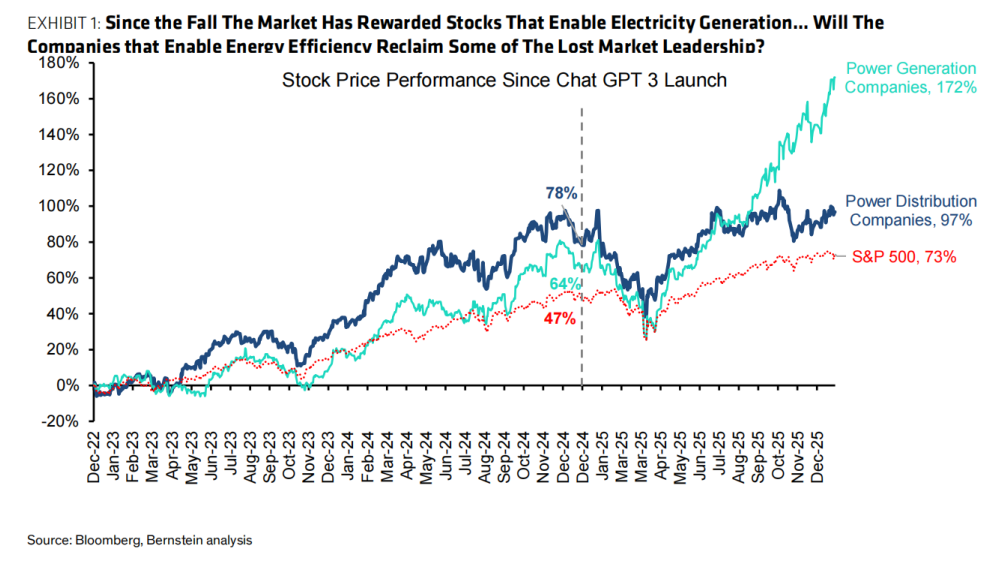
Core Insights - The core contradiction of the electricity supercycle has shifted from "how to increase power generation capacity" to "how to improve electricity usage efficiency" [1] - A global electricity supercycle has begun as the U.S. anticipates a 50 GW power supply gap by 2030, yet capital market reactions reveal a significant cognitive bias [1][3] - Companies focused on power generation, such as Caterpillar and Cummins, have seen stock prices surge by 80% over the past year, while those in power distribution and management, like Eaton and Schneider, have declined by 10% [1][3] Market Understanding - The valuation divergence reflects a limited understanding of the electricity supercycle, with most investors fixated on "building more power plants" rather than optimizing electricity efficiency through technological innovation [3] - The demand explosion, driven by the AI industry's rapid growth, is a key factor, with electricity demand projected to grow at an annual rate of 3.5%, significantly outpacing historical trends [6] Technological Innovations - High-voltage technologies, such as 800V data center architecture and 765kV transmission lines, can enhance electricity efficiency by up to 5% without increasing generation capacity [5] - The 800V architecture addresses critical issues in current power systems, offering efficiency improvements, cost optimization, and space savings, potentially saving nearly $12 billion annually for a 1 GW data center [8] - The 765kV transmission lines, which have not been built in the U.S. for 20 years, can transport 2 to 2.5 GW of electricity, significantly reducing costs and land use compared to lower voltage lines [12][13] Market Dynamics - The current phase of the electricity cycle is characterized by a shift from capacity expansion to efficiency enhancement, with previously undervalued distribution and power management companies likely to recover and reshape market dynamics [5][7] - The market is witnessing a long-term opportunity in high-voltage transmission due to the significant capacity gap, despite some data centers considering on-site generation [13]

美的集团:美的系列报告一:机器人与自动化业务,迈向智造未来-20260127
GOLDEN SUN SECURITIES· 2026-01-27 12:24
Investment Rating - The report maintains a "Buy" rating for Midea Group [5] Core Insights - Midea Group has successfully acquired KUKA, establishing a strong foothold in the industrial robotics sector, and is building an integrated automation industry system through self-research, international mergers, and ecological collaboration [1][12] - The industrial robotics market is highly concentrated, with the top five companies accounting for 42.8% of global revenue in 2023, and Midea ranks third with a market share of 8.9% [2][43] - Midea's robotics division is expected to see a significant increase in valuation as the market reassesses the value of its B-end business, with the overall P/E ratio currently lower than its peers [3] Summary by Sections 1. Robotics and Automation Business - Midea has completed a comprehensive acquisition of KUKA, securing a controlling stake and integrating its operations [1][12] - The acquisition process involved multiple stages, culminating in Midea holding 100% of KUKA's shares by 2022, with a total payment of approximately €3.7 billion [12][13] - KUKA's product structure includes industrial robots, mobile platforms, welding equipment, and system integration, catering to various industries such as electric vehicles and healthcare [1][21] 2. Industrial Robotics Industry - The industrial robotics industry is characterized by long-chain cooperation, with significant technological barriers in upstream components like controllers and servo systems, which account for about 70% of the total cost [2][33] - The market is projected to grow from ¥1,102 billion in 2017 to ¥1,421 billion in 2023, with a CAGR of 7.9% expected until 2027 [38] - Midea's market share in heavy-duty industrial robots is particularly strong, ranking second globally in both sales and revenue [43] 3. Competitive Landscape - The competitive landscape is dominated by the "Four Families" of industrial robots: ABB, FANUC, Yaskawa, and KUKA, which hold significant market shares and technological advantages [2][43] - Midea's robotics division is positioned to enhance its market share and stability by focusing on R&D and expanding its customer base in China [3][43] - The report highlights the need for Midea to improve its valuation in the robotics sector, as its current P/E ratio is significantly lower than that of its competitors [3]

美的集团(000333):系列报告一:机器人与自动化业务,迈向智造未来
GOLDEN SUN SECURITIES· 2026-01-27 11:55
美的历经全面要约、控股收购与退市计划三步推进,完成全球机器人龙头 库卡的控股与战略整合。美的机器人战略自引进到控股,构建"自主研发 +国际并购+生态协同"一体化自动化产业体系。KUKA 自 1898 年创立以 来,历经焊接设备扩展、工业机器人研发突破及自动化系统整合发展,成 功转型为全球领先的智能自动化解决方案提供商。产品结构:KUKA 的产 品体系以工业机器人为核心,向移动平台、焊接设备、系统集成、机队管 理、教育培训与软件生态等方向纵深拓展。客户群体:覆盖新能源车、电 池、电商零售至医疗健康,库卡构建起多行业适配的自动化客户群体系。 ➢ 工业机器人行业:长链合作,"四大家族"优势领先。 美的集团(000333.SZ) 美的系列报告一:机器人与自动化业务,迈向智造未来 ➢ 机器人与自动化业务:要约收购 KUKA,成功布局工业机器人业 务。 证券研究报告 | 公司深度 gszqdatemark 2026 01 27 年 月 日 | 买入(维持) | | | --- | --- | | 股票信息 | | | 行业 | 白色家电 | | 前次评级 | 买入 | | 01 月 22 日收盘价(元) | 77.49 ...