Anysphere

Search documents
23岁,她融资5000万
投资界· 2025-10-15 07:52
Core Viewpoint - The article highlights the emergence of Gen Z entrepreneurs, particularly Phoebe Gates, who is leveraging AI technology to innovate in the fashion retail space through her startup, Phi a, which focuses on price comparison for consumers [2][4][12]. Company Overview - Phoebe Gates, the youngest daughter of Bill Gates, co-founded an AI shopping platform called Phi a after graduating from Stanford University. The platform aims to simplify the shopping experience by allowing users to compare prices across different platforms [2][4][6]. - The company recently completed a seed funding round of $8 million, led by KPCB, with a post-money valuation of $32 million. Notable investors include celebrities and billionaires, indicating strong market interest [4][10][11]. Product Development - Phi a's initial product was a desktop extension for comparing second-hand goods, but the team pivoted to mobile development, launching their app in April 2023. The app quickly gained traction, reaching the top 30 in the App Store's shopping category and accumulating over 500,000 users [7][10]. - The app features image recognition and search algorithms, allowing users to track price changes and receive personalized product recommendations. It has partnerships with over 150 e-commerce platforms, generating revenue through commissions on sales [7][11]. Market Context - The article notes a growing trend of Gen Z entrepreneurs entering the startup scene, with several examples of successful ventures in AI and technology. This demographic is characterized by their adaptability and comfort with technology, which lowers the barriers to entry for entrepreneurship [12][15]. - Investment firms are increasingly focusing on Gen Z founders, with initiatives like Sequoia China's "Gen Z Plan" aimed at supporting young entrepreneurs with significant funding [15][16]. Future Plans - Phi a plans to use the recent funding to expand its team and aims to raise an additional $25-30 million in its next funding round, focusing on international expansion and generative AI capabilities [11].


这些辍学的00后,凭啥改写30岁以下创富榜? | F&M抢先看
虎嗅APP· 2025-10-14 13:39
Core Insights - The article highlights the emergence of a new generation of entrepreneurs born after 2000, particularly in the AI 2.0 era, with a significant portion of applicants for the "Top 20 AI Leaders Under 30" being from this demographic [2][11] - Many of these young founders are school dropouts, indicating a shift in traditional educational paths towards entrepreneurship in the tech sector [2][5] Group 1: Entrepreneurial Landscape - Approximately one-third of the applicants for the "Top 20 AI Leaders Under 30" are from the post-2000 generation, showcasing a trend of youth engagement in AI startups [2] - The fields of these young entrepreneurs include AI automation, AI sales, and AI programming assistants, with many having backgrounds from prestigious institutions like MIT and Stanford [3][4] - The article notes that these entrepreneurs often do not fit the mold of traditional "good students," with some openly discussing their controversial projects that led to academic consequences [5] Group 2: Motivations and Mindset - The advent of tools like ChatGPT has inspired many young entrepreneurs to explore AI's potential, leading to a surge in innovative projects and applications [6] - A common motivation among these entrepreneurs is the desire to create products that make a significant impact, with some expressing ambitions to develop groundbreaking technologies [6][8] - The acceptance of failure is notably high among these young founders, who frequently pivot their products in response to rapid technological changes [7] Group 3: Educational Perspectives - The article discusses the evolving nature of education in the context of AI, emphasizing the need for skills that foster collaborative, entrepreneurial, and interdisciplinary thinking [8][9] - It suggests that the current educational framework may need to adapt to better prepare future talent for the demands of the AI-driven market [8] Group 4: Future Outlook - The article concludes with a call to action for identifying and supporting these young innovators, as they are seen as key players in shaping the future of AI and its applications globally [11]

硅谷爆发反AI「起义」,程序员拒用Cursor被一周解雇
3 6 Ke· 2025-10-13 23:47
Group 1 - The phenomenon of job displacement due to AI is increasingly common, particularly in the tech industry, with major companies like Microsoft laying off employees [3][19] - AI investments are a primary reason for layoffs, as jobs requiring only "general skills" are quickly being replaced by AI [3][5] - The definition of "real work" is being challenged, with the argument that if a job can be replaced by AI, it may not be considered "true work" [5][18] Group 2 - The rapid adoption of AI technology is unprecedented compared to previous technological revolutions, suggesting that AI may be the last major technological revolution in human history [12][18] - The future of work is uncertain, as AI threatens the jobs of millions of knowledge workers, but new job forms are expected to emerge, similar to how the internet created new roles [15][18] - The ongoing "code wars" in Silicon Valley highlight the tension between traditional coding practices and the adoption of AI coding tools, with some engineers resisting the shift [31][34] Group 3 - Companies are increasingly encouraging the use of AI coding tools, but this has led to challenges, such as the production of low-quality code that lacks human logic [22][23] - The internal conflicts within companies regarding AI adoption reflect broader industry trends, as executives push for AI integration while some employees resist [32][34] - The core issue driving the "code wars" is the existential question of human value in a world where AI can produce high-quality code, leaving many to ponder their professional identity [35]

1000万抽160万,他们用AI疯狂捞钱
投中网· 2025-10-13 07:22
将投中网设为"星标⭐",第一时间收获最新推送 "天下苦SPV久矣。" 作者丨 蒲凡 来源丨 投中网 AI 独角兽们正在连续创造融资神话。 今年 9 月, OpenAI 最大的竞争对手 Anthropic 完成了最新的一轮融资计划,以 1830 亿美元(约合人民币 13034 亿元)的估值拿到了 130 亿美 元(约合人民币 926 亿元)。这个数字虽然仍远远落后 OpenAI ,但在整个人工智能赛道乃至整个硅谷,其实也只有 OpenAI 目前拥有更高的估值 —— 横向对比当下的其他 AI 独角兽, Scale AI 估值不到 300 亿美元、 Perplexity 的估值为 180 亿美元、 Cursor 的开发商 Anysphere 的估值 为 99 亿美元。 先来简单聊聊什么是 SPV 。 SPV 是 Special Purpose Vehicle (特殊利益实体)的缩写。 Vehicle (实体),代表着 SPV 本质是一家独立的公司,拥有自己独立的资产负债 表。 Special Purpose (特殊利益),代表着 SPV 的设立通常带有特定的、明确的目标,例如在投资高风险项目的时候用来隔离财务风险、 ...

速递|AI应用领域第三大收入巨头,Cursor制造商Anysphere,新一轮估值冲300亿美元
Z Potentials· 2025-10-10 04:36
Core Insights - Anysphere, the developer of programming assistant Cursor, is considering investment offers at a valuation of approximately $30 billion, nearly three times its valuation during mid-year financing [1] - Despite fierce competition from OpenAI and Anthropic, Anysphere has maintained strong investor interest due to rapid revenue growth [1][3] - The company's annual recurring revenue reached $500 million as of June, a tenfold increase from the previous November, and is projected to reach $1 billion by the end of the year [3][4] Investment and Valuation - Anysphere's valuation has significantly increased from about $2.5 billion at the beginning of the year to $9.9 billion during its June financing [1] - The company previously received investment offers valuing it between $18 billion and $22 billion but chose to decline [2] Competitive Landscape - Anysphere is competing with top AI companies that have developed their own coding tools, including Google and Amazon AWS [4][5] - OpenAI attempted to acquire Anysphere earlier this year but was unsuccessful, while Anysphere is developing its own AI models to reduce costs associated with using models from competitors [5] Company Growth and Strategy - Anysphere has raised over $1 billion from investors such as Andreessen Horowitz, Thrive Capital, Accel, and DST Global [3] - The company is focusing on large enterprise clients rather than individual users, with notable clients including Figma and Stripe [5] - Anysphere has established multiple offices in San Francisco and New York City to support its growth [7]

24岁,她融资4亿,来自广州
华尔街见闻· 2025-10-06 12:13
Core Viewpoint - Axiom Math, an AI startup founded by a Gen Z entrepreneur, Carina Hong, has successfully completed its first funding round of $64 million, achieving a post-money valuation of $300 million. The company aims to create a self-improving superintelligent reasoning system that can solve complex mathematical problems and generate detailed reasoning steps for verification [2][6][9]. Company Overview - Axiom Math is positioned as an AI company focused on developing a model that can solve complex mathematical problems by converting mathematical content from textbooks and journals into programmatic knowledge [6][7]. - The company’s vision includes expanding its research applications to areas such as financial modeling, chip architecture, and quantitative trading [7]. Founder's Background - Carina Hong, the founder, is a 24-year-old prodigy with a remarkable academic background, including studies at MIT, Oxford, and currently pursuing a PhD at Stanford. She has received numerous accolades in mathematics and has a strong focus on solving difficult technical problems [12][13][14]. Team Composition - Axiom's core team consists of 10 full-time employees, including several AI experts from Meta, such as Shubho Sengupta, who has a history of leading significant AI projects [9][11]. Market Context - The emergence of Axiom Math reflects a broader trend of Gen Z entrepreneurs entering the AI space, with several other startups founded by young innovators also gaining traction and securing significant funding [15][16][17]. - The current wave of AI startups is characterized by young founders who are unencumbered by traditional constraints, allowing for innovative approaches to new technologies [17].

24岁,她融资4亿
投资界· 2025-10-05 09:12
Core Viewpoint - The article highlights the emergence of a new generation of founders born after 2000, particularly focusing on Axiom Math, an AI company founded by Carina Hong, which recently completed a $6.4 million financing round, achieving a post-money valuation of $300 million [3][6][10]. Company Overview - Axiom Math is positioned as an AI company aiming to create a self-improving superintelligent reasoning system that can solve complex mathematical problems and provide detailed reasoning steps for its solutions [6][10]. - The company intends to convert mathematical content from textbooks, papers, and journals into programmable knowledge, enabling AI to tackle mathematical problems and verify solutions [6][10]. Founder's Background - Carina Hong, the founder of Axiom Math, is a 24-year-old prodigy from Guangzhou with a remarkable academic background, including studies at MIT, Oxford, and currently pursuing a PhD at Stanford [12][13]. - Hong has received numerous accolades, including the Schaffer Mathematics Award and the Morgan Prize, and was awarded the Rhodes Scholarship, highlighting her exceptional capabilities in mathematics [12][13]. Team Composition - Axiom Math's core team consists of 10 full-time employees, including several experts from Meta, such as Shubho Sengupta, who has a strong background in AI and distributed training systems [9][10]. Market Context - The article notes a trend of young founders in the AI sector, with several startups led by individuals born after 2000 successfully raising significant funding, indicating a shift in the entrepreneurial landscape [15][17]. - Examples include companies like Sol a Solutions and Any sphere, which have also secured substantial investments, showcasing the growing influence of this demographic in the tech industry [15][16].

AI改变创业生态,“一人独角兽公司”不远了?
Di Yi Cai Jing· 2025-10-02 00:31
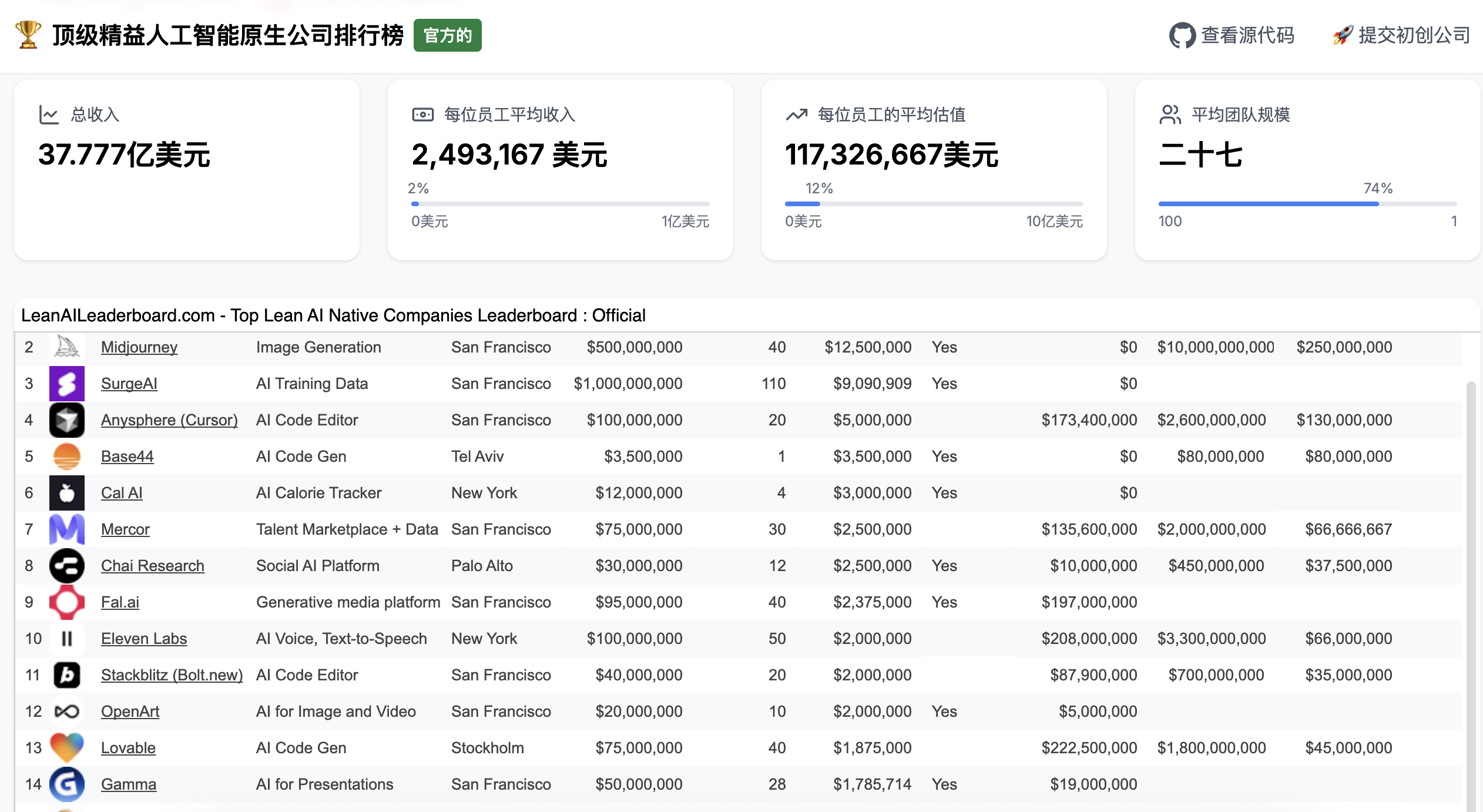
Core Insights - The emergence of "1-Person" Billion Dollar Companies is becoming a reality, with significant advancements in AI capabilities enabling individuals to manage substantial operations independently [1][5][6]. Group 1: AI-Driven Business Models - OpenAI's CEO Sam Altman predicts the rise of one-person unicorns, highlighting a shift towards smaller, highly efficient teams in the AI era [1]. - A leaderboard tracking top lean AI-native companies shows that 44 companies with an average team size of 27 generate nearly $3.8 billion in annual revenue, indicating a valuation of over $100 million per employee [1]. - Companies like base44 and Midjourney exemplify this trend, achieving significant revenues and valuations with minimal team sizes [7][8]. Group 2: Organizational Structure Changes - Traditional management structures are being challenged as AI capabilities allow a single founder to manage multiple AI agents, reducing the need for large teams [5][6]. - The shift towards smaller teams is evident, with many entrepreneurs finding that managing fewer than ten employees is becoming the norm [8][9]. - The ability of top AI researchers to leverage AI tools for rapid learning and problem-solving is transforming organizational dynamics, allowing individuals to fulfill multiple roles [9][10]. Group 3: Industry Transformation and Challenges - The transition to AI-native organizations is not uniform, with larger traditional companies struggling to adapt due to their existing structures and processes [10][11]. - A report from MIT highlights that despite significant investments in generative AI, 95% of organizations see no return, primarily due to integration challenges [12][13]. - Successful AI implementation requires a fundamental rethinking of business processes, moving beyond merely embedding AI into existing workflows [13].

GenAI系列报告之64暨AI应用深度之三:AI应用:Token经济萌芽
Shenwan Hongyuan Securities· 2025-09-24 12:04
Investment Rating - The report does not explicitly provide an investment rating for the industry Core Insights - The report focuses on the commercialization progress of AI applications, highlighting significant advancements in various sectors, including large models, AI video, AI programming, and enterprise-level AI software [4][28] - The report emphasizes the rapid growth in token consumption for AI applications, indicating accelerated commercialization and the emergence of new revenue streams [4][15] - Key companies in the AI space are experiencing substantial valuation increases, with several achieving over $1 billion in annual recurring revenue (ARR) [16][21] Summary by Sections 1. AI Application Overview: Acceleration of Commercialization - AI applications are witnessing a significant increase in token consumption, reflecting faster commercialization progress [4] - Major models like OpenAI have achieved an ARR of $12 billion, while AI video tools are approaching the $100 million ARR milestone [4][15] 2. Internet Giants: Recommendation System Upgrades + Chatbot - Companies like Google, OpenAI, and Meta are enhancing their recommendation systems and developing independent AI applications [4][26] - The integration of AI chatbots into traditional applications is becoming a core area for computational consumption [14] 3. AI Programming: One of the Hottest Application Directions - AI programming tools are gaining traction, with companies like Anysphere achieving an ARR of $500 million [17] - The commercialization of AI programming is accelerating, with several startups reaching significant revenue milestones [17][18] 4. Enterprise-Level AI: Still Awaiting Large-Scale Implementation - The report notes that while enterprise AI has a large potential market, its commercialization has been slower compared to other sectors [4][25] - Companies are expected to see significant acceleration in AI implementation by 2026 [17] 5. AI Creative Tools: Initial Commercialization of AI Video - AI video tools are beginning to show revenue potential, with companies like Synthesia reaching an ARR of $100 million [15][21] - The report highlights the impact of AI on content creation in education and gaming [4][28] 6. Domestic AI Application Progress - By mid-2025, China's public cloud service market for large models is projected to reach 537 trillion tokens, indicating robust growth in AI applications domestically [4] 7. Key Company Valuation Table - The report provides a detailed valuation table for key companies in the AI sector, showcasing significant increases in their market valuations and ARR figures [16][22]




OpenAI发布新模型硬刚Anthropic,Claude Code刚火,就被GPT-5-Codex拍在沙滩上?
3 6 Ke· 2025-09-16 10:09
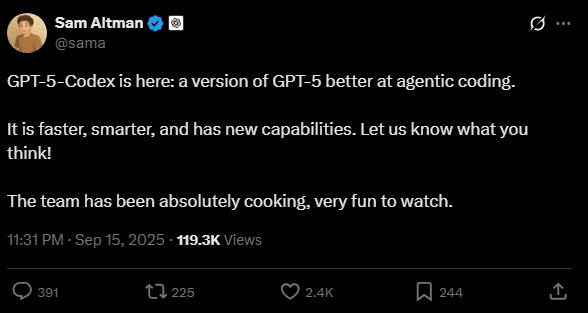
Core Insights - OpenAI has launched a new model, GPT-5-Codex, which is a fine-tuned variant of GPT-5 designed specifically for AI-assisted programming tools, demonstrating improved performance in coding tasks and dynamic thinking time [1][3][6] Model Features - GPT-5-Codex features enhanced code review capabilities, allowing it to identify potential critical errors before product release, thus helping developers mitigate risks [3][4] - The model can dynamically adjust its thinking time based on task complexity, enabling it to work independently for extended periods, completing large refactoring tasks and iterating until successful delivery [6][14] - It has become the default setting for Codex cloud tasks and code reviews, automatically auditing pull requests (PRs) in GitHub repositories [4][7] Performance Metrics - In benchmark tests, GPT-5-Codex outperformed GPT-5 in SWE-bench Verified tasks, which measure coding capabilities and code refactoring performance [8] - The model significantly reduces token usage for low-load tasks by 93.7% compared to GPT-5, while doubling the reasoning, editing, testing, and iteration time for high-complexity tasks [10][18] Market Context - The AI coding tools market is becoming increasingly competitive, with significant investments flowing into companies like Anysphere, which recently raised $900 million, and Anthropic, which secured $13 billion in funding [20][21][22] - The rapid growth of AI coding tools is prompting discussions about the future of programming jobs, with some suggesting a shift towards architecture design rather than traditional coding [19][20] User Feedback - Users have reported that GPT-5-Codex can autonomously run tasks for extended periods and effectively switch between local and web development environments, enhancing productivity [15][16] - There are concerns about the potential impact on entry-level programming jobs, as AI tools like GPT-5-Codex can operate continuously and at a lower cost than hiring junior developers [18][19]