Palantir

Search documents
美股巨头升势如潮,A股连涨让海外交易台也“动了心”
Di Yi Cai Jing· 2025-08-14 13:49
Group 1 - A-shares have become the second-largest market for capital inflow as of August 13, with a notable increase in trading activity and a strong upward trend, approaching the 3700-point mark [1][5] - The recent rally in A-shares is supported by ample liquidity, expectations of improved profitability due to "anti-involution" measures, and a significant increase in trading volume, with a transaction amount of 2.1 trillion yuan on August 13, the highest since February [5][6] - Morgan Stanley has shifted its preference from Hong Kong stocks to A-shares, noting that the Shanghai Composite Index and CSI 300 have outperformed the Hang Seng Index since late June [6] Group 2 - The U.S. stock market, particularly driven by technology giants, has seen significant gains, with Nvidia up approximately 33.5% and Meta up about 32.5% year-to-date, while the overall concentration of gains is at a historically high level [2][3] - The total market capitalization of the U.S. tech giants has exceeded $18 trillion, surpassing the annual GDP of all countries except the U.S. and China, with Nvidia becoming the first company to reach a $4 trillion market cap [3] - The recent mild inflation report in the U.S. has contributed to the bullish sentiment in the stock market, with the CPI rising 0.2% month-on-month and 2.7% year-on-year, which is lower than expected [3][4] Group 3 - The "anti-involution" campaign in China is positively influencing market sentiment, with foreign investors focusing on profitability growth despite previous low margins due to intense competition [7] - Morgan Stanley anticipates a stronger inflow of foreign capital into Chinese stocks in the latter half of the year, driven by structural improvements in the market and a shift towards high-quality large tech and financial companies [7][8] - The small-cap stocks have seen significant gains, with the Wind Micro-Cap Index rising over 50% since early April, leading to concerns about potential adjustments due to overvaluation [8]
美国会山“股神”的好日子到头了?美财长点名佩洛西“通过股票交易发横财”
Di Yi Cai Jing· 2025-08-14 07:42
Core Viewpoint - The article discusses the call by U.S. Treasury Secretary Becerra to ban stock trading by Congress members, highlighting concerns over ethics and public trust in the financial system, particularly in light of significant stock trading profits by certain lawmakers [1][2]. Group 1: Stock Trading Ban Proposal - Becerra emphasizes the need for a ban on individual stock trading by Congress members to maintain the credibility of the House and Senate [1]. - He criticizes specific lawmakers, including Nancy Pelosi and Ron Wyden, for profiting from stock trading, suggesting that their returns are enviable even to hedge funds [1]. - The proposal for a trading ban is gaining traction among Republican leaders in Congress, who are under pressure to act on it [2]. Group 2: Individual Lawmaker Trading Activities - Nancy Pelosi's financial disclosures indicate her income for 2024 could range from $7.8 million to $42 million, with a net worth estimated at $413 million [1]. - Congressman Rob Bresnahan has faced scrutiny for his frequent stock trading, having conducted at least 617 trades since taking office in January [4][5]. - Marjorie Taylor Greene is noted for her successful stock trading, with significant returns from investments in technology stocks, including a 100% increase in one stock and over 115% in another [6]. Group 3: Ethical Concerns and Responses - Becerra argues that ordinary citizens would face scrutiny from the SEC for similar trading practices, raising ethical concerns about Congress members' trading activities [2]. - Bresnahan's response to inquiries about his trading practices indicates a reliance on financial advisors, despite previously advocating for a trading ban [5]. - Greene's trading success has drawn attention, with analysts noting a surge in congressional interest in certain stocks, suggesting potential shared financial advice among lawmakers [6].
这是一家不生产一枪一炮的军火巨头:Palantir与未来AI战争
Hu Xiu· 2025-08-14 05:45
Core Viewpoint - Palantir has emerged as a significant player in the defense and intelligence sectors, leveraging big data analytics to support military operations and decision-making processes, positioning itself as a modern equivalent of a weapons manufacturer without producing physical arms [2][3][8]. Company Overview - Palantir was founded in 2003 by Peter Thiel and Alex Karp, focusing on data integration and analysis for military and commercial applications [4]. - Its key products include: - Gotham: Designed for military and intelligence agencies for counter-terrorism and battlefield intelligence analysis [4]. - Foundry: Aimed at government and enterprises for complex data integration and collaboration [5]. - Apollo: A platform for continuous deployment and operations [6]. - AIP (Artificial Intelligence Platform): A recently launched AI decision-making platform that integrates with large language models for real-time intelligence analysis [7]. - In 2024, Palantir's revenue is projected to be approximately $2.87 billion, with a significant increase in stock price over the past year, rising over 600% [8]. Comparison with Traditional Defense Contractors - Traditional defense contractors remain the backbone of the military-industrial complex, with five major companies dominating the sector: 1. Lockheed Martin: Projected revenue of $71 billion in 2024, known for products like the F-35 fighter jet [12][13]. 2. Boeing: Expected total revenue of $66.5 billion in 2024, with a defense segment generating $23.9 billion [15][16]. 3. RTX (Raytheon Technologies): Holds a defense order backlog of $63.5 billion [17][18]. 4. Northrop Grumman: Projected revenue of $41 billion in 2024 [19][20]. 5. General Dynamics: Consistent annual revenue in the hundreds of millions [21][22]. - Between 2020 and 2024, these five contractors secured approximately $771 billion in contracts, with Lockheed Martin alone accounting for $313 billion [23]. Future Warfare Trends - The future battlefield is expected to be characterized by: - Automation: The use of drones, unmanned vessels, and vehicles in coordinated operations [26]. - Intelligence and Autonomy: AI making tactical and strategic decisions [26]. - Data-Driven Operations: Real-time data integration for comprehensive situational awareness [26]. - Predictive Analytics: AI models potentially forecasting conflicts days or hours in advance [26]. Paradox of Technology and Conflict - The existence of companies like Palantir and traditional defense giants reflects a paradox where their business success is often linked to geopolitical conflicts, yet the hope remains that their technologies will not need to be deployed in actual warfare [29].


X @Ash Crypto
Ash Crypto· 2025-08-13 13:43
BREAKING:ETHEREUM HAS SURPASSED NETFLIX, MASTERCARD AND PALANTIR IN JUST ONE WEEK.$ETH PUMP IS MELTING FACES 🔥 https://t.co/6Lk9P7MYfx ...
X @The Economist
The Economist· 2025-08-12 22:40
Growth Analysis - Palantir has demonstrated significant growth, but faces the challenge of needing to increase its revenue by 560% to meet market expectations [1] - This required revenue multiplication is substantially greater than the progress Palantir has achieved in the past five years [1]
X @Decrypt
Decrypt· 2025-08-11 15:09
Vitalik Buterin Is a Billionaire Again as ETH Flips Palantir► https://t.co/s0yZSxyemN https://t.co/s0yZSxyemN ...
Wall Street Breakfast Podcast: U.S. Companies Absorb Tariff Hit
Seeking Alpha· 2025-08-11 10:34
Group 1: Tariff Impact on U.S. Businesses - U.S. businesses are absorbing 64% of tariff costs, with consumers and foreign exporters absorbing 22% and 14% respectively [3] - Tariffs have contributed an estimated 0.2 percentage points to the core PCE price index through June, and are projected to add 0.66 percentage points for the remainder of the year [4] - The core PCE inflation is expected to be at 3.2% year over year, indicating a softer underlying trend of 2.4% when excluding tariff effects [5] Group 2: Nvidia and AMD Revenue Sharing - Nvidia and AMD will pay 15% of their revenues from Chinese AI chip sales to the U.S. government in exchange for export licenses [5][6] - Nvidia's revenue share will come from its H20 AI accelerator sales, while AMD will contribute from its MI308 chip revenues [6] Group 3: C3.ai Revenue Outlook and Restructuring - C3.ai has restructured its global sales team and projects preliminary revenue of $70.2 million to $70.4 million, which is approximately 33% below previous forecasts [8] - The company anticipates a GAAP loss from operations between $124.7 million and $124.9 million, and a non-GAAP loss from operations of $57.7 million to $57.9 million [8] - C3.ai reported having $711.9 million in cash, cash equivalents, and marketable securities as of July 31 [8]




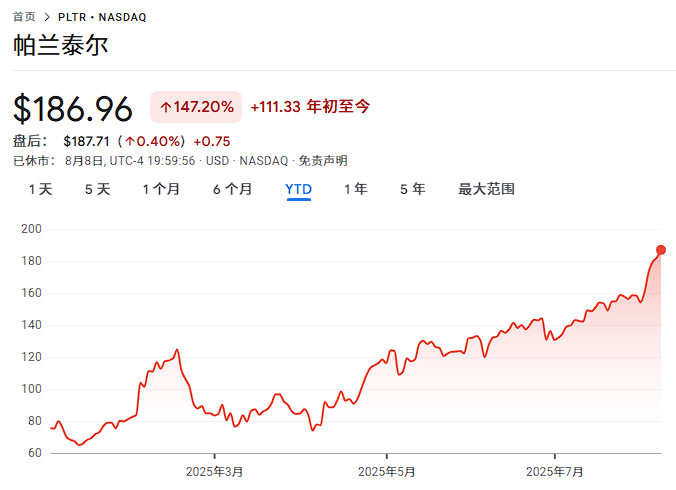
2021年上市以来涨了2500%,“245倍PE”的Palantir贵吗?
美股IPO· 2025-08-11 03:36
Core Viewpoint - Palantir has become the most expensive company in the S&P 500 index, with analysts estimating that it needs to generate $60 billion in annual revenue to reach a reasonable valuation, significantly exceeding Wall Street's expectations of $4-5.7 billion [1][8]. Group 1: Valuation Concerns - Analysts express concerns over Palantir's valuation bubble, with more than twice as many analysts rating the stock as a sell or hold compared to those giving a buy rating [6][10]. - The company's stock price has surged nearly 2500% since its IPO in 2021, leading to a projected price-to-earnings ratio of 245, making it the most expensive in the S&P 500 [5][7]. - Analysts estimate that Palantir must achieve $60 billion in revenue over the next 12 months to align its valuation with peers, a figure that is much higher than Wall Street's projections for fiscal years 2025 and 2026 [4][8]. Group 2: Growth Potential - Bullish investors are betting on Palantir's long-term growth potential, similar to the trajectories of other major tech companies [11]. - Some analysts acknowledge the valuation concerns but continue to hold the stock due to its growth potential, with expectations of maintaining a 50% annual growth rate and profit margin over the next five years [8][13]. - The company is seen as a must-hold stock by some portfolio managers, who are wary of falling behind in relative performance [13][14].

2021年上市以来涨了2500%,“245倍PE”的Palantir贵吗?
Hua Er Jie Jian Wen· 2025-08-11 01:07
Core Viewpoint - Palantir's stock price has surged nearly 2500% since its IPO in 2021, making it the most expensive company in the S&P 500 with a projected P/E ratio of 245, driven by rapid AI application growth, government contracts, and strong recent earnings [1][3] Valuation Concerns - Analysts express concern over Palantir's high valuation compared to peers, with estimates suggesting the company needs to generate $60 billion in revenue over the next 12 months to align with industry valuation standards [3][4] - Current revenue expectations for fiscal year 2025 and 2026 are significantly lower, at $4 billion and $5.7 billion respectively, indicating a substantial gap between expectations and reality [4] - Analysts warn that if Palantir fails to meet high expectations, it could lead to a decline in stock price, similar to Tesla's recent performance [4][5] Bullish Sentiment - Some investors remain optimistic about Palantir's long-term growth potential, likening it to the trajectory of other tech giants like Netflix, which once had a much higher P/E ratio [6] - Despite valuation concerns, certain portfolio managers view Palantir as a must-hold stock to avoid underperformance relative to peers [6][7] - Piper Sandler raised its target price for Palantir from $170 to $182, maintaining a buy rating based on expectations of continued growth and high free cash flow margins [6][7]
一家小规模企业如何跻身全球25家最具价值公司之列?
财富FORTUNE· 2025-08-08 13:05
Core Viewpoint - Palantir has achieved significant growth, surpassing $1 billion in quarterly revenue for the first time, leading to a substantial increase in its market valuation and stock price, despite ongoing controversies surrounding its government contracts and business practices [3][4][19]. Financial Performance - Palantir reported quarterly revenue exceeding $1 billion, with a year-over-year stock price increase of 555%, reaching over $160 per share [3][4]. - The company's market capitalization approached $409 billion, making it the 23rd most valuable company globally [3]. - Analysts have raised concerns about the company's valuation, suggesting its stock price is at least twice as high as traditional metrics would indicate [9][10]. Growth Drivers - The "40 Rule," which combines year-over-year revenue growth and adjusted operating margin, yielded a score of 94% for Palantir, indicating strong sustainable growth potential [12][13]. - A significant driver of growth has been a recent 10-year, $10 billion contract with the U.S. Army, marking the largest software contract in the Department of Defense's history [13][14]. - Palantir's commercial sector revenue grew by 93% year-over-year, largely attributed to its newly launched generative AI platform, AIP [15][16]. Controversies and Criticism - Palantir faces criticism for its contracts with the U.S. Immigration and Customs Enforcement and the Israeli Defense Forces, which have sparked protests and public outcry [19][20]. - The company has been accused of straying from its core principles due to its collaborations with the Trump administration, leading to dissent among former employees [22][23]. Market Position and Future Outlook - Despite its controversies, Palantir is positioned as one of the best-performing stocks in the S&P 500, with a volatile stock price influenced by retail investor activity [8]. - The company is navigating a changing landscape in defense technology, with increasing acceptance of government contracts among tech firms, a shift that Palantir has capitalized on [25][26].