
三博脑科

Search documents
医疗服务板块10月16日跌0.15%,美年健康领跌,主力资金净流出3.78亿元
Zheng Xing Xing Ye Ri Bao· 2025-10-16 08:20
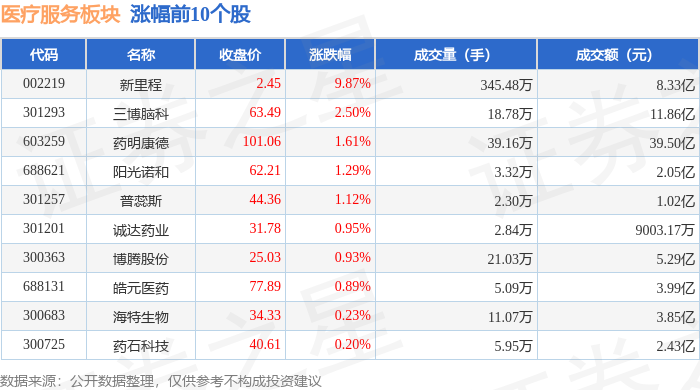
Market Overview - The medical services sector experienced a decline of 0.15% on October 16, with Meinian Health leading the drop [1] - The Shanghai Composite Index closed at 3916.23, up 0.1%, while the Shenzhen Component Index closed at 13086.41, down 0.25% [1] Stock Performance - Notable gainers in the medical services sector included: - Xinlicheng (002219) with a closing price of 2.45, up 9.87% and a trading volume of 3.45 million shares [1] - Sanbo Brain Science (301293) closed at 63.49, up 2.50% with a trading volume of 187,800 shares [1] - WuXi AppTec (603259) closed at 101.06, up 1.61% with a trading volume of 391,600 shares [1] - Major decliners included: - Meinian Health (002044) closed at 5.18, down 4.60% with a trading volume of 1.6852 million shares [2] - Jiuzhou Pharmaceutical (603456) closed at 19.78, down 4.58% with a trading volume of 522,500 shares [2] - Bid Pharma (688073) closed at 66.40, down 3.02% with a trading volume of 8,584 shares [2] Capital Flow - The medical services sector saw a net outflow of 378 million yuan from institutional investors, while retail investors contributed a net inflow of 198 million yuan [2] - Key stocks with significant capital flow included: - Xinlicheng (002219) had a net inflow of 159 million yuan from institutional investors, but a net outflow from retail investors [3] - Sanbo Brain Science (301293) experienced a net inflow of 81.69 million yuan from institutional investors, with outflows from both retail and speculative investors [3] - Sunshine Nuohuo (688621) had a net inflow of 24.84 million yuan from institutional investors, but a net outflow from retail investors [3]


地缘政治扰动不改行业长期趋势:医疗服务行业周报10.6-10.10-20251012
Xiangcai Securities· 2025-10-12 11:11
Investment Rating - The industry rating is maintained as "Buy" [6][10]. Core Views - The recent geopolitical tensions between China and the US have led to a pullback in the medical services sector, but the long-term positive trend remains unchanged due to the strengthening of domestic companies' capabilities in the innovative drug industry [10][64]. - The report emphasizes the importance of company capabilities in driving industry development, suggesting a focus on high-growth areas such as ADC CDMO and peptide CDMO, as well as companies like WuXi AppTec and Haoyuan Pharmaceutical [10][64]. Summary by Sections Industry Performance - The pharmaceutical and biological sector fell by 1.20%, ranking 25th among 31 primary industries [2][12]. - The medical services sub-sector reported a decline of 3.37%, closing at 7156.07 points, which is a significant drop compared to other sub-sectors [24][25]. Company Performance - Notable performers in the medical services sector include Sanbo Brain Science (+3.5%), Meinian Health (+2.8%), and Aier Eye Hospital (+2.6%), while underperformers include Medicy (-8.8%) and Kanglong Chemical (-7.5%) [3][31]. - The report highlights a significant pullback in CXO-related companies [3][31]. Valuation Metrics - The current PE ratio for the medical services sector is 36.92X, with a PB ratio of 3.77X, showing a decrease from the previous week [4][32]. - The PE ratio has fluctuated between a maximum of 41.13X and a minimum of 28.46X over the past year [4][32]. Investment Recommendations - The report suggests focusing on high-growth companies in the medical outsourcing services and those with expected improvements in profitability, particularly in third-party testing laboratories and consumer healthcare sectors like ophthalmology and dentistry [10][64].

研判2025!中国神经调节行业产业链、市场规模及重点企业分析:以精准神经调控革新治疗范式,重塑患者生活质量新标准[图]
Chan Ye Xin Xi Wang· 2025-10-10 01:33
Core Insights - Neuromodulation technology shows significant advantages in treating neurological diseases such as epilepsy and Parkinson's disease, enhancing treatment effectiveness and improving patients' quality of life [1][8] - The Chinese neuromodulation industry is projected to reach a market size of approximately 2.285 billion yuan in 2024, reflecting a year-on-year growth of 8.65%, driven by technological innovation and market demand [1][8] Industry Overview - Neuromodulation is a treatment method that regulates nervous system activity through electrical, magnetic, chemical, or other forms of stimulation, aiming to alleviate symptoms and improve functionality [2] - The industry can be categorized into invasive and non-invasive techniques, each comprising various specific technologies [2] Industry Development History - The Chinese neuromodulation industry has evolved over seventy years, starting from foundational research in the 1950s to the current stage of mature expansion, with significant milestones in technology introduction and innovation [2][3] - Key developments include the first DBS surgery in 1998 and the establishment of the first domestic DBS product registration in 2013, marking a shift from technology importation to independent innovation [2][3] Market Size - The neuromodulation market is expected to grow to approximately 2.285 billion yuan in 2024, with an 8.65% increase from the previous year, indicating a dual driving effect of technology transformation and market demand [1][8] Key Companies - Beijing Pincai Medical holds over 25% of the domestic market share with its comprehensive range of neuromodulation products, including DBS and SCS [9][10] - Suzhou Jingyu Medical is a leading player in the DBS field, having received FDA breakthrough device designation for its dual-target DBS technology [10][11] Industry Development Trends 1. Continuous integration of technological innovations will drive precision and intelligent upgrades in the neuromodulation sector, with advancements in AI and brain-computer interfaces expected to enhance treatment efficacy [12] 2. Application scenarios are expanding from traditional disease treatment to cognitive enhancement and emotional regulation, with consumer-grade neuromodulation devices anticipated to see explosive growth [13][14] 3. Policy and industry collaboration will promote domestic production and global expansion, with ongoing government support for brain science initiatives and the inclusion of neuromodulation procedures in insurance reimbursement [15]


医疗服务板块10月9日涨0.91%,九洲药业领涨,主力资金净流出3.08亿元
Zheng Xing Xing Ye Ri Bao· 2025-10-09 09:03
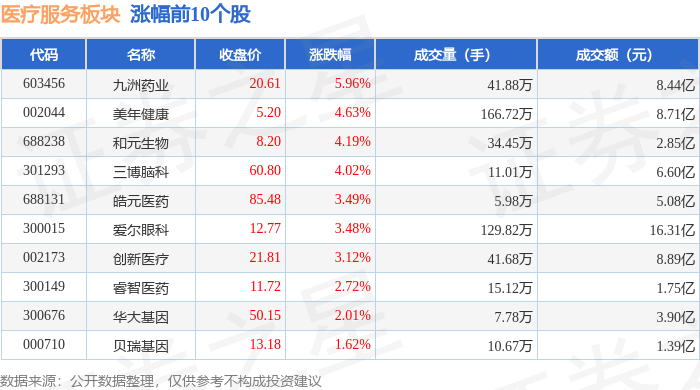
Market Overview - On October 9, the medical services sector rose by 0.91%, with Jiuzhou Pharmaceutical leading the gains [1] - The Shanghai Composite Index closed at 3933.97, up 1.32%, while the Shenzhen Component Index closed at 13725.56, up 1.47% [1] Top Gainers in Medical Services - Jiuzhou Pharmaceutical (603456) closed at 20.61, up 5.96% with a trading volume of 418,800 shares and a transaction value of 844 million [1] - Meinian Health (002044) closed at 5.20, up 4.63% with a trading volume of 1,667,200 shares and a transaction value of 871 million [1] - Heyuan Biotechnology (688238) closed at 8.20, up 4.19% with a trading volume of 344,500 shares and a transaction value of 285 million [1] - Sanbo Brain Science (301293) closed at 60.80, up 4.02% with a trading volume of 110,100 shares and a transaction value of 660 million [1] - Haoyuan Pharmaceutical (688131) closed at 85.48, up 3.49% with a trading volume of 59,800 shares and a transaction value of 508 million [1] Top Losers in Medical Services - Digital Human (920670) closed at 14.21, down 8.73% with a trading volume of 68,800 shares and a transaction value of 96.92 million [2] - ST Biological (000504) closed at 9.07, down 4.02% with a trading volume of 46,100 shares and a transaction value of 42.42 million [2] - Baicheng Pharmaceutical (301096) closed at 57.99, down 3.35% with a trading volume of 32,600 shares and a transaction value of 191 million [2] Fund Flow Analysis - The medical services sector experienced a net outflow of 308 million from institutional investors, while retail investors saw a net inflow of 348 million [2] - The net outflow from retail investors amounted to 40.85 million [2] Individual Stock Fund Flow - Aier Eye Hospital (300015) had a net inflow of 283 million from institutional investors, while retail investors experienced a net outflow of 137 million [3] - Sanbo Brain Science (301293) saw a net inflow of 63.69 million from institutional investors, with retail investors facing a net outflow of 45.84 million [3] - Jiuzhou Pharmaceutical (603456) had a net inflow of 53.54 million from institutional investors, while retail investors faced a net outflow of 63.40 million [3]



医保“绿色通道”打通,脑机接口加速从实验室狂飙至千亿级市场
Hua Xia Shi Bao· 2025-09-29 12:59
Core Insights - The brain-computer interface (BCI) technology is experiencing a critical breakthrough in China, with the National Healthcare Security Administration (NHSA) opening a "green channel" for BCI and surgical robots to enter the medical insurance coding system, facilitating faster clinical application and commercialization [2][3] Policy Developments - The NHSA's announcement allows BCI products with medical device registration to expedite their coding process, while products without registration can submit technical materials for preliminary review, significantly reducing the time from approval to clinical application [3][4] - This policy aims to accelerate the application of cutting-edge medical technologies in clinical settings and supports genuine innovation in high-level medical products [3][4] Market Growth - The global BCI market is projected to grow from $1.2 billion in 2019 to $2 billion in 2023, with an expected compound annual growth rate (CAGR) of 17.5%, reaching $7.63 billion by 2029 [4][5] - Investment in the BCI sector has exceeded $10 billion globally, with the U.S. accounting for over 50% and China over $2 billion [4][5] Clinical Applications - The medical rehabilitation sector is the primary area for BCI technology application, with a significant increase in clinical trials from 11 in 2023 to 31 in 2024, addressing various conditions such as stroke rehabilitation and depression [5][6] - The demand for BCI technology is driven by the high incidence of stroke and the large population of individuals with disabilities in China [5][6] Future Prospects - BCI technology is expected to expand beyond medical applications into industrial manufacturing, education, elderly care, and emergency safety, indicating a broad potential for growth [6][7] - The integration of BCI technology with home medical devices could lead to comprehensive health management solutions, enhancing the competitive landscape for home healthcare [7]

脑机接口研究报告及观点更新:打破人机界限,意念操控走进现实
2025-09-28 14:57
Summary of Brain-Computer Interface (BCI) Industry Research Report Industry Overview - The brain-computer interface (BCI) industry in China is benefiting from multi-faceted support, including technological innovations from various enterprises and research institutions, as well as policy support from government bodies such as the Ministry of Industry and Information Technology, the National Healthcare Security Administration, and the National Medical Products Administration, which is expected to accelerate clinical trials and approval processes [1][2][11]. Key Points and Arguments - **Classification of BCI Technologies**: BCI technologies are categorized into four types based on hardware access methods: invasive, semi-invasive, non-invasive, and interventional, each suitable for different levels of neurological disorders and rehabilitation [1][4]. - **Market Growth**: The domestic BCI market is projected to have a compound annual growth rate (CAGR) of 13.5% over the next five years, although challenges such as unclear product forms, clinical risks, and ethical issues may hinder market scaling [1][6]. - **Medical Applications**: BCI technology is primarily applied in healthcare, focusing on the rehabilitation of motor, language, visual, and cognitive impairments, with motor function rehabilitation being the most clinically advanced area [1][8]. - **Technological Innovations**: Key advancements include the shift from rigid to flexible electrodes, which enhance biocompatibility and reduce trauma to brain tissue, as well as breakthroughs in chip throughput and decoding algorithms [9][10]. Company Insights - **Meihua Medical Company**: The company has rapidly expanded its business from supplying home respiratory device components to entering the implanted BCI device market, leveraging its expertise in cochlear implants and CGM insulin pens. It is expected to see accelerated revenue growth in the upcoming quarters [5][19]. - **Notable Companies in the BCI Industry**: Key players include JieTi Medical, Tiger Technology, New Intelligence, and BoRuiKang, each involved in various aspects of the BCI supply chain, from electrode chip production to clinical trials [12]. Challenges and Risks - **Market Penetration Issues**: The penetration rate of BCI products is affected by high costs and the risks associated with surgical procedures, leading to cautious attitudes among patients and families [7]. - **Regulatory and Ethical Concerns**: The approval timeline for invasive and semi-invasive products may be delayed due to clinical risks and ethical considerations, impacting market growth [6]. Policy Environment - **Government Support**: A series of policies have been introduced to support the BCI industry, including healthcare reimbursement for innovative medical consumables and the establishment of industry standards, which are expected to catalyze market growth [11][18]. Future Outlook - The BCI industry is poised for significant growth, driven by technological advancements, supportive policies, and increasing applications in both medical and non-medical fields, including gaming and robotics [2][3].
4只脑机接口概念股年内涨幅翻倍
2 1 Shi Ji Jing Ji Bao Dao· 2025-09-28 12:48
9月28日,国家药监局正式发布YY/T1996—2025《采用脑机接口技术的医疗器械具备闭环功能的植入式 神经刺激器感知与响应性能测试方法》医疗器械行业标准,被业内人士视为脑机接口技术产业化加速的 又一利好。 21财经·南财快讯记者梳理发现,截至9月26日,脑机接口概念指数(8841700.WI)年内涨幅超55%,汉 威科技(300007)、赛诺医疗、创新医疗(002173)、赛微微电等4股年内股价翻倍,翔宇医疗、光电 股份(600184)、爱朋医疗(300753)等多只股涨幅超50%,迈瑞医疗(300760)、美好医疗 (301363)、科大讯飞(002230)、开立医疗(300633)和三七互娱(002555)均获10家以上机构评级 为买入,部分成份股被预测年内净利润增长率翻倍。 将有100万至200万中国患者受益 脑机接口(Brain Computer Interface,BCI)是在大脑与外部设备之间创建信息通道,是生命科学和信息 科学融合发展的前沿技术和科技创新及产业创新深度融合的重要领域。 可关注两方面机会 医疗是目前脑机产业下游商业应用最成熟、产业规模最大的行业。 2024年,国内脑机相关临床试 ...
阅峰 | 光大研究热门研报阅读榜 20250921-20250927
光大证券研究· 2025-09-28 02:22
Group 1 - The brain-computer interface (BCI) industry is projected to reach USD 7.63 billion by 2029, driven by policy support and demand from medical conditions such as stroke and ALS [4] - The industry is entering a "policy-research-application" closed loop, with a clearer commercialization path [4] - Recommended companies in the BCI sector include Xiangyu Medical, Weisi Medical, Chengyitong, Mailande, Aipeng Medical, and Sanbo Neurosurgery [4] Group 2 - Mengke Pharmaceutical plans to issue 164 million shares at a price of 6.3 CNY per share, raising up to 1.033 billion CNY, which will make Haiqing Pharmaceutical the controlling shareholder [9] - The projected net profit for Mengke Pharmaceutical from 2025 to 2027 is estimated to be -241 million, -190 million, and -99 million CNY respectively, maintaining a "buy" rating [9] Group 3 - The cobalt export quota system in the Democratic Republic of the Congo (DRC) is expected to lead to a significant reduction in cobalt supply, positively impacting cobalt prices [13] - The DRC accounted for 76.3% of global cobalt production in 2024, and the supply constraints are likely to benefit companies like Huayou Cobalt and Luoyang Molybdenum [13] Group 4 - China Railway Assembly reported stable revenue growth and improved cash flow in H1 2025, with a projected net profit of 2 million, 44 million, and 68 million CNY for 2025 to 2027 [16] - The company maintains an "overweight" rating based on its financial performance [16] Group 5 - The dividend yield of Midea Group has exceeded 7%, indicating a potential bottoming out, with a projected profit of 33 billion CNY for 2025 and a 52% cash dividend rate [18] - The company maintains a "buy" rating with a target price of 54.10 CNY [18] Group 6 - The real estate market in Shanghai is experiencing increased transaction volumes due to favorable policies, with a 62.5% increase in daily average transactions post-policy implementation [29] - The top three companies in Shanghai's new home transaction value from January to August 2025 are Poly Developments, China Merchants Shekou, and China Resources Land [29] Group 7 - PetroChina has signed a USD 359 million contract with Total for the design, procurement, supply, construction, and commissioning of a project in Iraq, with projected net profits of 909 million, 1.099 billion, and 1.315 billion CNY from 2025 to 2027 [33] - The company maintains an "overweight" rating for both its A-shares and H-shares [33]





脑机接口行业研究报告:解码大脑交互密码,开启人机协同纪元
EBSCN· 2025-09-25 00:53
Investment Rating - The report suggests focusing on companies with "technical barriers + clinical landing" as the dual main lines for investment, recommending attention to medical scene integrators and leaders in invasive technology [4]. Core Insights - The brain-computer interface (BCI) industry is driven by both policy and technology, with a market expected to grow from $1.2 billion in 2019 to $2 billion in 2023, and projected to reach $7.63 billion by 2029, indicating a compound annual growth rate (CAGR) of 17.5% from 2024 to 2029 [3][24]. - The medical sector is currently the most mature application area for BCI, with 31 clinical trials planned in 2024 covering various diseases, and the integration of medical and consumer applications is expected to create a dual growth curve [3][54]. - The domestic industry chain is becoming more self-sufficient, with significant advancements in invasive BCI technologies, and several regions are expected to form industrial clusters [4][27]. Summary by Sections Industry Overview - BCI technology is a frontier field at the intersection of life sciences and information technology, creating interactive systems between the brain and external devices [14][16]. - The global BCI market is projected to grow significantly, with a forecasted market size of $7.63 billion by 2029, reflecting a CAGR of 17.5% from 2024 to 2029 [24][25]. - The industry is currently in a technology validation phase, with active investment activities, particularly in China, where over 200 financing events have occurred, totaling nearly $2 billion [27][29]. Policy Guidance - The Chinese government has issued several policies to support the BCI industry, aiming for technological breakthroughs by 2027 and the establishment of a robust industrial ecosystem by 2030 [42][43]. - The regulatory framework is evolving, with ongoing efforts to ensure safety, effectiveness, and ethical compliance in BCI technology [45][47]. Clinical Situation - Stroke is identified as the primary indication for BCI applications, with a significant patient population in need of rehabilitation solutions [54][59]. - The number of clinical trials related to BCI is increasing, with 31 trials registered in 2024, indicating a growing interest in the clinical potential of BCI technologies [65][66].



光大证券晨会速递-20250925
EBSCN· 2025-09-25 00:19
Group 1: Bond Market Analysis - As of the end of August 2025, the total bond custody amount in China reached 174.54 trillion yuan, with a net increase of 1.51 trillion yuan month-on-month, which is a decrease of 0.24 trillion yuan compared to the end of July [1] Group 2: High-end Manufacturing Industry - In the first eight months of 2025, the export growth rates for electric tools, hand tools, and lawn mowers were 1%, -5%, and 45% respectively, while forklifts, machine tools, and industrial sewing machines saw growth rates of 1%, 14%, and 16% respectively [2] - The export growth rates for major engineering machinery categories such as excavators, tractors, and mining machinery were 14%, 25%, 30%, and 23% respectively [2] - The trend of declining exports to the U.S. continues, but the engineering machinery category remains in a high prosperity phase, with significant adverse impacts from tariffs on exports to North America [2] Group 3: Brain-Computer Interface Industry - The brain-computer interface market is projected to reach 7.63 billion USD by 2029, driven by policy support and demand from conditions like stroke and ALS [3] - A joint policy from seven departments outlines development goals for the industry, creating a "policy-research-application" closed loop, with a clearer commercialization path [3] - Recommended companies to watch include Xiangyu Medical, Weisi Medical, Chengyitong, Mailande, Aipeng Medical, and Sanbo Brain Science [3]