国泰基金

Search documents
基金回报榜:86只基金昨日回报超5%
Zheng Quan Shi Bao Wang· 2026-01-08 02:01
Core Viewpoint - The stock and mixed funds showed a mixed performance on January 7, with 55.88% achieving positive returns, while 459 funds experienced a net value decline of over 1% [1][2]. Fund Performance Summary - Among stock and mixed funds, 86 funds reported returns exceeding 5%, with the top performer being the GF Semiconductor Materials Equipment ETF, which had a net value growth rate of 7.34% [1][2]. - The average net value growth rate for these funds was 0.38% on January 7 [1]. - The sectors that performed well included comprehensive, coal, and electronics, with increases of 3.86%, 2.47%, and 1.25% respectively [1]. Fund Types and Returns - The leading fund, GF Semiconductor Materials Equipment ETF, belongs to the index stock type, with 37 funds in the index stock category achieving over 5% growth [2]. - The funds with the highest net value declines included Xinghua Jingcheng Mixed C, which fell by 2.47%, followed by Xinghua Jingcheng Mixed A and Dongcai Economic Driven Mixed A, both declining by 2.21% [2][5]. Detailed Fund Rankings - The top five funds by net value growth rate on January 7 are: 1. GF Semiconductor Materials Equipment ETF: 7.34% 2. Huaxia Semiconductor Materials Equipment Theme ETF: 7.32% 3. Guotai Semiconductor Materials Equipment Theme ETF: 7.31% 4. E Fund Semiconductor Materials Equipment Theme ETF: 7.27% 5. Wanjia Semiconductor Materials Equipment Theme ETF: 7.25% [2][3]. Decline Rankings - The funds with the largest declines on January 7 include: 1. Xinghua Jingcheng Mixed C: -2.47% 2. Xinghua Jingcheng Mixed A: -2.46% 3. Dongcai Economic Driven Mixed C: -2.21% 4. Dongcai Economic Driven Mixed A: -2.21% [5][6].
ETF市场5年成长——总规模突破6万亿元大关
2 1 Shi Ji Jing Ji Bao Dao· 2026-01-08 01:06
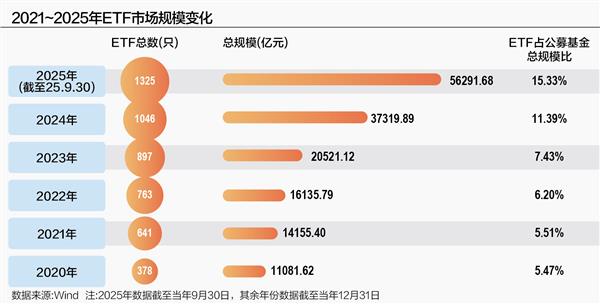
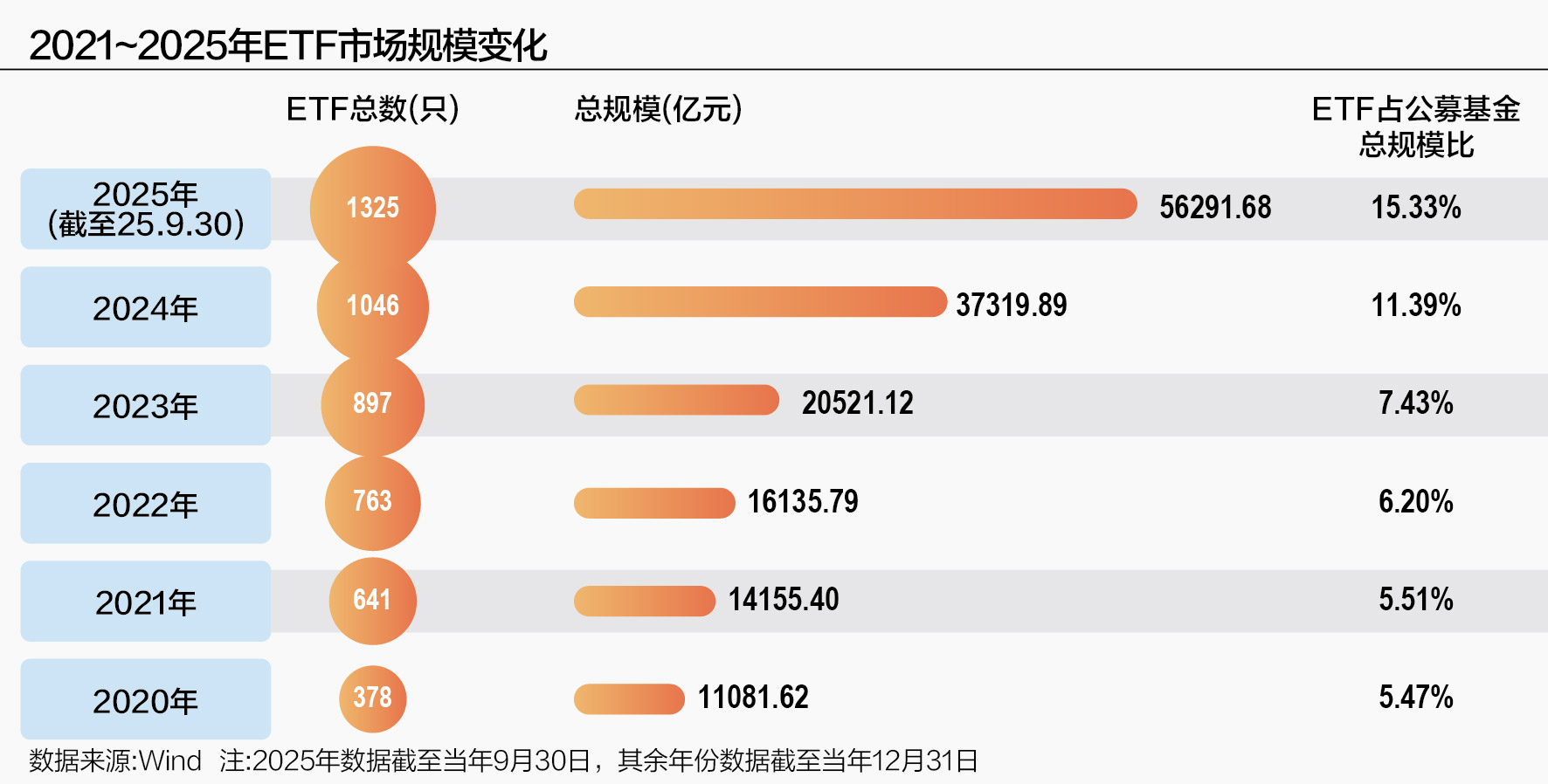
Core Insights - The ETF market in China has reached a significant milestone, surpassing 6 trillion yuan in total scale, reflecting a growth of 60% year-on-year [2] - Over the past five years, the total scale of ETFs has increased from 1.1 trillion yuan to 6.02 trillion yuan, marking a cumulative growth of 452.53% [4][5] - The market has seen a substantial increase in the number of products and trading volume, indicating a shift in investor preferences towards passive investment strategies [5] Market Overview - As of December 2025, the total scale of ETFs reached 6.03 trillion yuan, with an increase of 2.29 trillion yuan within the year [2] - The number of ETF products grew from 326 to 1402, with a total trading volume rising from 843.48 billion yuan to 3960.20 billion yuan, reflecting a growth of 369.51% [5] - The proportion of ETFs in the public fund market increased from 5.47% at the end of 2020 to 15.33% by the third quarter of 2025 [5] Competitive Landscape - The top ten ETF management firms have remained relatively stable, with seven firms consistently leading the market, including 华夏基金 (China Asset Management), 易方达基金 (E Fund), and 华泰柏瑞基金 (Huatai-PB) [6][8] - 华夏基金 has maintained its position as the largest ETF manager, with its scale growing from 1879 billion yuan in 2020 to 9570 billion yuan by the end of 2025 [8] - The entry threshold for the top ten ETF managers has significantly increased, with the required management scale rising from 300 billion yuan five years ago to 2000 billion yuan by the end of 2025 [9] Index Performance - The 沪深300 index remains the most popular, with ETF scale reaching 11855.57 billion yuan by the end of 2025, solidifying its status as a core asset allocation tool [12] - New indices like 中证A500 have gained traction, with its ETF scale surpassing 3000 billion yuan, indicating a shift towards high-quality asset representation [12] - The diversification of asset classes in the top ten indices reflects changing investor preferences, with technology and growth indices gaining prominence [13] Investor Composition - Institutional investors have solidified their dominance in the ETF market, with their share increasing from 69.07% at the end of 2020 to 76.84% by mid-2025 [16] - The absolute scale of institutional holdings grew from 743.8 billion yuan to 3.3 trillion yuan, highlighting a significant influx of long-term capital [16] - Individual investors have shown a consistent engagement with ETFs, maintaining a net value holding ratio close to that of institutional investors [17] Role of State-Owned Entities - The "national team" has increasingly utilized ETFs as a tool for market stabilization, with significant investments from 中央汇金 (Central Huijin) growing from 147 billion yuan in 2013 to over 12 trillion yuan by mid-2025 [18][19] - The diversification of the national team's ETF holdings has expanded to include various sectors, indicating a strategic approach to market support [19]

赎回新规“靴子落地” 公募债基或顺势重构生态圈
Zhong Guo Zheng Quan Bao· 2026-01-07 22:28
Core Viewpoint - The newly released "Regulations on the Management of Sales Fees for Publicly Raised Securities Investment Funds" introduces exemption clauses for redemption fees on bond funds, allowing fund managers to set their own standards for certain investors, which may impact the market dynamics for bond funds [1][2]. Group 1: Redemption Fee Changes - The new regulations provide exemptions for personal investors holding index and bond fund shares for more than 7 days, and for institutional investors holding bond fund shares for more than 30 days, allowing fund managers to set different redemption fee standards [2][4]. - The adjustment period for fund managers to comply with the new fee structures has been extended from 6 months to 12 months, giving the market ample time to adapt to these changes [2][4]. Group 2: Market Impact and Investor Behavior - The flexibility and cost-effectiveness of bond funds are perceived to be weakening, leading to a decline in the willingness of banks to allocate to bond funds, with a potential shift towards money market funds, interbank certificates of deposit index funds, and bond ETFs for liquidity management [1][4][5]. - Despite the reduced convenience of redeeming bond funds, industry insiders believe that bond funds will remain a primary investment target for institutional investors due to their role in addressing research shortcomings and expanding investment scope [1][8]. Group 3: Institutional Investor Preferences - Banks' proprietary trading desks prefer holding medium to long-term pure bond funds, while liquidity-sensitive bank wealth management products are likely to increase their interest in "fixed income plus" products, potentially absorbing some redemption funds [3][4]. - The importance and functionality of bond funds in institutional investment portfolios are perceived to be declining, with some institutions considering direct investments in bonds for more stable returns [5][6]. Group 4: Future Trends and Strategies - The exemption of redemption fees for ETFs under the new regulations is expected to drive institutional funds towards bond ETFs, which offer greater liquidity and flexibility compared to traditional bond funds [7][8]. - Public fund institutions are expected to focus on enhancing their research capabilities and product diversity in bond funds, emphasizing active management and value addition to attract investors in a low-interest-rate environment [8].
赎回新规“靴子落地”公募债基或顺势重构生态圈
Zhong Guo Zheng Quan Bao· 2026-01-07 20:50
Core Viewpoint - The newly released "Regulations on the Management of Sales Fees for Publicly Raised Securities Investment Funds" introduces exemption clauses for redemption fees on bond funds, allowing fund managers to set their own redemption fee standards under certain holding periods for individual and institutional investors [1][2]. Group 1: Redemption Fee Changes - The formal document relaxes the redemption fee requirements for bond funds compared to the previous draft, allowing fund managers to set different standards for individual investors holding for more than 7 days and institutional investors holding for more than 30 days [2][3]. - The adjustment period for fund managers to comply with the new sales fee structure has been extended from 6 months to 12 months, providing ample time for the market to adapt to these changes [2][3]. Group 2: Market Impact and Investor Behavior - The new regulations are expected to reduce the likelihood of concentrated redemptions in bond funds, as they provide fund managers with greater autonomy over fee rates, potentially stabilizing fund flows and mitigating risks associated with liquidity shocks [3][4]. - Despite the reduced flexibility and cost-effectiveness of bond funds, institutional investors are likely to continue viewing them as key investment targets due to their role in addressing research gaps and expanding investment scopes [5][6]. Group 3: Shift in Investment Preferences - There is a noticeable decline in the willingness of high liquidity-demanding bank wealth management products to allocate to bond funds, with a shift towards money market funds, interbank certificates of deposit index funds, and bond ETFs for liquidity management and tactical trading [1][3]. - The importance and functionality of bond funds in institutional portfolios are perceived to be decreasing, with some institutions considering direct investments in bonds or bond ETFs for more stable returns [4][5].
从籍籍无名中闯出天地,6万亿ETF市场5年养成
2 1 Shi Ji Jing Ji Bao Dao· 2026-01-07 12:45
Core Insights - The ETF market in China has reached a significant milestone, with total assets surpassing 6 trillion yuan, reflecting a growth of over 60% year-on-year [3][5] - The rapid expansion of the ETF market is characterized by a shift from slow accumulation to accelerated growth, with a cumulative increase of 452.53% over the past five years [5][6] - The market is witnessing a consolidation of leading fund companies, with a clear top tier emerging in ETF management [7][10] Market Overview - As of December 2025, the total ETF market size reached 6.03 trillion yuan, with an increase of 2.29 trillion yuan within the year [3] - The number of ETF products has grown from 326 to 1402 over the past five years, with a total issuance of 1076 new products [6] - The total trading volume of ETFs has surged from 843.48 billion yuan to 3.96 trillion yuan, marking a growth of 369.51% [6] Management Competition - The top seven fund companies have maintained their positions in the ETF management scale, with 华夏基金 (China Asset Management) leading the market [7][10] - 华夏基金's ETF management scale increased from 187.9 billion yuan in 2020 to 957 billion yuan by the end of 2025 [10] - The entry threshold for the top ten ETF managers has significantly risen, with the requirement increasing from 30 billion yuan five years ago to 200 billion yuan by the end of 2025 [11] Index Performance - The 沪深300 index remains the most popular, with ETF assets linked to it reaching 1.185 trillion yuan by the end of 2025 [14] - The 中证A500 index has emerged as a new favorite, with its ETF size surpassing 300 billion yuan, reflecting a shift towards quality assets [15] - The diversification of asset classes in the top ten indices indicates changing investor preferences, with new themes and sectors gaining traction [16] Holder Structure - Institutional investors have solidified their dominance in the ETF market, increasing their share from 69.07% at the end of 2020 to 76.84% by mid-2025 [20] - The absolute scale of institutional holdings has grown from 743.8 billion yuan to 3.3 trillion yuan, indicating a fourfold increase [20] - Individual investors have shown consistent participation in equity ETFs, maintaining a net value share close to that of institutional investors [21] National Team Involvement - The "national team" has increasingly utilized ETFs as a tool for market stabilization, with significant purchases made during market fluctuations [22][23] - By the end of 2024, the central government’s holdings in ETFs had surged to over 1 trillion yuan, reflecting a strategic shift towards broader ETF investments [23][24] - The national team's involvement in ETFs is expected to play a crucial role in the future of China's capital market ecosystem [24]
单只中证A500ETF最大规模突破500亿元
Zheng Quan Shi Bao Wang· 2026-01-07 10:01
Core Insights - The maximum scale of a single CSI A500 ETF has surpassed 50 billion yuan, specifically for the Huatai-PB CSI A500 ETF [1] - Other funds, including those from Southern Fund and Huaxia Fund, have also seen their CSI A500 ETFs exceed 40 billion yuan in scale [1] - Currently, there are a total of 8 CSI A500 ETFs with scales over 10 billion yuan, including products from Guotai Fund and E Fund [1] - From December 1, 2025, to the present, the CSI A500 ETF group has received over 90 billion yuan in net inflows, with both Huatai-PB and Southern CSI A500 ETFs seeing net inflows exceeding 20 billion yuan [1]
还给基民500亿
3 6 Ke· 2026-01-07 09:35
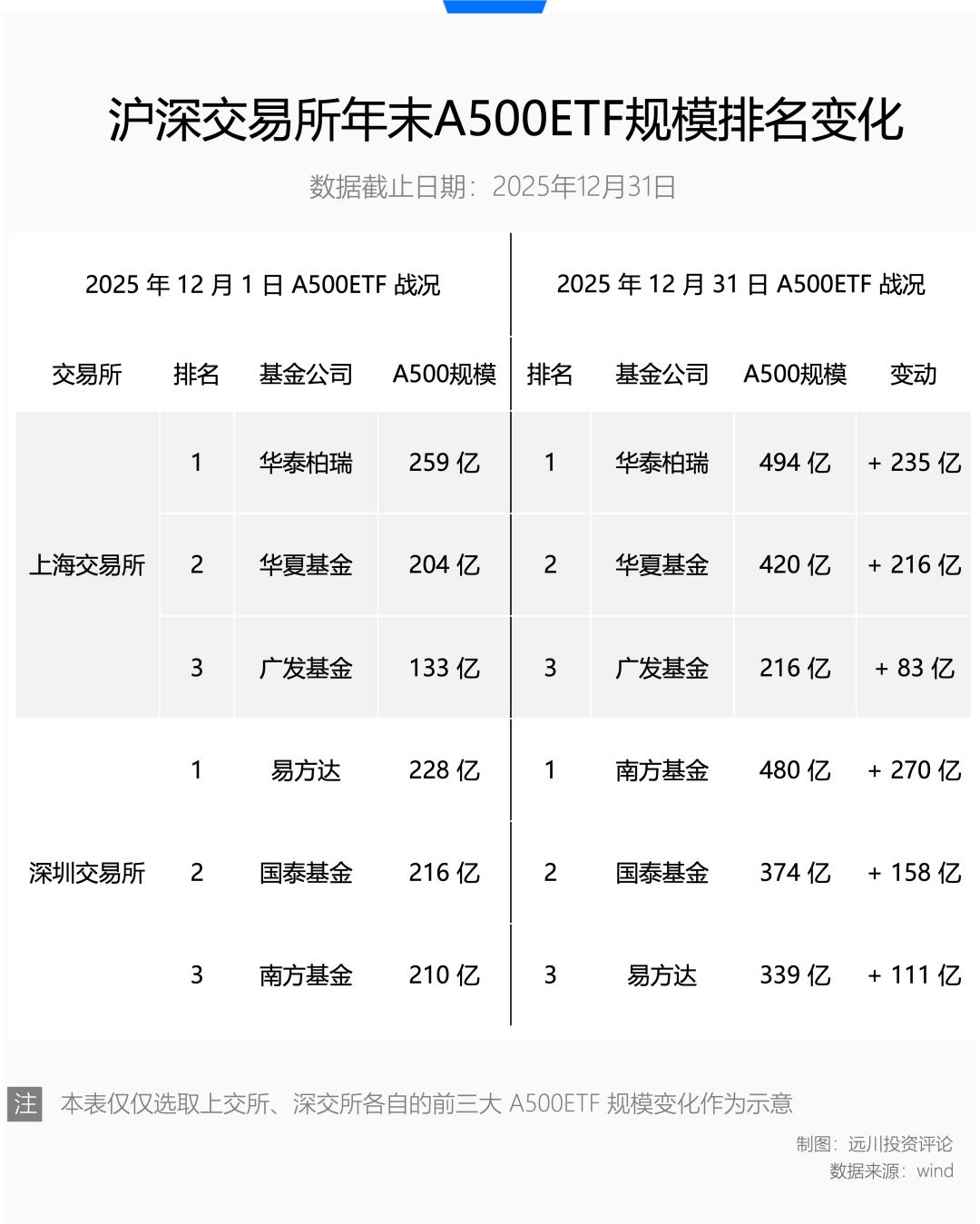
Core Insights - The A500 ETF market has seen significant growth, with total assets increasing by over 100 billion yuan in December 2025, despite a lack of retail investor activity [1] - The competition among fund companies for A500 ETF dominance is intensifying, with the focus shifting from annual performance to securing long-term market positions [3] - The upcoming introduction of options for A500 ETFs is expected to further consolidate the market, with only a few funds likely to survive the competition [4][20] Fund Company Performance - As of December 31, 2025, the A500 ETF rankings show significant changes, with Huatai-PB leading with 494 billion yuan, followed by Changxia Fund and GF Fund [2] - The A500 ETF battle reflects a broader transition in the public fund industry from an active to a passive investment approach [4][19] Fee Reform Impact - The public fund industry is undergoing a fee reform that aims to reduce management and transaction fees, resulting in an estimated annual savings of over 500 billion yuan for investors [5][11] - The first phase of the reform has already reduced management fees for active equity funds from 1.5% to 1.2%, leading to a projected annual benefit of 140 million yuan for investors [6] - The new transaction fee regulations are expected to further lower costs, allowing for an additional 70 million yuan in savings for investors [8] Sales Fee Regulations - The final phase of the fee reform targets sales fees, which have been a complex area with significant costs, and is expected to save investors around 300 million yuan annually [9][10] - The implementation of new sales fee regulations aims to encourage longer holding periods and reduce frequent trading, impacting the overall revenue structure of fund companies [10] Industry Outlook - The fee reform is seen as a double-edged sword, benefiting investors while simultaneously squeezing the profit margins of active equity funds, leading to a potential decline in their viability [13][14] - The shift towards passive investment strategies, particularly ETFs, is becoming more pronounced as the industry adapts to lower fee structures and changing investor expectations [19][22] - The future of public funds may become less dynamic and more standardized, as the focus shifts from individual performance to overall market returns and cost efficiency [23][26]
还给基民500亿,机构的好日子结束了
Xin Lang Cai Jing· 2026-01-07 07:58
Core Insights - The public fund industry in China is transitioning from an "active era" to a "passive era," highlighted by the fierce competition surrounding the A500 ETF, which saw a significant increase in total scale by over 100 billion in December 2025 [5][31][28] - The A500 ETF's growth is accompanied by a comprehensive fee reform that will lead to a reduction of over 500 billion in revenue across the fund industry, impacting all stakeholders [31][40] - The upcoming introduction of options for A500 ETFs is expected to further intensify competition, with only a few funds likely to survive in the long term [30][47] Fund Performance and Competition - As of December 31, 2025, the A500 ETF rankings showed significant growth for major fund companies, with Huatai-PB leading at 494 billion, followed by Huaxia and Southern Fund [29][3] - The focus for fund companies has shifted from achieving high annual returns to securing a long-term position in the A500 ETF market [3][29] Fee Reform Impact - The fee reform initiated by the China Securities Regulatory Commission aims to reduce management fees, custody fees, transaction costs, and sales fees, with the first phase targeting management fees and custody fees [32][33] - The management fee cap for active equity funds has been reduced from 1.5% to 1.2%, resulting in an annual benefit of approximately 140 billion for investors [33][36] - The second phase of the reform addresses transaction costs, with new regulations limiting commission rates for passive equity funds, leading to an estimated annual benefit of 70 billion for investors [35][36] Sales Fee Regulations - The sales fee reform, effective from January 1, 2026, aims to reduce sales fees and regulate commission distribution, potentially benefiting investors by around 300 billion annually [38][40] - The sales fees have been a complex area with significant growth despite overall fee reductions, indicating a need for stricter regulations [37][40] Industry Outlook - The shift towards passive investment strategies, particularly ETFs, is seen as a necessary adaptation to the changing market dynamics, with the potential for a more stable business model despite lower fees [46][45] - The competitive landscape is expected to narrow, with only a few fund companies likely to thrive as the industry moves towards a more standardized and less personalized approach [47][48] - The future of public funds may become less exciting as the focus shifts to efficiency and cost control, potentially diminishing the role of individual talent in the industry [48][49]

三年期FOF业绩榜:国泰产品回报超34%领跑 华夏多只产品亏损垫底
Xin Lang Cai Jing· 2026-01-07 07:47
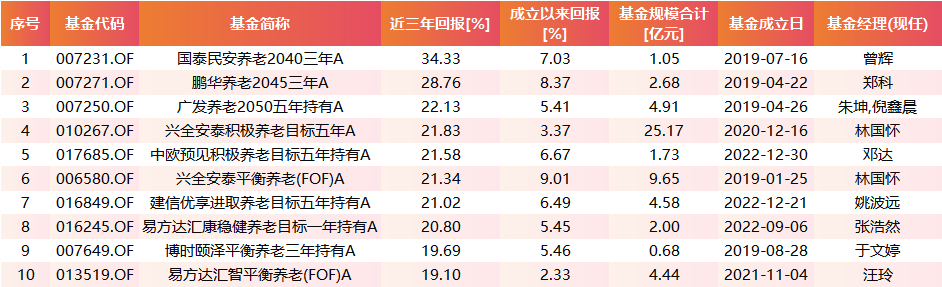
Core Insights - In 2025, equity funds emerged as the market leaders, with Yongying Technology Smart Selection A achieving a remarkable annual increase of 233.29%, making it the top-performing active equity fund [1][7] - The total scale of the fund industry approached a new high of 36 trillion yuan, indicating a strong market presence [1][7] - The top-performing FOF (Fund of Funds) over the past three years was Guotai Min'an Pension 2040 Three-Year A, with a return of 34.33% [2][8] Equity Fund Performance - Yongying Technology Smart Selection A led the active equity funds with a 233.29% annual increase [1][7] - Guotai Fund's Communication ETF ranked first among stock ETFs with a net value increase of 126.13% [1][7] - South Fund Changyuan Convertible Bond A achieved a return of 48.7%, securing the top spot among bond funds [1][7] FOF Fund Performance - Guotai Min'an Pension 2040 Three-Year A topped the three-year FOF performance chart with a return of 34.33% and a total return of 7.03% since its inception [2][8] - Other notable FOFs include Penghua Pension 2045 Three-Year A with a return of 28.76% and Guangfa Pension 2050 Five-Year A with a return of 22.13% [2][8] - Two products managed by renowned fund manager Lin Guohua also performed well, with returns of 21.83% and 21.34% respectively [3][9] Underperforming FOF Funds - Several FOF funds reported negative returns over the past three years, with Huaxia Fund's Huaxia Jufeng Stable Target A being the worst performer at -8.60% [4][10] - Other underperforming funds include Huaxia Fuyuan Pension Target Date 2045 Three-Year A at -7.27% and Huaxia Pension 2055 Five-Year A at -2.51% [4][10] - Additional funds with poor performance include Yin Hua Zunhe Pension 2030 Three-Year A and Minsheng Jia Yin Kangtai Pension Target Date 2040 Three-Year A, both showing negative returns [5][11]
还给基民 500 亿
远川投资评论· 2026-01-07 07:47
Core Viewpoint - The public fund industry is undergoing a significant transformation, moving from an "active era" to a "passive era," with the A500 ETF battle symbolizing this shift. The competition among fund companies is intensifying as they vie for a long-term foothold in the market, especially with the upcoming introduction of options related to the A500 ETF [5][7][20]. Group 1: A500 ETF Competition - The A500 ETF saw a dramatic increase in total scale, rising by over 100 billion yuan in December 2025, despite a lack of significant retail investor activity [3]. - By the end of December 2025, the leading A500 ETF products included Huatai-PB with 494 billion yuan, followed by Nanfang Fund with 480 billion yuan, indicating a fierce competition among fund companies [4]. - The battle for A500 ETF dominance is critical for fund companies, as the winner will secure a long-term revenue stream, especially with the anticipated launch of related options in early 2026 [5][6]. Group 2: Fee Reform Impact - The fee reform initiated by the China Securities Regulatory Commission (CSRC) aims to reduce management and custody fees, resulting in an annual benefit of approximately 140 billion yuan to investors [8][10]. - The average comprehensive fee rate for public funds decreased from 1.41% in 2022 to 1.29% by the end of 2023, with further reductions expected in 2024 [10]. - The sales fee reform, effective from January 1, 2026, is projected to provide an additional annual benefit of around 300 billion yuan to investors, further tightening the profit margins for fund companies [11][13]. Group 3: Industry Challenges - The fee reductions have significantly compressed the profit margins for actively managed equity funds, leading to a decline in their attractiveness and a shift towards passive investment strategies like ETFs [14][18]. - The public fund industry is experiencing a shift in incentive structures, where fund managers are increasingly pressured to deliver excess returns, leading to a potential exodus of talent from active management roles [15][20]. - The competitive landscape is becoming increasingly polarized, with only a few fund companies likely to survive in the A500 ETF space, mirroring the market dynamics seen in the U.S. with the S&P 500 [18][19].