
Waymo

Search documents
谷歌自动驾驶子公司Waymo据悉以1000亿美元估值商谈下一轮融资
Xin Lang Cai Jing· 2025-12-16 23:09
Core Viewpoint - Alphabet's autonomous driving subsidiary Waymo is negotiating with potential investors to raise funds with a valuation of at least $100 billion [1] Group 1: Funding Details - The funding round is expected to be at least several billion dollars, potentially exceeding $10 billion [1] - The exact valuation is not yet determined, and the funding round is anticipated to be arranged in early next year [1]

Waymo discusses raising billions at over $100 billion valuation, the Information reports
Reuters· 2025-12-16 22:57
Group 1 - Waymo, a unit of Alphabet, is in discussions with potential investors to raise funds at a valuation of at least $100 billion [1] - The report indicates that these talks are focused on the ride-hailing service sector [1] - The valuation reflects the growing interest and investment in autonomous vehicle technology [1] Group 2 - The investment discussions highlight the competitive landscape in the ride-hailing and autonomous vehicle markets [1] - Waymo's valuation signifies its position as a leading player in the industry, attracting significant investor attention [1] - The potential funding could enhance Waymo's capabilities and market reach in the rapidly evolving transportation sector [1]


X @Bloomberg
Bloomberg· 2025-12-16 22:44
Waymo, Alphabet’s autonomous driving unit, is in discussions to raise more than $15 billion at a valuation near $100 billion, in a round led by its parent company https://t.co/EefFwedDsf ...

Waymo Leads The 2025 Robotaxi Surge As Zoox Expands And Tesla Races To Catch Up
CNBC· 2025-12-16 17:01
Robotaxi Industry Overview - 2025 年被认为是 robotaxi 走向主流的一年,多家公司纷纷推出或扩展服务 [1] - Waymo 在旧金山、菲尼克斯和洛杉矶的高速公路上运营,并扩大了服务范围 [1] - 亚马逊通过其 Zoox 公司在拉斯维加斯首次向公众推出 robotaxi 服务,正式进入该领域 [1] - 中国的 robotaxi 发展迅速,Baidu 的 Apollo Go 服务已在 22 个城市运营 [18] Key Players and Their Progress - Alphabet 旗下的 Waymo 在美国处于领先地位,截至 5 月,已提供超过 10 million 次完全自动驾驶的付费乘车服务 [2][3] - Waymo 投资者估计,该公司每周提供 450,000 次乘车服务 [3] - Waymo 计划明年将商业自动驾驶出租车服务扩展到多个美国城市,并在伦敦和东京进行测试 [4] - Zoox 在拉斯维加斯推出免费 robotaxi 服务,并在西雅图、奥斯汀、亚特兰大和华盛顿特区进行测试 [5][6] - Tesla 的 robotaxi 仍处于演示模式,仅在天气良好时在有限区域内白天运营,并配备人类监控员 [2] Technology and Safety - Waymo 和 Zoox 的车辆使用雷达、激光雷达和摄像头组合进行导航,而 Tesla 主要依赖摄像头 [10] - Tesla 在奥斯汀启动试点服务后,向美国国家公路交通安全管理局 (NHTSA) 报告了 7 起碰撞事故 [10] - Tesla 计划明年生产 Cybercab,这是一款专为两人设计的自动驾驶出租车,没有踏板或方向盘 [11] Market Expansion and Partnerships - Baidu 的 Apollo Go 计划扩展到香港、迪拜、阿布扎比和瑞士,并与 Lyft 合作在英国和德国提供自动驾驶汽车乘车服务 [19] - WeRide 与 Uber 合作,将其自动驾驶汽车引入阿布扎比 [20] Challenges and Future Outlook - 消费者对车辆安全以及对司机工作的影响仍然存在担忧 [21] - 尽管存在挑战,但 robotaxi 公司在展示实际需求和业务增长方面取得了进展 [21]

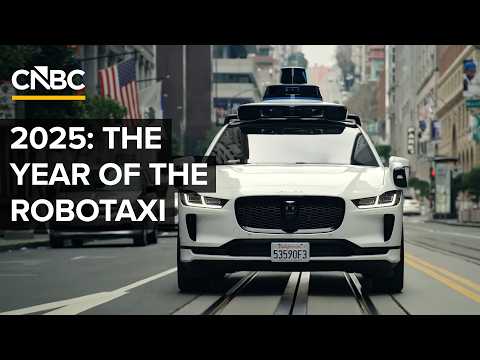
Robotaxis in 2025: Waymo plots global expansion as Zoox, Tesla roll to the starting line
CNBC· 2025-12-16 12:00
Core Insights - The robotaxi market has seen significant advancements in 2025, with companies like Waymo, Tesla, and Baidu's Apollo Go leading the charge in the U.S. and China [2][4][38] Company Developments - Waymo has expanded its service to five markets, up from three at the end of 2024, and aims for aggressive scaling [8][9] - In 2025, Waymo achieved 14 million trips, with an estimated 450,000 weekly paid rides, and plans to reach over 20 million trips by year-end [9][10] - Zoox, owned by Amazon, began public rides in Las Vegas and San Francisco, with plans to charge for rides in 2026 pending regulatory approvals [20][21] - Tesla launched a pilot robotaxi service in Austin and the San Francisco Bay Area, with plans to operate in Nevada, Florida, and Arizona by year-end [27][29] Market Competition - Waymo faces increasing competition from Baidu's Apollo Go, which reported over 250,000 weekly driverless rides and plans to expand internationally [38][39] - Other Chinese companies like Pony.ai and WeRide are also making strides in the robotaxi space, with services in various cities and plans for further expansion [41][42] Financial Performance - Waymo's "Other Bets" segment reported revenue of $344 million in Q3, down from $388 million the previous year, with losses increasing from $1.12 billion to $1.43 billion [14] Regulatory and Safety Challenges - Waymo has faced community pushback and safety concerns, including incidents involving its vehicles, leading to a software recall for illegal maneuvers [15][16] - Tesla's robotaxi service has drawn scrutiny due to safety incidents, including a driver monitor being caught asleep while on duty [30][33]


特斯拉股价年内新高简评和更新
CMS· 2025-12-16 09:32
汽车行业点评报告 特斯拉股价年内新高简评和更新 中游制造/汽车 12 月 15 日,马斯克证实奥斯汀开始测试 robotaxi 去掉安全员;当日特斯拉估 计创年内新高。我们点评如下。 ❑ 事件: 12 月 15 日,马斯克证实奥斯汀开始测试 robotaxi 去掉安全员。特斯拉股价 在纳指回调背景下收涨 3.56%,市值 1.58 万亿美元,创年内新高,紧逼 24 年末历史峰值。 ❑ 简评: 1)近期股价走强主要交易 robotaxi 进展。我们多次强调,奥斯汀去掉安全员 是年末最重要催化,是 robotaxi 商业化落地的里程碑。马斯克多次重申年内 达成。 2)在补贴取消导致汽车业务展望受损后,特斯拉股价在 Q4 仍向上突破,验 证了市场对特斯拉的估值向 AI(robotaxi+机器人)切换的叙事有韧性。 | | | 占比% | | --- | --- | --- | | 股票家数(只) | 266 | 5.2 | | 总市值(十亿元) | 4531.3 | 4.3 | | 流通市值(十亿元) | 3913.0 | 4.1 | ❑ 更新: 1)FSD 方面,11 月底特斯拉推送 FSD V14 免费试用。第 ...
这个自动驾驶黄埔军校,近4500人了
自动驾驶之心· 2025-12-16 09:25
Core Insights - The article emphasizes the establishment of a comprehensive community for autonomous driving knowledge, aiming to facilitate learning and collaboration among industry professionals and newcomers [22][10][8] Group 1: Community and Learning Resources - The "Autonomous Driving Heart Knowledge Planet" has over 4,000 members and aims to grow to nearly 10,000 in two years, providing a platform for technical exchange and job opportunities [8][22] - The community offers a variety of resources, including video tutorials, learning routes, and Q&A sessions, to help members navigate the complexities of autonomous driving technology [10][23] - Members can access insights from industry leaders and academic experts, enhancing their understanding of the latest trends and technologies in autonomous driving [11][10] Group 2: Technical Insights and Developments - Recent updates include discussions on Waymo's latest base model, advancements in self-driving technology, and insights from industry conferences [7][10] - The community has compiled over 40 technical routes covering various aspects of autonomous driving, such as perception, simulation, and planning control [23][10] - Key topics include end-to-end autonomous driving, multi-modal large models, and the integration of traditional planning with new technologies [44][52][56] Group 3: Job Opportunities and Industry Trends - The community provides job recommendations and internal referrals to help members connect with leading companies in the autonomous driving sector [27][10] - Members can inquire about job openings, industry trends, and the future of autonomous driving technologies, fostering a supportive environment for career development [26][10] - The platform encourages collaboration between academia and industry, aiming to bridge the gap between research and practical applications in autonomous driving [22][11]
文远知行韩旭:中国真正L4只有3家......
自动驾驶之心· 2025-12-16 09:25
Core Insights - The article discusses the evolution of autonomous driving, highlighting the progress made by WeRide, which is now a publicly listed company in both the US and Hong Kong, recognized as the "first Robotaxi stock" [3] - The CEO, Han Xu, emphasizes the importance of focusing on talent acquisition and international expansion, indicating a shift from proving the viability of autonomous driving to scaling operations [6][9] - Han Xu asserts that only three companies in China can truly operate Level 4 (L4) autonomous vehicles without a safety driver, indicating a significant technological barrier in the industry [7][28] Group 1 - WeRide has deployed over 1,600 autonomous vehicles globally, with more than 750 being Robotaxis, marking a growth of at least 30% since its IPO [9][10] - The company has recognized the international demand for Robotaxis, being the first to deploy in 11 countries and 30 cities, and has obtained eight different autonomous driving licenses [12][13] - Han Xu reflects on the past challenges of securing funding and the skepticism surrounding autonomous driving, contrasting it with the current landscape where the technology is being implemented at scale [14][16][18] Group 2 - The article highlights the distinction between L2 and L4 autonomous driving, with Han Xu stating that the barriers between these levels have not been broken, and many companies claiming to be L4 are actually "pseudo-Robotaxi" firms [24][29] - Han Xu sets two criteria for a company to be considered a true L4 operator: having a fleet of at least 20-30 vehicles operating without a safety driver for six months, and achieving pure unmanned commercial operations [25][27] - The article discusses the competitive landscape, with Han Xu predicting that if Tesla continues to use L2 vehicles without advanced sensors, it will not reach the operational level of Waymo in three years [33][34] Group 3 - WeRide is also advancing in the L2+ space, having launched a one-step end-to-end solution that is ready for mass production, indicating a dual focus on both L2 and L4 technologies [22][40] - The company collaborates with Bosch to enhance high-level intelligent driving solutions, showcasing its capability in both L4 and L2 technology stacks [37][40] - The article concludes with Han Xu's insights on the increasing salaries for AI talent, reflecting the growing demand and competition in the field, with top salaries reaching up to 5 million [54]

首席联合电话会-科技组
2025-12-16 03:26
Summary of Conference Call on Technology Sector Industry Overview - The conference call focused on the AI industry, particularly the development trends of AI models and their applications in various sectors, including storage, computing power, and PCB markets [1][2][3]. Key Points and Arguments AI Model Development - The trend in AI model development emphasizes enhancing intelligence density, stability, and cost efficiency under unit computing power, with domestic companies like Deepseek and Tongyi Qianwen excelling in cost optimization and open-source initiatives [1][2]. - Recent releases include Google's Gemini 3, which restructured search functionalities, and OpenAI's GPT-5.2, showing significant improvements over previous versions [2]. Productization of AI Models - AI models are increasingly being productized, with examples such as Google's Gemini 3 and the Doubao app, which utilizes operating system-level permissions for cross-app price comparisons [1][3][4]. - The Robot Taxi industry is projected to reach a market size of 100 billion RMB by 2035, with a penetration rate of 10%, indicating a shift from conceptual discussions to practical implementations [3][14]. Storage and Computing Power Trends - The AI industry is driving growth in upstream storage and computing power, with DRAM capital expenditures expected to exceed NAND, and DDR4 prices strengthening due to supply structure adjustments [1][6][7]. - TrendForce predicts DRAM capital expenditures could reach $61 billion by 2026, a 14-15% increase, while NAND is expected to grow by 5% to over $22 billion [7]. PCB Market Insights - The PCB market is currently chaotic, but investment opportunities in Google's ASIC chain are seen as stronger than those in NV chains, with recommendations for companies like ShenNan, Huadian, and Dongshan [11]. - The introduction of mid-plane designs in PCBs is expected to enhance system stability and drive demand and prices upward [9][10]. End-User Market and Future Products - The end-user market is expected to see innovative products such as OpenAI hardware and Apple AI glasses, with specific companies recommended for investment [12]. - The upcoming Siri iteration in 2026 is anticipated to enhance Apple's valuation [12]. Robot Taxi Industry Analysis - The Robot Taxi model focuses on providing a consistent user experience rather than merely competing on price, with local governments showing positive attitudes towards its development [13][14]. - The industry has transitioned from conceptual hype to practical validation, with companies like Waymo and domestic players like Xiaoma Zhixing and Wenyuan Zhixing making significant progress [15]. Autonomous Driving Technology - L4 autonomous driving technology is expected to have a short-term advantage, while L2+ technology companies like Xiaopeng Motors and Horizon Robotics may also see valuation opportunities [16][17]. Additional Important Insights - The emphasis on product design and user experience in AI applications is crucial for future competitiveness [5]. - The need for substantial storage resources in both training and inference phases of AI models highlights the importance of selecting the right stocks in the semiconductor sector [6].

载具纪元新章系列1:Robotaxi白皮书:技术政策双轮驱动,行业正处高速增长阶段
Shenwan Hongyuan Securities· 2025-12-16 01:43
Investment Rating - The report maintains a "Positive" outlook on the Robotaxi industry, indicating a strong belief in its growth potential driven by technological advancements and supportive policies [1]. Core Insights - The Robotaxi sector is undergoing a transformation, leveraging L4 autonomous driving technology to replace human drivers, thereby reducing operational costs and enhancing profit margins. The industry is transitioning from a phase of technical validation to one of scalable operations, with significant growth expected in the coming years [2][3]. - The industry structure is evolving, comprising intelligent driving technology, hardware production, and terminal operations. Key players are focusing on data collection, vehicle manufacturing, and operational management to create a cohesive ecosystem [2][3]. - Policy frameworks are gradually improving, encouraging pilot programs while ensuring safety. This regulatory environment is facilitating the expansion of Robotaxi companies into international markets [2][3]. Summary by Sections 1. Robotaxi Background: Intelligent Driving Technology Reshaping the Mobility Service Industry - The demand for efficient, comfortable, and affordable travel experiences drives the evolution of the mobility service industry, with technological upgrades transforming supply models [15]. - The entry of autonomous driving technology is leading to a restructuring of the capacity value chain, moving from traditional taxi ownership to a more decentralized model [20][22]. - The feasibility of technology is improving, with leading companies demonstrating lower accident rates compared to human drivers, validating the safety and reliability of L4 systems [26][34]. 2. Industry Chain Structure: Intelligent Driving Technology + Hardware Production + Terminal Operations - The current industry participants are adopting a triangular cooperation model, where intelligent driving companies provide solutions, manufacturers supply vehicle chassis, and service platforms manage operations [47][48]. - The operational aspect is becoming increasingly important, with the efficiency of fleet management and scheduling emerging as new competitive barriers [2][3]. 3. Policy Guidance: Encouraging Pilot Programs While Ensuring Safety - Domestic policies are evolving to support pilot programs under safety assurances, while international markets are gradually opening up, allowing Robotaxi companies to expand their operations [2][3]. 4. Industry Growth Phase: A Trillion-Dollar Market with Potential for Billion-Dollar Enterprises - The industry is in a high-growth phase, with the penetration rate of autonomous driving services expected to rise significantly. Key catalysts in the coming years will include mass production of vehicles and global operational expansion [2][3]. - The market is anticipated to give rise to billion-dollar enterprises as leading companies optimize costs and scale operations [2][3].