
荣耀

Search documents
从“猎奇”到“信赖”:折叠屏手机用户发展洞察报告
艾瑞咨询· 2026-01-14 00:06
Group 1 - The core viewpoint of the report highlights the continuous growth of the global foldable smartphone market, particularly in China, driven by technological advancements and an improved supply chain, leading to product diversification [1][4] - The report indicates that the global smartphone market has entered a phase of stock competition since 2017, with annual shipments declining by approximately 2.52%, projected to reach 1.22 billion units by 2024 [2] - Foldable smartphones are identified as a strategic direction to break through market growth bottlenecks, with expected high growth in shipments from 2022 to 2024 [5] Group 2 - The foldable smartphone industry chain encompasses upstream raw material supply, midstream design and manufacturing, and downstream sales, with companies like Huawei and Samsung leading the charge [7] - China's foldable smartphone industry has matured, achieving international advanced standards in technology, and creating a positive cycle of "technology-cost-market" [8][9] - The product forms of foldable smartphones are diverse, with Huawei leading in innovative designs such as tri-fold and wide-fold models [11] Group 3 - The report discusses the transition of foldable smartphones from niche devices to mainstream productivity tools, emphasizing the importance of hardware optimization, software ecosystem collaboration, and enhanced user experience [13][43] - By 2026, it is anticipated to be a critical year for the development of foldable smartphones, with a projected shipment of 6.6 million units in the first half of 2025 [15] - The competitive landscape in China's foldable smartphone market shows a "one strong, many strong" pattern, with Huawei's market share increasing significantly from 35% in Q1 2023 to 75% in Q1 2025 [17][18] Group 4 - User demographics indicate a strong preference for foldable smartphones among high-education users, with over 75% of users holding a bachelor's degree or higher [20] - The majority of users spend between 5,000 to 9,000 yuan on foldable smartphones, with Huawei being the most used brand at 62.3% [22] - Key reasons for purchasing foldable smartphones include a stronger sense of technology and future, with 44.7% of users citing this as a primary motivation [24] Group 5 - Brand recognition for Huawei in the foldable smartphone market is significantly higher than competitors, with strong perceptions of high-end quality and innovation [26][28] - User satisfaction is highest for Huawei, indicating strong brand loyalty and recommendation potential, with Huawei and Xiaomi leading in net promoter scores [30][31] - Consumers view foldable smartphones as carriers of innovation and multifunctional devices, with varying perceptions between genders regarding their roles [34] Group 6 - The primary use cases for foldable smartphones are social interaction and entertainment, with business applications still needing further exploration [36] - Users report pain points related to hardware durability and software experience, including screen wear and poor visual effects [39] - Over 90% of consumers are likely to consider purchasing a foldable smartphone for their next device, with a focus on reliability and battery life [41] Group 7 - The market for foldable smartphones is transitioning from "niche novelty" to "mainstream utility," driven by advancements in hardware and software [47] - The hardware is evolving from merely functional to providing a comprehensive user experience, with innovations in hinge and screen technology [45]


龙旗科技1月14日至1月19日招股 拟全球发售5225.91万股H股
Zhi Tong Cai Jing· 2026-01-13 23:06
Core Viewpoint - Longqi Technology (龙旗科技) is set to launch an IPO from January 14 to January 19, 2026, offering 52.2591 million H-shares, with a maximum price of HKD 31.00 per share, aiming to raise approximately HKD 1.521 billion [1][3] Group 1: Company Overview - Established in 2004, the company focuses on customer-centric values and has developed industry-leading capabilities in smart products, offering a comprehensive solution matrix that includes design, hardware innovation, software development, lean manufacturing, supply chain integration, and quality control [2] - The company has a diverse product portfolio covering smartphones, AIPC, automotive electronics, tablets, smartwatches, and smart glasses, serving major clients such as Xiaomi, Samsung, Lenovo, Honor, OPPO, and vivo [2] Group 2: Market Position - According to Frost & Sullivan, the company is the second-largest consumer electronics ODM manufacturer globally, holding a 22.4% market share, and the largest smartphone ODM manufacturer with a 32.6% market share as of 2024 [1][2] Group 3: Financial Performance - The company's revenues for the years 2022, 2023, and 2024, as well as for the nine months ending September 30, 2024, and 2025, were RMB 29.343 billion, RMB 27.185 billion, RMB 46.383 billion, RMB 34.921 billion, and RMB 31.332 billion respectively [2] - The corresponding net profits for the same periods were RMB 562 million, RMB 603 million, RMB 493 million, RMB 425 million, and RMB 515 million [2] Group 4: Use of Proceeds - The company plans to allocate approximately 40% of the net proceeds from the IPO to expand its production capacity, 20% for ongoing R&D, 10% for marketing and customer development, 20% for strategic investments or acquisitions, and 10% for working capital and general corporate purposes [3]
龙旗科技(09611.HK)拟全球发售5225.91万股H股 预计1月22日上市
Ge Long Hui· 2026-01-13 23:05
Group 1 - The company plans to globally offer 52.2591 million H-shares, with 5.226 million shares available in Hong Kong and 47.0331 million shares for international offering, subject to reallocation and the exercise of the over-allotment option [1] - The company is a leading provider of smart products and services, ranking as the second largest consumer electronics ODM manufacturer globally with a market share of 22.4% and the largest smartphone ODM manufacturer with a market share of 32.6% as of 2024 [1][2] - The company has established a diverse product portfolio including smartphones, AI PCs, automotive electronics, tablets, smartwatches, and smart glasses, supported by a professional team of approximately 5,200 personnel [2] Group 2 - The company has entered into cornerstone investment agreements, with cornerstone investors agreeing to subscribe for shares totaling approximately $56.5 million (or about HKD 440.2 million) [3] - The expected net proceeds from the global offering, assuming no exercise of the over-allotment option, will be approximately HKD 1.5207 billion, with planned allocations for capacity expansion, R&D support, marketing, strategic investments, and working capital [4]
龙旗科技(09611)1月14日至1月19日招股 拟全球发售5225.91万股H股
Zhi Tong Cai Jing· 2026-01-13 23:04
Group 1 - The company, Longqi Technology, plans to offer 52.2591 million H-shares globally, with 10% allocated for Hong Kong and 90% for international sales, at a maximum price of HKD 31.00 per share, expected to start trading on January 22, 2026 [1] - Longqi Technology is a leading global provider of smart products and services, holding the second-largest market share of 22.4% in the global consumer electronics ODM market and the largest share of 32.6% in the smartphone ODM market for 2024 [1][2] - The company has established a diverse product portfolio, including smartphones, AIPC, automotive electronics, tablets, smartwatches, and smart glasses, serving major clients like Xiaomi, Samsung, Lenovo, Honor, OPPO, and vivo [2] Group 2 - The company has entered cornerstone investment agreements with several entities, including Qualcomm and OmniVision HK, agreeing to subscribe for shares worth approximately USD 56.5 million under certain conditions [3] - The estimated net proceeds from the global offering, assuming no exercise of the over-allotment option, will be approximately HKD 1.521 billion, with 40% allocated to expand production capacity, 20% for R&D, 10% for marketing, 20% for strategic investments or acquisitions, and 10% for working capital [3]
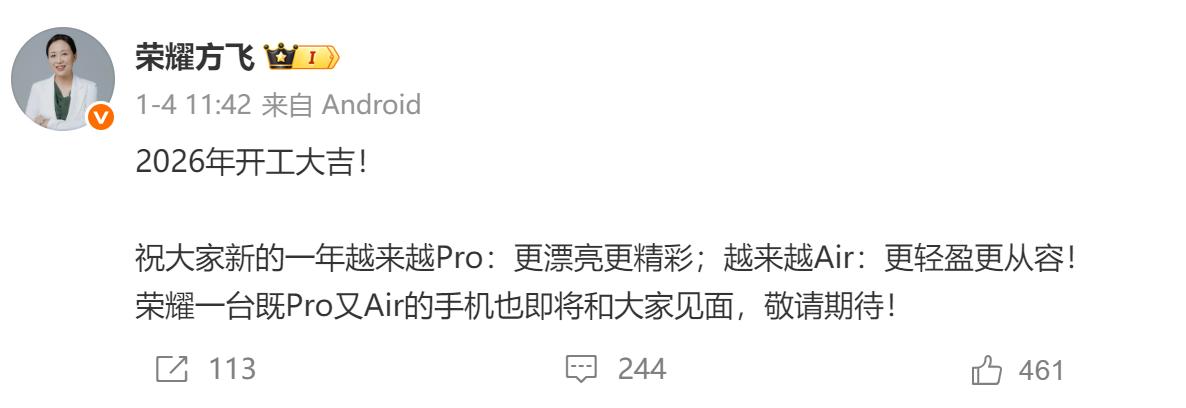
轻薄、潮玩、品牌整合 新年手机业浮现三大发展新趋势
Zheng Quan Shi Bao Wang· 2026-01-13 14:27
Group 1: Core Trends in the Smartphone Industry - The smartphone industry is witnessing three major trends: accelerated brand integration, a collective push towards lightweight high-end smartphones, and a focus on mid-range devices targeting young consumers in the outdoor and esports segments [1][4][5] Group 2: High-End Smartphone Developments - In early 2026, smartphone companies are focusing on launching "Air" models, which are both lightweight and powerful, following Apple's introduction of the iPhone Air [2][3] - Honor's upcoming Magic8 Pro Air features a thickness of only 6.1mm and a weight of 155g, while Red Magic is set to release the Red Magic 11 Air [2] - Despite the iPhone Air's lackluster sales, it highlighted a market demand for lightweight yet powerful devices, prompting other companies to follow suit [3] Group 3: Mid-Range Smartphone Innovations - Companies are targeting the mid-range market by developing products that appeal to young consumers interested in trendy, outdoor, and esports activities [5][6] - Honor has confirmed a collaboration with Pop Mart to launch the industry's first trendy toy smartphone, while Realme plans to unveil a new generation of trendy esports phones [4][5] Group 4: Internal Brand Integration - To address rising storage chip costs, smartphone companies are streamlining their internal brands to reduce competition and enhance efficiency [7] - OPPO has announced that Realme will return as a sub-brand under OPPO, aiming for strategic collaboration and differentiation among its brands [7][8] - The integration is expected to lower organizational costs and reduce internal competition, as seen with OnePlus's return to OPPO, which resulted in a 44% sales increase in 2025 [8] Group 5: Market Outlook - Counterpoint Research predicts a weakening global smartphone market in 2026 due to rising component costs and a shift in resources towards AI data centers, leading to a downward revision of shipment forecasts [8] - Despite challenges, the global smartphone shipment volume grew by 2% in 2025, driven by high-end product trends and increased 5G device adoption in emerging markets [8]
荣耀Air新机引热议 此前荣耀Win系列被指“撞脸”iPhone
Xi Niu Cai Jing· 2026-01-13 13:44
Core Viewpoint - The new smartphone, Honor Magic8 Pro Air, has sparked significant online criticism regarding its design similarities to existing models, particularly the iPhone Air and Google Pixel [2][3]. Group 1: Product Announcement - The Honor Magic8 Pro Air is officially named and set to be released on January 19, featuring four color options: black, white, purple, and orange [5]. - The device will offer storage options of 256GB, 512GB, and 1TB, with a thickness of 6.1-6.3mm and a weight of 155-158g [5]. Group 2: Design Controversy - There are ongoing design controversies surrounding not only the Magic8 Pro Air but also the Honor Win series, particularly the Win RT model, which has been criticized for its design similarities to the iPhone 17 Pro [5]. - Online reactions include comments about the lack of originality in design, with some users humorously noting the "fruit flavor" of the designs, indicating a strong resemblance to Apple products [3][5].
荣耀×泡泡玛特,潮玩手机要来了
Xin Lang Cai Jing· 2026-01-13 13:36
Core Viewpoint - Pop Mart is set to launch a trendy toy mobile phone in collaboration with a well-known smartphone brand, which has garnered significant attention from both toy enthusiasts and the digital community [1] Group 1: Collaboration Details - Pop Mart clarified that the upcoming mobile phone is not a self-developed product but a collaborative effort with a leading smartphone manufacturer [1] - The partner for this collaboration is Honor, a top domestic smartphone brand in China [1] - The collaboration will focus on Honor's 500 series, with the new product scheduled for release on January 19, 2026 [1]

泡泡玛特被曝将与荣耀合作,推“行业首款潮玩手机”
Xin Lang Cai Jing· 2026-01-13 13:36
Core Insights - Honor and Pop Mart are collaborating to launch the Honor 500 series, marketed as the "first trendy toy phone" set to be released on January 19 [1][2] - The collaboration is not a simple "sticker" marketing approach; it integrates Pop Mart's core IP MOLLY into the phone's design, system themes, boot animations, and ringtones [2] - Pop Mart has successfully developed multiple popular IPs, including LABUBU, MOLLY, and SKULLPANDA, with significant revenue growth projected for 2025 [2][3] Company Overview - Honor was established in 2013 as a sub-brand of Huawei, focusing on the young consumer market with mid-range smartphones priced below 3000 yuan [2] - In November 2020, Honor became an independent brand following its separation from Huawei and is currently pursuing an IPO [2] Pop Mart's Strategy - Pop Mart aims to maximize the commercial value of its IPs and established an IP licensing department in 2020 to facilitate cross-industry collaborations [2] - Recent collaborations include exhibitions and partnerships with various brands, indicating a strategy to diversify its revenue streams beyond single blockbuster products [3] Leadership Changes - Pop Mart has appointed a former executive from LVMH as a non-executive director to enhance its strategic direction towards luxury branding [4]
从“经典广货”到“科技广货”,解码“广货行天下”新路径
Nan Fang Du Shi Bao· 2026-01-13 13:04
Core Viewpoint - Guangdong is transforming its traditional manufacturing into high-tech "Guangdong goods," leveraging technological innovation to enhance competitiveness and drive high-quality development in the global value chain [1][4]. Group 1: High-Tech Manufacturing - Guangdong accounts for 40% of the country's industrial robots, 80% of service robots, and 18% of integrated circuits, showcasing its significant role in high-tech manufacturing [2]. - The province is a major hub for smartphone production, with one in three smartphones sold globally being manufactured by Guangdong enterprises, highlighting its dominance in the industry [3]. - Key technological advancements in the smartphone sector include breakthroughs in chip technology by Huawei and innovations in fast charging and foldable screens by various local brands [3][4]. Group 2: Traditional Industry Transformation - Guangdong's textile and apparel industry is the largest in China, with 4,240 registered enterprises, representing 18.34% of the national total [5][6]. - The integration of digital technologies in traditional industries is enhancing productivity, with companies achieving significant efficiency gains through smart manufacturing processes [6][7]. - Companies like Yida Textile are innovating in functional fabrics, meeting market demands and expanding their reach to 137 countries, with notable sales growth in outdoor functional clothing [6][7]. Group 3: Export and Market Expansion - Guangdong's exports of high-tech products increased by 13.3% in the first half of 2025, reflecting the province's strong export capabilities in innovative manufacturing [8]. - The "Guangdong Goods Going Global" initiative aims to enhance market access and brand recognition for local products through coordinated promotional activities and partnerships with major e-commerce platforms [9]. - A series of promotional events will be held in early 2026 to showcase Guangdong's industrial products, emphasizing the transition from traditional to high-tech goods [9].
内存涨价“伤不起”:一犹豫电脑涨千元,华强北组装机加价两千
Xin Jing Bao· 2026-01-13 12:24
Core Viewpoint - The PC and smartphone markets are experiencing a significant price increase due to the rising costs of memory components, with major brands like Lenovo, Dell, and HP signaling price hikes across their product lines [1][2][3]. Group 1: Price Increases in Consumer Electronics - Lenovo laptops have seen price increases of approximately 15%, with specific models like the MagicBook Pro 16 increasing by around 1000 yuan [3]. - New smartphones from brands such as Honor and Vivo have increased in price by 300 to 500 yuan compared to previous generations, with Honor's Power2 model starting at 2699 yuan [2]. - The overall trend of price increases in consumer electronics has been noted since the end of 2025, affecting various brands and product categories [2][3]. Group 2: Impact on the Assembly Market - The rising prices of memory components have severely impacted the computer assembly market, with some businesses reporting a significant drop in sales and even considering early closures [4][5]. - The cost of essential components like 32GB memory modules has surged from around 600 yuan to over 2000 yuan, leading to a decline in consumer interest in custom-built PCs [4][5]. - As assembled PC prices rise, consumers are increasingly opting for branded machines that offer stability and include licensed software [5]. Group 3: Memory Component Price Surge - High-end memory prices have skyrocketed, with some DDR5 server memory modules exceeding 40,000 yuan each, leading to comparisons with real estate prices in Shanghai [6]. - The demand for memory components is driven by the explosive growth of AI applications, with major tech companies significantly increasing their storage needs [6][7]. - Market research indicates that the storage market is entering a "super bull market," with prices expected to rise by 40-50% in the coming quarters [8].