
平安银行

Search documents
2025年度企业ABS承销排行榜
Wind万得· 2026-01-07 11:53
Core Viewpoint - The ABS market in 2025 showed a robust issuance trend, with a total of 2,435 new projects and an issuance scale of 23,250 billion yuan, representing a 14% increase compared to the previous year [1][7]. Segment Summaries Credit ABS - A total of 238 new projects were issued, with an issuance amount of 2,915 billion yuan, reflecting an 8% year-on-year growth. The largest asset class was personal auto loans, with 32 issuances totaling 1,185 billion yuan, followed by non-performing loans with 178 issuances totaling 821 billion yuan [2][8]. Corporate ABS - The corporate ABS segment saw 1,560 issuances, amounting to 14,133 billion yuan, which is a 20% increase year-on-year. The largest issuance was in financing lease receivables, with 295 projects totaling 2,891 billion yuan, followed by corporate receivables with 246 projects totaling 2,308 billion yuan [2][9]. Asset-Backed Notes (ABN) - The ABN market had 612 issuances, totaling 5,731 billion yuan, marking a 9% year-on-year increase. The primary issuances were in bank/internet consumer loans with 191 projects totaling 1,685 billion yuan, and general small loan receivables with 141 projects totaling 1,295 billion yuan [2][13]. Market Size and Growth - As of the end of 2025, the cumulative market size reached approximately 35,832 billion yuan, with credit ABS at 4,339 billion yuan, corporate ABS at 22,808 billion yuan, ABN at 6,535 billion yuan, and public REITs at 2,150 billion yuan [4]. Underwriting Rankings - In the corporate ABS underwriting rankings, CITIC Securities maintained the top position with 308 projects and a total underwriting amount of 1,853.5 billion yuan, followed by Ping An Securities with 257 projects totaling 1,693.3 billion yuan [16][18]. Original Rights Holder Rankings - In the corporate ABS market, China Railway Capital ranked first with 545.9 billion yuan, followed by China Foreign Trade Trust with 517.6 billion yuan [20][21]. Public REITs Market - In the public REITs market, CITIC Securities led with 127.9 billion yuan from 8 projects, followed by Southern Capital Management with 101.9 billion yuan from 3 projects [28][29].





平安银行1月7日大宗交易成交754.64万元
Zheng Quan Shi Bao Wang· 2026-01-07 09:46
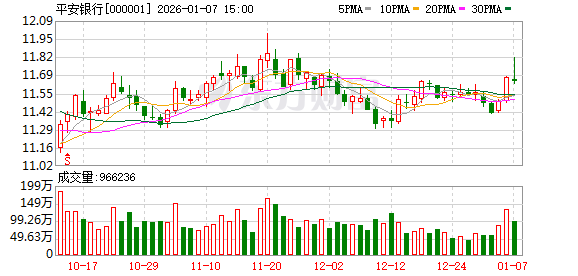
| 成交量 | 成交金额 | 成交价 | 相对当日收盘 | | | | --- | --- | --- | --- | --- | --- | | (万 | (万元) | 格 | 折溢价(%) | 买方营业部 | 卖方营业部 | | 股) | | (元) | | | | | 71.87 | 754.64 | 10.50 | -9.79 | 中国银河证券股份有限公司南 | 中信证券股份有限 | | | | | | 京江东中路证券营业部 | 公司江苏分公司 | 平安银行1月7日大宗交易平台出现一笔成交,成交量71.87万股,成交金额754.64万元,大宗交易成交价 为10.50元,相对今日收盘价折价9.79%。该笔交易的买方营业部为中国银河证券股份有限公司南京江东 中路证券营业部,卖方营业部为中信证券股份有限公司江苏分公司。 进一步统计,近3个月内该股累计发生2笔大宗交易,合计成交金额为1086.68万元。 证券时报·数据宝统计显示,平安银行今日收盘价为11.64元,下跌0.26%,日换手率为0.50%,成交额为 11.31亿元,全天主力资金净流入4986.91万元,近5日该股累计上涨0.69%,近5日资金合计净 ...
复旦张江(01349.HK)认购2.7亿元平安银行结构性存款产品
Ge Long Hui· 2026-01-07 09:16
Group 1 - The company, Fudan Zhangjiang (01349.HK), has announced an agreement with Ping An Bank to subscribe to a structured deposit product using idle funds generated from daily operations, amounting to RMB 270 million [1]

复旦张江(01349)向平安银行认购金额为2.7亿元的结构性存款产品
智通财经网· 2026-01-07 09:08
Group 1 - The core point of the article is that Fudan Zhangjiang (01349) has entered into an agreement with Ping An Bank to subscribe to a structured deposit product worth RMB 270 million using its idle funds generated from daily operations [1] Group 2 - The structured deposit product agreement signifies a strategic move by the company to manage its idle cash effectively [1] - The amount of RMB 270 million indicates a significant investment in financial products, reflecting the company's approach to optimizing its liquidity [1]
复旦张江向平安银行认购金额为2.7亿元的结构性存款产品
Zhi Tong Cai Jing· 2026-01-07 09:05
复旦张江(01349)发布公告,近日,公司与平安银行订立平安银行结构性存款产品协议,同意以日常营 运产生的自有闲置资金向平安银行认购金额为人民币2.7亿元的结构性存款产品。 ...
平安银行今日大宗交易折价成交71.87万股,成交额754.64万元
Xin Lang Cai Jing· 2026-01-07 09:00
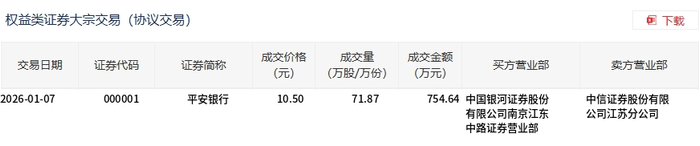
| 权益类证券大宗交易(协议交易) | | | | | | | 团 下载 | | --- | --- | --- | --- | --- | --- | --- | --- | | 交易日期 | 证券代码 | 证券简称 | 成交价格 (元) | 成交量 (万股/万份) | 成交金额 (万元) | 买方营业部 | 卖方营业部 | | 2026-01-07 | 000001 | 平安银行 | 10.50 | 71.87 | | 754.64 中国银河证券股份 有限公司南京江东 中路证券营业部 | 中信证券股份有限 公司江苏分公司 | 1月7日,平安银行大宗交易成交71.87万股,成交额754.64万元,占当日总成交额的0.66%,成交价10.5 元,较市场收盘价11.64元折价9.79%。 ...
超2700万!A股2025年新开户数创3年新高
Xin Lang Cai Jing· 2026-01-07 08:40
Group 1 - The core viewpoint of the article highlights a significant increase in new A-share accounts in 2025, reaching 27.44 million, a 9.75% year-on-year growth, marking the highest annual figure since 2022 [2][3] - The data indicates a strong correlation between new account openings and market conditions, with a notable increase in new accounts during the second half of the year, particularly in December, which saw a 30.54% year-on-year increase [2][3] - Individual investors remain the primary force in account openings, with 27.33 million new personal accounts, while institutional accounts surged by 35% to 104,500, indicating a structural shift in the market [3][4] Group 2 - The growth in new accounts is attributed to a shift in asset allocation towards equity markets, driven by the adjustment in the real estate market and the performance of sectors like AI and new energy, which resonate with younger investors [3][4] - Policy initiatives aimed at enhancing the capital market environment, including lowering transaction costs and promoting long-term capital inflows, have significantly boosted market attractiveness [4][5] - Analysts express optimism for the A-share market in 2026, anticipating a continued "slow bull" market driven by incremental capital and steady corporate earnings recovery [5][6] Group 3 - The expected drivers for the A-share market in 2026 include a transformation in corporate profit structures, sufficient valuation recovery potential, and increased liquidity from insurance funds and high-net-worth individuals [6][7] - Different institutions predict various investment focuses, including technology innovation, advanced manufacturing, upstream cycles, and domestic consumption, reflecting a consensus on the market's potential [7][8] - Goldman Sachs forecasts a transition from a "hope" phase to a "growth" phase in the Chinese stock market, with a projected 14% profit growth in 2026 and a potential 38% increase by the end of 2027 [8]

“破净股”大缩水,仅剩300只!国家队持有+绩优+回购+低价全名单来了!
私募排排网· 2026-01-07 07:00
Core Viewpoint - The article discusses the performance of the Chinese stock market in 2025, highlighting a "slow bull" trend with significant gains in A-shares and Hong Kong stocks, particularly noting the impressive performance of the ChiNext index with nearly 50% growth [2]. Group 1: Market Performance - By December 31, 2025, the average increase in A-shares was 38.15%, with 572 stocks doubling in value. In comparison, the "924 market" from 2024 saw an average increase of 87.84%, with 1586 stocks doubling [2]. - The number of "broken net" stocks decreased from 836 in the previous "924 market" to 303, representing only 5.54% of all A-shares, indicating a market recovery [3]. Group 2: Broken Net Stocks - The article categorizes broken net stocks into five groups: broken net + performance stocks, broken net + repurchase stocks, broken net stocks + state-owned holdings, broken net + high dividend stocks, and broken net + low price stocks [4]. - Among the 303 broken net stocks, only 15 were identified as performance stocks with significant revenue growth and profit increases of over 50% [4]. Group 3: Repurchase Stocks - Of the 303 broken net stocks, 72 companies engaged in stock repurchases, with 29 companies repurchasing over 100 million yuan. This indicates management's belief that their stock prices are undervalued [6][7]. - The top three companies by repurchase amount in 2025 were Jiuan Medical (925 million yuan), China State Construction (887 million yuan), and Youngor (693 million yuan) [7]. Group 4: High Dividend Stocks - There are 22 broken net stocks with a dividend yield of over 5%, enhancing their investment appeal due to potential capital appreciation and stable dividend income [9]. - Among these, Jizhong Energy had a net asset ratio of 0.99 and a dividend yield of 11.15%, despite a significant drop in revenue and profit [9]. Group 5: State-Owned Holdings - The "national team" held 95 broken net stocks in the third quarter, with significant investments in Agricultural Bank of China, Bank of China, and Industrial and Commercial Bank of China, indicating a focus on stabilizing these sectors [11][12]. - The national team increased its holdings in 17 broken net stocks, with six being newly added in the third quarter [11]. Group 6: Low Price Stocks - There are 34 broken net stocks priced below 3 yuan, with only 7 showing positive revenue and profit growth, indicating that many may not have strong underlying asset values [14].




已有十余家银行聘任首席合规官
Jin Rong Shi Bao· 2026-01-07 02:52
Core Viewpoint - The appointment of Chief Compliance Officers (CCOs) in banks is a response to increasing regulatory demands, aiming to enhance compliance management and integrate it into business processes [1][2]. Group 1: Appointment of Chief Compliance Officers - Zhangjiagang Rural Commercial Bank appointed Wu Kai as its Chief Compliance Officer, marking a trend where over ten banks have made similar appointments [1]. - In December 2025 alone, several banks, including Ping An Bank and Industrial Bank, approved the hiring of CCOs [1]. - The rapid appointment of CCOs aligns with the implementation of the "Financial Institutions Compliance Management Measures," which mandates the establishment of CCO positions at the headquarters of financial institutions [2]. Group 2: Responsibilities and Challenges - CCOs are expected to take on more responsibilities, including the formulation and supervision of compliance policies, ensuring that all business activities adhere to regulatory frameworks [5]. - There is a concern that an increase in executive positions may burden banks, particularly smaller financial institutions [2]. - Many currently appointed CCOs are existing senior executives, which helps mitigate potential operational burdens [3]. Group 3: Recruitment Trends - Some banks, such as Jiangxi Bank and Shangrao Bank, have publicly announced recruitment for CCO positions, indicating a proactive approach to compliance management [4].





白银年涨幅超黄金两倍,银行贵金属资产规模大增,普通投资者配置难度加大
Xin Lang Cai Jing· 2026-01-07 01:12
Core Viewpoint - Industrial and Commercial Bank of China (ICBC) has announced adjustments to the risk tolerance levels for personal customers' accumulation gold business, requiring a minimum risk assessment of C3-balanced type for account opening and investment plans, citing market instability as a reason for the change [1] Group 1: Market Trends - The gold and silver markets have seen significant price increases, with London gold and silver experiencing annual gains of approximately 65% and 148% respectively in 2025, leading to heightened demand for precious metals among domestic investors [1] - The strong performance of the precious metals market has driven rapid expansion in banks' precious metal asset scales, with 17 out of 19 banks reporting growth in their precious metal assets in the third quarter of 2025, and 10 banks showing increases exceeding 100% [3] - The demand for precious metals is being fueled by both customer-driven business and increased self-trading by banks, as they seek to enhance their positions in precious metals and hedge against price volatility [3] Group 2: Regulatory Adjustments - ICBC's new risk assessment requirements will take effect on January 12, 2026, and customers must complete a risk assessment questionnaire and sign a risk disclosure document to engage in accumulation gold business [2] - Other banks, including Ningbo Bank and CITIC Bank, have also adjusted their accumulation gold risk levels in response to rising gold prices, with many banks increasing the minimum investment thresholds for accumulation gold [2] Group 3: Investment Strategies - Ordinary investors face challenges in accessing precious metal investments, as many banks have halted new accounts for derivative products like "paper silver," limiting investment channels primarily to physical products and related stocks [5] - Analysts suggest that investors should adopt a long-term investment approach, treating precious metals as a hedge rather than a speculative tool, and recommend dollar-cost averaging to mitigate risks associated with short-term price fluctuations [6]