中国海洋石油

Search documents
1月20日24时起,油价上涨!
Sou Hu Cai Jing· 2026-01-20 12:07
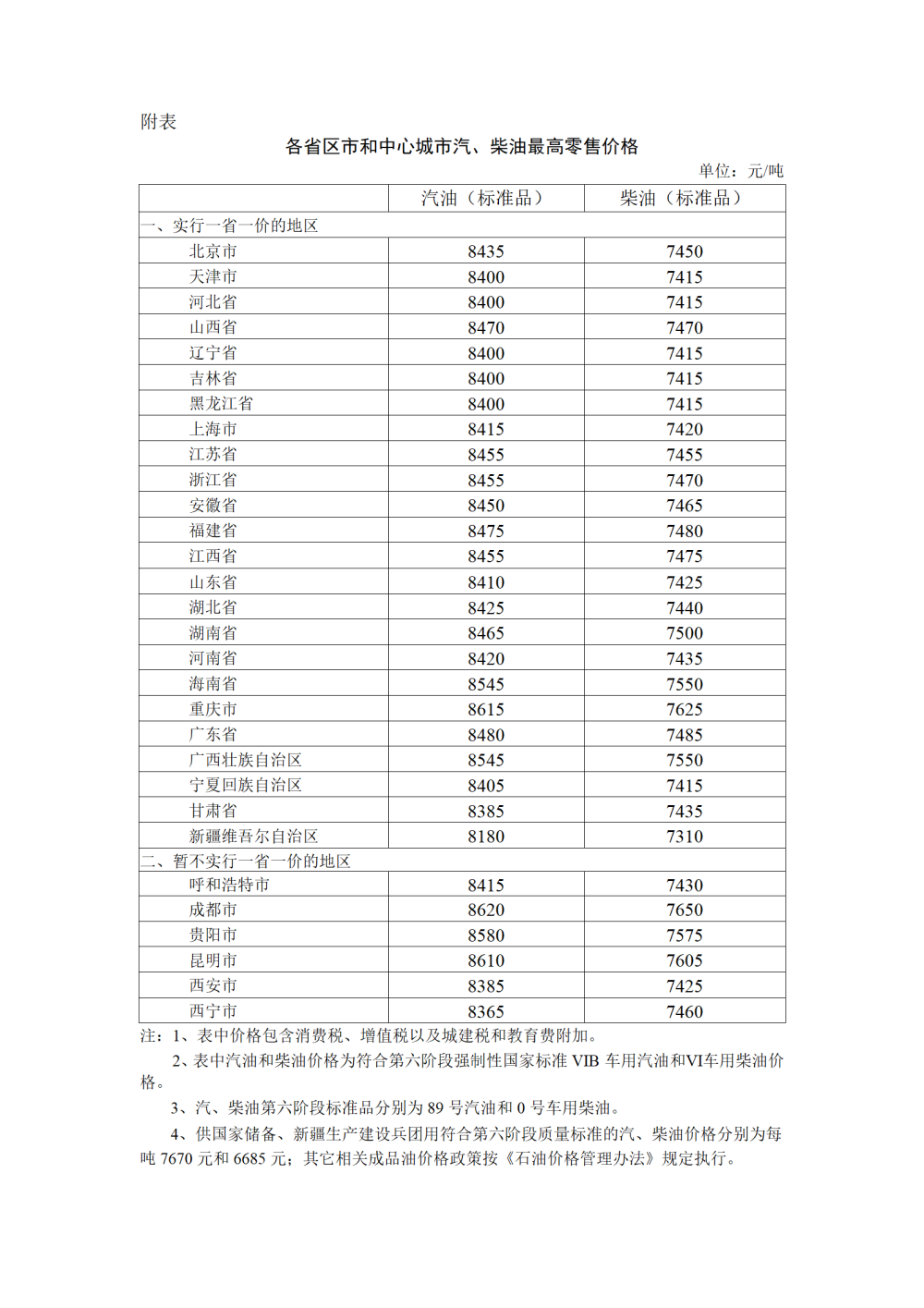
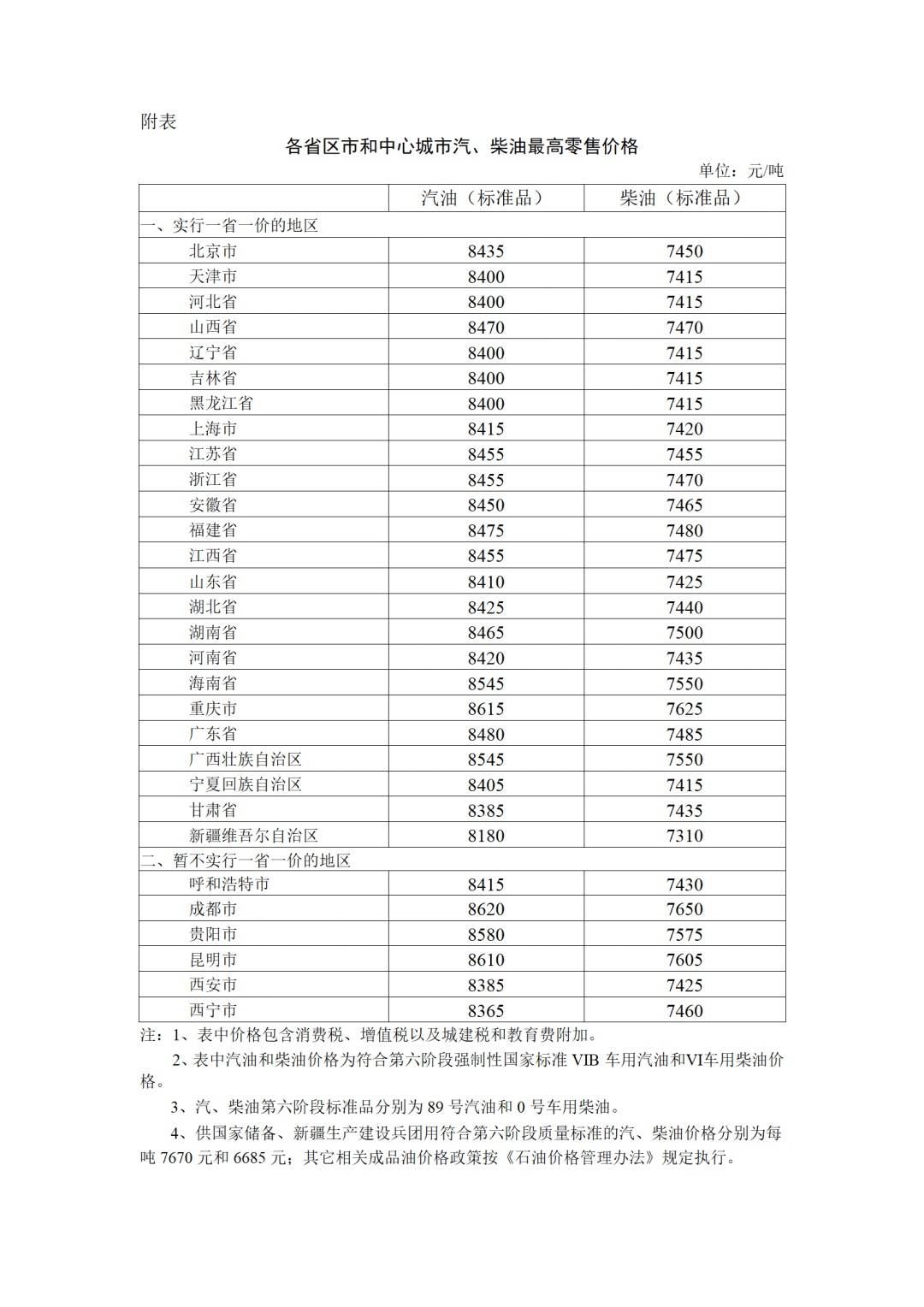
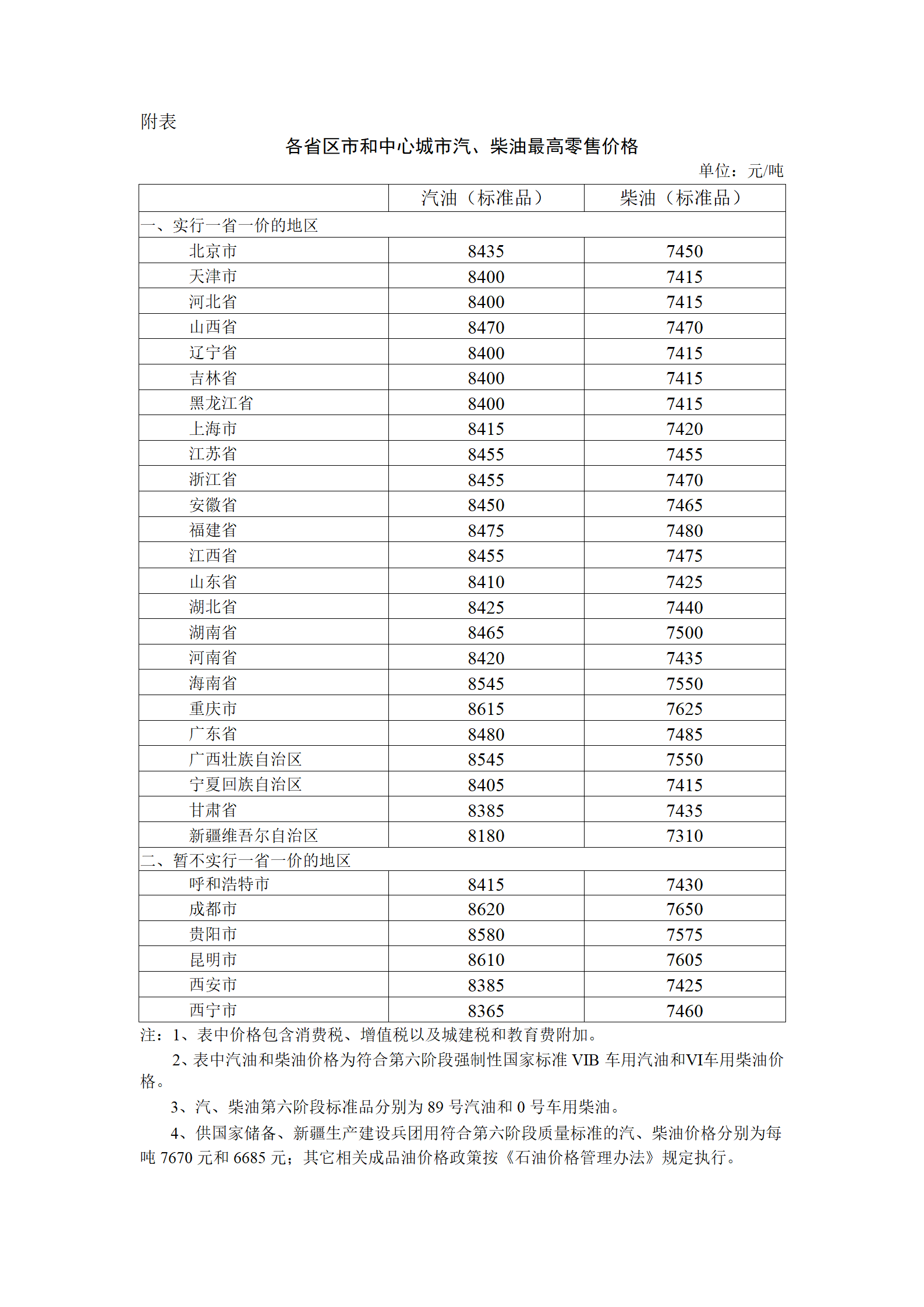
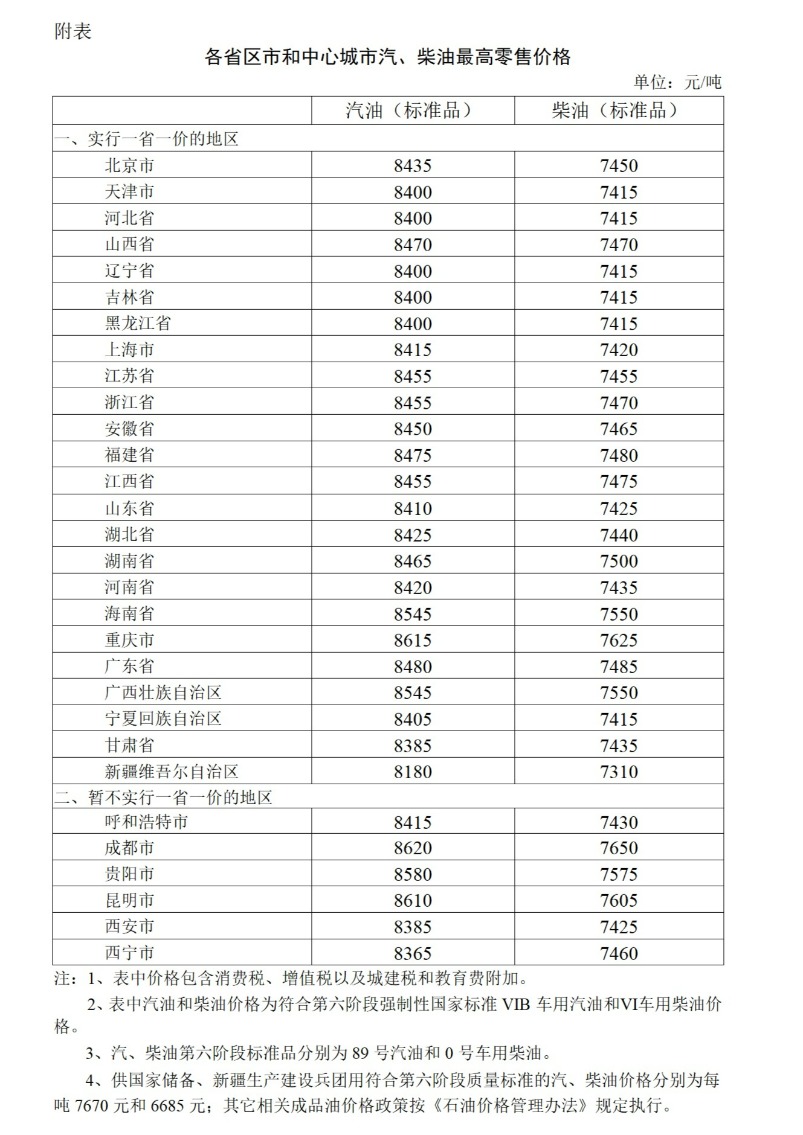
Core Viewpoint - Recent fluctuations in international oil prices have led to an increase in domestic gasoline and diesel prices in China, effective from January 20, with a rise of 85 yuan per ton for both fuels [1]. Price Adjustments - The new maximum retail prices for gasoline and diesel across various provinces and municipalities have been updated, reflecting the price increase [2]. - The prices for gasoline (standard) and diesel (standard) in major regions are as follows: - Beijing: Gasoline 8435 yuan/ton, Diesel 7450 yuan/ton - Shanghai: Gasoline 8415 yuan/ton, Diesel 7420 yuan/ton - Guangdong: Gasoline 8480 yuan/ton, Diesel 7485 yuan/ton - Other regions have similar price adjustments [2]. Compliance and Market Stability - Major oil companies, including PetroChina, Sinopec, and CNOOC, are required to ensure stable supply and adhere to national pricing policies [5]. - Local authorities are tasked with increasing market supervision and enforcing compliance with national price policies, with mechanisms in place for consumers to report violations [5].

抓紧去加油!今晚,油价调整
Sou Hu Cai Jing· 2026-01-20 11:44
Core Viewpoint - Recent fluctuations in international oil prices have led to an increase in domestic gasoline and diesel prices in China, effective from January 20, with a rise of 85 yuan per ton for both fuels [1]. Group 1: Price Adjustments - The average price comparison of the first ten working days of January indicates a price adjustment in accordance with the current refined oil pricing mechanism [1]. - The new maximum retail prices for gasoline and diesel across various provinces and central cities have been established, reflecting the price increase [2][3]. Group 2: Market Regulation - Major oil companies, including PetroChina, Sinopec, and CNOOC, are required to ensure stable supply and adhere to national pricing policies [1]. - Local authorities are tasked with enhancing market supervision and strictly enforcing compliance with national pricing regulations to maintain normal market order [1].
北水动向|北水成交净买入36.63亿 泡泡玛特时隔两年回购 北水抢筹超3亿港元
智通财经网· 2026-01-20 11:07
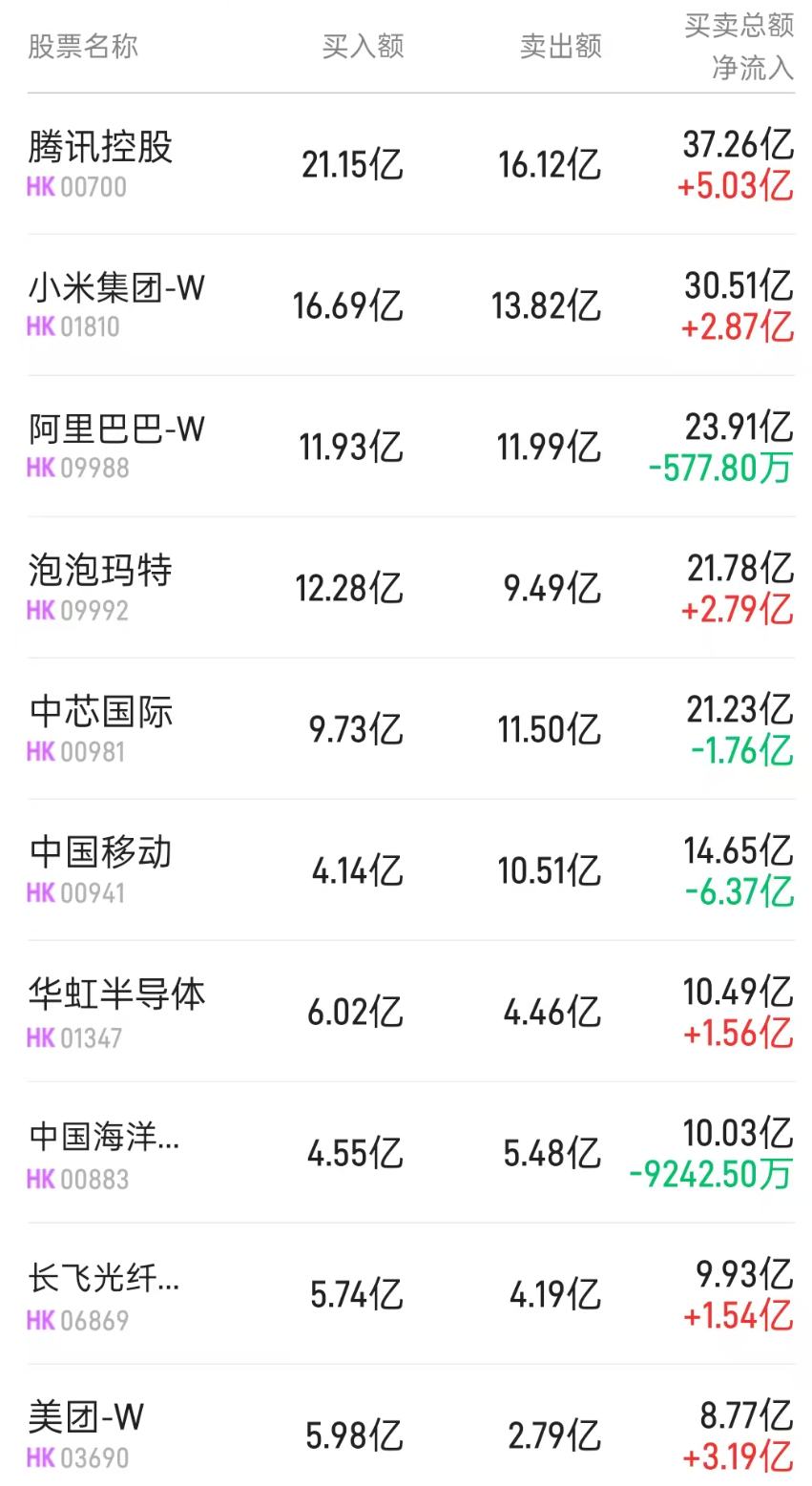
Group 1 - The core point of the news is that the Hong Kong stock market saw significant net buying from northbound capital, totaling HKD 36.63 billion, with Tencent, Meituan, and Xiaomi being the most purchased stocks [2][6] - Tencent Holdings (00700) had a net inflow of HKD 5.03 billion, with total buy and sell amounts of HKD 21.15 billion and HKD 16.12 billion respectively [3][5] - Meituan (03690) recorded a net inflow of HKD 3.19 billion, with total buy and sell amounts of HKD 5.98 billion and HKD 2.79 billion respectively [3][6] Group 2 - Semiconductor stocks showed divergence, with Hua Hong Semiconductor (01347) receiving a net inflow of HKD 2.45 billion, while SMIC (00981) faced a net outflow of HKD 7.17 billion [7] - The report from Open Source Securities indicated that TSMC raised its capital expenditure forecast significantly, reflecting strong long-term demand driven by AI [7] - Long-distance fiber optic cable stocks like Changfei Optical Fiber (06869) saw a net inflow of HKD 1.54 billion, supported by rising prices in the G.652.D fiber market [7] Group 3 - Xiaomi Group-W (01810) received a net inflow of HKD 3.95 billion, while China Mobile (00941) faced a net outflow of HKD 6.37 billion [8] - The report from Bank of America noted that the growth in metal demand is no longer cyclical, as economies are restructuring their energy infrastructure [8] - The sentiment around resource competition is affecting copper prices, which may remain volatile in the short term [8]





智通港股通活跃成交|1月20日
智通财经网· 2026-01-20 11:01
Core Insights - On January 20, 2026, Tencent Holdings (00700), Xiaomi Group-W (01810), and Alibaba-W (09988) were the top three companies by trading volume in the Southbound Stock Connect, with trading amounts of 3.726 billion, 3.051 billion, and 2.391 billion respectively [1] - In the Shenzhen-Hong Kong Stock Connect, Tencent Holdings (00700), Alibaba-W (09988), and SMIC (00981) led the trading volume, with amounts of 2.662 billion, 2.502 billion, and 1.936 billion respectively [1] Southbound Stock Connect Trading Activity - The top active companies in the Southbound Stock Connect included: - Tencent Holdings (00700) with a trading amount of 3.726 billion and a net buying amount of +0.503 billion [2] - Xiaomi Group-W (01810) with a trading amount of 3.051 billion and a net buying amount of +0.287 billion [2] - Alibaba-W (09988) with a trading amount of 2.391 billion and a net selling amount of -5.778 million [2] - Other notable companies included Pop Mart (09992) and SMIC (00981) with trading amounts of 2.178 billion and 2.123 billion respectively [2] Shenzhen-Hong Kong Stock Connect Trading Activity - The top active companies in the Shenzhen-Hong Kong Stock Connect included: - Tencent Holdings (00700) with a trading amount of 2.662 billion and a net buying amount of +0.160 billion [2] - Alibaba-W (09988) with a trading amount of 2.502 billion and a net buying amount of +7.257 million [2] - SMIC (00981) with a trading amount of 1.936 billion and a net selling amount of -5.420 billion [2] - Other notable companies included Xiaomi Group-W (01810) with a trading amount of 1.603 billion and a net buying amount of +0.108 billion [2]



汽油、柴油价格上涨
Xin Hua Wang· 2026-01-20 10:02
Core Viewpoint - The National Development and Reform Commission (NDRC) announced an increase in domestic gasoline and diesel prices by 85 yuan per ton, effective from January 20, due to fluctuations in international oil prices [1]. Group 1: Price Adjustment - The price adjustment is based on the comparison of the average prices over the last ten working days with the previous adjustment period [1]. - The increase in fuel prices is a response to the recent rise in international oil prices, which have shown volatility [1]. Group 2: Market Stability Measures - Major oil companies, including PetroChina, Sinopec, and CNOOC, are required to ensure stable production and supply of refined oil products [1]. - Local authorities are tasked with enhancing market supervision and strictly enforcing national pricing policies to maintain normal market order [1]. Group 3: Market Conditions - The NDRC's price monitoring center indicates that geopolitical factors are the primary influence on the fluctuations of international oil prices, amidst a backdrop of oversupply in the global oil market [1].
今晚调油价!国内汽、柴油价格每吨均上涨85元
Yang Shi Wang· 2026-01-20 10:01
Core Viewpoint - Recent fluctuations in international oil prices have led to an increase in domestic gasoline and diesel prices in China, effective from January 20, with a rise of 85 yuan per ton for both fuels [1]. Group 1: Price Adjustments - Domestic gasoline and diesel prices will increase by 85 yuan per ton starting January 20 at 24:00 [1]. - The adjustment is based on the average price comparison of the first ten working days of January with the previous adjustment period [1]. Group 2: Market Regulation - Major oil companies, including PetroChina, Sinopec, and CNOOC, are required to ensure stable supply and adhere to national pricing policies [1]. - Local authorities are tasked with enhancing market supervision and strictly enforcing compliance with national price policies to maintain market order [1]. Group 3: Retail Prices - The highest retail prices for gasoline and diesel across various provinces and municipalities have been detailed, with prices varying by region [2][3]. - The prices include consumption tax, value-added tax, urban construction tax, and educational fees [3].
北水动向|北水成交净买入36.63亿 泡泡玛特(09992)时隔两年回购 北水抢筹超3亿港元
智通财经网· 2026-01-20 10:01
Core Viewpoint - The Hong Kong stock market experienced significant net inflows from northbound trading, with a total net buy of HKD 36.63 billion on January 20, 2023, indicating strong investor interest in certain stocks [1]. Group 1: Net Buying and Selling Activities - Tencent (00700) received the highest net buy of HKD 21.15 billion, with a total trading volume of HKD 37.26 billion, reflecting a net inflow of HKD 5.03 billion [2]. - Meituan-W (03690) saw a net buy of HKD 16.69 billion, with a total trading volume of HKD 30.51 billion, resulting in a net inflow of HKD 2.87 billion [2]. - Xiaomi Group-W (01810) had a net buy of HKD 3.95 billion, contributing to the overall positive sentiment in the tech sector [7]. - Conversely, SMIC (00981) faced the largest net sell of HKD 9.73 billion, with a total trading volume of HKD 21.23 billion, indicating a net outflow of HKD 1.76 billion [2]. - China Mobile (00941) also experienced significant net selling, with a net outflow of HKD 6.37 billion [7]. Group 2: Sector Insights and Market Trends - The technology sector, particularly companies like Tencent, Meituan, and Alibaba, is seeing increased investment interest, driven by expectations of growth in AI and cloud computing [4]. - The semiconductor sector showed divergence, with Hua Hong Semiconductor (01347) receiving a net buy of HKD 2.45 billion, while SMIC faced a net sell of HKD 7.17 billion, reflecting varying investor confidence [5]. - The optical fiber and cable industry is experiencing a price recovery, with Longi Optical Fiber (06869) receiving a net buy of HKD 1.54 billion, supported by rising market prices for G.652.D optical fibers [5]. - The mining sector, particularly Zijin Mining (02899) and Luoyang Molybdenum (03993), faced net selling pressures, attributed to changing market sentiments regarding metal demand and supply dynamics [6].
港股20日跌0.29% 收报26487.51点
Xin Hua Wang· 2026-01-20 09:51
Market Overview - The Hang Seng Index fell by 76.39 points, a decrease of 0.29%, closing at 26,487.51 points [1] - The total turnover on the main board was HKD 2,377.66 million [1] - The National Enterprises Index dropped by 39.69 points, closing at 9,094.76 points, a decline of 0.43% [1] - The Hang Seng Tech Index decreased by 66.54 points, closing at 5,683.44 points, a drop of 1.16% [1] Blue-Chip Stocks - Tencent Holdings decreased by 1.48%, closing at HKD 601 [1] - Hong Kong Exchanges and Clearing fell by 1.11%, closing at HKD 427 [1] - China Mobile remained unchanged, closing at HKD 79.3 [1] - HSBC Holdings increased by 1.1%, closing at HKD 128.4 [1] Local Hong Kong Stocks - Cheung Kong Holdings rose by 0.74%, closing at HKD 43.34 [1] - Sun Hung Kai Properties decreased by 0.99%, closing at HKD 110.2 [1] - Henderson Land Development increased by 0.52%, closing at HKD 31.12 [1] Chinese Financial Stocks - Bank of China fell by 0.45%, closing at HKD 4.47 [1] - China Construction Bank decreased by 0.51%, closing at HKD 7.76 [1] - Industrial and Commercial Bank of China dropped by 0.47%, closing at HKD 6.31 [1] - Ping An Insurance rose by 0.88%, closing at HKD 69 [1] - China Life Insurance increased by 4.31%, closing at HKD 33.4 [1] Oil and Petrochemical Stocks - China Petroleum & Chemical Corporation fell by 0.61%, closing at HKD 4.92 [1] - China National Petroleum Corporation decreased by 0.12%, closing at HKD 8.21 [1] - CNOOC Limited dropped by 1.74%, closing at HKD 21.52 [1]



国家发展改革委:自1月20日24时起国内汽、柴油价格每吨均上涨85元
Xin Hua Cai Jing· 2026-01-20 09:38
Core Viewpoint - The National Development and Reform Commission announced an increase in domestic gasoline and diesel prices by 85 yuan per ton, effective from January 20, due to rising international oil price fluctuations [1]. Price Adjustment Summary - The adjustment is based on the average price comparison of the first ten working days of January with the previous adjustment period [1]. - The new maximum retail prices for gasoline and diesel across various provinces and cities are detailed in the accompanying table [2][3]. Regional Price Details - The maximum retail prices for gasoline and diesel in major cities and provinces are as follows: - Beijing: Gasoline 8435 yuan, Diesel 7450 yuan - Shanghai: Gasoline 8415 yuan, Diesel 7420 yuan - Guangdong: Gasoline 8545 yuan, Diesel 7550 yuan - Other regions have varying prices, with the highest recorded in Chongqing at Gasoline 8612 yuan and Diesel 7625 yuan [3]. Compliance and Market Stability - Major oil companies, including PetroChina, Sinopec, and CNOOC, are required to ensure stable supply and adhere to national pricing policies [5]. - Local authorities are tasked with increasing market supervision and addressing any violations of the pricing policy to maintain market order [5].
1月20日24时起国内汽、柴油价格每吨均上涨85元
Xin Hua Wang· 2026-01-20 09:18
Core Viewpoint - Domestic gasoline and diesel prices will increase by 85 yuan per ton starting from January 20, 2026, due to fluctuations in international oil prices and the current pricing mechanism [2]. Pricing Adjustment - The adjustment is based on the average prices from the previous ten working days compared to the last adjustment period [2]. - The new maximum retail prices for gasoline and diesel across various provinces and central cities are provided in a detailed table [3]. Market Regulation - Major oil companies, including PetroChina, Sinopec, and CNOOC, are required to ensure stable supply and adhere to national pricing policies [2]. - Local authorities are tasked with increasing market supervision and strictly enforcing compliance with national pricing regulations [2]. Retail Price Details - The maximum retail prices for gasoline and diesel in various regions are specified, with prices ranging from 7,310 yuan to 8,615 yuan per ton for diesel and 8,180 yuan to 8,675 yuan per ton for gasoline [3]. - The prices include consumption tax, value-added tax, urban construction tax, and educational fees [3][4]. Quality Standards - The gasoline and diesel prices mentioned are for products that meet the sixth phase of mandatory national standards, specifically 89-octane gasoline and zero-grade diesel [4].