
诺诚健华

Search documents
经济热力站丨诺诚健华超20亿美元授权合作刷新中国自免领域小分子交易记录,中关村生命科学园迎创新药国际化里程碑
Cai Jing Wang· 2025-10-10 03:09
Core Insights - The collaboration between Innovent Biologics and Zenas for three self-immune pipeline products marks a significant milestone in the internationalization of the drug Orelabrutinib and sets a new record for small molecule transactions in China's self-immune field, with a total potential transaction value exceeding $2 billion [1] - The development of the first-class new drug HH-003 (Libevev) by Huahui Anjian, targeting chronic hepatitis D, is expected to receive approval for market launch around the first quarter of 2026, representing a major milestone in the company's growth [2][3] Company Developments - Huahui Anjian has been developing HH-003 since its inception, with significant funding rounds supporting its clinical trials, including a recent A++ round financing and breakthrough therapy designation from the FDA for treating chronic hepatitis D [3][4] - The drug HH-003 has shown promising results in clinical trials, demonstrating good safety and antiviral activity, with a notable decrease in HBV DNA and hepatitis B surface antigen levels observed in patients [3][4] Industry Context - The Zhongguancun Life Science Park, where both Innovent Biologics and Huahui Anjian are based, is a key area for biotechnology innovation in Beijing, having produced significant drugs like Orelabrutinib and Zebutinib [1][5] - The park is recognized for its comprehensive industry chain, facilitating the transition from laboratory research to clinical application, thus fostering a competitive pharmaceutical health industry [10] Product Pipeline and Market Potential - Innovent Biologics has developed Orelabrutinib, a BTK inhibitor that has been approved in China and Singapore, with plans for further clinical trials targeting multiple sclerosis [6][7] - The company is also advancing its pipeline with a new generation TRK inhibitor, demonstrating a strategic focus on expanding its product offerings in oncology and autoimmune diseases [7][8] Competitive Landscape - The competitive landscape for BTK inhibitors in China includes several products, with Orelabrutinib positioned to capture market share due to its rapid development and broad application potential [6] - WanTai Biologics, another company in the park, is expanding its vaccine pipeline, including the world's first marketed hepatitis E vaccine, showcasing the diverse innovation occurring within the Zhongguancun Life Science Park [9][10]


诺诚健华再挫逾8% 日前宣布与Zenas就三款自免管线达成授权许可合作
Zhi Tong Cai Jing· 2025-10-10 03:05
值得关注的是,诺诚健华此次和Zenas就三款自免管线达成授权许可合作,其中奥布替尼治疗进展型多 发性硬化(MS)进入全球III期临床开发。据公司2024年年报,奥布替尼去年实现收入10.00亿元,同比 增长49.14%。此外,资料显示,Zenas于去年9月在纳斯达克证券交易所挂牌上市,当前总市值约11亿美 元,聚焦自身免疫性疾病领域,现有产品均处于临床阶段。 诺诚健华(09969)再挫逾8%,该股昨日大跌超11%。截至发稿,跌8.84%,报15.15港元,成交额4.35亿港 元。 消息面上,诺诚健华日前公告称,全资子公司InnoCare Pharma Inc.(简称"公司")与Zenas BioPharma, Inc.(简称"Zenas")签署授权许可协议,将具有自主知识产权的产品奥布替尼及2项临床前资产有偿许 可给Zenas,使其可以开发、生产、商业化或以其他方式利用该等产品。交易金额包括1亿美元首付款和 700万普通股股票,以及潜在的研发及注册里程碑付款,总额超过20亿美元,此外,公司有权按许可产 品年度净销售额收取最高达高百分之十几的分层特许权使用费。 ...
港股异动 | 诺诚健华(09969)再挫逾8% 日前宣布与Zenas就三款自免管线达成授权许可合作
智通财经网· 2025-10-10 02:58
消息面上,诺诚健华日前公告称,全资子公司InnoCare Pharma Inc.(简称"公司")与Zenas BioPharma, Inc.(简称"Zenas")签署授权许可协议,将具有自主知识产权的产品奥布替尼及2项临床前资产有偿许 可给Zenas,使其可以开发、生产、商业化或以其他方式利用该等产品。交易金额包括1亿美元首付款和 700万普通股股票,以及潜在的研发及注册里程碑付款,总额超过20亿美元,此外,公司有权按许可产 品年度净销售额收取最高达高百分之十几的分层特许权使用费。 智通财经APP获悉,诺诚健华(09969)再挫逾8%,该股昨日大跌超11%。截至发稿,跌8.84%,报15.15港 元,成交额4.35亿港元。 值得关注的是,诺诚健华此次和Zenas就三款自免管线达成授权许可合作,其中奥布替尼治疗进展型多 发性硬化(MS)进入全球III期临床开发。据公司2024年年报,奥布替尼去年实现收入10.00亿元,同比 增长49.14%。此外,资料显示,Zenas于去年9月在纳斯达克证券交易所挂牌上市,当前总市值约11亿美 元,聚焦自身免疫性疾病领域,现有产品均处于临床阶段。 ...
创新药概念异动拉升
Di Yi Cai Jing Zi Xun· 2025-10-10 02:32
Core Viewpoint - The innovative drug concept has seen a significant surge in the market, with several companies experiencing notable stock price increases [1] Group 1: Company Performance - Changchun High-tech has risen over 8% [1] - Xinghao Pharmaceutical and Wanbangde have both increased by over 5% [1] - Other companies such as Tibet Pharmaceutical, Rongchang Bio, Xinlitai, Guangsheng Tang, and Nuocheng Jianhua have also shown upward movement in their stock prices [1]


创新药概念异动拉升
第一财经· 2025-10-10 02:25
10月10日早盘,创新药概念异动拉升。长春高新涨超8%,星昊医药、万邦德涨超5%,西藏医药、 荣昌生物、信立泰、广生堂、诺诚健华等跟涨。 ...

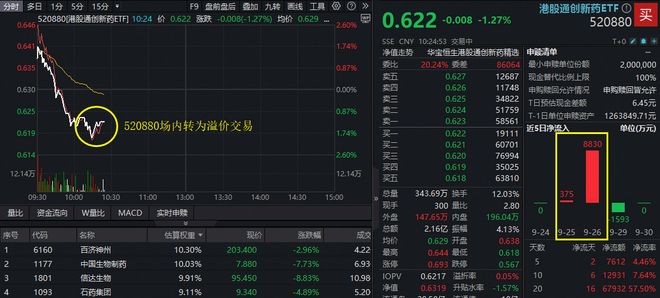
港股医药重挫!港股通创新药ETF标的指数下探逾6%,诺诚健华跌超10%
Xin Lang Cai Jing· 2025-10-10 02:15
Core Viewpoint - The Hong Kong pharmaceutical sector experienced a significant decline on October 9, with the Hang Seng Biotechnology Index dropping over 5%, influenced by external factors such as U.S. tariff announcements on pharmaceutical products [1][3]. Group 1: Market Performance - The Hang Seng Hong Kong Stock Connect Innovative Drug ETF (520880) saw a decline of over 1% after initially opening up 1.75% [1]. - The Hang Seng Hong Kong Stock Connect Innovative Drug Selective Index fell to a low of 6.14%, with major stocks like Innovent Biologics and China Biologic Products dropping over 10% and 7% respectively [1]. - During the previous week (September 29 - October 3), the index had gained 6.54%, reflecting a positive trend before the recent downturn [1]. Group 2: External Influences - On September 25, U.S. President Trump announced a 100% tariff on any brand or patented pharmaceutical products starting October 1, 2025, unless companies establish manufacturing facilities in the U.S. [1][3]. - This announcement is expected to directly impact Chinese innovative pharmaceutical companies that rely heavily on the U.S. market and do not have manufacturing plants in the U.S. [3]. Group 3: Future Outlook - Analysts from Southwest Securities predict that companies with high dependence on the U.S. market will face short-term pressure, while those utilizing business development (BD) strategies for international expansion will be less affected [3]. - Upcoming industry conferences, such as ESMO (October 17-21) and ASH (December), are anticipated to serve as catalysts for the innovative drug sector [3]. - The fund manager of the Hong Kong Stock Connect Innovative Drug ETF noted that the current market adjustment may provide a buying opportunity for high-quality innovative drug companies [3]. Group 4: ETF Characteristics - The Hong Kong Stock Connect Innovative Drug ETF (520880) is the first ETF tracking the Hang Seng Hong Kong Stock Connect Innovative Drug Selective Index, focusing exclusively on innovative drug research and development companies [4]. - The ETF has shown a year-to-date increase of 119.75%, outperforming other innovative drug indices, and aims to avoid the influence of contract research organizations (CROs) on its performance [5].
芯片股集体重挫 多股两融折算率降为0
Jing Ji Guan Cha Wang· 2025-10-10 02:14
Core Viewpoint - The semiconductor stocks experienced a significant decline, with several companies seeing drops exceeding 10% due to adjustments in margin financing rates related to high static price-to-earnings ratios [1] Group 1: Stock Performance - Dongxin Co. and Baiwei Storage fell over 11% - Yandong Micro and Jinghe Integration dropped over 10% - Demingli, Huahong, and Purun shares decreased over 8% - Lianyun Technology and Chiplink Integration fell over 7% - Other companies like Hengsuo, Aojie Technology, and Zhongke International saw declines over 6% [1] Group 2: Margin Financing Adjustments - On October 9, margin financing rates for stocks like Zhongke International and Baiwei Storage were reduced to 0 due to their static price-to-earnings ratios exceeding 300 times - Multiple brokerages clarified that this adjustment is a routine operation based on exchange rules established in 2016, applicable to all A-share stocks with similar high static price-to-earnings ratios [1]




生银行的少数股东权益盈利减值后,将维持高派息比率
ZHONGTAI INTERNATIONAL SECURITIES· 2025-10-10 01:58
Market Overview - On October 9, the Hang Seng Index closed at 26,752 points, down 76 points, while the Hang Seng Tech Index fell 42 points to 6,471 points, with a trading volume of HKD 386.82 billion[1] - HSBC Holdings (5 HK) proposed privatization of Hang Seng Bank (11 HK), leading to a 6% drop in HSBC shares, while Hang Seng Bank shares surged 30%[1] - Semiconductor stocks, including SMIC (688981 CH), faced a sell-off after a financing adjustment, with shares dropping nearly 7% after an initial rise of 4%-9%[1] U.S. Market Dynamics - On October 9, the Dow Jones Index fell 243 points after reaching a record high, while the S&P 500 and Nasdaq dropped 0.28% and 0.08%, respectively[2] - Nvidia (NVDA US) gained 1.8% after receiving approval to sell chips to the UAE, reaching a record high[2] - Gold prices fell over 2%, dropping below USD 4,000, as Middle East tensions eased following a ceasefire agreement[2] Macroeconomic Trends - During the National Day and Mid-Autumn Festival holiday (October 1-7), retail and catering sales in China grew by 2.7% year-on-year[3] - Foot traffic and sales in monitored pedestrian streets increased by 8.8% and 6.0%, respectively, highlighting a shift towards green and smart consumption[3] - Sales of green organic food surged by 27.9%, while smart home products and domestic fashion saw increases of 14.3% and 14.1% respectively[3] Industry Insights - In the smart driving sector, Black Sesame Technologies (2533 HK) anticipates L3 autonomous driving technology to mature in the next 3-5 years, with shares rising 5.3%[4] - The Hang Seng Healthcare Index fell 4.96%, attributed to lower-than-expected milestone payments from Innovent Biologics (9969 HK), despite stable performance from WuXi AppTec (2359 HK) and WuXi Biologics (2269 HK)[4] - The renewable energy sector saw positive performance, with wind power stocks rising between 3.4% and 8.4%, reflecting market optimism for the second half of the year[5]
诺诚健华放弃巨头背书,奥布替尼二次出海换2.8亿美元“首付+股权绑定”
Tai Mei Ti A P P· 2025-10-09 15:15
Core Viewpoint - The recent licensing agreement between Nuo Cheng Jian Hua and Zenas has led to a significant market reaction, with Nuo Cheng Jian Hua's stock dropping while Zenas's stock surged, indicating a divergence in market sentiment regarding the deal's value and potential [1][2]. Summary by Sections Licensing Agreement Details - Nuo Cheng Jian Hua has licensed its BTK inhibitor, Oubutini, for multiple sclerosis and other autoimmune diseases to Zenas, receiving an upfront payment of $100 million, milestone payments, and 7 million shares of Zenas stock, with a total potential deal value exceeding $2 billion [1][2]. - The upfront payment and stock value combined amount to $280 million, which is considered reasonable compared to industry standards, where the average upfront payment ratio is around 8% [3]. Market Reaction and Sentiment - The market's cautious sentiment towards the deal stems from two main concerns: the upfront payment not meeting expectations and the perceived lack of recognition of Zenas as a partner [2][5]. - Nuo Cheng Jian Hua's stock fell by 6.24% in A-shares and 11.64% in Hong Kong shares, while Zenas's stock rose by 24.22% following the announcement [1]. Strategic Considerations - Nuo Cheng Jian Hua had previously engaged with multinational corporations (MNCs) but ultimately chose Zenas due to smoother communication and Zenas's strong clinical development capabilities, particularly in the field of multiple sclerosis [5][10]. - Zenas, founded in 2019 and listed on NASDAQ in 2024, currently has no commercial products but has a promising pipeline, including a dual-function monoclonal antibody that complements Oubutini [7][8]. Industry Context - The collaboration reflects a shift in the global innovation drug landscape from one-time licensing deals to deeper collaborative models, where local pharmaceutical companies can retain equity in new ventures [12]. - Nuo Cheng Jian Hua's previous partnership with Biogen ended after about 18 months, highlighting the challenges in securing long-term collaborations in the industry [11]. Future Outlook - The partnership aims to advance the development of Oubutini in treating primary and secondary progressive multiple sclerosis, with significant market opportunities projected in the U.S. alone [8]. - The success of this collaboration will depend on Zenas's ability to progress its pipeline and the overall market performance of its shares [12].
诺诚健华20251009
2025-10-09 14:47
Summary of the Conference Call for 诺诚健华 (Nocera Biopharma) Company Overview - **Company**: 诺诚健华 (Nocera Biopharma) - **Partner**: Xenios BioPharma - **Industry**: Biopharmaceuticals, focusing on autoimmune diseases and central nervous system disorders Key Points and Arguments Strategic Partnership - 诺诚健华 has entered a significant global licensing agreement with Xenios BioPharma, covering the global rights for 奥布替尼 (Obutinin) in multiple sclerosis (MS) and two preclinical drugs outside Greater China and Southeast Asia, with a total potential deal value exceeding $2 billion [2][3][5] - The deal includes an upfront payment of $100 million, milestone payments, and approximately $180 million worth of 7 million shares of Zyno common stock, totaling $280 million in upfront and near-term milestone payments [2][5] - 诺诚健华 will receive royalties of up to 17% to 19% on net product sales [2][5] Rationale for Partnership - The choice of Xenios BioPharma was based on its clinical development experience in autoimmune diseases, its Nasdaq listing, and strong execution capabilities, which are expected to maximize the global development potential of 奥布替尼 and other assets [2][6] - The partnership is expected to accelerate the clinical development of 奥布替尼 and other products in the global market, supporting 诺诚健华's internationalization efforts and enhancing long-term value through equity exchange [2][8] Development Stage and Future Plans - 诺诚健华 is entering a 2.0 development phase, focusing more on internationalization, commercialization, and differentiated product development, with plans to strengthen these capabilities through flexible business models and partnerships with international companies [4][11] - The company has over 10 products in various stages of development and aims to increase revenue through business development (BD) partnerships, with a focus on internationalization over the next three years [11][12] Clinical Development and Market Potential - 奥布替尼's global oncology rights remain with 诺诚健华, which is expanding into tumor indications and plans to submit applications in countries like Australia and Canada [13] - The company is also advancing clinical studies for ITP and SLE, which are particularly relevant in Asian populations [13] - The partnership with Xenios is expected to enhance the success potential of 奥布替尼 in global Phase III clinical trials and facilitate expansion into more autoimmune disease areas [8] Financial Implications - The cash component of the deal includes the $100 million upfront payment and milestone payments, with the stock component being part of the transaction price [16] - The transaction is anticipated to have a positive impact on the company's revenue and asset profit and loss statements [16] Additional Insights - The 7 million shares of Zyno common stock were issued at a nominal value of $0.001 per share, resulting in a minimal cost of approximately $700 [10] - The partnership with Zenith for 奥布替尼 development is based on their strong clinical development capabilities and successful track record in the autoimmune disease sector [8][12] - The collaboration is expected to create synergies and enhance the execution capabilities of both companies [12][18] Market Competition - Genesys is developing a dual antibody for MS, which may have a differentiated profile compared to 奥布替尼, but 诺诚健华 believes its Aurora kinase B inhibitor has higher success rates and market potential in treating MS [18] Conclusion The partnership between 诺诚健华 and Xenios BioPharma represents a strategic move to enhance the development and commercialization of innovative therapies in the autoimmune disease space, with significant financial implications and a focus on international growth. The collaboration is expected to leverage both companies' strengths to maximize the potential of their product pipelines.