平安银行

Search documents
中国中免等25家A股上市公司修订ESG细则|ESG热搜榜
2 1 Shi Ji Jing Ji Bao Dao· 2026-01-05 05:05
Group 1: Solid Waste Management and Environmental Regulations - The State Council issued the "Comprehensive Action Plan for Solid Waste Management," emphasizing strict enforcement of environmental laws and regulations related to solid waste pollution prevention [1] - The plan includes measures to strengthen supervision across all stages from production to disposal and to crack down on illegal activities such as unauthorized discharges [1] - The ecological environment department will oversee cases causing severe ecological damage and pollution, implementing joint regulatory mechanisms across departments and regions [1] Group 2: Corporate Governance and ESG Initiatives - A total of 25 A-share listed companies revised their ESG committee guidelines or management measures, including prominent firms like Shunxin Agriculture and CITIC Securities [2] - Companies such as Bosch and Dangseng Technology have established specific ESG management topics, with Water Crystal Optoelectronics holding individuals accountable for failing to meet ESG targets [2] Group 3: Legal and Financial Issues in Companies - Yibin Paper announced its subsidiary Huijie Environmental Protection intends to appeal a criminal judgment for environmental pollution, which resulted in a fine of 100,000 RMB [3] - ST Rendo disclosed that its subsidiary Guangzhou Heli Bao was fined a total of 74.88 million RMB for multiple regulatory violations, including breaches of clearing management regulations [4] Group 4: Dividend Distribution in A-Share Market - In 2025, A-share listed companies distributed a total of 2.6 trillion RMB in cash dividends, with 3,767 companies participating [5] - Industrial and Commercial Bank of China led the dividend payouts with 160.17 billion RMB, followed by China Construction Bank and Agricultural Bank of China with 149.36 billion RMB and 126.48 billion RMB, respectively [5]



密集落地!6家银行,敲定首席合规官!
券商中国· 2026-01-05 04:43
Core Viewpoint - The establishment of Chief Compliance Officer (CCO) positions in Chinese banks has intensified in 2025, driven by regulatory requirements aimed at enhancing compliance management within financial institutions [2][4]. Group 1: Regulatory Background - In March 2025, the Financial Regulatory Administration implemented the "Compliance Management Measures for Financial Institutions," mandating that financial institutions appoint a CCO at their headquarters, who must be a senior management member [2][4]. - The year 2025 serves as a critical transitional period for compliance management, with many banks already appointing CCOs and obtaining regulatory approval for their qualifications [8]. Group 2: Appointment Trends - Several banks, including Jiangyin Bank, Ping An Bank, and Minsheng Bank, have recently appointed CCOs, with many of these positions filled by existing senior executives such as presidents or vice presidents [4][5][6]. - The trend shows that many banks are opting for current executives to take on the CCO role, which may help mitigate internal communication costs associated with having too many specialized positions [4][7]. Group 3: Compliance Management Practices - The unique nature of financial institutions necessitates a higher standard of compliance management compared to general enterprises, emphasizing the need for a robust compliance culture [4]. - The "Compliance Management Measures" also allow for the CCO to concurrently hold other executive roles, which is particularly beneficial for smaller banks [4][8]. Group 4: Recruitment Initiatives - Some regional banks, such as Jiangxi Bank and Shangrao Bank, have actively sought to recruit CCOs, indicating a proactive approach to compliance management [9]. - Recruitment criteria for these positions often prioritize candidates with judicial experience or previous roles in compliance departments of major banks [9].


前瞻预测:2026年,谁将会成为上市银行的十大牛股?
Sou Hu Cai Jing· 2026-01-05 04:16
Core Viewpoint - The A-share banking sector concluded 2025 with a structural rise, with 35 out of 42 listed banks experiencing gains, and the banking index rising by 12.04%, indicating strong defensive and allocation value [2][3]. Group 1: 2025 Banking Sector Performance - The banking sector exhibited significant structural differentiation, with the top ten stocks including Agricultural Bank (52.66%), Xiamen Bank (35.78%), and others showing gains over 20% [3][4]. - The market's focus shifted towards "certainty of returns" and "growth cost-effectiveness" amid an "asset shortage" backdrop, leading to a preference for certain banks [3][4]. Group 2: Core Drivers of 2025 Bull Stocks - Three main factors drove the performance of bull stocks: high dividends and low valuations supporting state-owned banks, regional economic vitality empowering small and medium banks, and asset structure optimization promoting value reassessment [4][5]. - Agricultural Bank led with a dividend yield above 5% and a price-to-book ratio exceeding 1, breaking the long-standing trend of state-owned banks trading below book value [4][5]. Group 3: 2026 Bull Stock Predictions - The banking sector is expected to maintain a "steady progress" operational trend in 2026, with key dimensions for identifying bull stocks including net interest margin improvement, business transformation growth, and stable asset quality [5][6]. - The predicted top ten bull stocks for 2026 include Agricultural Bank, China Merchants Bank, and Ningbo Bank, among others, with each having specific growth drivers [7][8]. Group 4: Key Factors for 2026 Predictions - Agricultural Bank is expected to continue its strong performance due to its county-level business advantages and low liability costs [7]. - China Merchants Bank is anticipated to see dual growth in performance and valuation, driven by its wealth management transformation and strong asset quality [8]. - Ningbo Bank is positioned to benefit from regional economic vitality and diversified non-interest income growth [8][9]. Group 5: Structural Trends and Risks - The banking sector is likely to experience a dual rise in performance and valuation, supported by improved net interest margins and robust asset quality [12][13]. - However, structural differentiation risks may intensify, with some smaller banks facing challenges due to high regional economic dependency and single customer structures [12][13].





混合类理财收益表现分化!股份行代销产品收益居前
2 1 Shi Ji Jing Ji Bao Dao· 2026-01-05 01:26
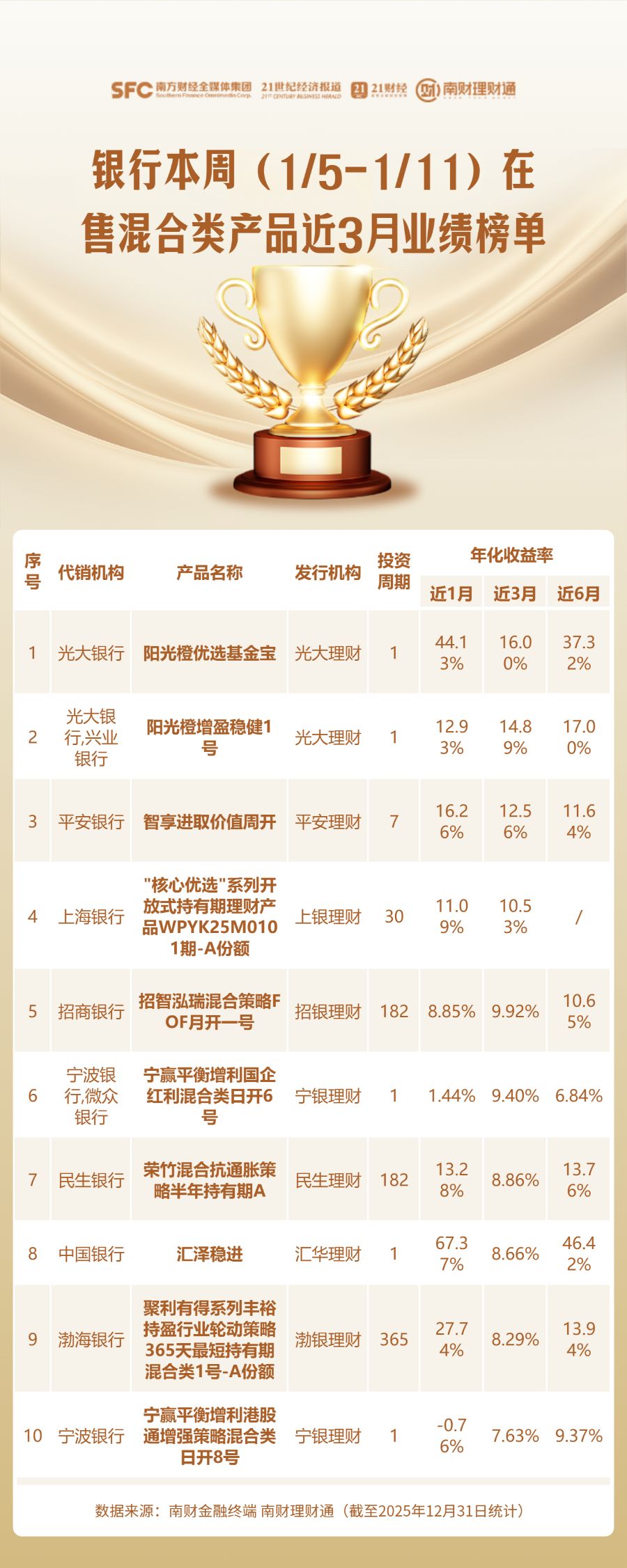
Core Insights - The report focuses on mixed-asset products issued by wealth management companies, highlighting superior-performing products available for investors through distribution channels [1] - A ranking of products is provided based on their annualized performance over the past month, three months, and six months, with a specific emphasis on the three-month annualized yield to reflect their performance amid recent market fluctuations [1] Group 1: Product Performance - The ranking includes products from 28 distribution institutions, such as major banks like Industrial and Commercial Bank of China, Bank of China, Agricultural Bank of China, and others [1] - The report emphasizes that the assessment of products being "on sale" is based on their investment cycle, but actual availability may vary due to factors like sold-out quotas or differences in product listings for different clients [1] Group 2: Recommendations and Limitations - Investors are advised to refer to the actual listings displayed on the distribution bank's app for accurate product availability [1] - The report aims for objectivity but does not guarantee the authenticity, completeness, or accuracy of the ranking information, which is intended for reference only [1]
银行今十条:数字人民币1月1日起计付利息;农商行头部阵营形成“五强”格局;新疆银行注册资本增至122亿元...
Jin Rong Jie· 2026-01-04 14:13
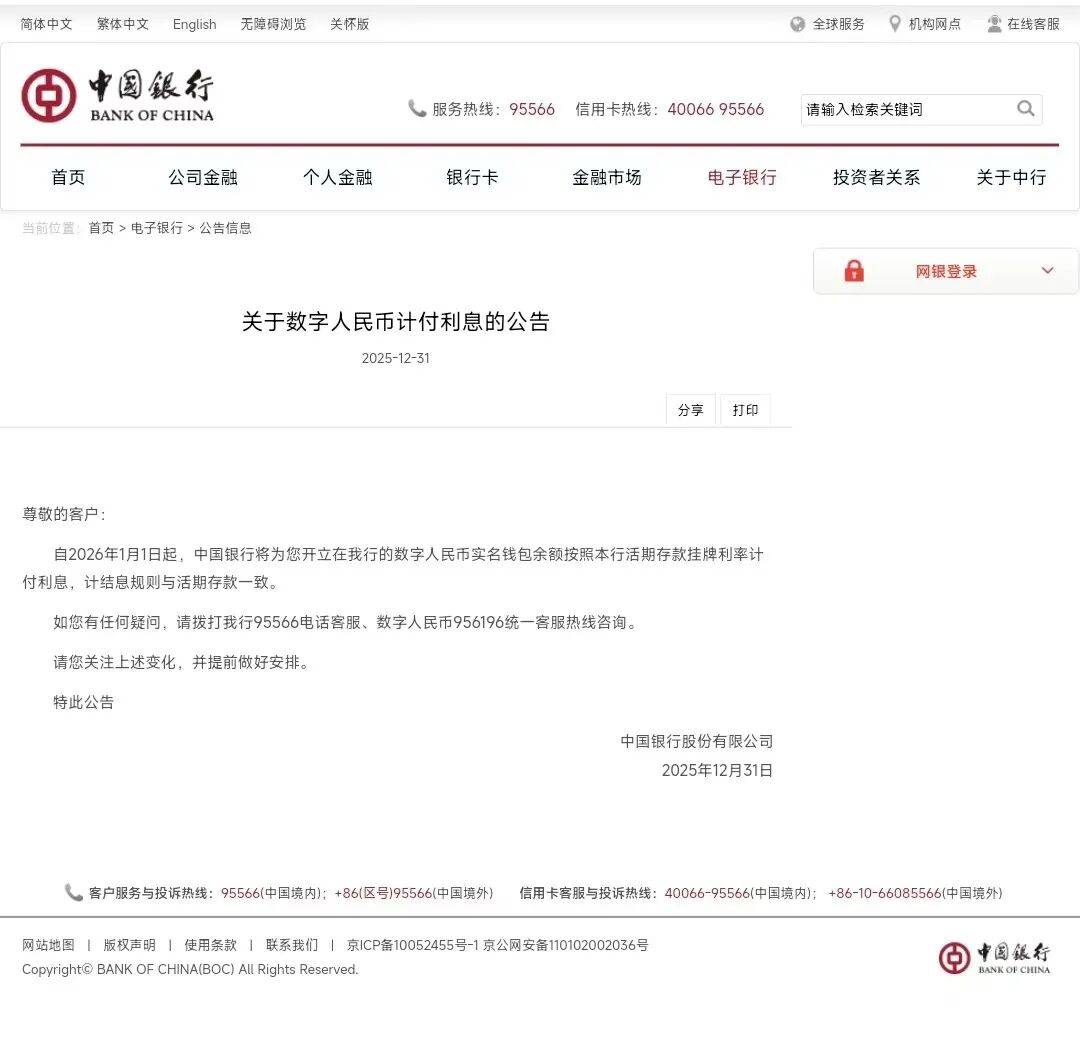
Group 1 - The People's Bank of China conducted a 365 billion yuan 7-day reverse repurchase operation, resulting in a net withdrawal of 433.6 billion yuan [1] - The People's Bank of China issued the "Non-Bank Payment Institutions Classification Rating Management Measures" to enhance supervision of non-bank payment institutions, effective from February 1, 2026 [2] - In 2025, the banking sector saw a net increase of 623 physical bank branches, marking the first positive growth in three years despite the closure of 7,871 branches [3] Group 2 - Ten digital RMB operating banks announced that starting January 1, 2026, they will pay interest on digital RMB wallets at the same rate as their demand deposit rates [4] - Chengdu Rural Commercial Bank announced that its total assets have surpassed 1 trillion yuan, becoming the fifth rural commercial bank in China to reach this milestone [5] - Xinjiang Bank received approval to increase its registered capital from 7.906 billion yuan to 12.222 billion yuan [6] Group 3 - Baoding Bank's plan to change its registered capital was approved, allowing it to raise 250 million shares [7] - Ningbo Tongshang Bank was approved to issue capital instruments not exceeding 2 billion yuan, including perpetual bonds and subordinated bonds [8][9] - The Dongguan Financial Regulatory Bureau and other departments will pilot real estate trust property registration in Dongguan to support the transformation of the trust business [10] Group 4 - New Era Trust's 100% equity is being offered for transfer for the third time, with a base price of approximately 1.851 billion yuan, consistent with previous offers [11]




2025,银行大罚单明显变多了
Xin Lang Cai Jing· 2026-01-04 12:48
Core Insights - A significant trend observed in 2025 is the increase in large fines imposed on banks, reflecting compliance shortcomings and risk points during the transition to high-quality development in the banking industry [2][16] - In 2025, regulatory authorities issued a total of 454 fines exceeding one million yuan to banking institutions and personnel, an increase of 58 from the previous year, with the total amount of fines nearly doubling [2][16] - The main areas of violations in 2025 were concentrated in credit business, anti-money laundering, and internal control systems, with anti-money laundering violations seeing the most notable increase, reaching 894 fines, a rise of 185.09% compared to the previous year [2][16] Summary of Fines Over 20 Million Yuan - In 2025, there were 12 fines disclosed with amounts exceeding 20 million yuan, primarily related to compliance management issues in traditional business areas such as loans and bills, indicating deficiencies in basic business risk control and regulatory cooperation [4][17] - Common violations included issues with account management and anti-money laundering, highlighting flaws in customer identity verification and transaction monitoring processes [3][17] Summary of Fines Between 10 Million and 20 Million Yuan - This category of fines predominantly involved joint-stock banks, reflecting a conflict between business innovation and compliance management [6] - Violations were mainly related to compliance operations (account and anti-money laundering) and business management (internet loans and agency sales), with cross-border foreign exchange violations being a secondary concern [7] Summary of Fines Between 5 Million and 10 Million Yuan - Fines in this range were primarily concentrated among city commercial banks, joint-stock banks, and rural commercial banks [10] - The most common violations included anti-money laundering and customer identity verification issues, alongside traditional problems related to credit "three checks" failures [10]




今年1月1日起 六大银行数字人民币计利息收益
Sou Hu Cai Jing· 2026-01-04 11:48
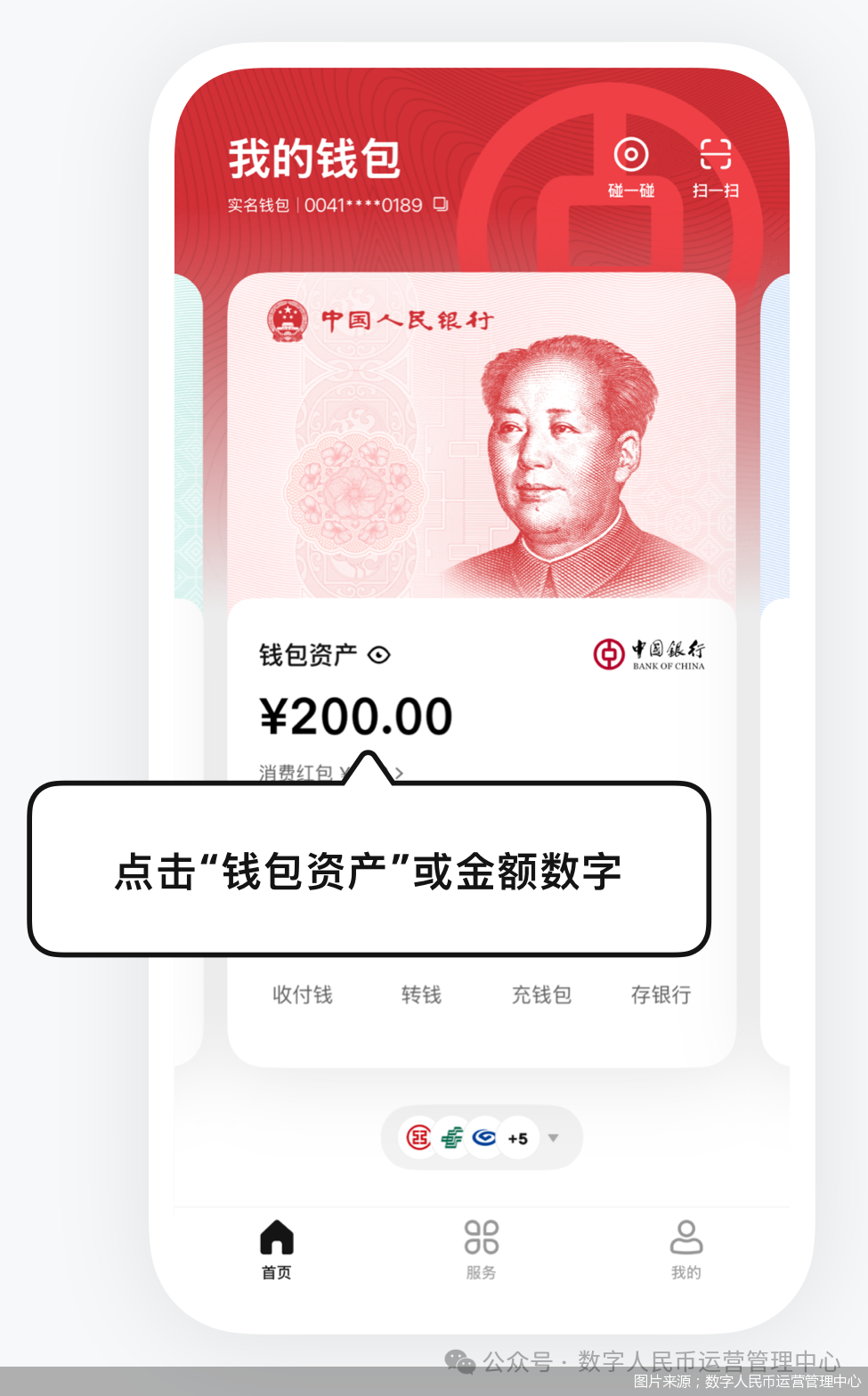
Group 1 - From January 1, 2026, digital RMB real-name wallet balances will earn interest based on the current demand deposit rate set by the respective banks, which is currently 0.05% [1] - The digital RMB is categorized into four types of wallets, with only the first three types (real-name wallets) eligible for interest, while the fourth type (anonymous wallet) will not earn interest [1] - The interest will be calculated according to the People's Bank of China’s demand deposit interest rules, with interest credited on the 20th of each quarter's last month [1] Group 2 - There are currently 10 designated operating institutions for digital RMB, including six state-owned commercial banks, two joint-stock commercial banks, and two internet banks [2] - The central bank is working on expanding the number of operating institutions and has introduced a new action plan to enhance the management and service system for digital RMB, set to be implemented on January 1, 2026 [2] - Banks will manage the digital RMB wallet balances autonomously and provide the same level of security as traditional deposits through deposit insurance [2]
亲测有效!数字人民币能“生息”,理财、信贷等服务可期
Bei Jing Shang Bao· 2026-01-04 11:43
Core Viewpoint - The digital renminbi is set to transition into its 2.0 era on January 1, 2026, evolving from "digital cash" to "digital deposits," which will significantly impact everyday payments and consumer behavior [1][5]. Group 1: Key Features of Digital Renminbi 2.0 - From January 1, 2026, the balance in real-name digital renminbi wallets will earn interest at the same rate as demand deposits, with a current annual interest rate of 0.05% as observed from banks like China Merchants Bank [5][6]. - Interest will be calculated quarterly, with specific dates for interest payment, allowing consumers to earn passive income on idle funds [5][6]. - Only real-name wallets will be eligible for interest; anonymous wallets will not receive this benefit [6]. Group 2: Security and Insurance - Digital renminbi deposits will be included in the deposit insurance scheme, providing a safety net of up to 500,000 yuan, similar to traditional bank deposits [6][9]. - This inclusion aims to alleviate consumer concerns regarding the safety of their funds, enhancing the attractiveness of digital renminbi [10]. Group 3: Implications for Financial Institutions - The upgrade will encourage banks to integrate digital renminbi into their asset-liability management, enabling them to offer additional financial services such as loans and investment products [9][12]. - Banks can leverage the interest-bearing feature to attract more customers and create a closed-loop business model around digital wallets [9][10]. Group 4: Market Impact and Future Prospects - The digital renminbi's evolution is expected to have profound effects on the financial market, allowing banks to shift from passive to active deposit strategies [10][12]. - The introduction of smart contracts and programmable currency capabilities will facilitate innovative financial solutions, potentially increasing the frequency of digital renminbi usage in various sectors [11][12]. - The digital renminbi has already processed transactions worth 16.7 trillion yuan since its launch, indicating strong market adoption and a diverse range of applications [11].
星展银行(中国)宣布任命黎端为首席风控官
Xin Lang Cai Jing· 2026-01-04 10:56
1月4日金融一线消息,据星展银行官方披露,星展银行(中国)有限公司("星展中国")今日宣布,任 命黎端女士为首席风控官,全面负责星展中国的风险管理工作,直接向星展中国行长郑思祯汇报。此次 任命自2026年1月1日起生效,这将进一步夯实星展中国本土化风控团队实力,助力银行在复杂市场环境 中实现稳健发展。 1月4日金融一线消息,据星展银行官方披露,星展银行(中国)有限公司("星展中国")今日宣布,任 命黎端女士为首席风控官,全面负责星展中国的风险管理工作,直接向星展中国行长郑思祯汇报。此次 任命自2026年1月1日起生效,这将进一步夯实星展中国本土化风控团队实力,助力银行在复杂市场环境 中实现稳健发展。 星展银行指出,黎端女士拥有近30年金融行业从业经验,深耕风险管理领域,兼具国际金融视野与本土 市场实操经验。她的职业履历覆盖国际银行与中资银行核心风控岗位,曾任职于加拿大帝国商业银行、 平安银行、渣打银行等知名金融机构,在信贷政策制定、大型企业及机构银行风控管理、信用风险研判 等方面积累了深厚专业能力。 加入星展中国以来,黎端女士历任风险管理部信用风险主管、大型企业及机构银行信贷主管等关键岗 位,深度参与星展中国 ...

银行业去年被罚26亿元,同比增四成多!这项违规行为暴增
Nan Fang Du Shi Bao· 2026-01-04 07:29
2025年我国银行业被罚没金额同比猛增四成多。南都湾财社记者根据企业预警通数据统计发现,以披露 日期为准,去年,央行、金融监管总局、外管局及派出机构对我国千余家银行及其分支机构开出罚单, 累计罚没26.41亿元(含个人罚金),较2024年大幅增长44.95%。罚金猛增背后是巨额罚单的频现,去 年我国银行业共收到千万元级别的罚单31张,是2024年的5倍有余。 从银行类型来看,城商行去年罚单最多,股份行被罚没金额则居首。从违规领域看,主要集中在信贷业 务、反洗钱业务、内控制度等方面。其中,反洗钱业务违规相关罚单数量较2024年增长了185.92%。 千万元巨额罚单数量猛增 根据企业预警通数据,以披露日期为准,2025年,央行、金融监管总局、外管局及派出机构针对银行机 构及从业人员开出罚单6521张,较上年减少0.81%;罚没金额达26.41亿元,较上年增加44.95%;共计 1094家银行及分支机构被罚。 近年我国银行业处罚趋势。数据来源:企业预警通 从处罚趋势来看,罚单数量最高的月份是1月份、7月份和12月份,分别为799张、874张和916张。而要 论总罚没金额,则9月份、12月份和10月份位列前三甲,分别 ...