京东方

Search documents
大国基座2025:新材料三重战线的突破与2026年体系化决战
材料汇· 2025-12-31 11:27
Core Viewpoint - The article discusses the strategic transformation of China's new materials industry by 2025, emphasizing a "three-dimensional war" approach that includes "fortress materials" for national security, "sovereign materials" for technological independence, and "fusion materials" for future industry definition [3]. Group 1: Fortress Materials - The development of safety dimension materials is closely tied to national core interests, focusing on absolute reliability and performance under extreme conditions rather than cost-effectiveness [5]. - A significant breakthrough in 2025 is the mass production of the fourth-generation single crystal high-temperature alloy turbine blades, which can withstand temperatures above 1200°C and have a lifespan increased by nearly 50% compared to previous generations [8][10]. - Continuous silicon carbide fibers have transitioned from laboratory preparation to stable engineering mass production, with a production capacity of hundreds of tons, marking a strategic leap in the aerospace sector [14][15]. Group 2: Sovereign Materials - Sovereign materials focus on achieving "self-control" and enhancing industrial competitiveness, particularly in strategic sectors like semiconductors and high-end manufacturing [40]. - In the semiconductor sector, the production of 12-inch silicon wafers has reached a milestone with over 500,000 monthly shipments, and significant advancements in low-oxygen high-resistivity silicon wafer technology have been made [44]. - The domestic supply ratio of 300mm semiconductor silicon wafers is expected to increase from 15% to 40% by the end of 2025, significantly reducing reliance on imports [45]. Group 3: Fusion Materials - The fusion materials dimension represents a shift towards creating new demands and defining new products, characterized by the integration of materials science with cutting-edge fields like artificial intelligence and synthetic biology [72]. - AI-driven platforms for materials research have emerged, enabling rapid property prediction and screening, significantly reducing development cycles for critical materials [74]. - The integration of intelligent materials in robotics is evolving, allowing materials to interact with their environment and make autonomous decisions, marking a shift from passive components to intelligent structures [77].







科技焕新,超越增长丨21世纪经济报道2025年终特刊
21世纪经济报道· 2025-12-31 10:32
Core Viewpoint - The article emphasizes the structural transformation of the Chinese economy, focusing on the transition from production-oriented to wealth-oriented growth, and the importance of leveraging technological innovation to drive future growth opportunities leading up to 2026 [1][4]. Group 1: Economic Transformation and Opportunities - The year 2025 is identified as a pivotal point for global restructuring, where China's strength will be reassessed across multiple dimensions including technology, trade, governance, and security [4]. - China has three major advantages for economic growth: the potential for GDP per capita to reach levels of developed countries, the new technology revolution focusing on digital and green technologies, and the benefits of a super-large market economy [6]. - The focus for 2026 will be on short-term demand expansion and risk control, while also promoting an innovation-driven growth model that emphasizes modern industrial systems and technological self-reliance [7]. Group 2: Industry Insights and Innovations - The automotive industry is at a crossroads, with a shift from a "favorable wind" era to a new phase characterized by technological competition and globalization [19]. - The Chinese manufacturing sector is expanding globally, with companies adapting to new trade rules and focusing on localizing supply chains [10]. - The rise of new industries such as robotics, artificial intelligence, and innovative pharmaceuticals is seen as a foundation for future economic growth, reflecting a systematic reassessment of growth paradigms [13]. Group 3: Financial and Market Dynamics - The capital market in China requires a significant ideological shift to better support long-term technological innovations and address mismatches in investment strategies [13]. - The banking sector is diversifying its global presence, moving from traditional markets to emerging markets along the Belt and Road Initiative, focusing on infrastructure and resource development [11]. - The trend of "investing in people" is highlighted as essential for stimulating consumer markets, moving away from a focus solely on physical investments [7].

TrendForce集邦咨询:预计2025年全球LED芯片对外销售市场总产值为28.41亿美元
智通财经网· 2025-12-31 09:28
Group 1 - The global LED chip sales market is projected to reach $2.841 billion by 2025, with兆元光电 ranked ninth in the industry, primarily generating revenue from lighting, backlighting, and Mini LED display applications [1] - TCL CSOT has successfully acquired 80% of 兆元光电's shares and related debts, marking its entry into the LED chip sector and completing its supply chain layout from upstream chips to downstream Mini LED applications [1][4] - The trend of vertical integration in the LED chip industry is being driven by brands and panel manufacturers, significantly reducing the coordination costs between product applications and chip supply [3] Group 2 - TCL CSOT's acquisition of 兆元光电 for 490 million RMB ($70 million) highlights the ongoing integration trend among brands and panel manufacturers in the upstream LED chip sector [4] - Other companies such as Samsung, AUO, Hisense, BOE, and HKC have also engaged in similar mergers or investments to deepen vertical integration in the industry [1][4][5] - TCL CSOT's Mini LED display production line in Suzhou is expected to commence production in 2025, with a current monthly capacity of 6,000 square meters, aiming to enhance product competitiveness in a competitive market [4]

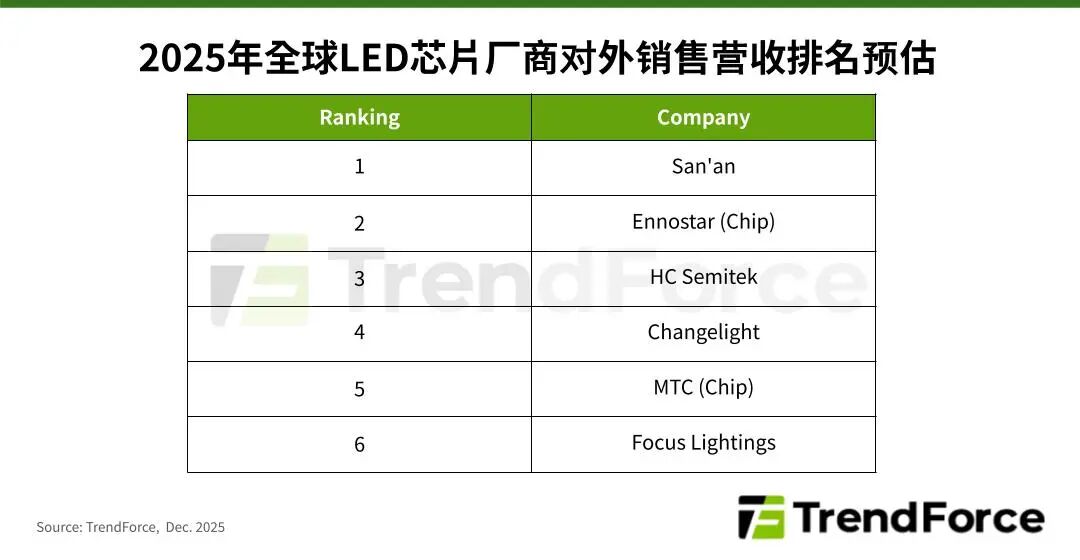
京东方、TCL华星将为三星手机供应OLED屏?
WitsView睿智显示· 2025-12-31 09:25
Core Viewpoint - Samsung Electronics is considering a dual-supplier model for the upcoming Galaxy A57, involving both Samsung Display and TCL Huaxing for OLED screens, to enhance competitiveness and manage costs [1][3][4] Group 1: Supplier Strategy - Samsung is likely to rely more on Samsung Display for OLED supply, given the high demand for the Galaxy A series, which is a hot-selling model [1] - The dual-supplier approach aims to mitigate potential supply shortages and ensure a steady supply of OLED screens for both Galaxy A57 and Galaxy S FE models [1][4] - TCL Huaxing is expected to provide OLED screens at a lower price, which could help Samsung control costs while adopting flexible OLED technology [4][6] Group 2: Product Development - Starting with the Galaxy A57, Samsung plans to replace rigid OLED panels with flexible OLED panels, which offer greater design flexibility but come with higher manufacturing costs [3][4] - The adoption of flexible OLED technology is seen as a way for Samsung to enhance its competitiveness in the mid-range smartphone market, especially as Chinese manufacturers are already using flexible OLED in lower-priced models [3][6] Group 3: Market Dynamics - The increasing competition in the global smartphone market and rising component costs are prompting Samsung to reassess its OLED supply strategy [6][7] - Chinese manufacturers like BOE and TCL Huaxing have improved their technology and production capacity, posing a significant challenge to Samsung Display's market dominance [7] - The shift towards Chinese suppliers for OLED panels may provide Samsung with cost advantages, but it also indicates a potential erosion of its competitive edge in the panel industry [7]
2家韩国设备企业拟中标京东方8.6代OLED项目
WitsView睿智显示· 2025-12-31 09:25
Group 1 - The core point of the article is that BOE is advancing its 8.6-generation OLED production line project in Chengdu, with Sunic System and Avaco being the likely winners of the bidding for the deposition system equipment and components [1][2]. - The 8.6-generation OLED production line (B16) has a monthly capacity of 32,000 sheets, with the first phase already completed, and the second phase expected to match the investment scale of the first phase [2]. - Sunic System has received orders for two deposition machines, with an estimated total price of approximately 450 billion KRW (around 21.82 million RMB), and has already delivered one machine [2][3]. Group 2 - In Q2 2025, Sunic System reported an operating profit of 40 billion KRW, recovering from an operating loss of 1.8 billion KRW in Q1, with cumulative operating profit reaching 58 billion KRW, a more than tenfold increase compared to the same period last year [3]. - Avaco has delivered two deposition logistics devices for the first phase of the production line, with a contract amount estimated between 200 billion KRW to 250 billion KRW (approximately 9.7 million to 12.125 million RMB) [3]. - Avaco's Q2 operating profit reached 19.4 billion KRW, a year-on-year increase of 487%, and its cash flow from operating activities turned from a loss of 63.7 billion KRW in Q3 of the previous year to a profit of 12.2 billion KRW this year [3].

韩媒:惠科或投资建设第6代OLED产线
WitsView睿智显示· 2025-12-31 09:25
Core Viewpoint - Huike is considering building a 6th generation OLED production line in Mianyang, Sichuan Province, China, and has submitted an approval application to the government in the first half of the year, although specific technology details were not disclosed [1][2]. Group 1: Technology Evaluation - Huike is evaluating two technology options for the OLED production line: the "Full-Cut Fine Metal Mask (FMM)" process and the "eLEAP" process, which does not use FMM [1]. - The FMM process involves a thin metal layer with holes for depositing RGB subpixels, while the eLEAP technology allows for patterning RGB subpixels without FMM, potentially doubling maximum brightness and tripling lifespan [1][5]. Group 2: Market Position and Challenges - Huike aims to enter the OLED IT product market and faces challenges with both technology options [2]. - As a leading panel manufacturer alongside BOE and TCL, Huike currently operates four G8.6 LCD production lines but lacks OLED panel production lines [3]. - The investment decision for the 6th generation OLED line is expected to be finalized in the first half of next year, but equipment manufacturers are cautious about the feasibility of the new technologies [3][5]. Group 3: Industry Concerns - Concerns about market oversupply are significant, especially with Samsung Display and BOE set to operate their 8.6 generation IT OLED production lines, which could meet global demand [5]. - A representative from an equipment manufacturer noted that while the FMM OLED half-cut system is mature, transitioning to a full-cut system is challenging, and the eLEAP technology's practicality and cost-effectiveness need further validation [5].


研报 | TCL华星并购兆元光电,品牌与面板厂垂直整合Micro/Mini LED产业趋势深化
TrendForce集邦· 2025-12-31 09:12
Core Insights - TCL CSOT has successfully acquired an 80% stake in Zhaoyuan Optoelectronics for 490 million RMB (70 million USD), marking its entry into the LED chip sector and completing its supply chain layout from upstream chips to downstream Mini LED display applications [2][5] - TrendForce estimates that the global LED chip external sales market will reach a total value of 2.841 billion USD by 2025, with Zhaoyuan Optoelectronics ranked ninth in the market, primarily generating revenue from lighting, backlighting, and Mini LED display applications [2][3] Industry Trends - The trend of vertical integration in the LED chip industry is being driven by brands and panel manufacturers, significantly reducing the coordination costs between product applications and chip supply [3][5] - Major companies like Samsung, AUO, Hisense, BOE, Innolux, and HKC have been pursuing similar mergers or investments since 2018 to deepen this vertical integration trend [2][5] Competitive Landscape - TCL CSOT's Mini LED display production line in Suzhou is expected to achieve a monthly capacity of 6,000 square meters by 2025, enhancing its competitive edge in the market [5] - The competitive landscape includes significant investments and acquisitions by other major players, such as Samsung's investment in PlayNitride and AUO's investments in Ennostar and PlayNitride, which have led to the production of Micro LED products [5][6]
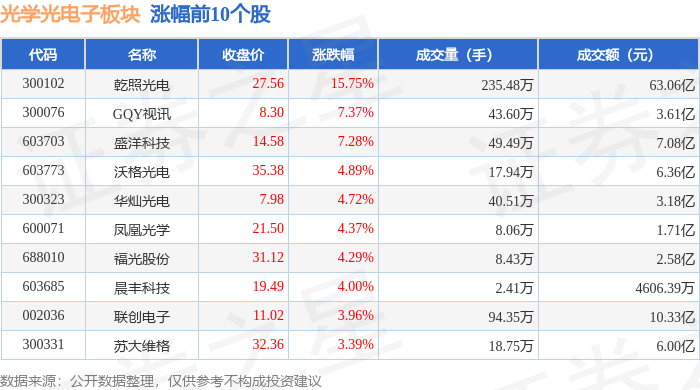
光学光电子板块12月31日涨0.77%,乾照光电领涨,主力资金净流入3.94亿元
Zheng Xing Xing Ye Ri Bao· 2025-12-31 08:59
| 代码 | 名称 | 收盘价 | 涨跌幅 | 成交量(手) | 成交额(元) | | | --- | --- | --- | --- | --- | --- | --- | | 300102 | 乾照光电 | 27.56 | 15.75% | 235.48万 | | 63.06亿 | | 300076 | GQY视讯 | 8.30 | 7.37% | 43.60万 | | 3.61亿 | | 603703 | 盛洋科技 | 14.58 | 7.28% | 49.49万 | | 7.08亿 | | 603773 | 沃格光电 | 35.38 | 4.89% | 17.94万 | | 6.36亿 | | 300323 | 表和光电 | 7.98 | 4.72% | 40.51万 | | 3.18亿 | | 600071 | 凤凰光学 | 21.50 | 4.37% | 8.06万 | | 1.71亿 | | 688010 | 福米股份 | 31.12 | 4.29% | 8.43万 | | 2.58亿 | | 603685 | 晨丰科技 | 19.49 | 4.00% | 2.41万 | | 4606.39万 ...

国企渝进 | 渝富控股集团:揭秘产业投资“链式密码”
Sou Hu Cai Jing· 2025-12-31 07:42
Core Viewpoint - The development of new quality productivity is essential for promoting high-quality development, with state-owned enterprises playing a crucial role in this process, particularly in Chongqing as a strategic hub for western development [2]. Group 1: Investment Strategy - Chongqing Yufu Holding Group's investment strategy is centered around the "33618" modern manufacturing cluster system, focusing on proactive engagement rather than passive task acceptance [3]. - Since the 14th Five-Year Plan, Yufu has invested over 120 billion yuan in advanced manufacturing and strategic emerging industries, targeting more than 400 companies in the industrial chain [3]. - The core logic of Yufu's investments is to "invest heavily, invest in strong companies, and invest in chain leaders," aiming to enhance the entire industrial chain [3]. Group 2: Empowering Key Industries - Yufu's investment in the smart connected electric vehicle sector, particularly in the company Seres, exemplifies effective industry empowerment, with a total investment of 6.55 billion yuan [4]. - This "patient capital" has attracted over 13.7 billion yuan in social capital, demonstrating confidence in the market and supporting the entire development cycle of the enterprise [4]. - Seres has achieved a market value exceeding 200 billion yuan, becoming the second-largest car manufacturer in China and a benchmark for the electric vehicle industry in the western region [4]. Group 3: Electronics Manufacturing Cluster - In the new generation of electronic information manufacturing, Yufu has invested 26.3 billion yuan in the BOE project over a decade, leading to significant economic and industrial benefits [6]. - The B8 project has generated 16.2 billion yuan in investment returns, while the B12 project has attracted over 86 billion yuan in industrial chain investments, creating a complete high-end display industry cluster in Chongqing [6]. - Yufu's investments in semiconductor companies further strengthen Chongqing's industrial chain in this sector [6]. Group 4: Future-Oriented Investments - Yufu is focusing on future-oriented sectors, leading investments in aerospace and industrial software, aiming to establish a high-end equipment manufacturing base and a cloud operation headquarters in Chongqing [8]. - The company is also promoting key enterprises in advanced materials, solidifying Chongqing's industrial foundation in new energy and materials [8]. Group 5: Market-Oriented Mergers and Acquisitions - Yufu has effectively utilized investment mergers and acquisitions to strategically restructure existing assets, completing four significant investments in recent years [9]. - Notable actions include a 2.115 billion yuan investment to acquire a stake in Longxin General, aiding a local advanced manufacturing company in overcoming debt challenges [9]. - These "rescue-style mergers" not only revitalize existing assets but also enhance the integrity and resilience of local industrial chains [9]. Group 6: Comprehensive Industry Empowerment - Yufu's investment approach has evolved from simple financial investment to comprehensive industry empowerment, injecting development momentum into invested enterprises [10]. - The company leverages its financial resources to optimize financing structures and reduce costs, while also facilitating collaborations between upstream and downstream partners [10]. - Yufu's chain investment strategy exemplifies the role of state capital in shaping modern industrial systems, positioning Chongqing as a significant advanced manufacturing center [10].

专访李东生:将中国制造产业优势,扩展到全球
21世纪经济报道· 2025-12-31 06:33
记者丨倪雨晴 编辑丨骆一帆 蒂华纳位于美墨边境线上,是全球制造产业链的一个特殊枢纽。依托毗邻美国加州的区位优势,这座城市长期承担着跨境制造与贸 易的关键角色,形成了以电子、汽车、医疗设备为代表的密集型产业带。 在今年的实地走访中,记者看到越来越多的全球化企业在蒂华纳布局生产基地,包括TCL等一众国内科技企业。随着全球供应链重 组,墨西哥逐渐成为中国企业出海的重要落点之一。 而蒂华纳延绵的制造带,既是全球化版图重塑下的一个典型样本,也是经济体之间新型贸易生态的一个缩影。在规则调整、地缘博 弈与产业安全考量交织的环境下,跨国制造生态正在发生深刻演变。 在这样的背景下,TCL创始人、董事长李东生接受21世纪经济报道记者专访时谈道:"全球化演变进程中,带来的利益分配并不均 衡,导致地区发展失衡,全球化受到广泛质疑。当下,全球经贸格局在经历深度调整期,但历史已经无数次证明,任何暂时的波 折,都无法阻挡全球化洪流奔涌向前。" 李东生。资料图 全球化的"新周期" 在全球化路径上,TCL的选择并非简单的市场扩张,而是围绕产业能力与组织结构展开长期布局。近几年,TCL在本土化基础上继 续深入推进,将海外业务进一步划分为北美、拉 ...