
铖昌科技

Search documents
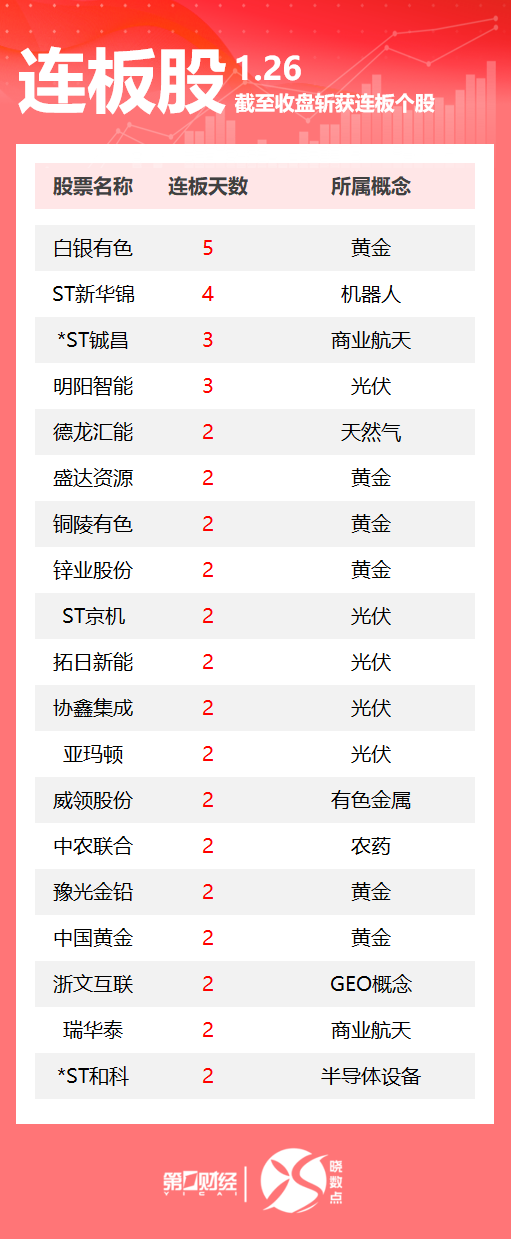
连板股追踪丨A股今日共79只个股涨停 这只黄金股5连板
Di Yi Cai Jing· 2026-01-26 08:20
Group 1 - The A-share market saw a total of 79 stocks hitting the daily limit up on January 26, with significant activity in gold and silver sectors, particularly with multiple stocks achieving consecutive limit ups [1] - Silver and colored metals stocks experienced a five-day consecutive limit up, with notable mentions including Baiyin Youse and Zhongguo Jinrong, both achieving two consecutive limit ups [1] - The photovoltaic sector also showed strong performance, with Mingyang Smart Energy achieving three consecutive limit ups, alongside other solar-related stocks like ST Jingji and Tuo Ri Xin Neng, both achieving two consecutive limit ups [1] Group 2 - Other sectors with notable performances included robotics, commercial aerospace, and semiconductor equipment, with stocks like ST Xinhua Jin and Ruihua Tai achieving four and two consecutive limit ups respectively [2] - The data indicates a diverse range of sectors experiencing upward momentum, reflecting investor interest across various industries [2]


午间涨跌停股分析:49只涨停股、20只跌停股,贵金属板块活跃,四川黄金等多股涨停
Xin Lang Cai Jing· 2026-01-26 03:52
1月26日午间,A股半日下来共有49只涨停股、20只跌停股。贵金属板块活跃,四川黄金8天5板,招金 黄金6天4板,盛达资源2连板,兴业银锡、湖南黄金等涨停。 连板股方面,天地在线6天3板,红宝丽5天3板,明阳智能、*ST铖昌3连板,运机集团、*ST云网3天2 板,豫光金铅、协鑫集成等2连板,长飞光纤、钒钛股份等涨停。 *ST奥维连续12日跌停,*ST万方连续10日跌停,*ST岩石、*ST恒久等跌停。 ...
神话褪色,陈小群遭遇“滑铁卢”
Guo Ji Jin Rong Bao· 2026-01-25 21:59
1月15日他追了三维天地,结果当天被套,16日早盘割肉,大亏10个点,然后看到华胜天成低开滑向跌停,接着向上反弹,于是觉得机会来了,立即买 入,又套着了…… 股民"老虎"这两天有点烦。 与此同时,交易所也在行动。1月16日晚间,深交所表示,近期"*ST铖昌"股价出现严重异常波动,公司停牌核查并发布风险提示公告,1月16日复牌后股 价继续涨停,部分投资者在交易该股过程中,存在影响股票交易正常秩序的异常交易行为,依规对相关投资者采取了暂停交易等自律监管措施。 也就是说,监管层给市场过度炒作、操纵市场上了紧箍咒。 "老虎"的烦来自于对顶级游资陈小群席位溢价的信仰。前段时间,只要陈小群买入的股票,要么一字涨停,要么持续涨停,一时间陈小群成了许多股民追 捧的市场"领袖"。"老虎"之所以买入三维天地,因为他看到中国银河证券股份有限公司大连黄河路证券营业部(陈小群常用席位)买了4600万元,后来陈 小群说,这不是他买的,于是三维天地随后下跌,老虎只好割肉止损。1月16日,"老虎"觉得新机会来了,因为华胜天成可是陈小群重仓股,觉得只要他 在,股票就能反弹甚至拉地天板。结果他变成了接盘侠:龙虎榜显示,1月16日,中国银河证券股 ...

今日涨跌停股分析:121只涨停股、2只跌停股,钙钛矿电池概念活跃,沃格光电3天2板,钧达股份2连板
Xin Lang Cai Jing· 2026-01-23 07:12
1月23日,A股全天下来共有121只涨停股、2只跌停股。钙钛矿电池概念活跃,沃格光电3天2板,钧达 股份2连板,捷佳伟创、太阳能等涨停;电力设备板块走强,明阳智能2连板,金风科技、迈为股份等涨 停;BC电池概念上涨,宇晶股份2连板。 *ST奥维连续11日跌停,*ST万方连续9日跌停。 连板股方面,锋龙股份18连板,江化微5连板,金安国纪7天4板,ST八菱5天4板,*ST长药、白银有色4 连板,汉商集团5天3板,巨力索具、ST新华锦等3连板,浙文互联、山东赫达等4天2板,大中矿业3天2 板,*ST铖昌、西部材料等2连板,中国卫星、铜陵有色等涨停。 ...

和而泰:持续优化经营策略,提升盈利能力,坚持稳定现金分红政策
Sou Hu Cai Jing· 2026-01-22 08:38
Group 1 - The company has received feedback from investors regarding its poor market value management and low stock price, despite the controlling shareholder reducing holdings [1] - In response, the company emphasized its commitment to shareholder returns and maintaining investor interests through optimized operational strategies and improved profitability [1] - The company has consistently implemented a stable cash dividend policy since its listing, aiming to reward investors and enhance communication regarding its strategic plans and operational achievements [1] Group 2 - The company encourages investors to focus on long-term value rather than short-term stock price fluctuations [1]

中美竞逐万亿美元新赛道,五层解构下的投资蓝图
Tebon Securities· 2026-01-21 04:07
Investment Rating - The report maintains an "Outperform" rating for the commercial aerospace industry [1] Core Insights - The aerospace sector is transitioning from being viewed as a "cost center" driven by national will to a "growth engine" driven by commercial demand, with significant investments and strategic planning from both the US and China [6][9] - The global aerospace economy is projected to reach $613 billion in 2024, with commercial aerospace contributing 78%, and is expected to exceed $1 trillion by 2032 [6][9] - The value chain of commercial aerospace is divided into five core levels: "space, ground, terminal, rocket, and application," each presenting unique market opportunities and technical challenges from 2026 to 2030 [10][29] Summary by Sections 1. Space: Satellite Manufacturing - The satellite manufacturing market in China is expected to grow from approximately 7.1 billion yuan in 2025 to about 39.4 billion yuan by 2030, reflecting a shift from sporadic research models to continuous, batch engineering deliveries [16][18] 2. Ground: Ground Systems - The ground systems market is projected to increase from around 1.2 billion yuan in 2025 to approximately 39.1 billion yuan by 2030, evolving from a supporting role to a core infrastructure essential for stable satellite constellation operations [21][22] 3. Terminal: Key Variable for Commercial Aerospace - The terminal market is anticipated to grow from 500 million yuan in 2025 to about 141.9 billion yuan by 2030, driven by multiple vertical industries and potential consumer scenarios [23][24] 4. Rocket: Core Constraint - The cost of rocket launches is a critical constraint, with reusable technology expected to reduce costs by 80%-90% compared to traditional expendable rockets. The market for rocket launch services is projected to grow from approximately 10.7 billion yuan in 2025 to about 34.3 billion yuan by 2030 [25][26] 5. Application: Final Value Realization - The application market is expected to expand from 200 million yuan in 2025 to 525 billion yuan by 2030, with the revenue share from applications projected to rise from single digits to over 67% by around 2030 [27][28] 6. Investment Opportunities - Investment opportunities in commercial aerospace can be categorized into three main tracks: 1. Launch and manufacturing segments, which are expected to benefit directly from increased orders and visibility 2. Core components and systems, characterized by high technical barriers and critical for long-term competitiveness 3. Downstream applications and operational services, which, while currently limited in scale, hold the greatest long-term potential for value realization [29][30]


*ST铖昌2026年1月21日跌停分析
Xin Lang Cai Jing· 2026-01-21 02:37
Core Viewpoint - *ST Chengchang's stock hit the daily limit down, reflecting significant concerns regarding its operational stability and market confidence due to various risks including potential delisting and project delays [2] Group 1: Company Fundamentals - The company is under delisting risk as a *ST (Special Treatment) entity, raising doubts about its ongoing operational capability [2] - The new generation chip project has been delayed twice until 2026, indicating high R&D challenges and negatively impacting market confidence in the company's future [2] - The operating cash flow for the first three quarters was -106 million yuan, with accounts receivable increasing by 53.45%, highlighting cash flow pressures [2] Group 2: Market Environment and Valuation - The company operates in the phased array T/R chip sector, which has a first-mover advantage in the low-orbit satellite field, but faces a complex and volatile market environment [2] - The company's price-to-earnings ratio is 278 times (industry average 54 times) and price-to-book ratio is 17 times (industry average 5.5 times), indicating significant valuation pressure [2] - Recent performance in related concept sectors has been poor, with multiple stocks experiencing declines, which could further negatively impact *ST Chengchang's stock price [2] Group 3: Short-term Trends and Investor Behavior - The stock reached a historical high on January 16, 2026, before hitting the daily limit down, suggesting that the previous price surge may have led to profit-taking by investors [2] - The lack of fundamental support for the recent price increase may have triggered sell-offs from technical investors [2]

商业航天板块为何上演过山车行情
第一财经· 2026-01-20 10:19
2026.01. 20 本文字数:3193,阅读时长大约5分钟 作者 | 第一财经 王方然 封图 | AI生成 1月20日,商业航天板块集体重挫,多股跌停,部分个股上演"天地板"极端行情。 该板块持续一个多月的凌厉上涨暂时宣告结束。回顾来看,从政策催化的热浪,到概念澄清、发射失利等多重因素的叠加冷却,板块短期走势呈现 出典型的"过山车"特征。 市场狂热褪去后,商业航天概念股的成色正经受考验。多家业内机构认为,部分公司业务关联度低、业绩支撑薄弱,而真正的核心企业仍面临持续 亏损、技术攻坚与商业化前景的长期挑战。 走出过山车行情 1月20日,商业航天板块出现明显回调。Choice数据显示,截至收盘,商业航天板块(BK0963)下跌超过3.2%。 个股方面,西测测试(301306.SZ)、航天宏图(688066.SH)、超捷股份(301005.SZ)跌幅超过11%;航宇微(300053.SZ)、七丰精工 (873169.BJ)、西部材料(002149.SZ)、等11只个股跌停;航天环宇(688523.SH)、盛路通信(002446.SZ)等也下跌超过8%。部分个股 波动尤为剧烈,如*ST铖昌(001270.SZ)早 ...

商业航天上演过山车行情 板块加速“去伪存真”
Di Yi Cai Jing· 2026-01-20 08:52
Core Viewpoint - The commercial aerospace sector experienced a significant downturn on January 20, with many stocks hitting their daily limit down, marking the end of a month-long rally. The sector's volatility is attributed to a combination of policy changes, clarifications of business relevance, and recent launch failures [1][2][3] Market Performance - As of January 20, the commercial aerospace sector index (BK0963) fell over 3.2%, with individual stocks like Xice Testing (301306.SZ) and Aerospace Hongtu (688066.SH) dropping more than 11%. A total of 11 stocks hit their daily limit down, while others like Aerospace HuanYu (688523.SH) and Shenglu Communication (002446.SZ) saw declines exceeding 8% [2][3] - The index has decreased from above 3100 points on January 12 to around 2790 points, ending a rapid rise that began in late November 2025 when it climbed from approximately 1900 points. By December 2025, at least 10 stocks had doubled in price [2][3] Factors Influencing Market Changes - The recent market correction is influenced by multiple factors, including over 20 listed companies issuing risk warnings or clarifications about their lack of substantial involvement in commercial aerospace. For instance, Aerospace Hongtu stated that a strategic cooperation agreement signed in July 2023 has not led to any significant business collaboration [3][6] - The sector faced setbacks with launch failures, including the Long March 3B rocket's mission failure and the unsuccessful maiden flight of the private commercial rocket by Star River Power [3][4] Policy and Industry Developments - The previous surge in the sector was driven by favorable policies, such as China's application for 203,000 new satellites, marking a significant resource declaration in the global aerospace sector. Additionally, the Shanghai Stock Exchange announced that commercial rocket companies could apply for IPOs under specific standards [4][5] - Recent developments indicate that several companies with core technology capabilities are in the IPO preparation stage, although many have not yet gone public [6][9] Financial Challenges - Financial data reveals that companies in the sector are facing significant challenges. For example, Blue Arrow Aerospace reported net losses of 8.21 billion yuan in 2022 and projected losses of 12.16 billion yuan in 2023, with cumulative losses exceeding 35 billion yuan over three and a half years [7][8] - The commercial viability of the sector is constrained by the need for low-cost and high-reliability technologies, where domestic capabilities still lag behind international competitors like SpaceX [8][9] Investor Sentiment and Future Outlook - Despite the recent downturn, long-term prospects for the commercial aerospace sector remain positive, with investors encouraged to focus on companies with core technological capabilities and commercial potential. The market is transitioning from speculative enthusiasm to more cautious value assessment [9][10] - Analysts suggest that the current market dynamics may resemble those of the new energy sector, with ongoing policy support and potential for profitability improvements, indicating that the sector may continue to experience fluctuations in the short to medium term [9][10]
商业航天上演过山车行情,板块加速“去伪存真”
Di Yi Cai Jing· 2026-01-20 08:48
Core Viewpoint - The commercial aerospace sector experienced a significant downturn on January 20, with many stocks hitting their daily limit down, marking the end of a month-long rally. The sector's volatility is attributed to a combination of policy changes, clarifications of business relevance, and recent launch failures [1][2][3]. Market Performance - As of January 20, the commercial aerospace sector index (BK0963) fell over 3.2%, with individual stocks like Xice Testing (301306.SZ) and Aerospace Hongtu (688066.SH) dropping more than 11%. A total of 11 stocks hit their daily limit down, while others like Aerospace Huanyu (688523.SH) and Shenglu Communication (002446.SZ) saw declines exceeding 8% [2][3]. - The index has decreased from above 3100 points on January 12 to around 2790 points, ending a rapid rise that began in late November 2025, during which at least 10 stocks doubled in price [2][3]. Factors Influencing Market Changes - The recent market cooling is attributed to multiple factors, including over 20 companies issuing risk warnings or clarifications about their lack of substantial involvement in commercial aerospace. For instance, Aerospace Hongtu stated that its strategic cooperation with a space technology company has not led to any significant business collaboration [3][6]. - The sector faced setbacks with launch failures, including the Long March 3B rocket and the private commercial rocket from Star River Power, which both experienced mission failures [3][4]. Policy and Industry Developments - The previous surge in the sector was driven by favorable policies, such as China's application for 203,000 new satellites, the largest in recent years, and the Shanghai Stock Exchange's announcement allowing commercial rocket companies to apply for IPOs under specific standards [4][5]. - Recent developments indicate that several companies with core technology capabilities are in the IPO preparation stage, although many have not yet gone public [6][7]. Financial Challenges - Financial data reveals significant challenges for companies in the sector. For example, Blue Arrow Aerospace reported net losses of 8.21 billion yuan in 2022, 12.16 billion yuan in 2023, and 9.16 billion yuan in 2024, with a total loss exceeding 35 billion yuan over three and a half years [7][8]. - The commercial viability of these companies is hindered by their early-stage development and the high costs associated with rocket technology, which still lag behind international competitors [8]. Future Outlook - Despite the recent downturn, long-term prospects for the commercial aerospace sector remain positive, with industry experts suggesting that the current market correction may help identify companies with genuine technological capabilities and commercial potential [9]. - Analysts believe that the sector may experience a recovery similar to the renewable energy market, driven by ongoing policy support and potential improvements in profitability [9].


