
农业银行

Search documents
黄金急跌!银行收紧,金条抢空
Jin Rong Jie· 2026-02-02 04:36
Group 1 - The international precious metals market experienced significant adjustments on January 30, leading major banks such as ICBC, CCB, BOC, and ABC to issue risk warnings and adjust related business rules [1] - ICBC advised investors to adopt a rational perspective on market fluctuations, control positions, and follow a principle of gradual and diversified allocation [1] - Other major banks also issued risk warnings, with CCB raising the minimum amount for personal gold accumulation to 1500 yuan, BOC advising clients to consider their risk tolerance, and ABC enhancing risk assessment requirements for gold accumulation [1][2] Group 2 - The physical gold market is experiencing high demand despite price adjustments, with popular products sold out on banking apps and limited availability of physical gold bars at branches [2] - There is a noticeable increase in inquiries about gold bars, as many view the price correction as an opportunity to accumulate for long-term holding, although supply constraints exist [2] - The interest rates for account-based gold products are being reduced to zero by major banks, indicating a weakening of their "interest property" [2]





金价大幅震荡!多家银行发布公告
Sou Hu Cai Jing· 2026-02-02 04:28
Core Viewpoint - Major Chinese banks have adjusted their gold accumulation business and issued risk warnings due to significant fluctuations in gold prices and increased market uncertainty [1][2][5][7]. Group 1: Bank Adjustments - Industrial and Commercial Bank of China (ICBC) has modified its gold accumulation business rules, implementing limit management for transactions on non-trading days starting February 7 [3]. - ICBC raised the minimum investment amount for gold accumulation from 1000 yuan to 1100 yuan as of January 8 [4]. - China Construction Bank increased the minimum investment amount for personal gold accumulation to 1500 yuan starting February 2 [5]. Group 2: Risk Warnings - ICBC advises investors to assess their risk tolerance and maintain a rational investment approach, suggesting a diversified investment strategy [2]. - Bank of China has highlighted the uncertainties in the precious metals market since 2026, urging clients to manage their gold holdings carefully to mitigate potential losses [7]. - China Agricultural Bank requires clients to complete a risk assessment before engaging in gold accumulation activities, emphasizing the importance of risk awareness [12]. - Traffic Bank has set conditions for clients based on their risk assessment results, allowing only those with higher risk tolerance to engage in all gold-related transactions [9].

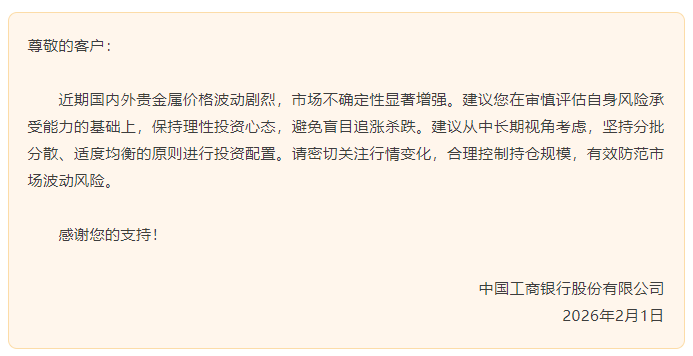
涉黄金业务调整及交易风险提示!工、农、中、建、交通、邮储六大行发布公告
Sou Hu Cai Jing· 2026-02-02 04:22
Core Viewpoint - Recent fluctuations in gold prices have prompted major banks in China to take urgent measures to control risks associated with gold trading [1] Group 1: Bank Responses - Industrial and Commercial Bank of China (ICBC) issued a risk warning on February 1, advising clients to assess their risk tolerance and maintain a rational investment mindset amid significant price volatility [3] - Agricultural Bank of China (ABC) announced an increase in margin requirements for gold trading contracts from 44% to 60% starting January 30, urging clients to manage their positions carefully [5] - Bank of China (BOC) highlighted the uncertainties in the precious metals market and advised clients to control their holdings to mitigate potential losses from price fluctuations [7] - China Construction Bank (CCB) raised the minimum investment amount for its gold accumulation business to 1500 yuan, emphasizing the need for clients to be aware of market risks [9] - Both Bank of Communications and Postal Savings Bank of China also issued trading alerts, with the latter increasing margin requirements for various gold contracts from 80% to 120% [11] Group 2: Market Analysis - The international gold market has experienced significant volatility, with experts warning that investors need to possess adequate risk tolerance due to increased short-term risks [12] - Despite the current fluctuations, the long-term outlook for gold prices remains positive, supported by multiple factors, suggesting that investors should make informed decisions based on their financial situations and risk preferences [12]
沪银主力合约跌停,上金所:若2月2日Ag(T+D)现单边市将把其保证金调至26%
Sou Hu Cai Jing· 2026-02-02 04:14
Group 1 - The core viewpoint of the articles highlights significant fluctuations in the precious metals market, particularly affecting domestic futures markets, with major contracts like silver and gold experiencing sharp declines [1][2] - On February 2, 2026, the main silver futures contract on the Shanghai Futures Exchange hit the daily limit down, trading at 24,832 yuan per kilogram, while gold and other precious metals also saw notable downward trends [1] - The Shanghai Gold Exchange announced adjustments to the margin levels and price limits for silver contracts due to the large price volatility, increasing the margin requirement from 20% to 26% in case of a one-sided market [1] Group 2 - Major banks such as ICBC, ABC, BOC, CCB, and Bank of Communications have adjusted their gold accumulation business rules in response to recent market volatility, including raising the minimum purchase amount and implementing risk tolerance thresholds [2] - These banks have also introduced limit management for accumulation business on non-trading days and issued risk alerts to guide investors in managing their positions effectively [2]
涉黄金业务调整,六大行公告
Sou Hu Cai Jing· 2026-02-02 04:06
Core Viewpoint - Recent fluctuations in gold prices have led to significant volatility, prompting major banks to take measures to control risks associated with gold-related businesses [1][4]. Group 1: Bank Responses - Industrial and Commercial Bank of China (ICBC) issued a risk warning on February 1, advising clients to assess their risk tolerance and adopt a rational investment approach amidst market uncertainty [2]. - Agricultural Bank of China (ABC) announced an increase in margin requirements for gold trading contracts from 44% to 60% effective January 30, urging clients to manage their positions carefully [3]. - China Bank highlighted the need for clients to protect their interests in gold-related businesses and to control their holdings based on financial status and risk tolerance [4]. - China Construction Bank (CCB) raised the minimum investment amount for gold accumulation business to 1500 yuan starting February 2, emphasizing the need for risk awareness [5]. - Bank of Communications and Postal Savings Bank also issued trading alerts, with the latter increasing margin requirements for certain gold contracts from 80% to 120% [6]. Group 2: Market Analysis - The international gold market has experienced significant volatility, with experts warning that investors need to possess adequate risk tolerance due to increased short-term risks [7]. - Despite the current fluctuations, the long-term outlook for gold prices remains positive, supported by various factors, suggesting that investors should focus on their own investment experience and risk preferences [7].

银行股逆势上涨,中信银行涨超3%
Ge Long Hui· 2026-02-02 03:57
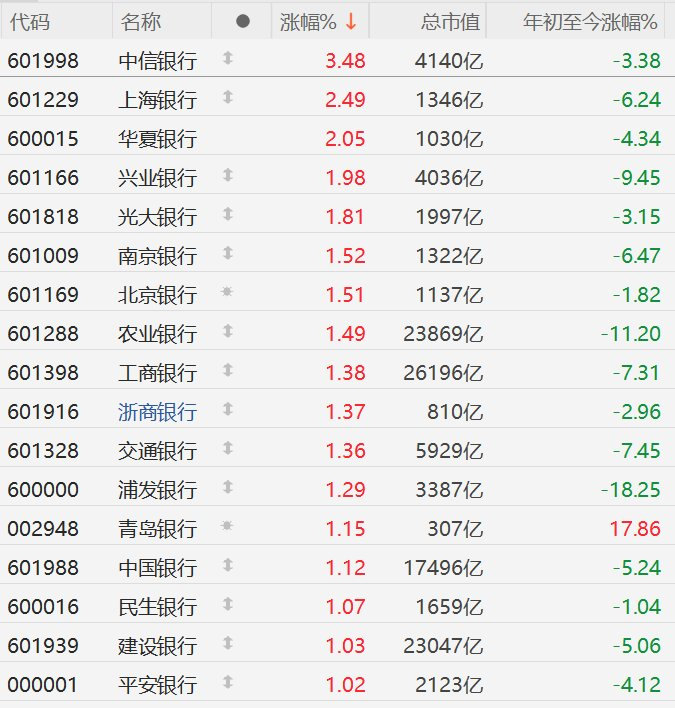
Core Viewpoint - The A-share market's banking sector experienced a counter-trend increase, with several banks showing significant gains despite overall market conditions [1]. Group 1: Stock Performance - CITIC Bank saw an increase of 3.48%, with a total market capitalization of 414 billion [2] - Shanghai Bank increased by 2.49%, with a market cap of 134.6 billion [2] - Huaxia Bank rose by 2.05%, with a market cap of 103 billion [2] - Other banks such as Industrial Bank, Everbright Bank, and Nanjing Bank also reported gains exceeding 1% [1][2] - Agricultural Bank, Industrial and Commercial Bank, and China Merchants Bank had market caps of 2386.9 billion, 2619.6 billion, and 2304.7 billion respectively, with slight increases [2] Group 2: Year-to-Date Performance - Year-to-date performance shows that most banks have negative returns, with CITIC Bank down 3.38% and Shanghai Bank down 6.24% [2] - Notably, Qingdao Bank has a positive year-to-date return of 17.86%, indicating strong performance relative to its peers [2] - Other banks like Agricultural Bank and Industrial Bank have year-to-date declines of 11.20% and 7.31% respectively [2]





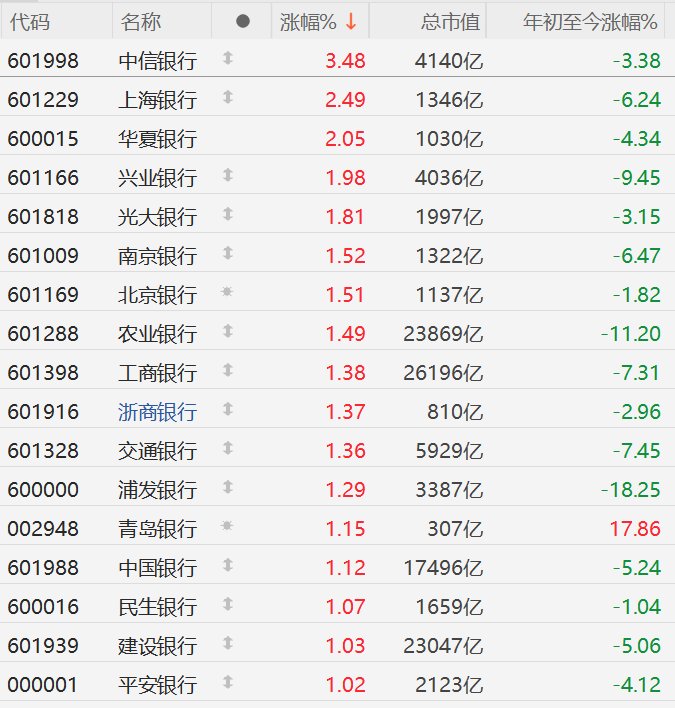
A股银行股逆势上涨,中信银行涨超3%
Ge Long Hui A P P· 2026-02-02 03:54
Core Viewpoint - The A-share market has seen a rise in bank stocks, with several banks experiencing significant gains despite overall market trends [1] Group 1: Stock Performance - CITIC Bank increased by 3.48%, with a total market capitalization of 414 billion [2] - Shanghai Bank rose by 2.49%, with a market cap of 134.6 billion [2] - Huaxia Bank saw a gain of 2.05%, with a market value of 103 billion [2] - Industrial Bank increased by 1.98%, with a market cap of 403.6 billion [2] - Everbright Bank rose by 1.81%, with a total market capitalization of 199.7 billion [2] - Nanjing Bank increased by 1.52%, with a market cap of 132.2 billion [2] - Beijing Bank saw a rise of 1.51%, with a market value of 113.7 billion [2] - Agricultural Bank increased by 1.49%, with a market cap of 23,869 billion [2] - Industrial and Commercial Bank rose by 1.38%, with a market value of 26,196 billion [2] - Zhejiang Bank increased by 1.37%, with a market cap of 81 billion [2] - Bank of Communications rose by 1.36%, with a market value of 592.9 billion [2] - Shanghai Pudong Development Bank increased by 1.29%, with a market cap of 338.7 billion [2] - Qingdao Bank saw a rise of 1.15%, with a market value of 30.7 billion [2] - Bank of China increased by 1.12%, with a market cap of 17,496 billion [2] - Minsheng Bank rose by 1.07%, with a market value of 165.9 billion [2] - China Construction Bank increased by 1.03%, with a market cap of 23,047 billion [2] - Ping An Bank rose by 1.02%, with a market value of 212.3 billion [2] Group 2: Year-to-Date Performance - CITIC Bank has a year-to-date decline of 3.38% [2] - Shanghai Bank has decreased by 6.24% year-to-date [2] - Huaxia Bank has a year-to-date decline of 4.34% [2] - Industrial Bank has decreased by 9.45% year-to-date [2] - Everbright Bank has a year-to-date decline of 3.15% [2] - Nanjing Bank has decreased by 6.47% year-to-date [2] - Beijing Bank has a year-to-date decline of 1.82% [2] - Agricultural Bank has decreased by 11.20% year-to-date [2] - Industrial and Commercial Bank has a year-to-date decline of 7.31% [2] - Zhejiang Bank has decreased by 2.96% year-to-date [2] - Bank of Communications has a year-to-date decline of 7.45% [2] - Shanghai Pudong Development Bank has decreased by 18.25% year-to-date [2] - Qingdao Bank has increased by 17.86% year-to-date [2] - Bank of China has a year-to-date decline of 5.24% [2] - Minsheng Bank has decreased by 1.04% year-to-date [2] - China Construction Bank has a year-to-date decline of 5.06% [2] - Ping An Bank has decreased by 4.12% year-to-date [2]
金价继续大跌!多家银行紧急发布公告!
Sou Hu Cai Jing· 2026-02-02 03:51
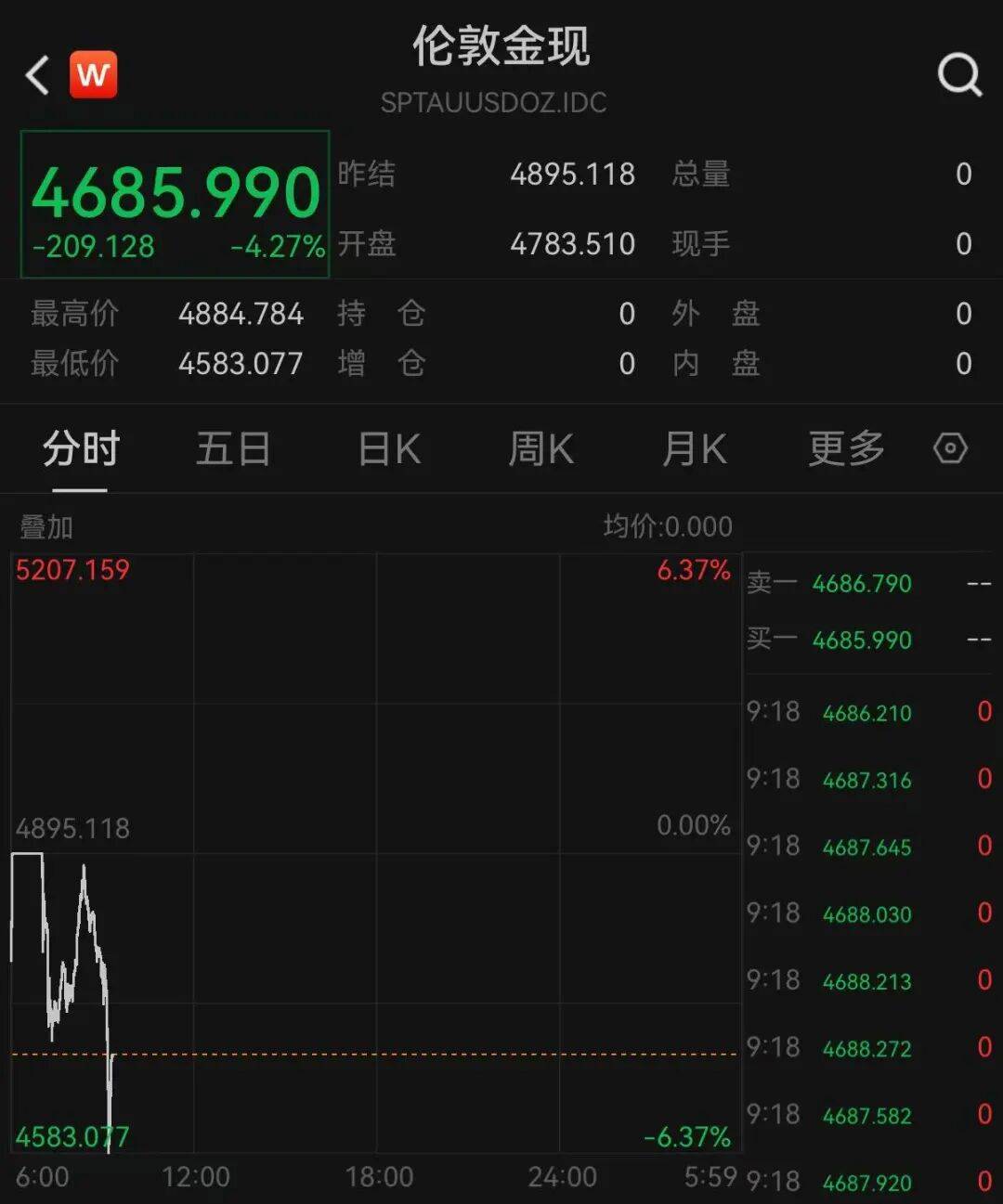
Market Overview - On February 2, 2026, London spot gold opened at $4685.99 per ounce, down over 4.2%, with a daily low of $4583.077 per ounce. London spot silver opened at $82.887 per ounce, down over 2.7% [1][2][3] - Domestic precious metal futures prices opened lower, with Shanghai silver futures hitting the limit down, Shanghai gold futures down over 10%, platinum futures limit down, and palladium futures down over 15% [3][4] Price Adjustments - The Shanghai Gold Exchange announced adjustments to the margin levels and price limits for silver contracts due to significant price volatility. If a one-sided market occurs, the margin level will increase from 20% to 26%, and the price limit will change from 19% to 25% [4] - Domestic brand gold jewelry prices have adjusted downwards, with Chow Sang Sang's gold jewelry reported at ¥1484 per gram, down from ¥1618 per gram [5][6] Consumer Behavior and Refund Policies - Sales personnel at gold brand counters have stated that returns will not be accepted due to price drops, with a standard deduction of ¥500 for any return [7] - Online return policies vary, with most platforms not accepting returns for investment gold products. Some brands allow returns within 24-48 hours under specific conditions, while others charge a fee of 1%-5% for returns [9][11][12] Risk Management by Financial Institutions - Several banks, including ICBC, ABC, BOC, and CCB, have issued announcements adjusting their gold accumulation business and providing risk warnings due to significant price fluctuations in precious metals [17][19][22][26] - ICBC has raised the minimum purchase amount for gold accumulation from ¥1000 to ¥1100 and adjusted business rules for gold accumulation starting February 7 [20][21]
涉黄金业务调整,工、农、中、建、交通、邮储六大行公告
Sou Hu Cai Jing· 2026-02-02 03:51
Core Viewpoint - Recent fluctuations in gold prices have prompted major banks in China to adjust their gold-related business operations and issue risk warnings to clients [1] Group 1: Bank Responses - Industrial and Commercial Bank of China (ICBC) has issued a risk warning advising clients to assess their risk tolerance and maintain a rational investment mindset amid significant price volatility in precious metals [3] - Agricultural Bank of China (ABC) has increased the margin requirement for certain gold contracts from 44% to 60% and emphasized the need for clients to control their positions and trade rationally [5] - Bank of China (BOC) has highlighted the uncertainties in the precious metals market and advised clients to manage their holdings carefully to mitigate potential losses from price fluctuations [7] - China Construction Bank (CCB) has raised the minimum investment amount for its gold accumulation business to 1500 yuan, urging clients to enhance their risk awareness and manage their positions effectively [9] - Both Bank of Communications and Postal Savings Bank have also issued announcements regarding adjustments in margin requirements for gold trading, with the latter increasing the margin from 80% to 120% for certain contracts [11] Group 2: Market Outlook - The international gold market has experienced significant volatility, with experts warning that investors need to possess adequate risk tolerance due to the increased short-term risks associated with high gold prices [12]
信用债市场周观察:关注CRMW一级发行定价机会
Orient Securities· 2026-02-02 03:43
Report Industry Investment Rating - Not mentioned in the provided content Core Viewpoints of the Report - In the second half of 2025, CRMW products were issued intensively in conjunction with private enterprise science and technology innovation bonds, with obvious cost - reduction and credit - enhancement effects. Currently, there is little room for participation in the secondary market. It is recommended to focus on the pricing opportunities during the primary issuance of new products. The "underlying bond + CRMW" combination under the strong guarantee of large - scale national and joint - stock banks has valuation advantages, and institutions with stable liability ends such as proprietary trading can hold them until maturity [5]. - When classified by creation entities, special attention should be paid to CRMW created by joint - stock banks [5]. Summary According to Relevant Catalogs 1. Credit Bond Weekly Viewpoint: Focus on the Pricing Opportunities of CRMW Primary Issuance - CRMW is an important credit - enhancement product. In 2025, over a hundred CRMW were created by various institutions, a slight reduction from 2024. Nearly 40% of the protected underlying bonds were science and technology innovation bonds, and the protected issuers were mostly technology - based private enterprises. Commercial banks are the mainstream creation institutions, while securities companies have rarely participated since 2024, and guarantee companies such as Zhongyu Guarantee and Zhongzhai Zengxin have been active [9]. - It is difficult to participate in the secondary market of CRMW. The focus should be on the primary issuance, especially the CRMW created by joint - stock banks. The average maturity of recently issued underlying bonds is about 2 years, and the maturity considering the exercise right is generally no more than 3 years, which meets the preferences of mainstream institutions [15]. - By creation entity types: - State - owned banks: Since 2024, the frequency of state - owned banks creating CRMW has declined. The credit spread of the "CRMW + underlying bond" investment portfolio created by state - owned banks is generally low, with most spreads around 40bp since Q4 2025, and there is no excess return compared to mainstream urban investment/industrial bonds [15][17]. - Joint - stock banks: Banks such as China Zheshang Bank have created a relatively large number of CRMW. The credit spread of the "CRMW + underlying bond" investment portfolio is around 70bp, and the absolute return can exceed 2.4%, which is very attractive in a low - return environment. The higher return mainly comes from the higher coupon rate of the protected underlying bonds, and there is sufficient safety margin under the strong guarantee of CRMW [25]. - City commercial banks: Banks such as Dongguan Bank and Qingdao Bank are the main creation institutions. The returns of their "CRMW + underlying bond" portfolios are more differentiated, and the recent returns are mainly in the range of 2.1% - 2.2%, with limited attractiveness [25]. - Rural commercial banks: Only Shanghai Rural Commercial Bank participates, and the overall return of the portfolio is not high due to the strong credit quality of the credit - enhancement subject [25]. - Guarantee companies: Zhongyu Guarantee and Zhongzhai Zengxin have created a small number of CRMW in the past two years. The returns are scattered, and the "underlying bond + CRMW" portfolio has a slightly higher return due to weak liquidity, which is suitable for institutions with stable liability ends and high - risk preferences to hold until maturity [23][26]. - Secondary market opportunities are mainly concentrated in the "underlying bond + CRMW" portfolio with a maturity of less than 1 year. The primary market is the main way to participate, while the secondary market has weak liquidity. The short - term portfolio with a maturity of less than 1 year and a return of over 2.1% created by state - owned banks and strong joint - stock banks has cost - effectiveness [28]. 2. Credit Bond Weekly Review: The Enthusiasm for Medium - Term Bond Mining Continues 2.1 Negative Information Monitoring - There were no bond defaults, overdue payments, downgrades of issuer or bond ratings, or overseas rating downgrades during the week from January 26 to February 1, 2026. However, there were significant negative events for companies such as Sunshine City Group, Country Garden Real Estate Group, and Rongqiao Group [31][33]. 2.2 Primary Issuance: Net Financing Remains High, and Financing Costs Fluctuate Narrowly - The new issuance scale of credit bonds remained high, the maturity volume decreased, and the net financing remained high. From January 26 to February 1, 2026, the primary issuance of credit bonds was 307.4 billion yuan, a slight decrease from the previous period. The total repayment was 151.7 billion yuan, a 19% decrease from the previous period, and the net financing was 155.7 billion yuan [34]. - The number and scale of cancelled or postponed bond issuances remained at a low level. The financing costs of medium - and high - grade bonds fluctuated slightly. The average coupon rates of AAA and AA+ grades were 2.12% and 2.24% respectively, with a month - on - month increase of 9bp and a decrease of 7bp [35]. 2.3 Secondary Trading: Valuations Fluctuated Slightly, and 3 - year Bonds Outperformed Relatively - The valuations of credit bonds of various grades and maturities were mostly flat compared to the previous period, except for a 3bp decline in the 3 - year medium - and low - grade bonds. The risk - free interest rate fluctuated slightly, and the credit spreads were mostly flat. The term spreads of 3Y - 1Y and 5Y - 1Y of various grades almost all narrowed, with an average of about 2bp, and the AA - grade 3Y - 1Y narrowed by up to 4bp. The AA - AAA grade spread of the 3 - year bond narrowed by 4bp [37][40]. - The credit spreads of urban investment bonds in various provinces narrowed slightly, with an average narrowing of about 2bp, and the spreads in Heilongjiang and Yunnan narrowed the most. The credit spreads of industrial bonds fluctuated within ±1bp, significantly underperforming urban investment bonds, and the real estate sector widened by 3bp [42][43]. - The weekly turnover rate decreased by 0.18 percentage points to 1.85%. The issuers of the top - ten turnover bonds were mostly central and state - owned enterprises. The issuers of credit bonds with a discount of more than 10% in trading were mainly related to Country Garden, Vanke, and AVIC Industry Finance [45]. - The distribution of urban investment bonds with the largest narrowing or widening of spreads was scattered. Among industrial bonds, the top five issuers with widening spreads were mostly real - estate companies, including Times Holdings, Rongqiao, Yuzhou Hongtu, and Greenland [47][48].