
个人黄金积存业务

Search documents
建设银行遭监管处罚并调整业务,股价近期小幅下跌
Jing Ji Guan Cha Wang· 2026-02-14 07:38
Group 1 - Construction Bank's A-shares closed at 8.70 yuan on February 13, 2026, down 1.25% for the day and a cumulative decline of 1.58% over the past five days; Hong Kong shares closed at 7.96 HKD, down 1.49% for the day and a cumulative decline of 0.13% over the past five days [1] - On February 13, 2026, net inflow of main funds into A-shares was 70.07 million yuan, while net inflow into Hong Kong shares was 53.80 million HKD; short-term moving averages for Hong Kong shares show a bullish arrangement, but KDJ indicators are at a high level, indicating increased volatility [1] Group 2 - On February 14, 2026, Construction Bank's Shanghai branch was fined 4.2 million yuan for serious violations in internet loan risk management and working capital loan management; related responsible persons were warned and fined [2] - Construction Bank announced on February 11, 2026, an increase in the minimum amount for personal gold accumulation business to 1,500 yuan and implemented dynamic trading limit management for "Jianxing Gold" from February 14 to 23, 2026, while suspending physical repurchase business during the Spring Festival to enhance risk management [2] - Construction Bank's subsidiary participated in the Guangdong-Hong Kong-Macao Greater Bay Area fund investment and led the underwriting of Morgan Stanley Panda bonds, highlighting its cross-border service capabilities [2] Group 3 - Huatai Securities reported on February 10, 2026, that central bank policies focusing on personal credit recovery and green finance are favorable for structural opportunities in the banking sector, and noted that Construction Bank's H-shares have a high dividend yield [3] - CICC reported on February 14, 2026, indicating that net profit for large commercial banks is expected to grow by 2% year-on-year in 2025, with a narrowing decline in net interest margin, suggesting an improvement in the industry's profitability environment [3]

一周银行速览(1.30—2.6)
Cai Jing Wang· 2026-02-06 11:01
Industry Focus - The China Banking Association has released guidelines to regulate the collection behavior of credit card and personal consumer loan collections, aiming to promote healthy industry development. The guidelines clarify issues such as collection timing, reasonable frequency, and channels for obtaining contact information, establishing quantitative standards and specific definitions [1] Corporate Dynamics - Citic Bank plans to increase its capital contribution to Citic Financial Leasing by 2 billion yuan, raising the registered capital from 10 billion yuan to 12 billion yuan. This marks the second capital increase for Citic Financial Leasing by Citic Bank in a year [4] Financial Personnel - Qingdao Rural Commercial Bank has elected Liang Yanbo as the chairman of its fifth board of directors, pending approval from the Qingdao Financial Regulatory Bureau [5] - Ningbo Bank has received approval from the Ningbo Financial Regulatory Bureau for Fu Wensheng to serve as the vice president [6] - Guangfa Bank has received approval for Lin Zhaohui to serve as the director, vice chairman, and president, effective from January 30, 2026 [7] - The credit card center of Bank of Communications has appointed He Bo, the former vice president of the Zhejiang branch, as the new general manager, pending regulatory approval [8] - Bai Xiaodong has been appointed as the party secretary of Beijing Rural Commercial Bank, as announced during the bank's recent meeting [9] Market Trends - Despite an overall downward trend in market interest rates, many small and medium-sized banks have raised deposit rates by 5 to 20 basis points ahead of the Spring Festival, with some banks launching limited-time exclusive deposit products [3] Gold Market - Following a significant drop in gold prices, several banks have issued risk warnings and adjusted the entry thresholds for gold-related businesses, including increasing the minimum purchase amount for gold accumulation products [2]



“短短几天坐了一趟过山车”!金价狂震,各大银行密集公告
Sou Hu Cai Jing· 2026-02-04 07:40
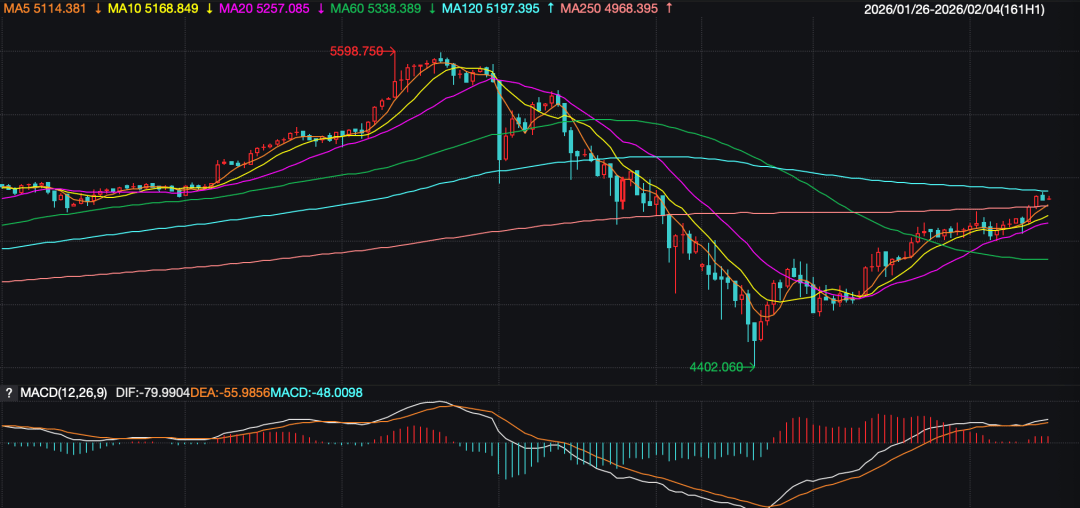
Core Viewpoint - International gold prices have experienced significant volatility, rebounding from a previous drop and surpassing the $5000 per ounce mark as of February 4, 2026, prompting banks to enhance risk management for gold investment businesses [1][2]. Group 1: Gold Price Fluctuations - Gold prices saw a dramatic rise and fall, peaking near $5600 per ounce on January 29, 2026, followed by a nearly 10% drop on January 30, and falling below $4500 per ounce by February 2, before rebounding with over a 6% increase on February 3 [2]. - Analysts from Guangzhou Futures Co. noted that concerns over future monetary policy, coupled with technical selling pressure, contributed to the significant price drop, while long-term factors such as central bank gold purchases and geopolitical risks are expected to support gold prices [3]. Group 2: Bank Responses to Volatility - Major state-owned banks, including Bank of China and Agricultural Bank of China, have announced adjustments to margin requirements and trading limits for gold and silver contracts in response to the volatility [4][5]. - The Bank of China adjusted the margin ratio for gold contracts from 16% to 17% and for silver contracts from 26% to 23%, effective February 3, 2026 [4]. - Agricultural Bank of China also modified the trading limits for gold and silver contracts, reducing the daily price fluctuation limit from 25% to 22% for silver and from 15% to 16% for gold [5]. Group 3: Changes in Investment Products - Some banks have raised the minimum purchase threshold for gold accumulation products to 1500 yuan, reflecting a tightening of investment conditions [10]. - Industrial and Commercial Bank of China announced limits on gold accumulation business during weekends and holidays, indicating a more cautious approach to managing gold investments [8]. - Analysts emphasize the importance of viewing gold as a stabilizing asset in investment portfolios, advising against speculative trading practices [10][11].

黄金、白银,崩盘式跳水!创40年最大单日跌幅
Sou Hu Cai Jing· 2026-02-03 03:34
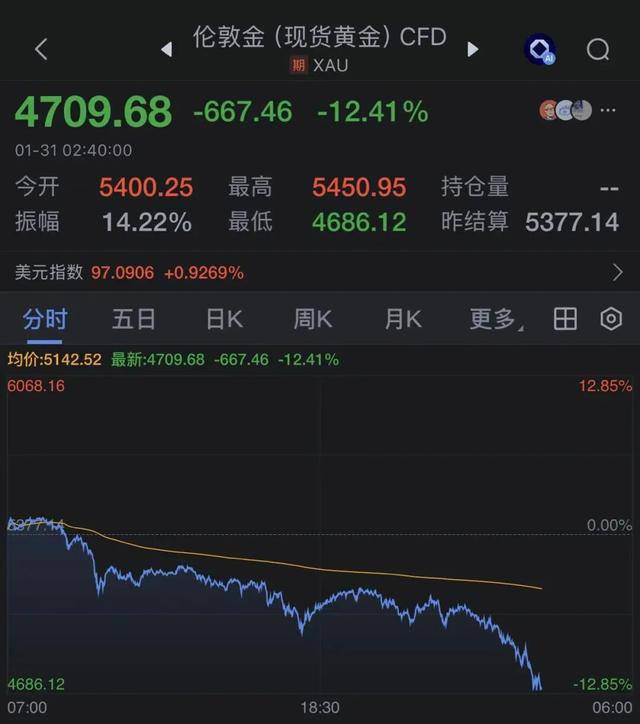
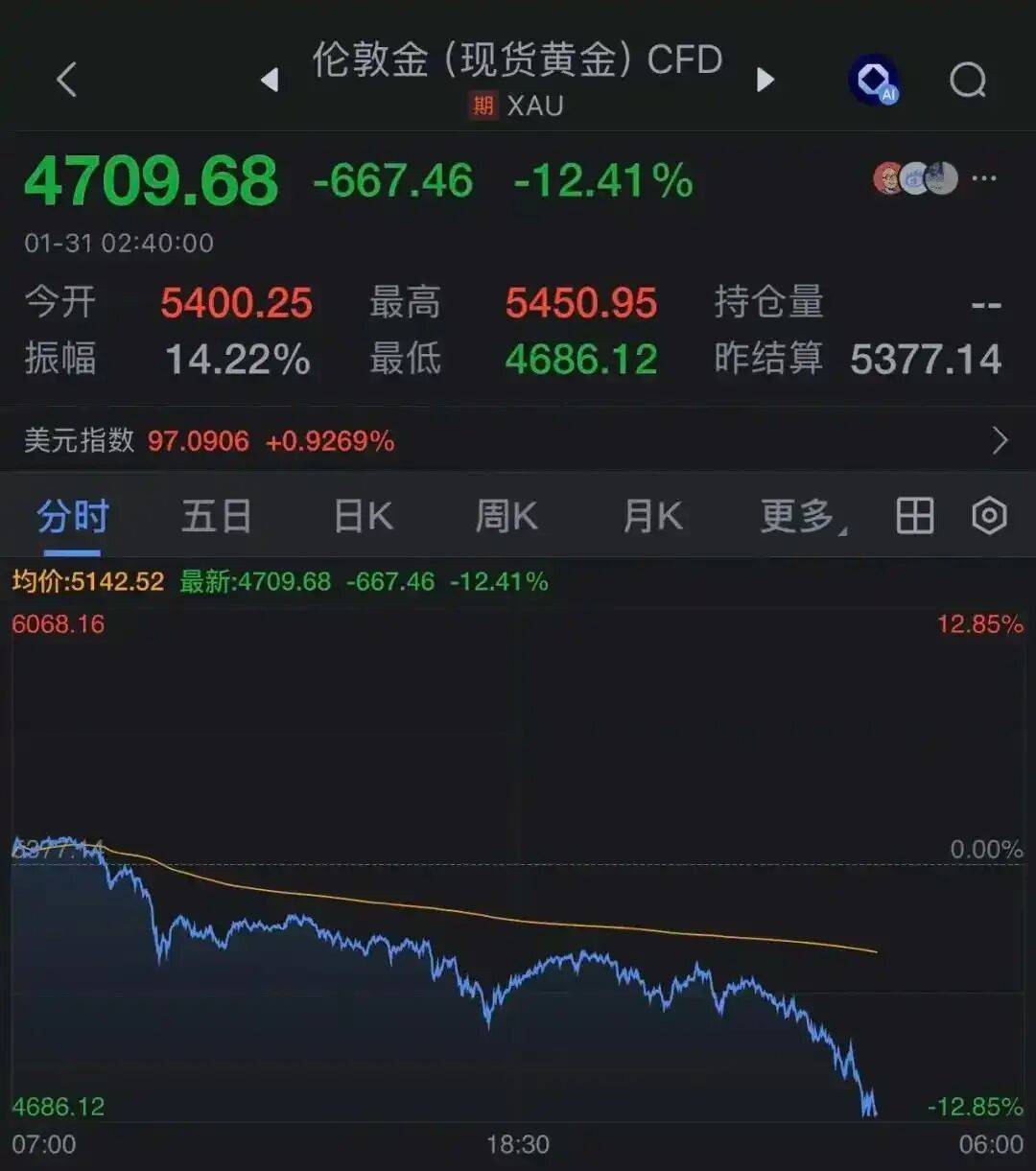
Group 1 - Global panic selling has swept the precious metals market, with silver prices dropping by 34.67% from over $110/oz to $75.38/oz, and gold prices falling by 12.41% from $5400/oz to $4709.68/oz [1] - As of the market close, spot gold was reported at $4880.034/oz, down 9.25%, marking the largest single-day decline since April 1, 1980 [4] - The U.S. stock market experienced a broad decline, with the Nasdaq down 1.22%, the Dow Jones down over 1%, and the S&P 500 down 0.92% [5] Group 2 - President Trump nominated Kevin Walsh as the next Federal Reserve Chairman, shifting market focus to his monetary policy stance and the independence of the Fed [5] - Analysts predict that the Federal Reserve may lower interest rates by approximately 50 to 100 basis points over the next year, which could influence gold prices [5] - Despite the current volatility, analysts from China International Capital Corporation (CICC) suggest that the gold bull market may not be over, as the Fed's policies and U.S. economic conditions continue to evolve [6] Group 3 - Industrial and Commercial Bank of China (ICBC) announced adjustments to its personal gold accumulation business, implementing limit management for transactions on non-trading days starting February 7, 2026 [6][7] - China Construction Bank (CCB) also announced an increase in the minimum amount for personal gold accumulation plans to 1500 yuan, effective February 2, 2026 [7] Group 4 - Retail gold stores generally do not accept returns after purchase, while online platforms have varying return policies, often not allowing returns for investment gold products [9][13] - Some brands have specific return policies for gold jewelry, allowing returns within 24-48 hours under certain conditions, while others impose fees for returns [11][13] - Legal interpretations indicate that gold jewelry and bars purchased in physical stores are generally not subject to a 7-day no-reason return policy, aligning with consumer protection laws [13]
黄金续跌,投资者如何风控?
3 6 Ke· 2026-02-02 23:49
Core Viewpoint - The precious metals market, particularly gold and silver, has experienced significant volatility, with sharp declines in prices leading to concerns about market stability and investor risk management [2][3][4]. Price Movements - As of February 2, 2026, gold prices fell to $4421.31 per ounce, down over 9% for the day, while silver dropped to $72.21, down over 15% [2]. - Earlier in the day, gold had broken below $4800 per ounce, marking a 3.35% decline, and silver had seen a drop of 6% to $79.57 per ounce [2]. - The day also saw gold reach a new low of $4450 per ounce, the lowest since January 8, 2026, while silver approached levels that erased its gains for the year [2]. Market Analysis - Analysts noted that the sharp decline in precious metals prices indicates a potential market frenzy, with increased positions and leverage leading to widespread sell-offs [3]. - The volatility in precious metals has been accompanied by declines in other commodities, including WTI crude oil, palladium, copper, and platinum, with WTI oil dropping over 6% to $61.69 per barrel [3]. Risk Management by Financial Institutions - Major state-owned banks in China have issued multiple risk warnings regarding precious metals price fluctuations, with the Industrial and Commercial Bank of China (ICBC) issuing four warnings in a week [4]. - ICBC advised investors to adopt a long-term perspective and diversify their investments to manage risks effectively [4]. - Other banks, such as China Construction Bank, have raised the minimum investment amounts for gold accumulation and implemented limit management for gold investment products [4]. Influencing Factors - The precious metals market has been affected by liquidity issues and market expectations surrounding potential policy changes following the nomination of Kevin Warsh as the next Federal Reserve Chair by President Trump [5]. - Analysts believe that while the immediate impact of Warsh's nomination may be short-term, the long-term fundamentals for precious metals remain intact, with a focus on stable monetary policy and low inflation [5]. Long-term Outlook - Despite recent volatility, some analysts maintain a positive long-term outlook for precious metals, particularly gold, due to ongoing geopolitical shifts and concerns over fiscal sustainability [6]. - The World Gold Council reported that global gold demand is expected to exceed 5000 tons for the first time in 2025, with a significant increase in demand value, indicating strong market fundamentals [6].
金价暴跌!原因找到了!
Sou Hu Cai Jing· 2026-02-02 14:42
Core Viewpoint - A significant sell-off in the global precious metals market has led to a sharp decline in gold and silver prices, with gold dropping below $5000 per ounce and silver experiencing a dramatic fall of 36% at one point [1][4]. Group 1: Market Reactions - Spot gold prices fell by 9.52% to $4865 per ounce, with intraday losses exceeding 12% [1]. - Spot silver saw a decline of 26.9%, closing at $84.7 per ounce, while platinum and palladium dropped by 17.59% and 14.89%, respectively [1]. - Domestic gold jewelry prices also fell significantly, with brands like Chow Sang Sang and Lao Feng Xiang reporting daily declines of over 100 yuan per gram [4]. Group 2: Influencing Factors - The potential nomination of Kevin Warsh as the next Federal Reserve Chairman has raised concerns about a more hawkish monetary policy, which could suppress market expectations for further interest rate cuts [5][6]. - Market analysts suggest that the sell-off may be driven by forced liquidation due to high leverage among traders, particularly in the silver market [6]. - The market is reacting to the prospect of a stronger dollar and a reassessment of concentrated risks, contributing to the decline in precious metal prices [6]. Group 3: Future Outlook - According to China International Capital Corporation (CICC), the gold bull market may not be over, as the Federal Reserve's policies and the U.S. economy have not yet reached a turning point [10]. - CICC anticipates that inflation in the U.S. will continue to rise, potentially leading to a slowdown in the Fed's easing measures, which could exert temporary pressure on gold prices [10]. - The outlook for silver is expected to be more volatile than gold due to its smaller market size and lower liquidity [10].
事关黄金,工行、农行、邮储、招行最新提示
第一财经· 2026-02-02 14:24
Core Viewpoint - The article discusses the significant volatility in the gold and silver markets, leading banks to increase risk warnings and adjust their risk management measures in response to the sharp price fluctuations [2][3]. Group 1: Market Volatility - On February 2, international gold prices fell to $4,403.64 per ounce, with a maximum daily drop exceeding 9%, while silver prices hit a low of $71.33 per ounce, with a drop close to 15% [2]. - Banks, including Industrial and Agricultural Banks, issued warnings about the increased volatility in the precious metals market, urging clients to assess their risk tolerance and maintain a rational investment approach [2][3]. Group 2: Risk Management Adjustments - Several banks announced adjustments to the margin requirements for gold and silver futures contracts in response to the volatility. For instance, Industrial Bank raised the margin for silver contracts from 60% to 66% on February 2 [4]. - Prior to this, on January 28, Industrial Bank had already increased the margin for various gold contracts from 43% to 60% and for silver contracts from 47% to 60% [4]. - Agricultural Bank also adjusted the price fluctuation limits for silver contracts, increasing the limit from 19% to 25% if a one-sided market condition occurs [5]. Group 3: Client Advisory - Banks emphasized the importance of clients maintaining awareness of market changes and controlling their positions to mitigate risks associated with price fluctuations in precious metals [3][5]. - Postal Savings Bank similarly advised clients to strengthen their risk awareness and rationally allocate investments based on their financial situations and risk tolerance [3].




现货黄金跌破4500美元!国有六大行多次发公告调整黄金相关业务,提示交易风险
Bei Jing Qing Nian Bao· 2026-02-02 07:55
Core Viewpoint - The recent volatility in precious metal prices has led to significant adjustments in trading practices and risk management by major banks in China, with gold prices dropping below $4500 per ounce for the first time since January 9, and silver prices also experiencing a notable decline [1] Group 1: Market Trends - Spot gold fell 8% to below $4500 per ounce, marking a significant drop since early January [1] - Spot silver decreased by 14%, currently priced at $72.54 per ounce [1] - The overall market for precious metals is experiencing heightened uncertainty and volatility [1] Group 2: Bank Adjustments - Industrial and Commercial Bank of China announced changes to its gold accumulation business and will implement limit management on weekends and holidays starting February 7 [2] - Agricultural Bank of China increased the margin ratio for gold deferred delivery contracts from 44% to 60% effective January 30, and introduced risk assessment for clients engaging in gold accumulation transactions [3] - Bank of China highlighted the need for clients to manage risks associated with precious metals trading due to significant price fluctuations [4] - China Construction Bank raised the minimum amount for regular gold accumulation to 1500 yuan, effective February 2, and advised clients to be aware of market risks [5] - Bank of Communications and Postal Savings Bank also issued notices regarding adjustments in trading requirements and margin ratios for gold contracts [6]

黄金、白银再次大跳水,现货黄金XAU跌破千元大关
Sou Hu Cai Jing· 2026-02-02 07:01
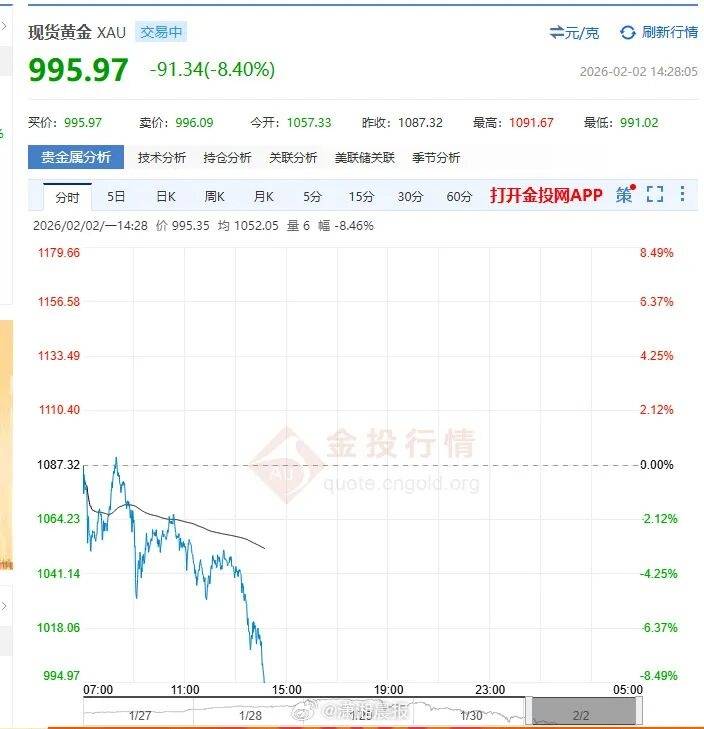
Core Viewpoint - The recent volatility in gold and silver prices has led to significant market uncertainty, prompting major banks in China to issue warnings and adjust their trading policies to mitigate risks [3][4][7]. Group 1: Market Performance - On February 2, gold and silver opened lower but rebounded, with spot gold reaching $4883.8 per ounce and silver increasing nearly 4% before experiencing a sharp decline [1]. - Spot gold fell below the $1000 mark, dropping to 995.97 yuan per gram, while spot silver also fell below $17 per gram, with a decline exceeding 10% [1]. Group 2: Bank Responses - Major state-owned banks, including Industrial and Agricultural Banks, have issued risk warnings and adjusted their trading policies due to the heightened volatility in precious metals [3][4][6][7]. - Industrial Bank advised clients to maintain a rational investment mindset and consider a long-term perspective, emphasizing the importance of risk assessment and diversified investment strategies [4]. - Agricultural Bank increased the margin requirement for gold trading contracts from 44% to 60% and implemented stricter risk assessments for clients engaging in gold accumulation products [6]. - China Bank highlighted the need for clients to manage their positions carefully and be aware of market risks associated with precious metals [7]. - Construction Bank raised the minimum investment amount for gold accumulation products to 1500 yuan, urging clients to enhance their risk awareness [8]. - Other banks, including Bank of Communications and Postal Savings Bank, also adjusted margin requirements and trading policies to address the increased market risks [9].
特朗普提名鹰派美联储主席触发贵金属跳水 A股三十余只有色股跌停
Sou Hu Cai Jing· 2026-02-02 04:24
Group 1 - The international gold and silver prices experienced a significant correction, erasing previous gains due to the hawkish monetary policy stance of Kevin Walsh, nominated by President Trump as the next Federal Reserve Chair [1] - The A-share market saw a broad decline in the non-ferrous sector, with over thirty stocks in the precious metals sector hitting the daily limit down, and multiple gold ETF stocks also facing similar declines [1] - Domestic trading institutions have increased risk control measures, raising margin ratios and price fluctuation limits for precious metal contracts to mitigate market volatility risks [1] Group 2 - The physical gold market showed a polarized trend, with increased buying and selling activity in Shenzhen's Shui Bei trading market following the price correction, as some investors sold holdings to lock in profits while others took the opportunity to buy physical gold [1] - Goldman Sachs' trading department indicated that the market adjustment is primarily a technical position clean-up, with no substantial changes in the core driving factors since the beginning of the year [2] - UBS raised its gold price targets for March, June, and September 2026 to $6,200 per ounce, while cautioning that a hawkish shift in Federal Reserve policy could suppress gold prices [2]