伦敦现货黄金

Search documents
金价银价,突然飙升
新华网财经· 2026-03-25 03:19
Group 1 - The Middle East tension shows signs of easing, leading to a reduction in market concerns over liquidity tightening, prompting some investors to buy on dips during the Asian trading session on the 25th [1] - As of 9:45 AM Beijing time on the 25th, the London spot gold price reached $4,595.66 per ounce, with an intraday increase of nearly 3% [1] - The New York Mercantile Exchange (NYMEX) gold futures contract for the main delivery rose to $4,578.40 per ounce, up 4.01% from the previous day's close [1] - The NYMEX silver futures contract for the main delivery increased to $74.110 per ounce, marking a rise of 6.53% from the previous day's close [1]

国际金银价格暴跌 金价全年涨幅归零
新华网财经· 2026-03-23 09:26
Group 1 - The core viewpoint of the article highlights a significant decline in gold prices, with both New York Mercantile Exchange gold futures and London spot gold prices falling below $4200 per ounce, erasing all gains made this year [2] - International gold prices have dropped sharply over the past two weeks, with a cumulative decline of over $1400 per ounce compared to the historical high on January 29 [3] - Analysts attribute the decline in gold prices to multiple factors, including heightened inflation concerns due to the ongoing conflict in the Middle East, reduced expectations for interest rate cuts, and tightening liquidity [3] Group 2 - The ongoing conflict in the Middle East is identified as a key variable affecting market sentiment, with the potential for worsening conditions if the conflict persists [4] - Disruptions in the Strait of Hormuz are reported to severely impact oil and gas export revenues for Middle Eastern countries, which may lead these nations to sell gold, further increasing downward pressure on gold prices [3]
黄金、白银价格大跌
新华网财经· 2026-03-21 01:04
Commodity Market - As of March 20, London spot gold decreased by 3.42%, closing at $4,491.670 per ounce, while COMEX gold futures fell by 2.47%, settling at $4,492.0 per ounce [1] - London spot silver dropped by 6.80%, ending at $67.897 per ounce, and COMEX silver futures declined by 4.78% [1] - LME copper fell by over 2%, while LME zinc saw a slight increase; LME aluminum and LME tin both decreased by over 1%, and LME nickel experienced a minor decline [1] Oil Market - As of March 20, ICE Brent crude oil rose by 0.61%, and NYMEX WTI crude oil increased by 2.66% [2]
方正中期贵金属月度策略-20260306
Fang Zheng Zhong Qi Qi Huo· 2026-03-06 03:03
Report Industry Investment Rating No relevant content provided. Core View of the Report - The short - term market is affected by the rebound of the US dollar index and the uncertainty of the Fed's interest - rate cut path, causing the prices of gold and silver to decline. However, the underlying logic of the long - term precious metals bull market remains intact. Central banks' gold purchases continue, the US inflation is sticky, the Fed is in an interest - rate cut cycle, and the real interest rate of US Treasury bonds may decline further. Silver is likely to have a supply - demand gap for the sixth consecutive year, and the price rebound elasticity is expected to be stronger than that of gold. [8][9] Summary by Directory 1. Precious Metal Market Data - The domestic precious metal market was volatile on March 5, 2026. The settlement price of Shanghai gold rose 0.37% to 1151.04 yuan/gram, and Shanghai silver rose 2.05% to 21658 yuan/kilogram. The London gold and silver markets also rebounded after hitting the bottom. As of 16:00, the spot gold price in London was 5161.84 US dollars/ounce, and the spot silver price was 83.653 US dollars/ounce. [13] - For gold, due to the rebound of the US dollar index and the uncertain prospect of the Fed's interest - rate cut, it is expected to decline in the short term, with a short - selling strategy. The support level is 1050 - 1100 yuan/gram, and the pressure level is 1250 - 1300 yuan/gram. For silver, with the same influencing factors, it is also expected to decline in the short term, with a short - selling strategy. The support level is 17000 - 18000 yuan/kilogram, and the pressure level is 23000 - 24000 yuan/kilogram. [14] 2. Precious Metal - Related Macroeconomic Data - On January 28, 2026 (EST), the Fed kept the federal funds rate target range unchanged at 3.5% - 3.75%, pausing after three consecutive interest - rate cuts since September 2025. Powell indicated that if "tariff inflation" peaks and falls, policy can be further relaxed, and raising interest rates is not the basic assumption for the next step. [3] - On February 11, 2026, the US Bureau of Labor Statistics reported that the non - farm payrolls in January increased by 130,000, much higher than expected, and the unemployment rate unexpectedly dropped to 4.3%. [3] - US consumers expect the annual price increase in the next year to be 4.2%, the same as last month. The long - term inflation expectation for the next 5 - 10 years rose to 3.4%, higher than the previous 3.2%. The consumer confidence index in January rose to 54, and the consumer expectation index reached a five - month high. [4] - In December 2025, the US PCE price index increased by 2.9% year - on - year and 0.4% month - on - month. The core PCE increased by 3% year - on - year and 0.4% month - on - month. The annualized quarter - on - quarter growth rate of real GDP in the fourth quarter of 2025 was 1.4%, lower than the estimate of 3%. The annual GDP growth in 2025 was 2.2%, lower than 2.8% in 2024. [4] - In December 2025, the US CPI increased by 2.7% year - on - year, and the core CPI increased by 2.6% year - on - year and 0.2% month - on - month. In January 2026, the US PPI increased by 2.9% year - on - year and 0.5% month - on - month. [5] - On February 20, 2026, US President Trump announced an additional 10% tariff on all imported goods for 150 days. On February 17, he announced a 10% tariff on goods from Denmark, Norway, Sweden, France, Germany, the UK, the Netherlands, and Finland, to be raised to 25% on June 1. He also said that a 25% tariff on countries trading with Iran would soon take effect. [5][7] - In 2025, China's gold consumption was 950.096 tons, a year - on - year decrease of 3.57%. Gold jewelry consumption was 363.836 tons, a year - on - year decrease of 31.61%. Gold bars and coins consumption was 504.238 tons, a year - on - year increase of 35.14%. Industrial and other gold consumption was 82.022 tons, a year - on - year increase of 2.32%. The annual increase in domestic gold ETFs in 2025 was 133.118 tons, a 149.91% increase from 2024. By the end of December, the domestic gold ETF position was 247.852 tons. [6] - In January 2026, China's central bank's gold reserves were reported at 74.19 million ounces, a month - on - month increase of 40,000 ounces. This was the 15th consecutive month of gold purchase since November 2024, but the increase in January was at a low level for the 11th consecutive month. The Polish central bank approved a plan to purchase 150 tons of gold, and its gold reserves will increase to 700 tons. [6] 3. Supply and Demand Analysis of Precious Metals (Gold and Silver) No specific analysis content is provided in the text, only mentions related charts. 4. Precious Metal Options Data Analysis - In the long term, central banks' gold purchases will continue, investment demand remains strong, the US debt level is rising, the US dollar's credit is damaged, and the US dollar index is expected to enter a long - term downward channel. The monetary attributes of gold and silver are gradually returning. [39] - In the short term, concerns about US tariff increases have resurfaced, the precious metals market has ended consolidation and broken upward. The risk of stagflation in the US economy has increased, and the Fed is still in an interest - rate cut cycle. The real interest rate of US Treasury bonds may decline further. Geopolitical conflicts may intensify. [39] - For option single - leg strategies, in the long term, one can try to buy a small amount of far - month deep - out - of - the - money gold and silver call options. In the next stage, the implied volatility of precious metal options is expected to gradually rise, and one can try to construct a long - straddle strategy to bet on the increase in volatility. [39]
光大期货:美伊第三轮谈判结束 黄金波动加剧
Jin Rong Jie· 2026-02-27 02:49
Core Viewpoint - The gold market is experiencing fluctuations with a slight downward trend in futures, while geopolitical tensions remain a significant focus for investors [1] Group 1: Market Performance - London spot gold shows a strong oscillation, while COMEX gold futures fell by 0.47% and SHFE gold dropped by 0.25% [1] - Silver experienced greater volatility, with New York silver dropping by 4% during trading before rebounding [1] Group 2: Geopolitical Context - The third round of negotiations between the US and Iran concluded with differing statements from both sides, contributing to market uncertainty [1] - During the negotiation period, market participants were betting on a de-escalation of geopolitical tensions, leading to a temporary decline in prices [1] - Technical discussions between both parties' teams are scheduled for next Monday, indicating ongoing diplomatic efforts [1]
光大期货:2月27日金融日报
Xin Lang Cai Jing· 2026-02-27 01:40
Market Overview - The A-share market experienced mixed fluctuations, with Wind All A index rising by 0.21% and a trading volume of 2.56 billion [9] - The geopolitical risks remain a concern, particularly with the ongoing U.S. military buildup in the Middle East and the potential for renewed U.S.-Iran conflict [9] - The market has largely priced in expectations regarding the U.S.-Iran conflict, suggesting limited impact on equity markets from localized conflicts [9] Economic Indicators - The U.S. Supreme Court ruled that Trump's tariffs under IEEPA were illegal, requiring cessation and refunds, but this does not affect his ability to impose tariffs through other domestic laws [9] - Trump announced a global tariff increase from 10% to 15%, which may have a short-term impact on global equity markets, though the overall effect is expected to be limited [9] Sector Performance - The technology sector is anticipated to remain a strong investment theme in the first half of the year, with consumer and cyclical sectors likely to stabilize after inflation data shows improvement [9] - Historical trends indicate that style shifts often occur around the Chinese New Year, which is a point of interest for market participants [9] Bond Market - The bond futures market saw declines across various maturities, with the 30-year contract down by 0.53% and the 10-year contract down by 0.10% [10] - The People's Bank of China conducted a 7-day reverse repurchase operation of 320.5 billion yuan at a rate of 1.4%, maintaining the same rate as the previous operation [10] - The bond market is currently driven by a loose liquidity environment and a weak economic recovery, with long-term bonds showing greater yield declines compared to shorter maturities [10][11] Precious Metals - Gold prices showed a strong upward trend, while silver and platinum experienced weaker fluctuations, with the gold-silver ratio around 58 [11] - Geopolitical tensions, particularly regarding U.S.-Iran negotiations, are influencing gold market dynamics, with expectations of high volatility around the $5000 per ounce mark [11] - Zimbabwe's ban on raw and refined mineral exports has impacted platinum and palladium markets, although the actual effect is expected to be limited due to previous export adjustments [11]

地缘局势与商品周期共振国际油价中期有望延续强势
Zhong Guo Zheng Quan Bao· 2026-02-25 20:22
Core Viewpoint - International crude oil prices have continued their strong performance since the Spring Festival, with Brent crude futures experiencing the highest increase in 13 years during this period, driven primarily by geopolitical tensions rather than supply-demand fundamentals [1][2]. Geopolitical Influence - The current rise in international oil prices has diverged from the oversupply fundamentals, with geopolitical factors, particularly the U.S.-Iran situation, becoming the main influence [2][3]. - Analysts suggest that the geopolitical risk premium in the oil market is currently around $1, which could rise to $4-$5 if tensions escalate, while a de-escalation could lead to a rapid price drop [2]. Historical Trends Post-Spring Festival - Historical data from 2013 to 2025 indicates that oil prices tend to have a higher potential for increase in the month following the Spring Festival, with an average increase of approximately 10.96% during the years when prices rose [2][3]. - Despite more years of price declines, the magnitude of increases in rising years significantly outweighs the declines, suggesting a favorable risk-reward ratio for price increases post-holiday [2]. Factors Affecting Oil Prices - Key supportive factors for oil prices include geopolitical uncertainties and U.S. sanctions on oil-producing countries, while global economic weakness and ongoing oversupply remain as negative factors [3]. - Historical events have shown that significant geopolitical events have a greater impact on oil prices than conventional supply-demand dynamics [3]. Commodity Cycle and Oil Price Outlook - The current global commodity cycle, characterized by rising prices in precious and industrial metals, is expected to provide upward momentum for oil prices [4][5]. - The analysis indicates that the transmission of price increases from precious metals to industrial metals and then to oil is effective, driven by liquidity improvements and economic recovery [4][5]. - Despite the unique characteristics of the current cycle, two main supportive factors for oil prices are identified: bullish market expectations and geopolitical risk premiums [5]. Short-term and Long-term Predictions - In the short term, geopolitical factors are expected to strongly influence oil prices, with potential fluctuations based on developments in U.S.-Iran relations [5]. - In the long term, historical trends suggest that oil prices may rise to the range of $75 to $80 per barrel by 2026, supported by bullish market sentiment and geopolitical risk premiums [5].
光大期货0225黄金点评:聚焦美国情咨文,短线黄金或延续高位震荡
Xin Lang Cai Jing· 2026-02-25 03:56
Core Viewpoint - The article discusses the recent fluctuations in gold prices, influenced by geopolitical events and U.S. tariff policies, suggesting a strategy for investors to adopt a long-term holding approach to gold as part of their asset allocation [2][5]. Market Overview - London spot gold showed weak fluctuations, with COMEX gold futures down 1.25% at $5160.50 per ounce, and SHFE gold down 0.30% [2][5]. - The U.S. dollar index rebounded, nearing a four-week high, while tech stocks strengthened, boosting U.S. equities, leading to declines in gold and oil prices [2][5]. U.S. Tariff Policy - A 10% global tariff policy by the U.S. government took effect, implemented through the 1974 Trade Act, bypassing Congress for a period of 150 days, with uncertainty about a potential increase to 15% [2][5]. - The imposition of tariffs has heightened global economic uncertainty, particularly following a Supreme Court ruling that deemed the previous administration's tariff actions illegal, impacting its credibility ahead of midterm elections [2][5]. Geopolitical Factors - Geopolitical events have become a focal point for market attention, particularly during the holiday period, which previously drove gold prices upward [2][5]. - The article emphasizes the importance of monitoring developments in U.S.-Iran tensions and the anticipation of future interest rate cuts as catalysts for gold price movements [2][5]. Investment Strategy - It is suggested that investors adopt a "phased layout, long-term holding" strategy for gold, positioning it as a significant component of their investment portfolio [2][5].
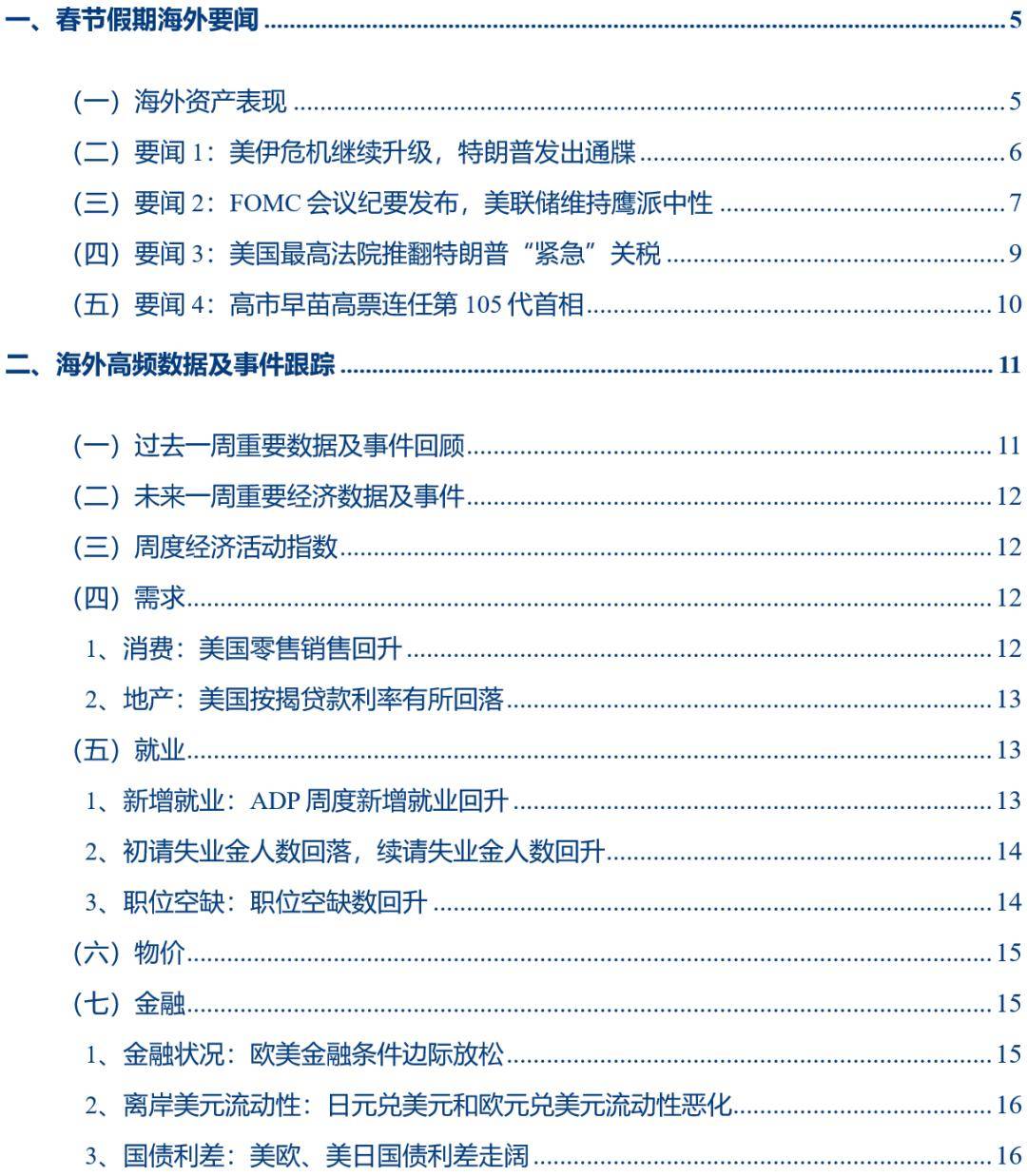
春节假期海外四大要闻:美伊危机继续升级,特朗普发出通牒;FOMC会议纪要发布,美联储维持中性偏鹰;美国最高法院推翻特朗普“紧急”关税;高市早苗高票连任第105代首相
Sou Hu Cai Jing· 2026-02-23 03:20
Group 1: Market Performance During Spring Festival - Global major stock indices mostly rose, with South Korea, France, and the UK leading in gains. From February 16 to 20, the Korean Composite Index rose by 5.5%, CAC40 by 2.5%, FTSE 100 by 2.3%, and others showed similar increases, while the Hang Seng Index and Nikkei 225 fell by 0.6% and 0.2% respectively [2][10] - Global major 10-year government bond yields mostly declined, except for US Treasury yields which rose by 4.0 basis points. The yields for 10-year Japanese, French, British, and Italian bonds fell by 6.1, 3.8, 2.7, and 2.3 basis points respectively [2][10] - Most global commodities saw price increases, with Brent crude oil rising by 5.9%, WTI crude by 5.7%, and London spot silver by 4.1% during the same period [2][10] - Among major currencies, the Japanese yen and British pound experienced significant declines, falling by 1.5% and 1.3% respectively, while the US dollar index rose by 0.9% [2][10] Group 2: Geopolitical Events Impacting Markets - The US-Iran crisis escalated with indirect negotiations taking place in Geneva, while the US increased military presence in the region. If negotiations fail or military action occurs, the market is pricing in potential disruptions in the Strait of Hormuz, leading to a rise in WTI crude oil prices from approximately $62.33 to $66.39, marking a 6.5% increase [3][20][22] - The FOMC meeting minutes indicated a neutral but hawkish stance, with most members agreeing that current rates are appropriate. The market expects a potential rate cut of about 60 basis points this year, reflecting a slight easing compared to previous expectations [4][27][30] Group 3: Legal and Trade Developments - The US Supreme Court ruled against Trump's large-scale tariffs, stating that the International Emergency Economic Powers Act did not authorize such actions. This ruling could lead to a decrease in supply chain costs and improve corporate profit expectations [5][33][35] - Following the Supreme Court's decision, Trump announced a new 10% tariff on global imports for 150 days, which he later increased to 15%. This move may provoke retaliatory actions from major trading partners [5][35] Group 4: Political Developments in Japan - Fumio Kishida was re-elected as Japan's Prime Minister, emphasizing a fiscal policy focused on significant tax cuts and public investment in infrastructure, semiconductors, AI, and green energy. This policy is expected to boost Japan's GDP growth forecast for 2026 [7][39]
春节假期海外四大要闻——海外周报第128期
一瑜中的· 2026-02-23 02:49
Core Viewpoint - During the Spring Festival holiday, overseas markets were dominated by risk-averse trading due to Middle East geopolitical risks and uncertainties surrounding FOMC monetary policy. Major asset prices showed varied performances, with most global stock indices rising, while major currencies like the yen and pound experienced significant declines [2][4]. Group 1: Overseas Asset Performance - Global stock indices mostly rose, with the Korean Composite Index, French CAC40, and FTSE 100 leading the gains, increasing by 5.5%, 2.5%, and 2.3% respectively from February 16 to 20. The Hang Seng Index and Nikkei 225 fell by 0.6% and 0.2% respectively [4][14]. - Global 10-year government bond yields mostly declined, with Japanese, French, British, and Italian bonds decreasing by 6.1bps, 3.8bps, 2.7bps, and 2.3bps respectively, while the 10-year US Treasury yield rose by 4.0bps [4][14]. - Most major commodities saw price increases, with Brent crude oil and WTI crude oil rising by 5.9% and 5.7% respectively during the same period [4][14]. - Among major currencies, the yen and pound experienced significant declines, falling by 1.5% and 1.3% respectively, while the US dollar index rose by 0.9% [4][14]. Group 2: Key News Events - The US-Iran crisis escalated, with indirect negotiations taking place in Geneva. The US is increasing military presence in the region, leading to a rise in oil prices, with WTI crude increasing from approximately $62.33 to $66.39, marking a 6.5% increase [5][25]. - The FOMC meeting minutes indicated a neutral but hawkish stance, with most members agreeing that current rates are appropriate. The market expects a potential rate cut of about 60 basis points later this year, reflecting a slight easing compared to previous expectations [6][30]. - The US Supreme Court ruled against Trump's large-scale tariffs, stating that the International Emergency Economic Powers Act did not authorize such actions. This decision led to a decrease in supply chain costs and a rise in the Nasdaq index by 0.90% [7][36]. - Japanese Prime Minister Kishi Sanae was re-elected, promoting a fiscal policy focused on significant tax cuts and public investment, which is expected to boost Japan's GDP growth forecast for 2026 [9][39].