
紫光国微

Search documents
你的下一部手机,或不再有卡槽!京东iPhone Air成交额1秒破亿!苹果“引爆”eSIM手机商用,国产芯片供应进程到哪了?
Mei Ri Jing Ji Xin Wen· 2025-10-21 07:11
Core Insights - The three major telecom operators in China, China Mobile, China Unicom, and China Telecom, have been approved to conduct commercial trials of eSIM technology nationwide, allowing users to register without a physical SIM card [1][2][3] - The iPhone Air, set to launch on October 22, is the first smartphone in China to support only eSIM, achieving over 100 million yuan in sales within one second during pre-sales [1][2] - Domestic manufacturers like Huawei and OPPO are expected to release eSIM-enabled smartphones soon, indicating a significant shift towards eSIM technology in the market [1][3] Industry Developments - The eSIM technology in China has evolved through various stages, including exploration, trials, and pauses, with significant contributions from China Unicom since 2015 and China Mobile's introduction of the smallest eSIM module in 2017 [3][5] - The eSIM market faced a setback in 2023 when the three major operators paused the one-number dual-terminal service and independent eSIM card applications, leading to stagnation in the eSIM market [3][5] - Unisoc is the first domestic company to achieve global commercial use of eSIM chips, with products compliant with GSMA standards [3][5] Supply Chain and Collaboration - The supply of domestic eSIM chips is currently dependent on establishing new business models and protocols for integration into smartphones, with uncertainty regarding the final partners involved [5][6] - Companies like Unisoc and Changdian Technology are actively developing technologies and expanding their market presence in the eSIM sector, indicating a positive outlook for future opportunities [4][5] - The telecom operators are pursuing different strategies for eSIM technology, with China Mobile focusing on domestic chip and OS development, while China Unicom emphasizes innovation and collaboration within the industry [5][6] Future Prospects - Apple plans to introduce an eSIM Quick Transfer feature in the Chinese market, highlighting the growing importance of eSIM technology in the telecommunications landscape [7] - The readiness of domestic chip manufacturers to meet market demand will be crucial for the success of the eSIM transition in China [7]


2026-2032年中国集成电路(IC)市场前景研究与市场分析预测报告
Sou Hu Cai Jing· 2025-10-21 06:35
Core Insights - The report titled "2026-2032 China Integrated Circuit (IC) Market Outlook Research and Market Analysis Forecast" provides a comprehensive analysis of the IC industry in China, including market trends, regulatory environment, and competitive landscape [2][3][4]. Chapter Summaries Chapter 1: Overview of the Integrated Circuit (IC) Industry - Defines the electronic device manufacturing industry and its classifications [2]. - Provides definitions and classifications of integrated circuits (IC), including technical complexity and application breadth [2][3]. - Explains the terminology used in the IC industry and the classification within the national economic industry codes [2]. Chapter 2: Macro Environment Analysis of China's IC Industry (PEST) - Analyzes the policy environment, including regulatory frameworks and standard systems in the IC industry [2][3]. - Discusses the economic environment, including GDP growth and structural changes in China's economy [2][3]. - Examines the social environment, focusing on urbanization, disposable income, and consumer spending patterns [2][3]. - Reviews the technological environment, including key processes, research investments, and innovation outcomes in the IC sector [2][3]. Chapter 3: Global IC Industry Development and Market Trends - Provides an overview of the global IC industry, including historical development and macroeconomic background [4]. - Analyzes global market size, shipment volumes, and competitive landscape [4]. - Discusses regional market dynamics, focusing on key players in the US and South Korea [4]. Chapter 4: Supply and Demand Conditions in China's IC Industry - Reviews the development history and trade status of China's IC industry, including import and export dynamics [5][6]. - Analyzes market supply conditions, including production capacity and output levels [5][6]. - Discusses market demand characteristics and sales performance of IC enterprises [5][6]. Chapter 5: Competitive Landscape and M&A Analysis in China's IC Industry - Examines the competitive layout and market concentration in the IC industry [6][7]. - Analyzes the investment and merger trends within the industry, highlighting significant transactions [6][7]. Chapter 6: Structure and Layout of the IC Industry Chain - Analyzes the structure and value chain of the IC industry, including upstream supply markets [7][8]. - Discusses the market analysis of IC chip design, manufacturing, and packaging/testing [7][8]. Chapter 7: Case Studies of Key Enterprises in China's IC Industry - Provides detailed case studies of major IC companies in China, including their business structures and market strategies [9][10]. Chapter 8: Market and Investment Strategy Recommendations - Conducts a SWOT analysis of the IC industry and evaluates its development potential [11][12]. - Offers strategic recommendations for investment opportunities and sustainable development in the IC sector [11][12].

iPhone 17卖爆+Air明日开抢!港A果链概念股应声大涨
Ge Long Hui· 2025-10-21 03:56
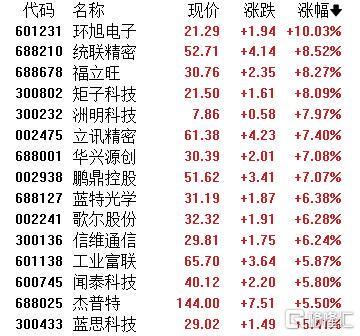
Core Viewpoint - The strong performance of Apple's stock and its supply chain is driven by the impressive sales of the newly launched iPhone 17 series, which has seen a significant increase in demand compared to its predecessor [1][4]. Group 1: Stock Performance - Apple's stock price rose nearly 4%, reaching a new historical high, which positively impacted the Apple-related stocks in both Hong Kong and A-share markets on October 21 [1]. - In the A-share market, companies like Huanxu Electronics and Tonglian Precision saw their stock prices hit the daily limit, with increases exceeding 8% for several other firms [1][2]. - In the Hong Kong market, stocks such as Gaowei Electronics and Lens Technology also experienced strong gains, with increases over 7% [1][3]. Group 2: iPhone 17 Sales Performance - The iPhone 17 series recorded a 14% higher sales volume in the first ten days post-launch in the U.S. and China compared to the iPhone 16 series [4]. - The base model of the iPhone 17 achieved nearly double the sales of its predecessor in the Chinese market, indicating strong consumer acceptance [4]. Group 3: eSIM Technology and Market Trends - The upcoming release of the iPhone Air, Apple's first model without a physical SIM card slot, is expected to further drive interest in eSIM technology, with initial sales showing strong demand [5][6]. - The global eSIM smartphone connections are projected to reach 1 billion by the end of 2025 and 6.9 billion by 2030, representing 76% of total smartphone connections, indicating a significant growth opportunity for the industry [6][7]. Group 4: Financial Performance of Supply Chain Companies - Companies in the Apple supply chain have demonstrated strong profitability, with Industrial Fulian reporting a net profit of approximately 12.11 billion yuan, a year-on-year increase of 38.61% [7]. - Other companies like GoerTek and Lens Technology also reported significant profit growth, with net profits increasing by 15.65% and 32.68% respectively [7]. - Luxshare Precision anticipates a net profit of 10.89 billion to 11.34 billion yuan for the first three quarters, reflecting a year-on-year growth of 20% to 25% [8]. Group 5: Market Outlook and Investment Recommendations - Analysts are optimistic about the continued opportunities within the Apple supply chain, with expectations of higher-than-expected sales for the iPhone 17 series driven by its performance and features [8]. - Investment firms suggest focusing on undervalued companies within the Apple supply chain, as the new iPhone models are expected to exceed sales expectations [8].
双融日报-20251021
Huaxin Securities· 2025-10-21 01:32
Core Insights - The report indicates a "relatively hot" market sentiment with a composite score of 65, suggesting a positive outlook for the market [6][10] - Key investment themes identified include energy storage, eSIM technology, and nuclear fusion, with specific companies highlighted for potential investment opportunities [6] Energy Storage - The "New Energy Storage Special Action Plan" in China aims for an installed capacity of 180 million kilowatts by 2027, attracting direct investments of 250 billion yuan. Policies are expected to enhance project IRR to over 8% [6] - Overseas orders for energy storage are projected to surge by 220% year-on-year in the first half of 2025, reaching 160 GWh, indicating a shift in supply-demand dynamics [6] - Related companies include CATL (300750) and Sungrow Power (300274) [6] eSIM Technology - China Unicom launched its eSIM service on October 13, with over 60,000 reservations, indicating strong market interest [6] - The reactivation of eSIM services by major telecom operators is expected to accelerate commercial adoption [6] - Related companies include Eastcompeace (002017) and Unisoc (002049) [6] Nuclear Fusion - The CRAFT project in China achieved significant breakthroughs, with a prototype component passing expert testing, demonstrating a steady thermal load capacity of 20 MW/m² [6] - This development marks a milestone in the design of the largest and highest thermal load filter prototype globally [6] - Related companies include Chuangjiang New Materials (002171) and Hongxun Technology (603015) [6] Market Trends - The report highlights a trend of increasing market activity, with a focus on sectors such as telecommunications, light manufacturing, and household appliances, which have seen significant net inflows [16] - Conversely, sectors like electronics and automobiles are experiencing notable net outflows, indicating a shift in investor sentiment [21]

国内首款eSIM手机即将发售!多家公司早有布局相关业务
Zheng Quan Shi Bao· 2025-10-21 00:48
Core Insights - Apple CEO Tim Cook announced the official launch of the iPhone Air in China on October 22, which is the first smartphone in the country to utilize eSIM technology, eliminating the physical SIM card slot [1] - Major Chinese telecom operators, including China Unicom, China Mobile, and China Telecom, have received approval to commence eSIM services, marking a significant shift towards a "cardless era" in mobile technology [1][2] - The global eSIM market is projected to grow significantly, with an estimated 1 billion eSIM-enabled smartphones by the end of 2025 and 6.9 billion by 2030, representing 76% of total smartphone connections [2] Industry Developments - The eSIM technology integrates SIM card functions into the phone's internal chip, allowing for a more compact design and improved features such as water and dust resistance [2] - Domestic brands are quickly adapting to the eSIM trend, with OPPO announcing an eSIM version of its Find X9 series set to launch in November [1] - The eSIM industry involves a complex ecosystem, including chip design, platform management, operator services, device integration, and end-user applications, with expectations for collaborative growth and maturity [3] Company Activities - Several companies have been actively involved in the eSIM space, including Unisoc, which has launched multiple eSIM products compliant with GSMA standards [4] - Eastcompeace has developed an embedded operating system and eSIM management platform that has received GSMA security certification [5] - Megmeet has established a mature eSIM solution with large-scale production capabilities across 4G and 5G platforms [5] Market Performance - eSIM concept stocks have seen an average increase of 42.42% this year, significantly outperforming the Shanghai Composite Index [7] - Six stocks have recorded gains exceeding 50%, including Hengbao Co., Eastcompeace, and Chutianlong [7] - Despite the overall positive trend, some stocks have experienced significant pullbacks, with several dropping over 30% from their year-to-date highs [7]
四大证券报精华摘要:10月21日
Xin Hua Cai Jing· 2025-10-21 00:18
Group 1: A-Share Market Performance - As of October 20, 2025, 125 A-share companies have disclosed their Q3 reports, with 93 companies achieving a year-on-year increase in net profit attributable to shareholders, representing 74.4% [1] - Among 140 companies that released Q3 performance forecasts, 117 are optimistic, resulting in a forecast positivity rate of approximately 83.57% [1] - Technology sectors such as semiconductors, artificial intelligence, consumer electronics, and communications are showing continuous improvement in performance [1] Group 2: Robotics Industry Developments - Recent announcements from humanoid robot companies indicate significant orders in the manufacturing sector, with Zhiyuan Robotics securing a multi-billion yuan order from Longqi Technology [2] - Zhiyuan and Shenzhen Huizhi Wulian plan to deploy over 1,000 humanoid robots in production bases over the next three years [2] - The integration of robots into factories is expected to enhance efficiency and provide real-world data for technological advancements [2] Group 3: Wind Power Industry Outlook - The "Beijing Wind Energy Declaration 2.0" sets a target of an average annual new installed capacity of no less than 120 million kilowatts for the wind power industry over the next five years [3] - The industry is experiencing a surge in activity due to both domestic and international market drivers, coinciding with the peak construction season in Q3 [3] - The wind power sector is positioned for high-quality growth, supported by market reforms aimed at enhancing the sector's competitiveness [3] Group 4: Securities App User Growth - The number of monthly active users for securities service apps reached 175 million in September, marking a year-on-year increase of 9.73% and setting a new record for the year [4] Group 5: Investment Opportunities in A-Shares - Foreign institutions view the recent market fluctuations as creating long-term investment opportunities driven by "performance realization" and "technological innovation" [5] - The combination of strong industrial policy support, continued foreign capital inflow, and breakthroughs in key technology sectors is seen as the core logic for the long-term upward trend in the A-share market [5] Group 6: CATL's Q3 Financial Performance - CATL reported Q3 revenue of 104.186 billion yuan, a year-on-year increase of 12.90%, and a net profit of 18.549 billion yuan, up 41.21% [6] - For the first three quarters, the company achieved total revenue of 283.072 billion yuan, a 9.28% increase, and a net profit of 49.034 billion yuan, growing by 36.20% [6] - CATL's cash and financial assets exceeded 360 billion yuan, supporting its extensive R&D and global capacity expansion [6] Group 7: Cement Industry Developments - A meeting focused on stabilizing growth in the cement industry emphasized optimizing capacity structure to address supply-demand imbalances [8] - Major cement companies are increasing off-peak production halts due to declining demand, with overall capacity utilization remaining around 50% [8] Group 8: AI Toy Market Growth - The AI toy market is rapidly transforming the industry, catering to diverse consumer needs across age groups and creating a "golden age" for development [11] - AI toys are predicted to grow from a market size of $18.1 billion in 2024 to $60 billion by 2033, with a compound annual growth rate of approximately 14% [11] Group 9: Fund Issuance Trends - On October 20, 26 funds were launched simultaneously by 23 public fund institutions, with passive index funds being the most prevalent [12] - The concentration of passive index fund issuance reflects public fund institutions' strategic outlook on industry development [12] Group 10: iPhone Air Launch and eSIM Market - The iPhone Air, set to launch on October 22, is the first domestic smartphone to eliminate the physical SIM card slot, utilizing eSIM technology [10] - Several companies, including Unisoc and Eastcompeace, have been preparing for eSIM business for years, indicating a growing market for eSIM solutions [10] Group 11: iFlytek's Q3 Financial Results - iFlytek reported Q3 revenue of 6.078 billion yuan, a year-on-year increase of 10.02%, and a net profit of 172 million yuan, up 202.40% [13] - The company has made significant advancements in AI technology, focusing on self-controlled core technology strategies [13]
7天6板,600403,最新人气王!国内首款eSIM手机将发售,多家A股公司已抢先布局
Zheng Quan Shi Bao· 2025-10-20 17:56
Group 1: eSIM Technology and Market Development - eSIM technology is entering a new commercial phase in China, with major telecom operators like China Mobile, China Unicom, and China Telecom officially launching eSIM services for mobile phones [3][4] - The first eSIM phone in China, the iPhone Air, will be released on October 22, marking a significant milestone in the transition to a "no card" era for mobile devices [3][4] - Domestic brands such as OPPO and vivo are quickly following suit, with OPPO launching its eSIM-compatible phone in November and other brands expected to introduce similar products soon [3][4] Group 2: Industry Impact and Future Projections - eSIM is expected to become a mainstream communication solution, with predictions indicating that by the end of 2025, global eSIM smartphone connections will reach 1 billion, and by 2030, this number will grow to 6.9 billion, accounting for 76% of total smartphone connections [4] - The technology is seen as a key infrastructure for transforming the communication industry, enhancing user experience, and contributing to the development of the digital economy in China [4] Group 3: A-Share Market Performance and Company Involvement - Several A-share companies, including Unisoc, Eastcompeace, and Megmeet, have made significant advancements in eSIM technology, with products already in mass production and compliance with international standards [6] - The average increase in eSIM concept stocks has been 42.42% this year, significantly outperforming the Shanghai Composite Index, with six stocks rising over 50% [6][7] - Despite some stocks experiencing significant pullbacks, 14 eSIM concept stocks have received positive ratings from brokerage firms, indicating strong institutional interest [7]

国内首款eSIM手机即将发售 多家公司早有布局相关业务
Zheng Quan Shi Bao· 2025-10-20 17:10
Core Insights - Apple CEO Tim Cook announced the launch of the iPhone Air in China on October 22, which is the first smartphone in the country to use eSIM technology, eliminating the physical SIM card slot [1] - The launch follows the approval of eSIM services by major Chinese telecom operators, marking the official entry of eSIM technology into the mobile phone market in China [1][2] - The global eSIM market is projected to grow significantly, with an estimated 1 billion eSIM smartphone connections by the end of 2025 and 6.9 billion by 2030, representing 76% of total smartphone connections [2] Industry Developments - The eSIM ecosystem involves a complex supply chain including chip design, platform management, operator services, device integration, and end-user applications, with expectations for collaborative development and maturation of the industry [3] - Several companies in the A-share market have been actively developing eSIM capabilities, including Unisoc, which has launched multiple eSIM products compliant with GSMA standards [4] - Eastcompeace has successfully developed an embedded operating system and eSIM IoT management platform that received GSMA security certification [5] - Megmeet has established mature eSIM solutions with large-scale production on 4G/5G chip platforms [6] - Chutianlong's eSIM products have been approved by China Unicom, and Wanma Technology has been a long-term provider of eSIM solutions across various standards [7] Market Performance - eSIM concept stocks have seen an average increase of 42.42% year-to-date, significantly outperforming the Shanghai Composite Index, with six stocks rising over 50% [8] - Some eSIM concept stocks have experienced significant pullbacks from their year-to-date highs, with declines exceeding 30% for several companies [9] - A total of 14 eSIM concept stocks have received "positive" ratings from brokerage firms, with eight stocks rated by more than ten institutions, including ZTE, Guanghetong, China Telecom, China Mobile, and Megmeet [9]



苹果“引爆”eSIM手机商用,国产芯片供应企业:合作模式还待清晰|eSIM重返系列观察②
Mei Ri Jing Ji Xin Wen· 2025-10-20 15:08
Core Viewpoint - The approval of eSIM commercial trials by China's three major telecom operators marks a significant step towards the widespread adoption of eSIM technology in smartphones, with the iPhone Air leading the charge in the domestic market [1][2]. Group 1: eSIM Commercialization - China Mobile, China Unicom, and China Telecom have received approval to conduct eSIM commercial trials across all 31 provinces in China, allowing users to register for networks without a physical SIM card [1]. - The iPhone Air, set to launch on October 22, is the first smartphone in China to support only eSIM, achieving over 100 million yuan in sales within one second during pre-sales [1]. - Domestic manufacturers like Huawei and OPPO are expected to follow suit by launching their own eSIM-enabled smartphones [1]. Group 2: Supply Chain and Technology - The supply of domestic eSIM chips is still in the early stages, with companies like Unisoc and Tongfu Microelectronics being key players in the supply chain [1][3]. - Unisoc has developed eSIM chip technology that is compatible with over 400 global operators, but the final selection of domestic operators and partners remains unclear [1][6]. - The eSIM chip supply process is hindered by the need for clear operational protocols and collaboration models between telecom operators and smartphone manufacturers [6]. Group 3: Industry Development and Future Prospects - The eSIM market in China has experienced various phases, including exploration, trial, suspension, and re-initiation, with significant advancements made since 2015 [2][3]. - Companies like Huada Semiconductor and Changdian Technology are actively developing new technologies and expanding their market presence in the eSIM sector [4][5]. - The future of the eSIM market is contingent on the successful establishment of a collaborative ecosystem among industry players, as emphasized by the three major telecom operators [7].


苹果“引爆”eSIM手机商用,国产芯片供应企业:合作模式还待清晰
Mei Ri Jing Ji Xin Wen· 2025-10-20 14:24
Core Insights - The three major telecom operators in China, China Mobile, China Unicom, and China Telecom, have been approved to conduct commercial trials of eSIM technology nationwide, allowing users to register without a physical SIM card [1][2] - The launch of the iPhone Air, which exclusively supports eSIM, has generated significant market interest, with pre-sales reaching over 100 million yuan in just one second [1][3] - Domestic eSIM chip suppliers are currently in a preparatory phase, with companies like Unisoc and Tongfu Microelectronics indicating readiness but awaiting clarity on commercial partnerships and operational models [1][5] Telecom Operators' Initiatives - China Unicom has been a pioneer in eSIM technology since 2015, adapting 75 terminal types and serving millions of users in various applications [6] - China Mobile is focusing on domestic eSIM chip and operating system localization, aiming to develop more secure and functional eSIM terminals [5][6] - China Telecom is collaborating with industry partners to build an open and cooperative eSIM ecosystem, promoting innovation in terminal forms and service models [6] Chip Suppliers and Market Readiness - Unisoc has developed eSIM chip technology compatible with over 400 global operators, but the final selection of domestic partners remains uncertain [1][5] - Companies like Jiangsu Changjiang Electronics Technology and New Henghui are actively exploring eSIM market opportunities and enhancing their technological capabilities [4][5] - The eSIM market in China is still in its infancy, with previous policy support leading to a series of exploratory phases, but recent developments indicate a potential resurgence [2][3]