
光大证券

Search documents
上交所,新动作!交易所市场首个债券受托管理指南发布
Zheng Quan Shi Bao· 2025-12-24 11:52
Core Viewpoint - The Shanghai Stock Exchange has released the first specialized guideline for bond trustee management, aiming to enhance proactive credit management by trustees throughout the bond product lifecycle, emphasizing the importance of credit as the lifeline of corporate bonds [1][3]. Group 1: Guideline Overview - The guideline outlines a roadmap for proactive credit management, detailing processes from monitoring to implementation and incentives, and provides tools and case studies for trustees [3]. - It encourages trustees to utilize market-based tools such as bond buybacks and communication with credit enhancement entities to improve issuer credit [3][4]. Group 2: Industry Impact - Since 2025, the corporate bond market has been active, with issuance reaching nearly 4.5 trillion yuan, a 20% year-on-year increase, indicating robust growth in innovative bond types [6]. - The total outstanding bonds in the Shanghai Stock Exchange market reached approximately 14 trillion yuan by the end of November 2025, making it one of the largest exchange bond markets globally [6]. Group 3: Role of Trustees - Trustees are transitioning from compliance supervisors to value discoverers, leveraging their unique advantages in identifying credit risks and opportunities [5][8]. - The guideline supports trustees in tailoring proactive credit management strategies based on the credit characteristics of different issuers [8]. Group 4: Organizational Mechanisms - The guideline encourages brokerages to develop internal business mechanisms that suit their organizational structures, with some teams located in investment banking and others in quality control [10]. - Effective incentives for proactive credit management are crucial for the transformation of traditional trustee models, with some firms considering performance-based rewards [10]. Group 5: Future Directions - The Shanghai Stock Exchange plans to further enhance the quality and efficiency of trustee management services, promoting a win-win situation for all market participants through market-oriented approaches [11].
事关14万亿元存量市场!上交所最新发布
Shang Hai Zheng Quan Bao· 2025-12-24 11:36
Core Viewpoint - The Shanghai Stock Exchange (SSE) has released the "Guidelines for the Management of Corporate Bonds" to enhance proactive credit management by trustees, emphasizing the importance of credit throughout the bond lifecycle [1][3]. Group 1: Guidelines and Proactive Management - The guidelines introduce a roadmap for proactive credit management, detailing processes from monitoring to implementation and incentives, providing tools and case studies for trustees [3]. - Trustees can utilize market tools such as bond buybacks and engage with credit enhancement entities to improve issuers' credit status, thereby preemptively addressing risks [3][4]. - The SSE has initiated pilot programs for proactive credit management, with several brokerage firms successfully implementing these practices, resulting in improved issuer credit and reduced financing costs [3][4]. Group 2: Market Activity and Growth - The SSE's corporate bond market has seen significant activity, with nearly 4.5 trillion yuan issued since 2025, marking a 20% year-on-year increase [5]. - The market has introduced innovative bond types, including high-growth industry bonds and support bonds for small and micro enterprises, with issuance growth rates exceeding 800% for the latter [5]. - As of November 2025, the outstanding scale of corporate bonds on the SSE reached nearly 14 trillion yuan, establishing it as one of the largest exchange bond markets globally [5]. Group 3: Role of Trustees - Trustees play a crucial role in monitoring credit changes, ensuring information disclosure, and verifying the use of raised funds, acting as a vital link between issuers and bondholders [6]. - Historically, there has been a tendency to prioritize underwriting over trustee responsibilities, but the new guidelines encourage trustees to take a more active role in credit management [6][7]. - The SSE aims to support trustees in transitioning from compliance overseers to value discoverers, tailoring proactive management strategies to the specific credit characteristics of issuers [6][7]. Group 4: Mechanism and Organizational Structure - The SSE encourages brokerage firms to develop internal mechanisms that suit their organizational structures for effective proactive credit management [7][8]. - Different brokerage firms have varied organizational setups for their trustee teams, impacting their operational mechanisms and credit enhancement strategies [8][9]. - Effective incentives for proactive credit management are crucial, with some firms considering performance-based rewards linked to the success of credit management initiatives [9][10].

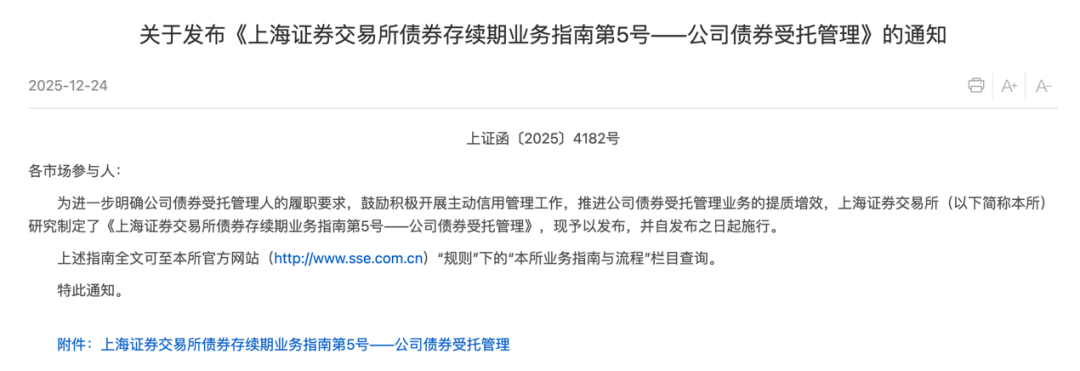
引导受托管理人发挥主动信用管理功能 上交所发布公司债券受托管理指南
Zheng Quan Shi Bao Wang· 2025-12-24 11:31
Core Viewpoint - The Shanghai Stock Exchange (SSE) has released the "Guidelines for the Management of Corporate Bonds" to enhance proactive credit management by trustees, emphasizing the importance of credit throughout the bond lifecycle and encouraging a shift in the role of trustees [1][4]. Group 1: Market Activity and Growth - Since 2025, the corporate bond market on the SSE has seen active issuance, with a total issuance scale of nearly 4.5 trillion yuan, representing a 20% year-on-year increase [2]. - The market has introduced innovative bond types, including 88 high-growth industry bonds and a more than 60% increase in sci-tech bonds, alongside an 800% increase in support bonds for small and micro enterprises [2]. - As of November 2025, the outstanding scale of corporate bonds on the SSE reached nearly 14 trillion yuan, making it one of the largest exchange bond markets globally [2]. Group 2: Importance of Proactive Credit Management - The management of bonds during their lifecycle is crucial, with a focus on accurately reflecting, repairing, and enhancing credit to optimize the long-term "credit curve" [2][3]. - Trustees play a key role in monitoring credit changes, ensuring information disclosure, and verifying the use of raised funds, thus connecting issuers and holders [3]. Group 3: Implementation of the Guidelines - The newly released guidelines provide a roadmap for proactive credit management, detailing processes from monitoring to implementation and incentives [4]. - The SSE has initiated pilot programs encouraging brokers to adopt proactive credit management, resulting in improved issuer credit and reduced financing costs [4][8]. Group 4: Organizational Structure and Mechanisms - Different brokers have varying organizational structures for their trustee teams, impacting their credit management processes [7]. - Effective incentives for proactive credit management are crucial, with some brokers considering performance-based rewards linked to the success of credit management initiatives [7]. Group 5: Future Directions - The SSE aims to further enhance the quality and efficiency of trustee management services, encouraging brokers to develop tailored strategies [8]. - Regulatory support will be directed towards brokers demonstrating significant proactive credit management results and issuers with strong credit levels, promoting a win-win scenario in the bond market [8].
上交所,新动作!交易所市场首个债券受托管理指南发布
证券时报· 2025-12-24 11:28
Core Viewpoint - The Shanghai Stock Exchange has released the first specialized guideline for bond trustee management, aiming to enhance proactive credit management by trustees throughout the bond product lifecycle, emphasizing the importance of credit as the lifeline of corporate bonds [1][3]. Group 1: Guideline Overview - The guideline provides a roadmap for proactive credit management, detailing processes from monitoring to implementation and incentives, and introduces market-based tools for trustees to enhance issuer credit [3][4]. - The guideline encourages a shift in the role of trustees from compliance oversight to value discovery, allowing them to actively manage credit risks and improve issuer creditworthiness [5][7]. Group 2: Market Context and Trends - Since 2025, the corporate bond market has seen significant activity, with issuance reaching nearly 4.5 trillion yuan, a 20% year-on-year increase, and innovative bond types like high-growth industry bonds and technology innovation bonds gaining traction [6]. - The total outstanding bonds in the Shanghai Stock Exchange's corporate bond market approached 14 trillion yuan by the end of November 2025, establishing it as one of the largest exchange bond markets globally [6]. Group 3: Case Studies and Practical Applications - Examples of proactive credit management include Huatai United's collaboration with guarantee institutions to enhance issuer credit and Everbright Securities' efforts to address discrepancies in bond pricing to improve liquidity and investor confidence [4][6]. - The guideline supports the establishment of internal business mechanisms within brokerages to adapt to different organizational structures, enhancing the effectiveness of proactive credit management initiatives [9][10].

债券受托业务“转舵”主动信用管理,多家券商已开展试点
Di Yi Cai Jing· 2025-12-24 11:06
Core Insights - The Shanghai Stock Exchange (SSE) has released a guideline to promote proactive credit management by trustees in the bond market, emphasizing the importance of credit throughout the bond lifecycle [1][3] - The guideline aims to transform the role of trustees from compliance overseers to value discoverers, encouraging tailored proactive credit management based on the credit characteristics of different issuers [3][5] Group 1: Market Activity - Since 2025, the corporate bond market on the SSE has been active, with an issuance scale of nearly 4.5 trillion yuan, representing a 20% year-on-year increase [2] - The outstanding scale of corporate bonds on the SSE reached nearly 14 trillion yuan by the end of November 2025, driven by the active primary market [2] Group 2: Proactive Credit Management - Proactive credit management is essential for maintaining long-term credit relationships and optimizing the "credit curve" during the bond's lifespan [2][3] - The SSE's guideline provides a roadmap for proactive credit management, detailing processes from monitoring to implementation and incentives [3][5] Group 3: Implementation and Case Studies - Several pilot brokers have begun implementing proactive credit management, leading to improved credit ratings and reduced financing costs for issuers [5][6] - Examples include Huatai United's collaboration with a guarantor to enhance an issuer's credit and Everbright Securities' efforts to address discrepancies in bond pricing through improved communication and valuation [5][6] Group 4: Organizational Structure and Mechanisms - Different brokers have varying organizational structures for their trustee teams, impacting their credit management processes [6] - Effective implementation of proactive credit management requires a comprehensive mechanism that includes initiation, decision-making, coordination, and incentives [6]
年内上交所公司债券发行规模近4.5万亿元 同比增长20%
Zheng Quan Ri Bao Wang· 2025-12-24 11:06
Core Viewpoint - The Shanghai Stock Exchange (SSE) is actively guiding trustees to enhance their proactive credit management functions, emphasizing the importance of credit throughout the entire lifecycle of corporate bonds with the release of the "Guidelines for Corporate Bond Trusteeship" [1][4]. Group 1: Market Activity and Growth - Since 2025, the corporate bond market on the SSE has seen active issuance, with a total issuance scale of nearly 4.5 trillion yuan, representing a year-on-year growth of 20% [2]. - The market has introduced innovative bond varieties, including 88 high-growth industry bonds and a more than 60% year-on-year increase in sci-tech bonds, alongside an 800% increase in support bonds for small and micro enterprises [2]. - As of November 2025, the outstanding scale of corporate bonds on the SSE reached nearly 14 trillion yuan, making it one of the largest exchange bond markets globally [2]. Group 2: Role of Trustees in Credit Management - The unique role of trustees in the bond market involves monitoring credit changes, ensuring information disclosure, and verifying the use of raised funds, making them essential in optimizing the "credit curve" [3]. - Historically, there has been a tendency to prioritize underwriting over trusteeship, but the new guidelines encourage trustees to take a more active role in credit management, transitioning from mere compliance to value discovery [3][4]. Group 3: Implementation of Proactive Credit Management - The guidelines provide a roadmap for proactive credit management, detailing processes from monitoring to implementation and incentives, equipping trustees with tools and case studies [4]. - Initiatives have already begun, with pilot programs allowing several brokerage firms to implement proactive credit management practices, resulting in improved credit ratings and reduced financing costs for issuers [4][5]. Group 4: Mechanism and Organizational Structure - The SSE emphasizes the importance of long-term mechanisms to support proactive credit management, encouraging brokerages to develop internal business structures that suit their specific needs [6][7]. - Different brokerages have varied organizational structures for their trustee teams, with some located in investment banking departments and others in quality control departments, leading to differences in operational mechanisms [7]. Group 5: Incentives and Future Directions - Effective incentives are crucial for the success of proactive credit management, with some brokerages considering performance-based rewards linked to the completion and effectiveness of credit management tasks [8]. - The SSE plans to further enhance the quality and efficiency of trustee management services, encouraging brokerages to find development paths that align with their unique circumstances, while also promoting a market-oriented approach to support the bond market [8].
上证指数录得六连阳,市场超4100股上涨 | 华宝3A日报(2025.12.24)
Xin Lang Cai Jing· 2025-12-24 10:59
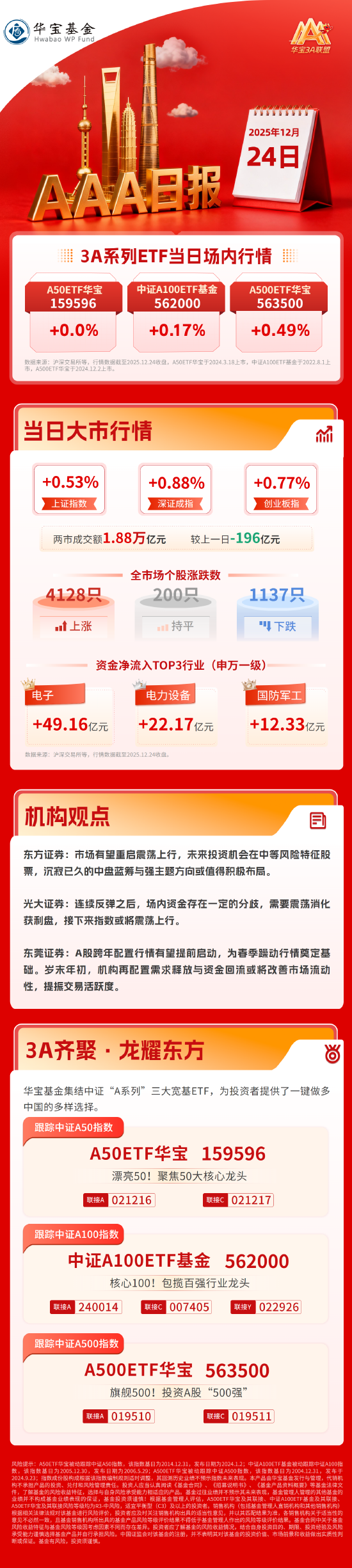
Core Viewpoint - The market is expected to restart a fluctuating upward trend, with investment opportunities in medium-risk stocks, particularly mid-cap blue chips and strong thematic directions [2][6]. Market Performance - The total trading volume in the two markets reached 1.88 trillion yuan, a decrease of 196 billion yuan from the previous day [6]. - The number of stocks that rose and fell in the market was 4,128 and 1,137 respectively, indicating a mixed performance [6]. Sector Analysis - The top three sectors for net capital inflow were Electronics (+4.916 billion yuan), Electric Equipment (+2.217 billion yuan), and National Defense and Military Industry (+1.233 billion yuan) [2][6]. Institutional Insights - Dongguan Securities anticipates an early start to the A-share cross-year allocation trend, laying the groundwork for a spring rally, with institutional reallocation and capital inflow expected to improve market liquidity and trading activity [2][6]. - Oriental Securities suggests that the market may experience a rebound, with future investment opportunities in medium-risk stocks [2][6]. - Everbright Securities notes that after consecutive rebounds, there is some divergence in market funds, indicating a need for consolidation of profit-taking before the index can continue to rise [2][6]. ETF Offerings - Huabao Fund has launched three major broad-based ETFs tracking the China A50, A100, and A500 indices, providing investors with diverse options for exposure to the Chinese market [2].
——2025年三季度美国经济数据点评:关税扰动边际消退,美国经济增速回升
EBSCN· 2025-12-24 07:44
Economic Growth - The annualized quarterly GDP growth rate for Q3 2025 is +4.3%, exceeding expectations of +3.3% and the previous value of +3.8%[1] - The annualized quarterly personal consumption expenditure growth rate for Q3 2025 is +3.5%, higher than the expected +2.7% and the previous +2.5%[1] - The core PCE price index for Q3 2025 shows an annualized quarterly growth rate of +2.9%, matching expectations and up from +2.6% in the previous quarter[1] Consumer Confidence and Spending - Consumer confidence index rose to 61.7 in July 2025, the highest since March 2025, contributing to a recovery in personal consumption[3] - The Q3 2025 personal consumption expenditure growth rate of +3.5% is the highest recorded in 2025, indicating a rebound in consumer spending[3] Investment Trends - Private investment in Q3 2025 recorded a quarterly growth rate of -0.3%, an improvement from -13.8% in the previous quarter[4] - Fixed investment growth rate for non-residential investment is +2.8%, while residential investment continues to decline at -5.1%[4] Net Exports - The "import rush" effect has weakened, with imports showing a negative growth rate of -4.7% in Q3 2025, while exports increased by +8.8%[6] - Net exports contributed 1.6 percentage points to GDP growth in Q3 2025, driven by improved export demand from trade negotiations[6] Market Reactions - Following the economic data release, major U.S. stock indices rose, with the Dow Jones up by +0.2%, S&P 500 by +0.5%, and Nasdaq by +0.6%[2] - The 10-year Treasury yield increased by 1 basis point to 4.18%, while the 2-year yield rose by 4 basis points to 3.48%[2]

A股午后涨幅扩大:商业航天概念股再度爆发,4125股收涨
Xin Lang Cai Jing· 2025-12-24 07:37
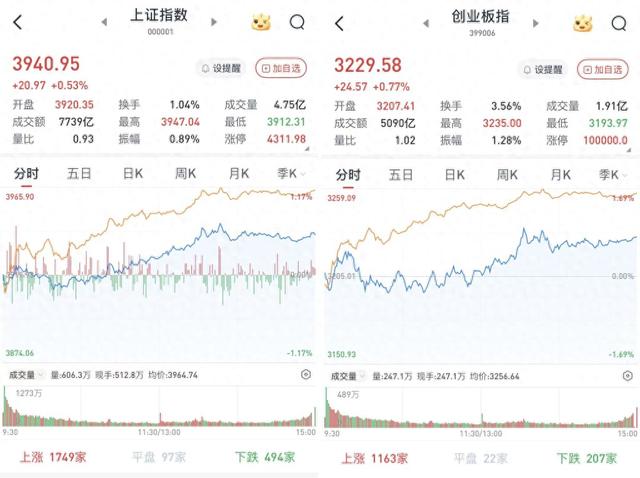
A股三大股指12月24日集体小幅高开。沪指早盘震荡攀升,深市则高位震荡。午后沪深两市同频上攻, 三大股指涨幅迅速扩大。 从盘面上看,商业航天概念股再度爆发,福建本地股反复活跃,光伏、锂电池、算力硬件、AI手机、 智能驾驶、化纤题材走强。 至收盘,上证综指涨0.53%,报3940.95点;科创50指数涨0.9%,报1352.13点;深证成指涨0.88%,报 13486.42点;创业板指涨0.77%,报3229.58点。 Wind统计显示,两市及北交所共4125只股票上涨,1132只股票下跌,平盘有200只股票。 农林牧渔领跌两市,生物股份(600201)跌超7%,粤海饲料(001313)、罗牛山(000735)、福成股 份(600965)、海大集团(002311)等跌超2%。 银行股逆市下挫,邮储银行(601658)、常熟银行(601128)、宁波银行(002142)、瑞丰银行 (601528)、交通银行(601328)等跌幅靠前。 食品饮料表现不佳,庄园牧场(002910)跌停,得利斯(002330)、欢乐家(300997)跌超3%,妙可 蓝多(600882)、千味央厨(001215)、西部牧业(300106 ...
光大证券:2026年港股或迎戴维斯双击 建议聚焦四大AI主线
智通财经网· 2025-12-24 07:02
Core Viewpoint - The Hong Kong stock market is expected to experience a "Davis Double Play" in 2026, driven by valuation recovery, profit growth, and a return to main themes, with a focus on the "Four AI Main Lines" framework to identify structural opportunities in the tech sector during the AI era [1][2]. Investment Focus - The Hang Seng Index is anticipated to regain upward momentum, with the Hang Seng Tech Index expected to outperform the broader market. The tech sector, representing core assets of China's new economy, is projected to be the strongest driver of market rebound [2]. Main Line 1: Internet Giants - AI is shifting competition among internet giants from traffic to ecosystem capabilities. Cloud business is accelerating due to AI demand, with capital expenditure doubling and stable profit margins. Advertising is seeing immediate monetization benefits from AI, with click-through rates increasing by 15%-20%. Key investment targets include Tencent, Alibaba-W, and Kuaishou, which are well-positioned to leverage technology and data [3]. Main Line 2: AI Computing Power Industry Chain - Leading companies are consistently exceeding expectations, with strong capital expenditure from cloud vendors and tight chip supply countering "bubble" concerns. High infrastructure investment and high ROI are justified, indicating a robust AI industry cycle. Key opportunities include communication networking benefiting from global tech upgrades, semiconductor manufacturing for domestic substitution, and critical equipment and materials for computing power upgrades [4]. Main Line 3: AI Applications - Investment in AI applications has entered a phase where performance is paramount. Clear signals of commercialization acceleration are observed in key sectors such as SaaS, content ecosystems, and advertising. The evolution of enterprise tools into "intelligent agents" is driving ARPU growth, while AIGC is lowering creation costs, leading to synchronized user and revenue growth [5]. Main Line 4: AI End-User and Robotics - The year 2026 is projected to be pivotal for AI-defined hardware and large-scale production of robots. Hardware manufacturers like Apple and Xiaomi are enhancing AI capabilities, while tech giants like OpenAI and Google are entering hardware markets. The investment landscape includes a comprehensive mapping of the robotics industry chain, highlighting opportunities from upstream expansion and capital empowerment, with humanoid robots like Tesla's Optimus expected to reach significant production levels [6].