包钢股份

Search documents
2025年第2期:稀土永磁体:烧/粘结钕铁硼及钐钴
Huachuang Securities· 2025-12-04 14:13
Investment Rating - The report does not explicitly provide an investment rating for the rare earth permanent magnet industry Core Insights - The strategic position of rare earth resources continues to rise, becoming a focal point of resource competition and industrial gamesmanship among major powers. Rare earth elements exhibit exceptional magnetic, optical, and electrical properties, making them indispensable in high-tech fields such as new energy, new materials, energy conservation, aerospace, electronic information, and national defense [1][5] - The Oxford Energy Institute predicts that demand for rare earths will grow significantly before 2030, primarily for use in permanent components in electric vehicles and wind turbines [1][5] - China holds the largest share of global rare earth reserves at 44 million tons (approximately 48%), followed by Brazil (21 million tons, 23%) and India (6.9 million tons, 7.6%). The U.S. has only 1.9 million tons, which is 4.3% of China's reserves [1][8] - In terms of production, China is expected to produce 270,000 tons of rare earths in 2024, accounting for 68.5% of the global output of 390,000 tons [1][8] Summary by Sections Rare Earth Elements Introduction - Rare earth elements include 17 metals, categorized into light and heavy rare earths based on their physical and chemical properties. They are primarily found in the form of rare earth oxides [4] Rare Earth Permanent Products and Industry Chain - Rare earth permanent materials are the largest deep-processing sector for rare earths, consuming over 40% of total rare earth production. They are classified into neodymium-iron-boron (NdFeB) and samarium-cobalt (SmCo) magnets, with NdFeB being widely used in electric vehicles, wind turbines, consumer electronics, and industrial automation due to its superior magnetic performance and lower cost [16][29] - The production of NdFeB relies on raw materials such as praseodymium-neodymium oxide, dysprosium oxide, terbium oxide, and neodymium metal. The separation of praseodymium and neodymium is challenging due to their similar chemical properties [24][28] Industry Landscape - The report indicates that the industry has experienced a decline in revenue for three consecutive years, with projected revenue of 36.85 billion yuan in 2024, down nearly 19% from 45.3 billion yuan in 2022. Gross profit and gross margin have also significantly decreased [1] - The competition among permanent magnet companies is characterized by "large concentration, structural differentiation, and a shift towards high-end upgrades." The focus has shifted from pure capacity to technology, quality, and customer chain integration [1]
建信期货钢材日评-20251203
Jian Xin Qi Huo· 2025-12-03 02:06
Report Overview - Report Type: Steel Daily Review [1] - Date: December 3, 2025 [2] - Research Team: Black Metal Research Team, including researchers Zhai Hepan, Nie Jiayi, and Feng Zeren [3] 1. Market Review and Future Outlook 1.1 Spot Market Dynamics and Technical Analysis - On December 2, most rebar spot markets and a few hot-rolled coil spot markets saw price increases. Rebar prices in Shanghai, Nanchang, Guangzhou, Changsha, Nanning, and Chengdu rose by 30 - 40 yuan/ton, while those in Nanjing, Zhengzhou, Tianjin, Wuxi, Hefei, Wuhan, Taiyuan, Shenyang, Chongqing, Kunming, Guiyang, and Lanzhou increased by 10 - 20 yuan/ton. Hot-rolled coil prices in Fuzhou, Jinan, Nanchang, and Nanning went up by 10 - 20 yuan/ton [8]. - The daily KDJ indicator of the rebar 2605 contract continued to rise after a golden cross the previous day. The daily KDJ indicator of the hot-rolled coil 2601 contract showed a divergent trend, with the J value slightly falling back and the K and D values continuing to rise. The daily MACD red bar of the rebar 2605 contract expanded for three consecutive trading days, and that of the hot-rolled coil 2601 contract for two consecutive trading days [8]. 1.2 Future Outlook - News: With high-level dialogues between China and the US, and the US and Japan, geopolitical risks have eased, investors' risk appetite has significantly recovered, and the prices of risk assets have been restored. The prices of steel and ore, which were previously resilient, have strengthened. The main January contracts of rebar, hot-rolled coil, and iron ore reached new highs since September 29, October 31, and October 31 respectively. Coke and coking coal futures also rebounded significantly in the past two days [9]. - Fundamentals: In the week of November 28, the demand for the five major steel products declined slightly compared to the previous week but remained at the level of late October. Although production has rebounded slightly in the past two weeks, the inventory continued to decline rapidly, further alleviating supply pressure [9]. - Raw Materials: The first round of spot price cuts for coke was implemented. The prices of major primary coking coal in the spot market decreased by 50 - 140 yuan/ton in the past week. After the spot prices of coal and coke followed the futures prices down, the risk release of coal and coke futures brought a certain degree of confidence recovery. The concern about increased supply in the iron ore market eased. With coking coal and coke giving profits to steel mills, the price support for iron ore was relatively strong, driving up the cost of steel [9]. - Overall: The steel futures market is expected to consolidate with an upward bias due to the warming macro - environment and favorable fundamental factors. Attention should be paid to the pace of the warming macro - environment and the resonance differences between various commodity market sectors and the stock market [9]. 2. Industry News - Environmental Protection Inspection: The third round and fifth batch of the central ecological and environmental protection inspection teams reported typical environmental problems in Tianjin and Hebei. Tianjin had serious problems in volatile organic compound treatment and vehicle inspections, with sub - standard air quality and many enterprises found to be illegally discharging pollutants. Tangshan, Hebei, was criticized for illegally launching steel projects and increasing production capacity, with obvious shortcomings in air pollution prevention and control [10]. - Steel Consumption and Production: Since the "14th Five - Year Plan", China's apparent steel consumption has declined for four consecutive years, and steel production has generally shown a downward trend. The domestic apparent consumption decreased from a peak of 1.04 billion tons in 2020 to 890 million tons in 2024, a decrease of 150 million tons, with an average annual decline of 3.8%. In the first three quarters of 2025, the domestic apparent consumption was 649 million tons, a decrease of 5.7%, with the decline further intensifying [10]. - Iron Ore Development: On November 28, the China Iron and Steel Industry Association held a symposium on domestic iron ore resource development. Relevant officials from national ministries and commissions introduced the work at the ministry level, interpreted the newly revised "Mineral Resources Law of the People's Republic of China" implemented on July 1, 2025, and briefly answered relevant questions. They stated that China has a high dependence on imported iron ore and large potential for increasing iron ore reserves and production, and efforts should be made to increase the conversion from exploration to mining to improve the domestic production capacity of iron ore [10]. - Corporate Repurchase: Baotou Steel Co., Ltd. announced a share repurchase plan from May 22, 2025, to May 21, 2026, with an expected repurchase of 100 - 200 million yuan worth of shares for reducing the registered capital. In November 2025, the company repurchased 7.0732 million shares, accounting for 0.016% of the total share capital, and paid 18.000483 million yuan. As of November 30, the cumulative repurchase was 29.3387 million shares, accounting for 0.065% of the total share capital, with a cumulative payment of 70.000827 million yuan and a repurchase price ranging from 1.79 - 2.72 yuan/share [11]. - Mining Project: Pangang Group Mining Co., Ltd. recently launched the project of green and intelligent mining of vanadium - titanium magnetite in Zhulan Iron Mine, aiming to start the project officially by the end of June 2027. The project plans a total investment of about 5 billion yuan. After completion, the Zhulan Iron Mine will shift from open - pit to underground mining, ensuring effective capacity connection and extending the mine's service life by more than 40 years. The underground mining scale for deep resources is 15 - 20 million tons/year, using the stage open - stoping and full - tailings backfill mining method to minimize solid waste generation [11]. - Stock Repurchase: On December 1, Yongtai Energy announced a plan to repurchase a portion of its issued A - share common stocks using its own funds and self - raised funds for cancellation to reduce the company's registered capital. The proposed repurchase amount is not less than 300 million yuan and not more than 500 million yuan, with a repurchase price not exceeding 2.50 yuan/share. The repurchase period is within 12 months after the shareholders' meeting's approval, and it will be implemented through centralized bidding transactions. The company also disclosed that its directors, supervisors, senior management, controlling shareholders, actual controllers, and shareholders with more than 5% of the shares have no plans to reduce their holdings in the next six months [11]. - Coal Resources: As of now, Anhui Province holds coal resource reserves of over 7.6 billion tons in Xinjiang, Gansu, Shanxi, Inner Mongolia and other regions, with an approved (designed) annual coal production capacity of over 70 million tons, ensuring the province's energy security while achieving long - term corporate development [11]. - Coal Contracts: The 2026 coal - steel - coke long - term contract negotiation meeting of the China Coking Coal Brand Cluster was successfully concluded. Shanxi Coking Coal signed contracts with 28 customer units, including 25 long - term agreement customers, 2 key customers, and 1 internal customer, achieving the goals of the meeting. The signing and performance work of Shanxi's 2026 coal long - term contracts has officially started. All coal long - term contracts for power supply and those in metallurgy, chemical, building materials and other industries will be uniformly operated online, marking a new stage in the standardized management of coal trading in Shanxi. The power coal supply contracts use the national unified contract model text and are signed following a standardized process. The signing process for non - power industries such as metallurgy, chemical, and building materials will be appropriately simplified. All contract signing work must be completed by December 13, 2025 [11][12]. - Coal Transportation: As of now, the China Railway Urumqi Bureau Group Co., Ltd. has cumulatively completed 85.1801 million tons of coal transportation from Xinjiang this year, a year - on - year increase of 6.4%. From December 1, 2025, Russia increased railway freight rates by 10%, including coal transportation on all routes [12]. - Coal Production and Sales: In November 2025, Coal India Ltd. (CIL) produced 68 million tons of coal, a year - on - year increase of 1.19% and a month - on - month increase of 20.57%. Coal sales were 62.7 million tons, a year - on - year decrease of 0.32% and a month - on - month increase of 7.55% [12]. - Coal Price: On December 1, the Indonesian Ministry of Energy and Mineral Resources released the reference prices for Indonesian thermal coal for the first half of December 2025, with most prices higher than those in the second half of November. The reference price for HBA (high - grade 6322 kcal) thermal coal was 98.26 US dollars/ton, HBA I (high - grade 5300 kcal) was 67.99 US dollars/ton, HBA II (high - grade 4100 kcal) was 44.37 US dollars/ton, and HBA III (high - grade 3400 kcal) was 34.15 US dollars/ton [12]. - Trade Investigations: On December 1, the US Department of Commerce announced a second anti - dumping sunset review investigation on non - oriented electrical steel imported from China, Germany, Japan, South Korea, Sweden, and Taiwan (China), and a second counter -vailing sunset review investigation on non - oriented electrical steel imported from China and Taiwan (China). The US International Trade Commission (USITC) also launched a second anti - dumping and counter -vailing sunset review industrial injury investigation. Interested parties should register for应诉 with the US Department of Commerce within 10 days of the announcement, submit responses to the USITC by December 31, 2025, and submit comments on the sufficiency of the responses to the USITC by February 6, 2026 at the latest. On the same day, the US Department of Commerce announced a first anti - dumping sunset review investigation on forged steel fittings imported from India and South Korea, and a first counter -vailing sunset review investigation on forged steel fittings imported from India. The US ITC launched a first anti - dumping and counter -vailing sunset review industrial injury investigation. Interested parties should register for应诉 with the US Department of Commerce within 10 days of the announcement, submit responses to the USITC by December 31, 2025, and submit comments on the sufficiency of the responses to the USITC by February 10, 2026 at the latest [12][13] 3. Data Overview - The report provides multiple data charts, including the spot prices of rebar and hot - rolled coils in major markets, the social inventories of rebar and hot - rolled coils in major cities, the weekly production of the five major steel products, the steel mill inventories of the five major steel products, blast furnace and electric furnace operating rates and capacity utilization rates, national daily average molten iron production, the apparent consumption of the five major steel products, and the basis between Shanghai rebar/hot - rolled coil spot and January contracts [15][16][23]
包钢股份:2025年11月公司回购股份7073200股
Zheng Quan Ri Bao· 2025-12-02 14:09
Group 1 - The company announced a share buyback of 7,073,200 shares, representing 0.016% of its total share capital [2] - The buyback was conducted through centralized bidding, with a maximum price of 2.69 yuan per share and a minimum price of 2.41 yuan per share [2] - The total amount paid for the buyback was 18,000,483 yuan, excluding commissions and transaction fees [2]


包钢股份:累计回购约2934万股
Mei Ri Jing Ji Xin Wen· 2025-12-02 09:25
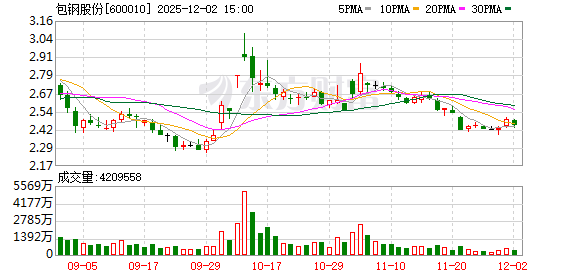
Group 1 - The company Baosteel Co., Ltd. announced on December 2 that as of November 30, 2025, it has repurchased approximately 29.34 million shares through centralized bidding, accounting for 0.065% of the total share capital [1] - The highest transaction price for the repurchased shares was 2.72 yuan per share, while the lowest was 1.79 yuan per share [1] - The total amount paid for the share repurchase was approximately 70 million yuan [1]
普钢板块12月2日涨0.07%,首钢股份领涨,主力资金净流出2.73亿元
Zheng Xing Xing Ye Ri Bao· 2025-12-02 09:03
Market Overview - On December 2, the steel sector saw a slight increase of 0.07% compared to the previous trading day, with Shougang Co., Ltd. leading the gains [1] - The Shanghai Composite Index closed at 3897.71, down 0.42%, while the Shenzhen Component Index closed at 13056.7, down 0.68% [1] Individual Stock Performance - Shougang Co., Ltd. (code: 656000) closed at 4.45, up 3.49% with a trading volume of 555,000 shares and a transaction value of 2.45 billion [1] - Sansteel Minguang (code: 002110) closed at 4.76, up 3.48% with a trading volume of 1,259,200 shares and a transaction value of 5.89 billion [1] - Jiuquan Iron & Steel (code: 600307) closed at 1.67, up 2.45% with a trading volume of 771,900 shares and a transaction value of 127 million [1] - Other notable performances include Hebei Steel (code: 000709) at 2.33, up 0.87%, and Angang Steel (code: 000898) at 2.56, up 0.79% [1] Fund Flow Analysis - The steel sector experienced a net outflow of 273 million from institutional investors, while retail investors saw a net inflow of 300 million [2] - The detailed fund flow for selected stocks shows that New Steel Co. (code: 600782) had a net inflow of 14.78 million from institutional investors, while it faced a net outflow of 12.27 million from speculative funds [3] - Shougang Co. (code: 000898) also saw a net inflow of 11.47 million from institutional investors, indicating strong interest despite overall sector outflows [3]


包钢股份(600010) - 包钢股份关于股份回购进展情况的公告
2025-12-02 08:17
| 股票代码:600010 | 股票简称:包钢股份 | 编号:(临)2025-077 | | --- | --- | --- | | 债券代码:175793 | 债券简称:GC钢联01 | | 内蒙古包钢钢联股份有限公司 关于股份回购进展情况的公告 本公司董事会及全体董事保证本公告内容不存在任何虚假记载、误导性陈述或者重大遗 漏,并对其内容的真实性、准确性和完整性承担个别及连带责任。 重要内容提示: | 回购方案首次披露日 | 2025 年 4 月 19 日 | | | --- | --- | --- | | 回购方案实施期限 | 2025 年 5 月 22 日至 2026 年 | 5 月 21 日 | | 预计回购金额 | 1 亿元(含)——2 亿元(含) | | | 回购用途 | 减少注册资本 □用于员工持股计划或股权激励 | | | | □用于转换公司可转债 | | | | □为维护公司价值及股东权益 | | | 累计已回购股数 | 2933.8700 万股 | | | 累计已回购股数占总股本比例 | 0.065% | | | 累计已回购金额 | 7000.0827 万元 | | | 实际回购价格区间 ...
包钢股份(600010.SH):累计回购7000.08万元股份
Ge Long Hui A P P· 2025-12-02 08:13
Group 1 - The company Baosteel Co., Ltd. (600010.SH) announced a share buyback program, having repurchased a total of 29,338,700 shares as of November 30, 2025, which represents 0.065% of the company's total share capital [1] - The highest price paid for the repurchased shares was 2.72 yuan per share, while the lowest price was 1.79 yuan per share [1] - The total amount spent on the share buyback, excluding commissions and transaction fees, was 70 million 82 thousand 700 yuan [1]
包钢股份:累计斥资7000万元回购股份,占总股本0.065%
Xin Lang Cai Jing· 2025-12-02 08:03
包钢股份公告称,公司于2025年4月、5月审议通过股份回购方案,自2025年5月22日至2026年5月21日, 预计回购1亿-2亿元股份用于减少注册资本。2025年11月,公司回购707.32万股,占总股本0.016%,支 付1800.0483万元。截至11月30日,累计回购2933.87万股,占总股本0.065%,累计支付7000.0827万元, 回购价格1.79-2.72元/股。 ...
包钢股份:累计回购7000.08万元股份
Ge Long Hui· 2025-12-02 08:02
格隆汇12月2日丨包钢股份(600010.SH)公布,截至2025年11月30日,公司通过集中竞价交易方式累计回 购股份29338700股,占公司总股本的比例为0.065%,成交的最高价为2.72元/股、最低价为1.79元/股, 已支付的总金额为7000.0827万元(不含佣金、手续费等交易费用)。 ...
稀土概念股走低,稀土相关ETF跌约2%
Mei Ri Jing Ji Xin Wen· 2025-12-02 03:31
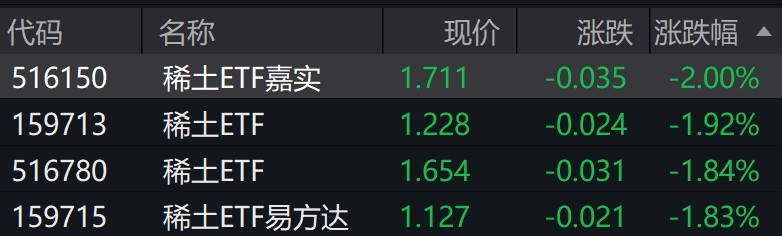
Group 1 - The core viewpoint of the article indicates a decline in rare earth stocks, with Chinese rare earths dropping over 3%, and companies like Northern Rare Earth, Wolong Electric Drive, Shenghe Resources, and Baotou Steel falling more than 2% [1] - The related rare earth ETFs also experienced a decline, with an approximate drop of 2% [1] Group 2 - Specific ETF performance includes: - Jiashi Rare Earth ETF (516150) at 1.711, down 0.035 or 2.00% - Rare Earth ETF (159713) at 1.228, down 0.024 or 1.92% - Rare Earth ETF (516780) at 1.654, down 0.031 or 1.84% [2] - Analysts suggest that rare earths, as core resources for high-end manufacturing and strategic emerging industries, are showing a resonance in both supply and demand [2] - The strategic position of the rare earth industry chain is expected to be further solidified against the backdrop of increased supply concentration and upgraded demand structure, providing long-term driving force for high-end manufacturing development [2]