稀土ETF嘉实

Search documents
权益ETF周度跟踪:工业有色和稀土获逆势布局-20260308
HUAXI Securities· 2026-03-08 07:52
Report Industry Investment Rating No information provided in the given content. Core Viewpoints of the Report - Combining the "Gain/Loss - Crowding" quadrant chart and ETF fund flow, there are gaming opportunities in the industrial non - ferrous metals and rare earth sectors [1]. - The oil and gas and power grid equipment sectors led the gains from March 2 - 6, becoming the market's main lines, while the gaming and media sectors had significant declines [1]. - Industrial non - ferrous metals and rare earths received reverse capital increases, presenting potential opportunities, while the power grid equipment may be volatile in the short term, and the oil and gas sector's future is highly uncertain [1]. Summary by Directory 1. Market Review: Oil and Gas and Power Grid Equipment Led the Gains - **Overall Market Trend**: From March 2 - 6, the market declined and then stabilized. As of March 6, 2026, the closing price of the Wind All - A Index was 6783.03, a 2.30% drop from February 27 [6]. - **Performance of Major Indexes**: Large - cap stocks outperformed. The Shanghai Composite Index and CSI 300 Index fell 0.93% and 1.07% respectively, while the STAR 50 Index and CSI 1000 Index had larger declines of 4.95% and 3.64% [7]. - **ETF Fund Flow**: Stock - type ETFs had a net outflow of 7.349 billion yuan from March 2 - 6, a narrower outflow compared to February 24 - 26. Broad - based index ETFs had a net outflow of 42.875 billion yuan, while theme index ETFs had a net inflow of 23.533 billion yuan, and industry index ETFs had a net inflow of 13.731 billion yuan [10][11]. - **Market Focus**: The market focused on the oil and gas and power grid equipment sectors. The oil and gas index rose 9.50% with a crowding degree of 3.7%, reaching a new high since 2020. The power grid equipment index rose 5.49%, and its crowding degree increased from the 98.7% percentile to the 99.7% percentile since 2020. The gaming and media sectors fell 7.44% and 7.04% respectively, and their crowding degrees decreased for the second consecutive week. The rare earth and industrial non - ferrous metals sectors fell 7.00% and 4.74% respectively, with a slight decrease in crowding degree [14][15]. 2. Future Focus: Rare Earths and Industrial Non - Ferrous Metals May Present Gaming Opportunities - **Fund Flow Analysis**: Industrial non - ferrous metals and rare earths received reverse capital increases. The Industrial Non - Ferrous Metals ETF Wanjia and Rare Earth ETF Jiashi fell 4.91% and 7.15% respectively, but had net inflows of 559 million yuan and 1.991 billion yuan [22]. - **Power Grid Equipment**: The power grid equipment ETF had a net inflow of 5.284 billion yuan from March 2 - 5, accounting for 17.49% of its fund size. However, its crowding degree reached 3.92%, at the 99.7% percentile since 2020, and there may be a risk of adjustment [23]. - **Oil and Gas**: The oil and gas ETF had a net inflow of 5.108 billion yuan from March 2 - 5. The sector's future depends on the development of the US - Iran situation [26]. - **Gaming and Media**: The media ETF and gaming ETF fell 7.29% and 6.99% respectively, with net outflows of 1.505 billion yuan and 538 million yuan. If the HALO trading trend remains unchanged, these two industries will continue to face pressure [26].
量化择时周报:两会来临,短期关注政策驱动
ZHONGTAI SECURITIES· 2026-03-01 13:25
Investment Rating - The industry investment rating is "Increase" with an expectation of a relative increase of over 10% compared to the benchmark index in the next 6 to 12 months [17]. Core Insights - The market is currently in an upward trend, with the core observation variable being the change in profit effect, which is at 1.91%, indicating a potential for continued market growth [5][8]. - The upcoming Two Sessions (Lianghui) period is expected to drive short-term policy focus, historically associated with stable market performance [5][8]. - The market has shown resilience despite geopolitical tensions in the Middle East, which may suppress risk appetite [5][8]. Summary by Sections Market Overview - The overall market (WIND All A Index) has shown an increase of 2.75% and reached a new high, with small-cap stocks (CSI 1000) rising by 4.34% and mid-cap stocks (CSI 500) by 4.32% [2][7]. - The steel sector has performed particularly well, with an increase of 11.8%, while the media sector has declined by 4.44% [2][7]. Timing System Analysis - The distance between the 20-day and 120-day moving averages is 6.28%, indicating a positive market trend, with the short-term average above the long-term average [2][5]. - The market trend line is positioned around 6812 points, suggesting a favorable environment for continued investment [5][8]. Sector Allocation - The industry trend configuration model suggests waiting for a reversal signal in the real estate chain (Construction Materials ETF code 159745.SZ) during the Two Sessions window, which may present short-term opportunities [6][15]. - The TWO BETA model continues to recommend the technology sector, particularly focusing on commercial aerospace (Satellite ETF code 563230.SH) for rebound opportunities [6][15]. - The performance trend model highlights the importance of focusing on the computing-related industry chain (Semiconductor Equipment ETF code 159516.SZ, Communication ETF code 515880.SH) as well as non-ferrous metals (Industrial Non-ferrous ETF code 560860.SH, Rare Earth ETF code 516150.SH) and chemicals (Chemical ETF code 159870.SZ) [6][15]. Valuation Metrics - The PE ratio of the WIND All A Index is near the 90th percentile, indicating a high valuation level, while the PB ratio is at the 50th percentile, suggesting a moderate valuation level [9][11]. - Based on the short-term trend assessment, an 80% allocation in absolute return products based on the WIND All A Index is recommended [9].
量化择时周报:两会来临,短期关注政策驱动-20260301
ZHONGTAI SECURITIES· 2026-03-01 12:42
Quantitative Models and Construction Methods 1. Model Name: Timing System Signal - **Model Construction Idea**: The model uses the distance between the short-term and long-term moving averages of the WIND All A Index to determine market trends and timing signals [2][7][13] - **Model Construction Process**: 1. Define the short-term moving average (20-day) and long-term moving average (120-day) of the WIND All A Index 2. Calculate the distance between the two moving averages: $ Distance = \frac{Short\text{-}term\ MA - Long\text{-}term\ MA}{Long\text{-}term\ MA} $ 3. If the absolute value of the distance is greater than 3%, it indicates a significant trend signal [2][7][13] - **Model Evaluation**: The model effectively identifies market trends and provides actionable timing signals [2][7][13] 2. Model Name: Industry Trend Allocation Model - **Model Construction Idea**: This model identifies industry allocation opportunities based on medium-term reversal expectations and performance trends [6][8][15] - **Model Construction Process**: 1. Monitor medium-term reversal signals for specific industries, such as the real estate chain 2. Use performance trend analysis to identify industries with strong growth potential, such as technology, semiconductors, and chemicals 3. Recommend ETF products corresponding to these industries for allocation [6][8][15] - **Model Evaluation**: The model provides clear industry allocation guidance and captures sectoral opportunities effectively [6][8][15] 3. Model Name: Position Management Model - **Model Construction Idea**: This model determines the recommended equity allocation ratio based on valuation levels and market trends [9] - **Model Construction Process**: 1. Assess the PE and PB valuation levels of the WIND All A Index 2. Combine valuation levels with short-term market trends to determine the recommended equity allocation ratio 3. For example, with the current PE at the 90th percentile and PB at the 50th percentile, the model suggests an 80% equity allocation [9] - **Model Evaluation**: The model provides a systematic approach to position management, balancing valuation and trend considerations [9] --- Model Backtesting Results 1. Timing System Signal - Moving average distance: 6.28% (absolute value > 3%) - Market trend line: 6812 points - Profitability effect: 1.91% (significantly > 0) [2][7][13] 2. Industry Trend Allocation Model - Recommended sectors: - Real estate chain (e.g., Building Materials ETF: 159745.SZ) - Technology (e.g., Satellite ETF: 563230.SH) - Semiconductors and communication (e.g., Semiconductor Equipment ETF: 159516.SZ, Communication ETF: 515880.SH) - Metals and chemicals (e.g., Industrial Metals ETF: 560860.SH, Rare Earth ETF: 516150.SH, Chemical ETF: 159870.SZ) [6][8][15] 3. Position Management Model - Recommended equity allocation: 80% [9] --- Quantitative Factors and Construction Methods 1. Factor Name: Profitability Effect - **Factor Construction Idea**: Measures the market's profitability to assess upward momentum [2][7][13] - **Factor Construction Process**: 1. Calculate the profitability effect as a percentage of profitable stocks in the market 2. A positive profitability effect indicates upward momentum [2][7][13] - **Factor Evaluation**: The factor effectively captures market sentiment and momentum [2][7][13] --- Factor Backtesting Results 1. Profitability Effect - Current value: 1.91% (significantly > 0) [2][7][13]
权益ETF周度跟踪:电网设备 ETF 价升量增-20260227
HUAXI Securities· 2026-02-27 15:32
1. Report Industry Investment Rating - No information provided in the given content 2. Core View of the Report - As of the market situation on February 27, considering the "return - crowding" quadrant chart and ETF fund flow, the power grid equipment sector still has high attention value. From February 24 - 27, resource products and power grid equipment led in terms of gains, and their crowding degrees increased. The resource products were the main market theme of the week, with both popularity and price rising. The crowding degree of the power grid equipment further heated up at a high level, and its short - term market depends on the flow of funds. Meanwhile, the chemical and semiconductor equipment sectors strengthened, with an increase in crowding degree but not overheating. The game, media, tourism, and liquor sectors declined significantly, with their sector popularity decreasing to varying degrees. The game sector adjusted significantly, and its popularity cooled down. Combining the ETF fund flow, the willingness to chase the rise of power grid equipment is strong, and its subsequent market is still worth tracking; the capital movement in the resource product sector is not obvious, and it may be in a wait - and - see state; some funds in the chemical and semiconductor equipment sectors took profits, the gambling sentiment increased, and there may be short - term fluctuations. In addition, the capital cashing sentiment in the game sector has eased, showing signs of stabilization [1]. 3. Summary by Relevant Catalogs 3.1 Market Trend: Steady Rise - From February 24 - 27, the market rose steadily. As of February 27, 2026, the closing price of the Wind All - A Index was 6942.40, up 2.75% from February 13 [6]. - From February 24 - 26, stock - type ETFs maintained a small net outflow. Stock - type ETFs had a net outflow of 32.86 billion yuan. Structurally, broad - based index ETFs had a net outflow of 26.244 billion yuan, theme index ETFs had a net outflow of 7.308 billion yuan, while industry index ETFs had a net inflow of 2.215 billion yuan [9]. 3.2 Theme Performance: Resource Products, Power Grid Equipment, and Chemicals Led in Gains - From February 24 - 27, resource products and power grid equipment led in gains, and their crowding degrees increased; the game, media, tourism, and liquor sectors declined significantly, and their popularity decreased to varying degrees. - Resource products were the main market theme of the week, with both popularity and price rising. From February 24 - 27, the rare earth, steel, non - ferrous metals, and oil and gas indexes rose 11.49%, 10.98%, 10.77%, and 9.06% respectively. At the same time, their crowding degree quantiles since 2020 increased by 6.4, 21.6, 4.9, and 17.1 percentage points respectively, showing the characteristics of volume - increasing and price - rising. The rare earth and non - ferrous metals mainly benefited from the price - rising logic, the oil market revolved around the US - Iran situation, and the steel benefited from the production control policy expectation. The crowding degrees of these themes are at a relatively high historical level, and the subsequent market may have stricter requirements for the logic [13]. - The crowding degree of the power grid equipment further heated up at a high level, and its short - term market depends on the flow of funds. The power grid equipment index rose 8.03%, and the crowding degree quantile since 2020 increased from 96.9% to 98.7%, a year - on - year increase of 1.8 percentage points. The power grid equipment has fundamental support, and the demand logic of AI for electricity is difficult to falsify, while the short - term market depends on the flow of funds [13]. - The chemical and semiconductor equipment sectors strengthened, with an increase in crowding degree but not overheating. The chemical and semiconductor equipment indexes rose 6.40% and 3.98% respectively this week. At the same time, their crowding degree quantiles since 2020 increased by 11.9 and 12.3 percentage points to 63.10% and 33.80% respectively [14]. - The game sector adjusted significantly, and its popularity cooled down. This week, the game index fell 6.57%, and the crowding degree decreased by 33.7 percentage points [14]. 3.3 Follow - up Attention: Focus on Power Grid Equipment - Combining the ETF fund flow, the power grid equipment had the largest net inflow and was favored by funds; while the chemical, media, and tourism sectors had large net outflows and faced cashing pressure. - The willingness to chase the rise of power grid equipment is strong, and its subsequent market is worth tracking. From February 24 - 26, against the background that most popular themes faced cashing, the power grid equipment ETF had a net inflow of 2.436 billion yuan. Moreover, this industry has both fundamental and logical support, and there may still be room for long - term growth. However, it is worth noting that the crowding degree of the power grid equipment is at a historical high since 2020, and the market may fluctuate in the short term. If the funds do not flow out significantly after the adjustment, it has high allocation value [19]. - The capital movement in the resource product sector is not obvious, and it may be in a wait - and - see state. From February 24 - 26, the net outflows of the Rare Earth ETF Harvest, Industrial Non - Ferrous Metals ETF Wanjia, Steel ETF, and Oil ETF Penghua were all less than 300 million yuan. After the crowding degree of the sector rose to a high level, the funds have not yet reached a consensus [19]. - Some funds in the chemical and semiconductor equipment sectors took profits, and the gambling sentiment increased. From February 24 - 26, some funds in the chemical and semiconductor equipment sectors chose to take profits, with net outflows of 1.685 billion yuan and 818 million yuan respectively for the ETFs. Coupled with the rising sector popularity and high gains this week, there may be short - term fluctuations [19]. - The game sector showed signs of stabilization. From February 24 - 26, the Game ETF had a net inflow of 25 million yuan, the capital cashing sentiment eased, and with the significant decline in sector popularity, it showed signs of stabilization [20].
ETF收评 | 稀有金属板块领涨,稀有金属ETF、稀土ETF嘉实涨4%
Ge Long Hui· 2026-02-27 07:35
Market Overview - The Shanghai Composite Index rose by 0.39%, while the ChiNext Index fell by 1.04% [1] - The total trading volume in the Shanghai, Shenzhen, and Beijing markets was 25,055 billion yuan, a decrease of 512 billion yuan compared to the previous day [1] - Over 3,200 stocks across the three markets experienced gains [1] Sector Performance - Rare metal stocks saw a surge, with significant increases in magnesium and tungsten stocks [1] - The rare metal ETFs, including the Rare Metal ETF and Rare Earth ETF, reported gains of 4.68% and 4.11% respectively [1] - The power sector showed strength, with the Power ETF and Green Power ETF rising by 2.73% and 2.53% respectively [1] - The steel sector also performed well, with the Steel ETF increasing by 2.45% [1] Declining Sectors - The ChiNext Growth ETF and the Deep Growth ETF both fell by 2% [1] - The semiconductor sector experienced declines, with the Semiconductor Equipment ETF and the Sci-Tech Semiconductor ETF dropping by 2.16% and 2.15% respectively [1]
ETF午评 | AI应用回暖,创业板软件ETF华夏涨2.9%
Ge Long Hui· 2026-02-27 03:57
Market Overview - The three major A-share indices experienced a collective decline in the morning session, with the Shanghai Composite Index down by 0.17%, the Shenzhen Component Index down by 0.68%, and the ChiNext Index down by 1.46% [1] - The North China 50 Index fell by 0.74%, and the total trading volume in the Shanghai and Shenzhen markets reached 1.5966 trillion yuan, a decrease of 53.2 billion yuan compared to the previous day [1] - Over 2,300 stocks in the market saw an increase [1] Sector Performance - The sectors that performed well included small metals, computing power leasing, cloud computing, coal mining and processing, cross-border payments, steel, photovoltaic equipment, AI applications, and tourism and hotel industries [1] - Conversely, the sectors that faced declines included paper making, PCB, CPO, storage chips, batteries, photolithography machines, and PET copper foil [1] ETF Performance - In the ETF market, AI applications showed a rebound, with the ChiNext Software ETF from Huaxia rising by 2.9%, the Software ETF increasing by 2.33%, and the Online Consumption ETF from Southern rising by 1.84% [1] - The small metals sector also strengthened, with the Rare Earth ETF from Jiashi and the Rare Metals ETF rising by 2.57% and 2.52%, respectively [1] - The computing power leasing sector saw gains, with the Computer ETF from Southern and the Big Data ETF increasing by 2.5% and 2.4%, respectively [1] - Growth sectors faced declines, with the ChiNext Growth ETF and the Shenzhen Growth ETF from Dacheng falling by 3% and 2.79% [1] - The semiconductor equipment sector experienced a pullback, with various ETFs in this category declining between 2.20% and 2.77% [1]

出口管制下稀土供给收紧,稀土ETF嘉实(516150)一键布局国内稀土产业链投资机遇
Xin Lang Cai Jing· 2026-02-26 02:47
Group 1 - The core viewpoint of the news highlights the significant impact of China's export controls on rare earth prices, particularly heavy rare earths, which have seen substantial price increases in the European market [1] - As of February 12, 2026, the price of yttrium in Europe reached its highest level since 2012, doubling to $850 per kilogram by February 19, 2026 [1] - The price of dysprosium, used in electric vehicle motor permanent magnets, reached $1,100 per kilogram on February 19, 2026, marking the highest level since 2015 [1] Group 2 - Data from the US Geological Survey and the China Rare Earth Industry Association indicates that by 2025, China will account for over 70% of global heavy rare earth production and over 90% of separation processing capacity, demonstrating strong supply dominance [1] - The growth rate of domestic rare earth mining control indicators in China is projected to be only 5% in 2026, alongside a contraction in imports from Myanmar, leading to a rigid supply characteristic [1] - Institutions forecast that export controls will become a norm, maintaining high volatility in heavy rare earth prices, enhancing pricing power for domestic leading enterprises, and accelerating global supply chain restructuring [1] Group 3 - As of January 30, 2026, the top ten weighted stocks in the China Rare Earth Industry Index accounted for 61.43% of the index, with notable companies including Northern Rare Earth, Goldwind Technology, and Xiamen Tungsten [2] - The Jiashi Rare Earth ETF (516150) closely tracks the China Rare Earth Industry Index, providing a convenient tool for investors to access the domestic rare earth industry chain [2] Group 4 - Investors can also leverage the Jiashi Rare Earth ETF linked fund (011036) to capitalize on investment opportunities in the rare earth sector [3]
ETF收评 | A股放量上涨,周期股全线上扬,稀土ETF嘉实涨6%
Ge Long Hui· 2026-02-25 07:31
Market Performance - The three major A-share indices collectively rose, with the Shanghai Composite Index increasing by 0.72%, the Shenzhen Component Index by 1.29%, and the ChiNext Index by 1.41% [1] - The total trading volume in the Shanghai, Shenzhen, and Beijing markets reached 24,809 billion yuan, an increase of 2,627 billion yuan compared to the previous day, with over 3,700 stocks rising [1] Sector Performance - Leading sectors included small metals, phosphate chemicals, steel, rare earth permanent magnets, batteries, PCB, real estate, PET copper foil, and port shipping, all showing significant gains [1] - Conversely, sectors such as film and cinema, banking, computing power leasing, and gaming experienced declines [1] ETF Performance - ETFs related to small metals, phosphate chemicals, steel, and rare earth permanent magnets saw substantial increases, with specific ETFs rising by 6.07%, 5.68%, 4.60%, 4.27%, 4.13%, 4.06%, 4.02%, and 3.85% respectively [1] - The semiconductor sector surged in the afternoon, with the Sci-Tech Semiconductor ETF and Semiconductor Equipment ETF rising by 5.04% and 4.56% respectively [1] Oil and Energy Sector - Oil prices fell, leading to a decline in the S&P Oil and Gas ETF by 2.72%, while the Energy ETF and Energy Chemical ETF dropped by 0.95% and 0.84% respectively [1] Consumer and Media Sector - The film and cinema sector declined, with the Online Consumption ETF, Media ETF, and Online Consumption ETF experiencing drops of 1.24%, 1.14%, and 1.04% respectively [1]
ETF午评 | 周期股全线霸屏,稀土ETF嘉实、稀有金属ETF涨超6%
Ge Long Hui· 2026-02-25 04:55
Market Performance - The Shanghai Composite Index rose by 1.2%, while the ChiNext Index increased by 1.43% [1] - Cyclical stocks, including steel, non-ferrous metals, chemicals, and construction, showed strong performance [1] Sector Highlights - The following ETFs saw significant gains: - Rare Earth ETF by 6.64% - Rare Metals ETF by 6.50% - Steel ETF by 5.76% - Industrial Non-Ferrous ETF by 5.49% - Non-Ferrous ETF by 4.91% - Mining ETF by 4.80% - Other related ETFs also reported increases ranging from 4.13% to 4.61% [1] - The semiconductor sector also performed well, with the following ETFs rising: - Sci-Tech Semiconductor ETF by 4.03% - Semiconductor Equipment ETF by 3.69% - Sino-Korean Semiconductor ETF by 3.69% [1] Weak Performers - The artificial intelligence sector experienced declines, with several ETFs dropping over 1%, including: - Sci-Tech AI ETF by Bosera - Sci-Tech Chip Design ETF - Online Consumption ETF by ICBC - Media ETF by Huaxia - Online Consumption ETF by Southern [1] - Other ETFs related to innovation and big data also reported declines [1]
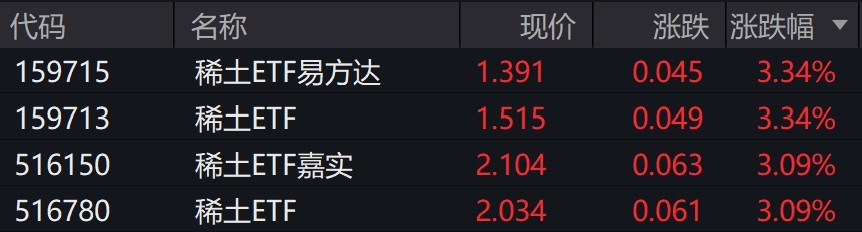
稀土概念股走强,稀土相关ETF涨超3%
Mei Ri Jing Ji Xin Wen· 2026-02-11 02:55
Group 1 - The core viewpoint of the news is that rare earth stocks are experiencing significant gains, with companies like Grinm Metallurgy and Northern Rare Earth seeing notable increases in their stock prices [1] - Rare earth-related ETFs have also risen over 3%, indicating a positive market sentiment towards the rare earth sector [1] - Analysts suggest that rare earths are essential resources for high-end manufacturing and strategic emerging industries, with a favorable supply-demand dynamic expected to strengthen the strategic position of the rare earth industry [2]