卧龙电驱

Search documents
量化大势研判:当成长只有预期在扩张
Minsheng Securities· 2025-09-03 09:32
Quantitative Models and Construction Methods Model Name: Quantitative Market Trend Analysis Framework - **Model Construction Idea**: The model aims to solve the systematic rotation problem of styles by conducting a bottom-up quantitative market trend analysis. It identifies the dominant asset characteristics that represent the future market's mainstream style through a comprehensive comparison of assets[1][5] - **Model Construction Process**: - The model considers five style stages based on the asset's industry lifecycle: external growth, quality growth, quality dividend, value dividend, and bankruptcy value[1][5] - The priority for asset comparison is based on the sequence: growth (g) > return on equity (ROE) > dividend (D)[1][5] - The model uses the spread of asset advantage differences to capture the trend changes of top assets, similar to factor timing[20] - **Model Evaluation**: The framework has shown good explanatory power for past A-share style rotations, achieving an annualized return of 27.25% since 2009[15] Model Backtesting Results - **Quantitative Market Trend Analysis Framework**: - 2009: Asset Comparison Strategy 133%, Wind All A 82%, Excess Return 51%[18] - 2010: Asset Comparison Strategy 7%, Wind All A -7%, Excess Return 14%[18] - 2011: Asset Comparison Strategy -33%, Wind All A -22%, Excess Return -11%[18] - 2012: Asset Comparison Strategy 5%, Wind All A 5%, Excess Return 0%[18] - 2013: Asset Comparison Strategy 41%, Wind All A 5%, Excess Return 36%[18] - 2014: Asset Comparison Strategy 48%, Wind All A 52%, Excess Return -4%[18] - 2015: Asset Comparison Strategy 55%, Wind All A 38%, Excess Return 16%[18] - 2016: Asset Comparison Strategy -14%, Wind All A -13%, Excess Return -1%[18] - 2017: Asset Comparison Strategy 32%, Wind All A 5%, Excess Return 27%[18] - 2018: Asset Comparison Strategy -21%, Wind All A -28%, Excess Return 7%[18] - 2019: Asset Comparison Strategy 41%, Wind All A 33%, Excess Return 8%[18] - 2020: Asset Comparison Strategy 69%, Wind All A 26%, Excess Return 44%[18] - 2021: Asset Comparison Strategy 47%, Wind All A 9%, Excess Return 38%[18] - 2022: Asset Comparison Strategy 44%, Wind All A -19%, Excess Return 62%[18] - 2023: Asset Comparison Strategy 5%, Wind All A -5%, Excess Return 10%[18] - 2024: Asset Comparison Strategy 62%, Wind All A 10%, Excess Return 52%[18] - 2025 (Aug): Asset Comparison Strategy 27%, Wind All A 23%, Excess Return 4%[18] Quantitative Factors and Construction Methods Factor Name: Expected Growth (gf) - **Factor Construction Idea**: The factor focuses on the highest analyst forecasted growth rates, regardless of the cycle stage[6] - **Factor Construction Process**: - The factor is constructed by selecting industries with the highest expected growth rates as forecasted by analysts[6] - The spread of expected growth advantage differences (Δgf) is used to capture the trend changes in top assets[20] - **Factor Evaluation**: The factor has shown significant excess returns since 2019, with notable performance in 2014-2015[34] Factor Name: Actual Growth (g) - **Factor Construction Idea**: The factor focuses on industries with the highest actual growth rates, particularly during transition and growth periods[6] - **Factor Construction Process**: - The factor is constructed by selecting industries with the highest actual growth rates (Δg)[6] - The spread of actual growth advantage differences (Δg) is used to capture the trend changes in top assets[24] - **Factor Evaluation**: The factor has shown significant excess returns in growth-dominant environments[36] Factor Name: Profitability (ROE) - **Factor Construction Idea**: The factor focuses on industries with high ROE and low valuation under the PB-ROE framework, concentrated in mature periods[6] - **Factor Construction Process**: - The factor is constructed by selecting industries with high ROE and low PB-ROE residuals[6] - The spread of ROE advantage differences is used to capture the trend changes in top assets[26] - **Factor Evaluation**: The factor has shown significant excess returns from 2016 to 2020, with weaker performance since 2021[39] Factor Name: Quality Dividend (DP+ROE) - **Factor Construction Idea**: The factor focuses on industries with the highest DP+ROE scores, concentrated in mature periods[6] - **Factor Construction Process**: - The factor is constructed by selecting industries with the highest DP+ROE scores[6] - The spread of DP+ROE advantage differences is used to capture the trend changes in top assets[42] - **Factor Evaluation**: The factor has shown significant excess returns in 2016, 2017, and 2023[43] Factor Name: Value Dividend (DP+BP) - **Factor Construction Idea**: The factor focuses on industries with the highest DP+BP scores, concentrated in mature periods[6] - **Factor Construction Process**: - The factor is constructed by selecting industries with the highest DP+BP scores[6] - The spread of DP+BP advantage differences is used to capture the trend changes in top assets[45] - **Factor Evaluation**: The factor has shown significant excess returns in 2009, 2017, and 2021-2023[46] Factor Name: Bankruptcy Value (PB+SIZE) - **Factor Construction Idea**: The factor focuses on industries with the lowest PB+SIZE scores, concentrated in stagnation and recession periods[6] - **Factor Construction Process**: - The factor is constructed by selecting industries with the lowest PB+SIZE scores[6] - The spread of PB+SIZE advantage differences is used to capture the trend changes in top assets[48] - **Factor Evaluation**: The factor has shown significant excess returns in 2015-2016 and 2021-2023[49] Factor Backtesting Results - **Expected Growth (gf)**: - Cable: 12 stocks, largest weight stock Zhongtian Technology, average market cap 21.791 billion yuan, 3-month performance 49.62%[34] - Cement: 19 stocks, largest weight stock Conch Cement, average market cap 17.929 billion yuan, 3-month performance 12.71%[34] - Glass Fiber: 6 stocks, largest weight stock China Jushi, average market cap 26.657 billion yuan, 3-month performance 63.67%[34] - Rare Earth and Magnetic Materials: 17 stocks, largest weight stock Northern Rare Earth, average market cap 31.018 billion yuan, 3-month performance 98.77%[34] - White Goods III: 10 stocks, largest weight stock Midea Group, average market cap 113.675 billion yuan, 3-month performance -1.21%[34] - **Actual Growth (g)**: - Integrated Circuits: 104 stocks, largest weight stock Cambricon-U, average market cap 45.058 billion yuan, 3-month performance 42.93%[37] - PCB: 38 stocks, largest weight stock Shenghong Technology, average market cap 27.163 billion yuan, 3-month performance 112.10%[37] - Tungsten: 4 stocks, largest weight stock Xiamen Tungsten, average market cap 30.523 billion yuan, 3-month performance 69.26%[37] - Lithium Battery Equipment: 12 stocks, largest weight stock Lead Intelligent, average market cap 11.731 billion yuan, 3-month performance 60.15%[37] - Weapons and Equipment III: 12 stocks, largest weight stock Great Wall Military Industry, average market cap 21.307 billion yuan, 3-month performance 80.22%[37] - **Profitability (ROE)**: - Beer: 7 stocks, largest weight stock Tsingtao Brewery, average market cap 26.758 billion yuan, 3-month performance -3.94%[39] - Liquor: 20 stocks, largest weight stock Kweichow Moutai, average market cap 162.722 billion yuan, 3-month performance 4.12%[39] - Non-dairy Beverages: 7 stocks, largest weight stock Eastroc Beverage, average market cap 32.754 billion yuan, 3-month performance -4.45%[39] - Network Connection and Tower Setup: 19 stocks, largest weight stock Zhongji Xuchuang, average market cap 64.299 billion yuan, 3-month performance 202.29%[39] - Building Decoration III: 28 stocks, largest weight stock Gold Mantis, average market cap 3.436 billion yuan, 3-month performance 4.42%[39] - **Quality Dividend (DP+ROE)**: - Automotive Motor Control: 15
29.58亿元资金今日流入电力设备股
Zheng Quan Shi Bao Wang· 2025-09-03 09:12
沪指9月3日下跌1.16%,申万所属行业中,今日上涨的有3个,涨幅居前的行业为综合、通信、电力设 备,涨幅分别为1.64%、1.61%、1.44%。电力设备行业位居今日涨幅榜第三。跌幅居前的行业为国防军 工、非银金融,跌幅分别为5.83%、3.05%。 资金面上看,两市主力资金全天净流出714.26亿元,主力资金净流入的行业仅有3个,电力设备行业净 流入资金29.58亿元;纺织服饰行业净流入资金2.22亿元;综合行业净流入资金310.66万元。 主力资金净流出的行业有28个,非银金融行业主力资金净流出规模居首,全天净流出资金122.10亿元, 其次是国防军工行业,净流出资金为101.31亿元,净流出资金较多的还有电子、计算机、机械设备等行 业。 电力设备行业今日上涨1.44%,全天主力资金净流入29.58亿元,该行业所属的个股共361只,今日上涨 的有111只,涨停的有2只;下跌的有248只。以资金流向数据进行统计,该行业资金净流入的个股有144 只,其中,净流入资金超亿元的有19只,净流入资金居首的是宁德时代,今日净流入资金16.63亿元, 紧随其后的是阳光电源、卧龙电驱,净流入资金分别为11.67亿元、4 ...





电机板块9月3日跌0.71%,湘电股份领跌,主力资金净流入1.49亿元
Zheng Xing Xing Ye Ri Bao· 2025-09-03 08:45
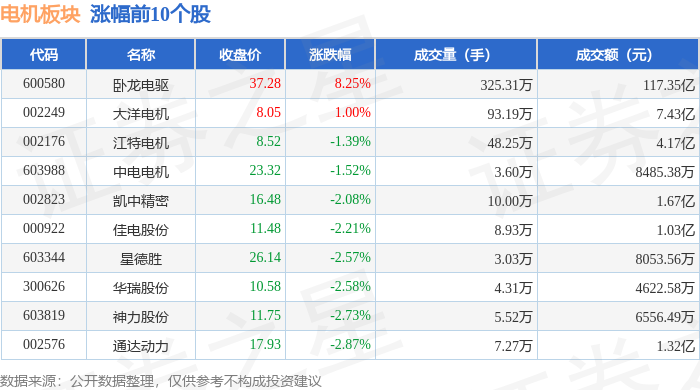
Market Overview - The electric motor sector experienced a decline of 0.71% on the previous trading day, with Xiangdian Co. leading the losses [1] - The Shanghai Composite Index closed at 3813.56, down 1.16%, while the Shenzhen Component Index closed at 12472.0, down 0.65% [1] Stock Performance - Notable gainers included Wolong Electric Drive, which rose by 8.25% to a closing price of 37.28, with a trading volume of 3.25 million shares [1] - Other stocks such as Jiangte Electric and Zhongdian Electric saw declines of 1.39% and 1.52%, respectively [1] - Xiangdian Co. reported a significant drop of 5.80%, closing at 14.93, with a trading volume of 509,900 shares and a transaction value of 778 million [2] Capital Flow - The electric motor sector saw a net inflow of 149 million from institutional investors, while retail investors experienced a net outflow of 1.56 billion [2] - Major stocks like Wolong Electric Drive had a net inflow of 524 million from institutional investors, while retail investors showed a significant outflow of 4.52 billion [3] - Other stocks such as Dayang Electric and Zhongdian Electric also experienced mixed capital flows, with Dayang Electric seeing a net inflow of 84.16 million from institutional investors [3]


宇树科技IPO定档 杠杆资金加仓这些概念股
Zheng Quan Shi Bao Wang· 2025-09-03 05:17
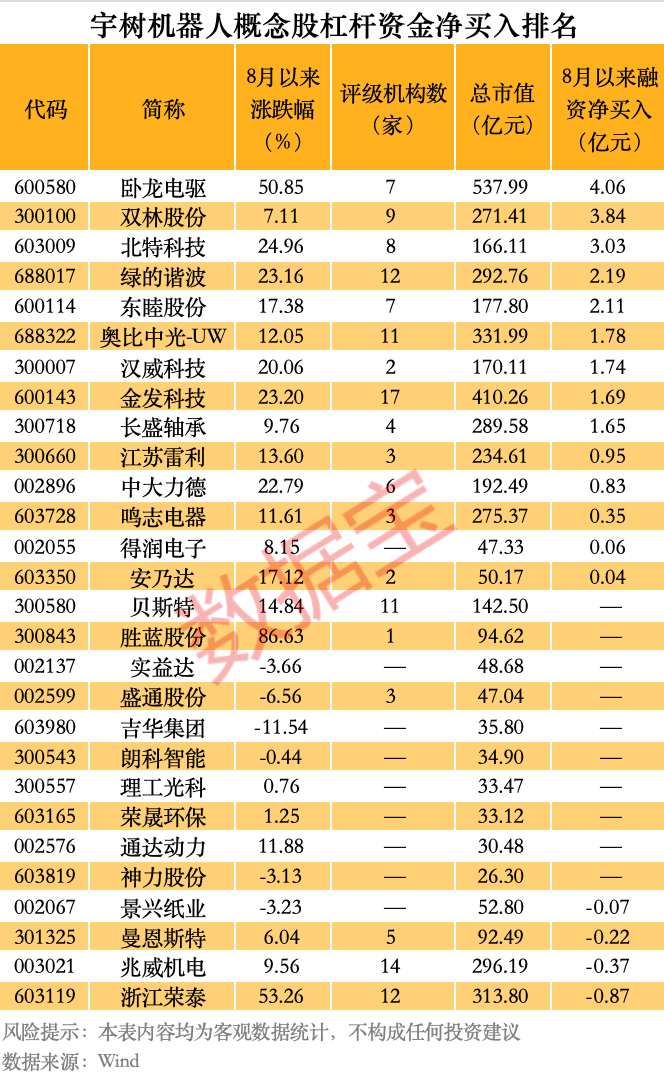
Group 1 - Yushu Technology plans to submit its IPO application to the stock exchange between October and December 2025, with relevant operational data to be disclosed at that time [1] - Following the announcement of Yushu Technology's IPO, related concept stocks surged, with Hong Kong's Shencheng Holdings rising over 15% to reach a new high [1] - In the A-share market, there are 28 concept stocks related to Yushu Robotics, with Jingxing Paper and Zhejiang Rongtai hitting the daily limit, while Langke Intelligent and Jinfat Technology rose over 2% [1] Group 2 - As of September 2, 2023, leveraged funds have shown significant interest in stocks such as Wolong Electric Drive and Shuanglin Co., with net purchases exceeding 300 million yuan since August [1] - The top leveraged fund inflow stocks since August include Wolong Electric Drive with a 50.85% increase and net purchases of 406 million yuan, and Shuanglin Co. with a 7.11% increase and net purchases of 384 million yuan [2] - Other notable stocks include Beite Technology with a 24.96% increase and net purchases of 303 million yuan, and Lide Harmony with a 23.16% increase and net purchases of 219 million yuan [2]
卧龙电驱股价涨5.55%,创金合信基金旗下1只基金重仓,持有28万股浮盈赚取53.48万元
Xin Lang Cai Jing· 2025-09-03 03:43
Core Viewpoint - Wolong Electric Drive's stock price increased by 5.55% to 36.35 CNY per share, with a trading volume of 6.366 billion CNY and a turnover rate of 11.53%, resulting in a total market capitalization of 56.783 billion CNY [1] Company Overview - Wolong Electric Drive Group Co., Ltd. is located in Shaoxing, Zhejiang Province, and was established on October 21, 1998, with its listing date on June 6, 2002 [1] - The company's main business includes electric motors and controls, power batteries, and photovoltaic energy storage [1] - Revenue composition: Industrial motors and drives 55.80%, daily-use motors and controls 24.21%, wind-solar hydrogen storage 7.64%, electric transportation 4.97%, others 4.96%, and additional 2.41% [1] Fund Holdings - According to data, the fund "Crea Jin He Xin CSI 500 Enhanced A" holds a significant position in Wolong Electric Drive, with 280,000 shares, accounting for 1.41% of the fund's net value, ranking as the sixth-largest holding [2] - The fund has achieved a floating profit of approximately 534,800 CNY today [2] - The fund was established on December 31, 2015, with a current scale of 194 million CNY and has recorded a year-to-date return of 24.77% [2] Fund Manager Performance - The fund managers, Dong Liang and Li Tianfeng, have tenures of 11 years and 3 years respectively, with total fund assets of 72.36 billion CNY and 8.18 billion CNY [3] - Dong Liang's best fund return during his tenure is 103.42%, while the worst is -26.54% [3] - Li Tianfeng's best fund return is 28.21%, with the same worst return of -26.54% [3]
卧龙电驱股价涨5.55%,华泰柏瑞基金旗下1只基金重仓,持有256.94万股浮盈赚取490.76万元
Xin Lang Cai Jing· 2025-09-03 03:43
Core Viewpoint - Wolong Electric Drive's stock price increased by 5.55% to 36.35 CNY per share, with a trading volume of 6.377 billion CNY and a turnover rate of 11.55%, resulting in a total market capitalization of 56.783 billion CNY [1] Company Overview - Wolong Electric Drive Group Co., Ltd. is located in Shaoxing, Zhejiang Province, and was established on October 21, 1998, with its listing date on June 6, 2002 [1] - The company's main business includes electric motors and controls, power batteries, and photovoltaic energy storage [1] - The revenue composition of the main business is as follows: Industrial motors and drives 55.80%, daily-use motors and controls 24.21%, wind and solar energy storage 7.64%, electric transportation 4.97%, and others 4.96% [1] Shareholder Information - Huatai-PineBridge Fund has a fund that ranks among the top ten circulating shareholders of Wolong Electric Drive [2] - The Rare Earth ETF (516780) entered the top ten circulating shareholders in the second quarter, holding 2.5694 million shares, accounting for 0.16% of circulating shares [2] - The Rare Earth ETF has a total scale of 1.119 billion CNY and has achieved a return of 70.19% this year, ranking 72 out of 4222 in its category [2] Fund Holdings - Huatai-PineBridge Fund's fund has a significant position in Wolong Electric Drive, having increased its holdings by 956,000 shares in the second quarter, totaling 2.5694 million shares, which represents 4.54% of the fund's net value [3] - The estimated floating profit from this position is approximately 4.9076 million CNY [3]
供需错配推动稀土价格上涨,稀土ETF(516780)持续“吸金”
Xin Lang Ji Jin· 2025-09-03 03:36
Core Viewpoint - The demand for rare earth elements in emerging industries such as new energy vehicles, industrial robots, and low-altitude economy continues to grow, leading to a supply-demand mismatch and an upward trend in prices for major rare earth products [1]. Group 1: Price Trends - As of September 2, the average price of praseodymium metal was reported at 806,250 CNY/ton, with a daily increase of 12,500 CNY/ton; neodymium averaged 788,750 CNY/ton, also up by 12,500 CNY/ton; and dysprosium averaged 2,037,500 CNY/ton, rising by 10,000 CNY/ton [1]. - The price increase in rare earth products has attracted significant capital into the rare earth sector, with the rare earth ETF (516780) showing a notable increase in trading volume [1]. Group 2: Investment Opportunities - The rare earth ETF (516780) closely tracks the CSI Rare Earth Industry Index, which includes companies involved in rare earth mining, processing, trading, and applications. The top five constituent stocks are Northern Rare Earth, China Rare Earth, Lingyi Technology, Shenghe Resources, and Wolong Electric Drive [2]. - In the context of rising rare earth prices due to supply-demand imbalance, the rare earth ETF and its linked funds are expected to be quality tools for investors looking to capitalize on opportunities in the rare earth sector [2]. Group 3: Fund Management - The manager of the rare earth ETF, Huatai-PB Fund, has over 18 years of experience in ETF operations, with industry-leading index investment management capabilities and tracking error [2].
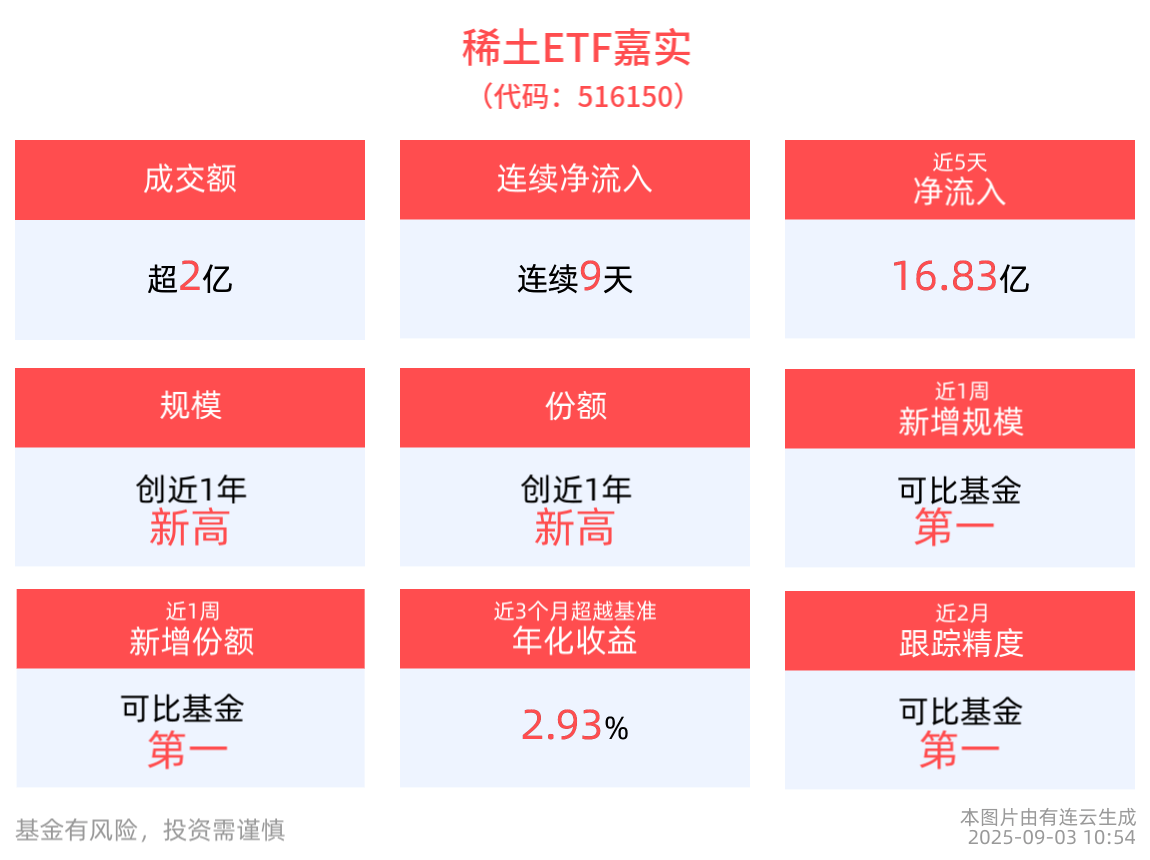
稀土ETF嘉实(516150)盘中涨近1%,连续9天净流入累计“吸金”近28亿元
Sou Hu Cai Jing· 2025-09-03 03:29
Group 1: Liquidity and Scale of Rare Earth ETF - The liquidity of the Rare Earth ETF managed by Jiashi has a turnover rate of 2.35% and a transaction volume of 201 million yuan [3] - As of September 2, the scale of the Rare Earth ETF reached 8.573 billion yuan, marking a new high since its inception and ranking first among comparable funds [3] - The latest share count for the Rare Earth ETF is 4.927 billion shares, also a new high since inception, and ranks first among comparable funds [3] Group 2: Fund Inflows and Performance - The Rare Earth ETF has seen continuous net inflows over the past 9 days, with a maximum single-day net inflow of 486 million yuan, totaling 2.783 billion yuan [3] - Over the past year, the net value of the Rare Earth ETF has increased by 113.75%, ranking 126th out of 2992 index equity funds, placing it in the top 4.21% [3] - Since its inception, the ETF has recorded a maximum monthly return of 41.25%, with the longest consecutive monthly gains being 4 months and the longest cumulative gain of 83.89% [3] Group 3: Industry Insights and Price Trends - The price of praseodymium and neodymium oxide is currently 597,200 yuan per ton, reflecting a week-on-week decrease of 4.05% [4] - The recent implementation of interim measures marks the official start of supply-side reforms in the rare earth industry [4] - July saw a significant increase in magnetic material exports, with month-on-month and year-on-year growth of 75% and 6% respectively, indicating potential for further recovery in exports [4] Group 4: Key Stocks in the Rare Earth Sector - The top ten weighted stocks in the China Rare Earth Industry Index account for 62.15% of the index, with notable companies including Northern Rare Earth and China Rare Earth [3][6] - Northern Rare Earth has a weight of 13.22% and a price increase of 3.43%, while China Rare Earth has a weight of 5.63% and a price decrease of 2.21% [6] - Investors can also access rare earth investment opportunities through the Jiashi Rare Earth ETF linked fund (011036) [6]





双融日报-20250903
Huaxin Securities· 2025-09-03 01:36
Market Sentiment - The current market sentiment score is 47, indicating a "neutral" sentiment [4][8] - Historical trends show that when the sentiment score is below or close to 50, the market tends to receive support, while scores above 90 may indicate resistance [8] Hot Themes Tracking - **Robotics Theme**: NVIDIA is set to launch a new "brain" for robots, with related stocks including Wolong Electric Drive (600580) and Changsheng Bearing (300718) [4] - **GPU Theme**: The Ministry of Industry and Information Technology emphasizes the orderly development of computing power facilities, aiming to enhance the quality of computing resources. Key stocks include Loongson Technology (688047) and Jingjia Micro (300474) [4] - **Rare Earth Theme**: Recent discussions in Shenzhen aim to integrate rare earth materials with low-altitude economy and robotics. Related stocks include Northern Rare Earth (600111) and Guangsheng Nonferrous (600259) [4] Capital Flow Analysis - The top net inflow stocks include: - Julu Intelligent (119,620.42 million) - Gongxiao Daji (71,192.06 million) - Kunlun Wanwei (60,072.23 million) [9] - The top net outflow stocks include: - Xinyi Sheng (316,840.45 million) - Dongfang Caifu (293,292.44 million) - Zhongxing Communication (164,072.01 million) [11] Industry Insights - The report highlights the importance of monitoring market sentiment and capital flows to identify potential investment opportunities and risks in various sectors [20][21]
【2日资金路线图】银行板块净流入近119亿元居首 龙虎榜机构抢筹多股
Zheng Quan Shi Bao· 2025-09-02 12:33
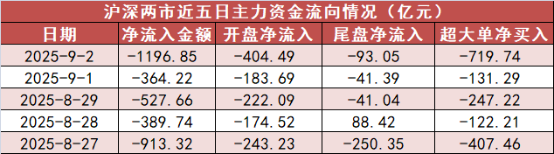
Market Overview - The A-share market experienced an overall decline on September 2, with the Shanghai Composite Index closing at 3858.13 points, down 0.45%, the Shenzhen Component Index at 12553.84 points, down 2.14%, and the ChiNext Index at 2872.22 points, down 2.85%. The North Stock 50 Index increased by 0.4% [1] - The total trading volume in the A-share market reached 29,127.66 billion yuan, an increase of 1,347.62 billion yuan compared to the previous trading day [1] Capital Flow - The main capital in the A-share market saw a net outflow of 1,196.85 billion yuan, with an opening net outflow of 404.49 billion yuan and a closing net outflow of 93.05 billion yuan [2][3] - The CSI 300 index recorded a net outflow of 311.43 billion yuan, while the ChiNext saw a net outflow of 524.41 billion yuan and the Sci-Tech Innovation Board a net outflow of 10.85 billion yuan [4][5] Sector Performance - Among the 4 sectors that experienced net capital inflow, the banking sector led with a net inflow of 118.85 billion yuan, reflecting a 1.69% increase [6][7] - The electronic sector faced the largest net outflow of 497.79 billion yuan, followed by the computer sector with 334.87 billion yuan and the communication sector with 194.06 billion yuan [7] Institutional Activity - The stock "Jilun Intelligent" saw the highest net inflow of main capital at 11.96 billion yuan [8] - Institutional investors showed interest in several stocks, with "Liou Shares" receiving a net purchase of 22,244.99 million yuan, while "Jingwang Electronics" faced a net sell-off of 29,027.97 million yuan [10][11] Institutional Focus - Recent institutional attention has been directed towards stocks such as "Gongchuang Turf" with a target price of 41.02 yuan, representing an upside potential of 28.87%, and "Qingdao Port" with a target price of 12.00 yuan, indicating a 36.05% upside [13]