
中国海洋石油

Search documents
南向资金今日净买入68.15亿港元,腾讯控股净买入14.12亿港元
Zheng Quan Shi Bao Wang· 2026-01-09 14:41
Core Viewpoint - The Hang Seng Index rose by 0.32% on January 9, with southbound capital totaling HKD 111.39 billion, resulting in a net inflow of HKD 6.81 billion [1] Group 1: Southbound Capital Activity - Total southbound trading amounted to HKD 111.39 billion, with buy transactions at HKD 59.10 billion and sell transactions at HKD 52.29 billion, leading to a net buy of HKD 6.81 billion [1] - The Shenzhen Stock Connect saw a total trading volume of HKD 44.30 billion, with net buying of HKD 5.15 billion, while the Shanghai Stock Connect had a total trading volume of HKD 67.08 billion, resulting in a net buy of HKD 1.66 billion [1] Group 2: Active Stocks - Alibaba-W had the highest trading volume among southbound stocks at HKD 99.89 billion, with a net sell of HKD 26.22 billion, despite a closing price increase of 2.73% [1] - Tencent Holdings recorded a net buy of HKD 14.12 billion, closing down by 0.81%, while Xiaomi Group-W had a net buy of HKD 8.70 billion, closing down by 0.53% [1][2] - Kuaishou-W also saw significant activity with a net buy of HKD 7.76 billion, closing up by 3.89% [2] Group 3: Continuous Net Buying - Xiaomi Group-W and Tencent Holdings were noted for continuous net buying, with Xiaomi seeing 7 consecutive days of net buying totaling HKD 55.53 billion, and Tencent with 3 consecutive days totaling HKD 42.31 billion [2]


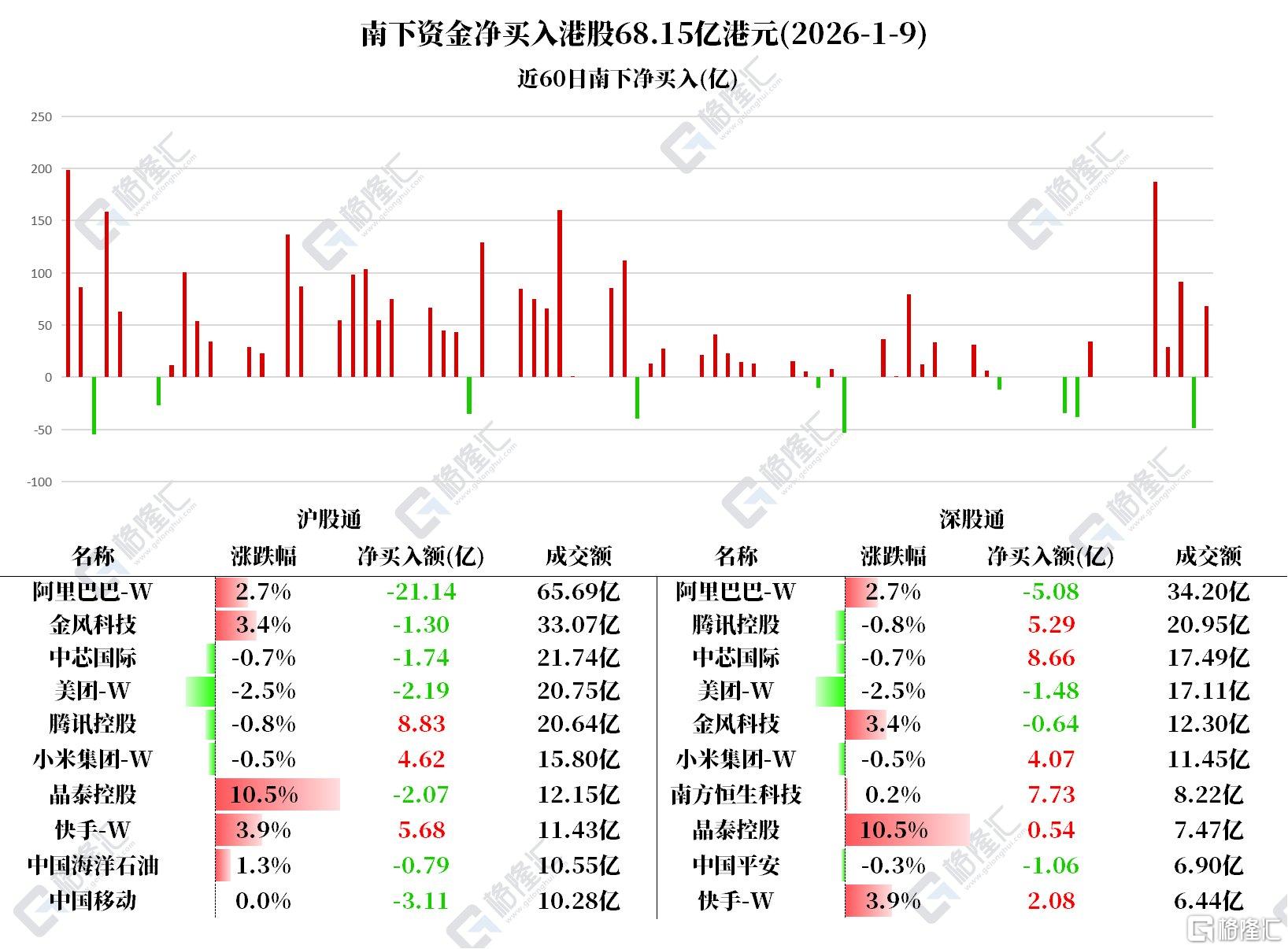
南向资金今日净买入68.15亿港元 腾讯控股净买入14.12亿港元
Zheng Quan Shi Bao Wang· 2026-01-09 14:35
Core Viewpoint - On January 9, the Hang Seng Index rose by 0.32%, with southbound funds totaling HKD 111.39 billion in trading volume, resulting in a net inflow of HKD 6.81 billion [1] Group 1: Southbound Trading Activity - The total trading volume for southbound funds was HKD 111.39 billion, with buy transactions amounting to HKD 59.10 billion and sell transactions at HKD 52.29 billion, leading to a net buy of HKD 6.81 billion [1] - The Hong Kong Stock Connect (Shenzhen) recorded a total trading volume of HKD 44.30 billion, with net buying of HKD 5.15 billion, while the Hong Kong Stock Connect (Shanghai) had a trading volume of HKD 67.08 billion and a net buy of HKD 1.66 billion [1] Group 2: Active Stocks - Alibaba-W had the highest trading volume among southbound funds at HKD 99.89 billion, but experienced a net sell of HKD 26.22 billion, despite a closing price increase of 2.73% [1] - Tencent Holdings saw a net buy of HKD 14.12 billion, with a closing price decrease of 0.81%, while Xiaomi Group-W had a net buy of HKD 8.70 billion [1] - Kuaishou-W recorded a net buy of HKD 7.76 billion, and Meituan-W and China Mobile faced net sells of HKD 3.67 billion and HKD 3.11 billion, respectively [1] Group 3: Continuous Net Buying - Xiaomi Group-W and Tencent Holdings were the only two stocks with continuous net buying for more than three days, with Xiaomi Group-W having a total net buy of HKD 55.53 billion over seven days, and Tencent Holdings with HKD 42.31 billion over three days [2]

港股通(深)净买入51.55亿港元
Zheng Quan Shi Bao Wang· 2026-01-09 14:34
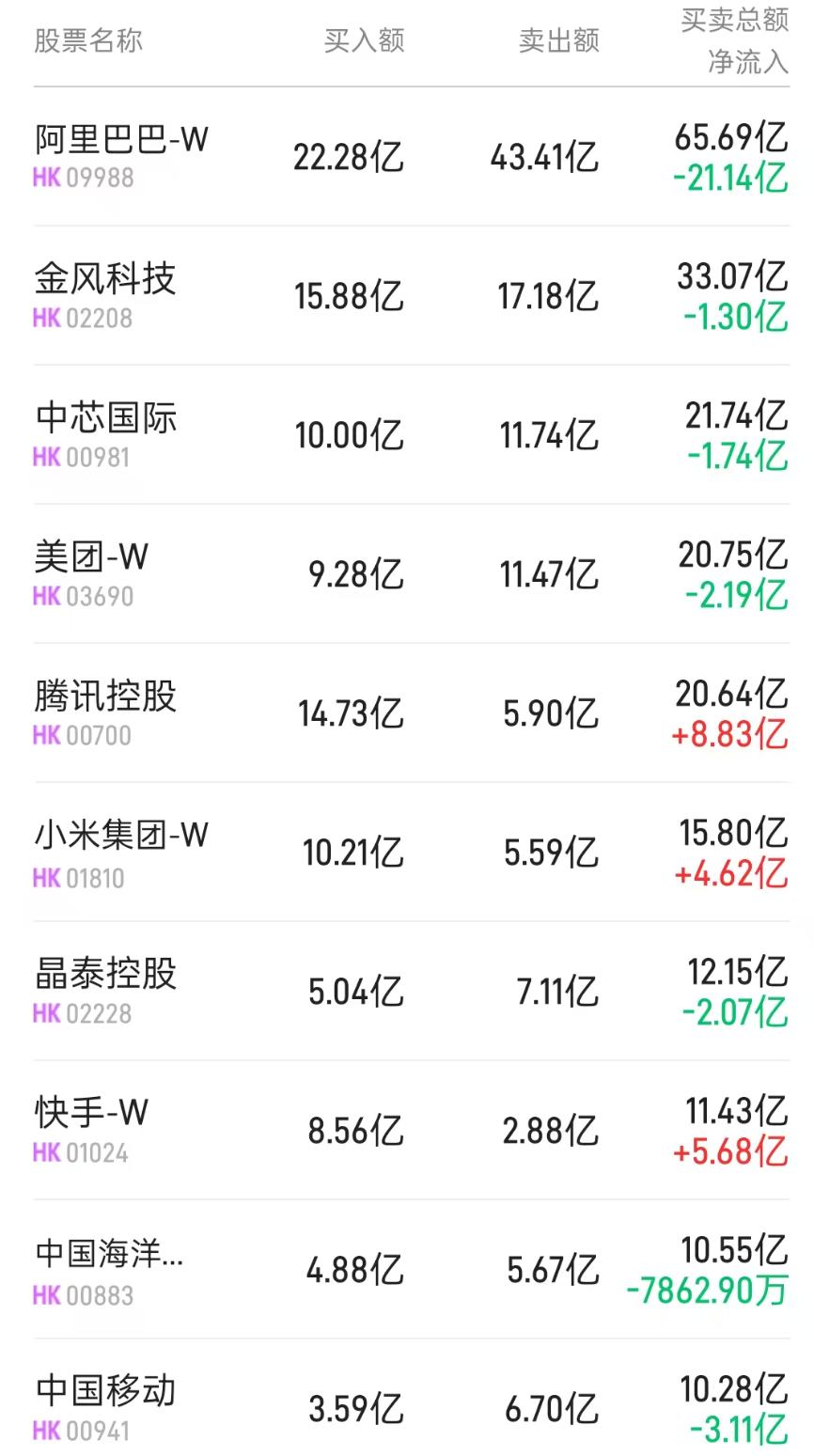
Core Viewpoint - On January 9, the Hang Seng Index rose by 0.32% to close at 26,231.79 points, with a net inflow of HKD 6.815 billion through the southbound trading channel [1] Group 1: Market Activity - The total trading volume for southbound trading on January 9 was HKD 111.389 billion, with a net buying amount of HKD 6.815 billion [1] - The Shanghai Stock Exchange's southbound trading amounted to HKD 67.084 billion, with a net buying of HKD 1.660 billion, while the Shenzhen Stock Exchange recorded HKD 44.305 billion in trading with a net buying of HKD 5.155 billion [1] Group 2: Active Stocks - In the Shanghai Stock Exchange's southbound trading, Alibaba-W had the highest trading volume at HKD 65.69 billion, followed by Goldwind Technology at HKD 33.07 billion and SMIC at HKD 21.74 billion [1] - Tencent Holdings had the highest net buying amount of HKD 0.883 billion, despite a closing price drop of 0.81% [1] - Alibaba-W recorded the highest net selling amount of HKD 2.114 billion, while its closing price increased by 2.73% [1] Group 3: Detailed Stock Data - The top active stocks in the southbound trading on January 9 included: - Alibaba-W: Trading amount of HKD 656.911 million with a net selling of HKD 211.364 million, closing up by 2.73% [3] - Goldwind Technology: Trading amount of HKD 330.673 million with a net selling of HKD 13.003 million, closing up by 3.41% [3] - SMIC: Trading amount of HKD 217.368 million with a net selling of HKD 17.406 million, closing down by 0.73% [3] - Tencent Holdings: Trading amount of HKD 209.478 million with a net buying of HKD 52.898 million, closing down by 0.81% [3]
港股9日涨0.32% 收报26231.79点
Xin Hua She· 2026-01-09 11:58
Core Viewpoint - The Hong Kong Hang Seng Index increased by 82.48 points, or 0.32%, closing at 26,231.79 points, with a total turnover of HKD 245.13 billion [1] Group 1: Index Performance - The Hang Seng Index rose by 82.48 points, closing at 26,231.79 points, reflecting a 0.32% increase [1] - The National Enterprises Index increased by 9.19 points, closing at 9,048.53 points, with a 0.1% rise [1] - The Hang Seng Technology Index gained 8.8 points, closing at 5,687.14 points, marking a 0.15% increase [1] Group 2: Blue-Chip Stocks - Tencent Holdings decreased by 0.81%, closing at HKD 611 [1] - Hong Kong Exchanges and Clearing rose by 0.38%, closing at HKD 426.8 [1] - China Mobile remained unchanged at HKD 80.95 [1] - HSBC Holdings increased by 0.4%, closing at HKD 124.8 [1] Group 3: Local Hong Kong Stocks - Cheung Kong Holdings fell by 0.33%, closing at HKD 42.1 [1] - Sun Hung Kai Properties rose by 1.36%, closing at HKD 104.2 [1] - Henderson Land Development increased by 0.89%, closing at HKD 29.62 [1] Group 4: Chinese Financial Stocks - Bank of China decreased by 0.68%, closing at HKD 4.39 [1] - China Construction Bank fell by 0.26%, closing at HKD 7.59 [1] - Industrial and Commercial Bank of China rose by 0.49%, closing at HKD 6.13 [1] - Ping An Insurance decreased by 0.28%, closing at HKD 70 [1] - China Life Insurance increased by 1.09%, closing at HKD 31.48 [1] Group 5: Oil and Petrochemical Stocks - China Petroleum & Chemical Corporation rose by 0.43%, closing at HKD 4.69 [1] - PetroChina increased by 1.63%, closing at HKD 8.1 [1] - CNOOC gained 1.26%, closing at HKD 20.94 [1]
智通港股通活跃成交|1月9日





智通财经网· 2026-01-09 11:22
Group 1 - On January 9, 2026, Alibaba-W (09988), Goldwind Technology (02208), and SMIC (00981) were the top three companies by trading volume in the Southbound Stock Connect, with transaction amounts of 6.569 billion, 3.307 billion, and 2.174 billion respectively [1] - In the Southbound Stock Connect for the Shenzhen-Hong Kong Stock Connect, Alibaba-W (09988), Tencent Holdings (00700), and SMIC (00981) also ranked as the top three, with transaction amounts of 3.420 billion, 2.095 billion, and 1.749 billion respectively [1] Group 2 - The top active companies in the Southbound Stock Connect included Alibaba-W (09988) with a net buy amount of -2.114 billion, Goldwind Technology (02208) with -0.130 billion, and SMIC (00981) with -0.174 billion [2] - In the Shenzhen-Hong Kong Stock Connect, Alibaba-W (09988) had a net buy amount of -0.508 billion, Tencent Holdings (00700) had +0.529 billion, and SMIC (00981) had +0.866 billion [2]
资金动向 | 北水大买港股逾68亿港元,连续7日加仓小米
Ge Long Hui A P P· 2026-01-09 11:13
Group 1: Investment Trends - Net purchases included Tencent Holdings at 1.412 billion, Xiaomi Group-W at 0.869 billion, Kuaishou-W at 0.776 billion, Southern Hang Seng Technology at 0.772 billion, and SMIC at 0.692 billion [1] - Net sales included Alibaba-W at 2.622 billion, Meituan-W at 0.366 billion, China Mobile at 0.311 billion, Goldwind Technology at 0.194 billion, Jingtao Holdings at 0.153 billion, and Ping An Insurance at 0.105 billion [1] - Southbound funds have recorded net purchases of Xiaomi for 7 consecutive days totaling 5.55407 billion HKD and Tencent for 3 consecutive days totaling 4.23097 billion HKD [1] Group 2: Stock Performance - Alibaba-W saw a decline of 2.7% with a net outflow of 2.114 billion [3] - Tencent Holdings experienced a slight decrease of 0.8% with a net inflow of 0.883 billion [3] - Kuaishou-W had a positive performance with a 3.9% increase and a net inflow of 0.568 billion [3] Group 3: Company Announcements - Xiaomi Group-W announced a price drop of 300 yuan for the Xiaomi 17 standard version, now starting at 4299 yuan, with the promotion running until January 31 [4] - Kuaishou-W's revenue forecast for its Keling AI is projected to exceed 140 million USD in 2025 and reach approximately 230 to 240 million USD in 2026, following a model upgrade and new feature launch [4] - China Ping An received a "buy" rating from Guosen Securities, indicating clear recovery potential in its valuation [5]
北水动向|北水成交净买入68.15亿 阿里(09988)拟加大淘宝闪购投入 北水全天抛售阿里超26亿港元
智通财经网· 2026-01-09 10:02
Group 1 - The Hong Kong stock market saw a net inflow of 68.15 billion HKD from northbound trading, with 16.6 billion HKD from Shanghai and 51.55 billion HKD from Shenzhen [1] - The most bought stocks included Tencent (00700), Xiaomi Group-W (01810), and Kuaishou-W (01024), while the most sold stocks were Alibaba-W (09988), China Mobile (00941), and Goldwind Technology (02208) [1][2] Group 2 - Alibaba-W (09988) had a net outflow of 26.21 billion HKD, with a total trading volume of 65.69 billion HKD, indicating significant selling pressure [2][7] - Tencent (00700) received a net inflow of 14.11 billion HKD, supported by a report from Morgan Stanley highlighting its AI strategy and high potential for monetization [4][5] - Xiaomi Group-W (01810) attracted a net inflow of 8.69 billion HKD, with plans for 200 billion HKD in R&D investment over the next five years [5] - Kuaishou-W (01024) saw a net inflow of 7.76 billion HKD, driven by strong performance in AI-generated content [5] - Semiconductor company SMIC (00981) had a net inflow of 6.92 billion HKD, following a strategic acquisition that is expected to positively impact earnings [6] - Goldwind Technology (02208) faced a net outflow of 1.94 billion HKD, despite potential positive catalysts from its stake in Blue Arrow Aerospace [7]
多家能源央企负责人2024年薪酬披露
Xin Lang Cai Jing· 2026-01-09 06:20
Summary of Key Points Core Viewpoint The recent disclosures from several major energy state-owned enterprises in China regarding the 2024 annual compensation of their executives reveal significant salary figures, reflecting the financial health and strategic priorities of these companies in the energy sector. Group 1: China National Petroleum Corporation (CNPC) - The chairman, Dai Houliang, received a pre-tax salary of 97.85 million RMB, with additional benefits totaling 26.36 million RMB [2] - Other executives, such as Duan Liangwei and Zhou Song, received pre-tax salaries of 85.13 million RMB, with similar additional benefits [2] - The total compensation for various executives includes social insurance, enterprise annuities, and supplementary medical insurance [2] Group 2: China Petroleum and Chemical Corporation (Sinopec) - Chairman Ma Qiansheng's pre-tax salary is reported at 93.55 million RMB, with additional benefits of 23.76 million RMB [3] - Other executives, including Zhang Shaofeng and Li Yonglin, received pre-tax salaries around 83 million RMB, with additional benefits in the range of 23 million RMB [3] - The compensation structure includes social insurance and other monetary income [3] Group 3: China National Offshore Oil Corporation (CNOOC) - Chairman Wang Dongjin's pre-tax salary is 96.69 million RMB, with additional benefits of 26.48 million RMB [5] - Other executives, such as Zhou Xinhai and Wang Rujia, received salaries between 80 million and 86 million RMB, with corresponding benefits [5] - The compensation details include social insurance and housing fund contributions [5] Group 4: China National Petroleum and Natural Gas Pipeline Group - Chairman Rong Wei's pre-tax salary is 87.29 million RMB, with additional benefits of 23.51 million RMB [7] - Other executives received salaries ranging from 6.55 million to 80.02 million RMB, with similar benefits [7] - The compensation includes social insurance and other monetary income [7] Group 5: China Huadian Corporation - Chairman Jiang Yi's pre-tax salary is reported at 96.11 million RMB, with additional benefits of 31.04 million RMB [12] - Other executives, including Ye Xiangdong and Zu Bin, received salaries around 86 million RMB, with substantial additional benefits [12] - The compensation structure includes social insurance and other monetary income [12] Group 6: China Huaneng Group - Chairman Wen Shugang's pre-tax salary is 96.17 million RMB, with additional benefits of 27 million RMB [9] - Other executives received salaries ranging from 40 million to 89 million RMB, with corresponding benefits [9] - The compensation includes social insurance and other monetary income [9] Group 7: China Datang Corporation - Chairman Zhong Yong's pre-tax salary is 92.21 million RMB, with additional benefits of 28.32 million RMB [11] - Other executives received salaries ranging from 6.9 million to 82.99 million RMB, with similar benefits [11] - The compensation structure includes social insurance and other monetary income [11] Group 8: China Longyuan Power Group - Chairman Liu Weiping's pre-tax salary is 61.15 million RMB, with additional benefits of 18.07 million RMB [15] - Other executives received salaries ranging from 45 million to 82 million RMB, with corresponding benefits [15] - The compensation includes social insurance and other monetary income [15] Group 9: Harbin Electric Corporation - Chairman Cao Zhishou's pre-tax salary is 79.11 million RMB, with additional benefits of 20.04 million RMB [17] - Other executives received salaries ranging from 17.80 million to 79.11 million RMB, with similar benefits [17] - The compensation structure includes social insurance and other monetary income [17]



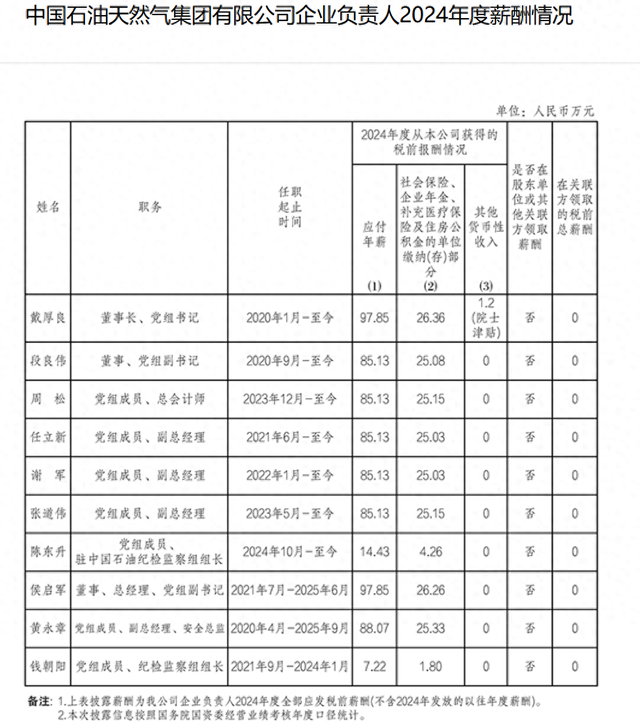
多家能源央企负责人2024年薪酬披露
中国能源报· 2026-01-09 05:43
Core Viewpoint - The article discusses the 2024 annual salary disclosures of executives from several major energy state-owned enterprises in China, highlighting the pre-tax remuneration and additional benefits for key personnel. Group 1: China National Petroleum Corporation (CNPC) - The chairman, Ma Yongsheng, has a pre-tax salary of 935,500 RMB, with additional social insurance and pension contributions totaling 237,600 RMB [3] - Other executives, such as Da Dong and Zhong Ren, also have salaries around 935,500 RMB and 842,000 RMB respectively, with similar additional benefits [3] Group 2: China Petroleum and Chemical Corporation (Sinopec) - Chairman Wang Dongjin's pre-tax salary is 966,900 RMB, with social insurance contributions of 264,800 RMB [5] - Other executives, including Zhou Xinhai and Wang Dehua, have salaries ranging from 289,200 RMB to 867,800 RMB, with similar additional benefits [5] Group 3: China National Offshore Oil Corporation (CNOOC) - Chairman Wang Dongjin earns 966,900 RMB, with social insurance contributions of 264,800 RMB [5] - Other executives have salaries from 14,510 RMB to 867,800 RMB, with additional benefits [5] Group 4: China Huaneng Group - Chairman Wen Shugang's pre-tax salary is 961,700 RMB, with social insurance contributions of 270,000 RMB [9] - Other executives, such as Zhang Wenfeng and Deng Jianling, have salaries ranging from 400,700 RMB to 860,000 RMB [9] Group 5: China Datang Corporation - Chairman Ren Jian's pre-tax salary is 922,100 RMB, with social insurance contributions of 283,200 RMB [11] - Other executives have salaries from 7,680 RMB to 824,900 RMB, with similar additional benefits [11] Group 6: China Huadian Corporation - Chairman Jiang Yi's pre-tax salary is 961,100 RMB, with social insurance contributions of 310,400 RMB [13] - Other executives have salaries ranging from 43,260 RMB to 865,000 RMB, with additional benefits [13] Group 7: China Longyuan Power Group - Chairman Liu Ming's pre-tax salary is 885,700 RMB, with social insurance contributions of 237,000 RMB [14] - Other executives have salaries from 7,250 RMB to 860,000 RMB, with similar additional benefits [14] Group 8: China Energy Investment Corporation - Chairman Yu Bing's pre-tax salary is 953,700 RMB, with social insurance contributions of 292,000 RMB [17] - Other executives have salaries ranging from 42,650 RMB to 850,000 RMB, with additional benefits [17] Group 9: China National Coal Group - Chairman Wang Shudong's pre-tax salary is 910,200 RMB, with social insurance contributions of 287,300 RMB [23] - Other executives have salaries from 15,170 RMB to 819,200 RMB, with similar additional benefits [23]
开年首例央企重组大戏,为何花落中石化中航油合并?市场影响几何?
Xin Lang Cai Jing· 2026-01-09 04:16
Core Viewpoint - The restructuring of China Petroleum & Chemical Corporation (Sinopec) and China Aviation Oil Group (CAOG) marks a significant shift in the domestic aviation fuel market, creating a powerful entity that connects refining to airport fuel sales, thereby reshaping competition in the sector [1][3]. Group 1: Restructuring Details - The restructuring was approved by the State-owned Assets Supervision and Administration Commission (SASAC) and is the first major merger among oil and gas state-owned enterprises since the establishment of the National Oil and Gas Pipeline Group in December 2019 [1]. - Sinopec is the world's largest refining company and the second-largest chemical company, while CAOG is Asia's largest aviation fuel service provider [1][2]. Group 2: Market Implications - The merger is expected to reshape the competitive landscape of the domestic aviation fuel market, with CAOG gaining direct access to stable revenue streams from aviation fuel sales, while Sinopec strengthens its upstream supply chain [1][3]. - China's aviation fuel consumption is projected to grow significantly, with a 13% increase expected in 2024, reaching 39.28 million tons, and a forecast of 75 million tons by 2040 [3]. Group 3: Strategic Considerations - The merger aligns with global trends of vertical integration in the energy sector, enhancing the combined entity's strength in both upstream and downstream operations [4]. - The focus on sustainable aviation fuel (SAF) is critical, as it is seen as a key pathway for decarbonizing the aviation industry, with Sinopec being a pioneer in SAF production in China [5][6]. Group 4: Concerns and Challenges - There are concerns regarding market barriers that may arise from the merger, particularly for private SAF producers, as the new entity may leverage its integrated advantages to dominate the market [7]. - Other suppliers and airlines are apprehensive about potential reductions in market space and the impact on pricing power due to the consolidation of the largest supplier and distributor in the aviation fuel sector [7].