
汉得信息

Search documents
计算机行业研究:动态漫Agent,景气的极致
SINOLINK SECURITIES· 2026-01-25 07:50
Investment Rating - The report indicates a positive investment outlook for the industry, highlighting a "golden window period" for the short drama sector, with expectations for significant growth in the coming years [2][11]. Core Insights - The short drama industry has reached a scale of nearly 1 trillion yuan, surpassing both the film and long video sectors, with a projected compound annual growth rate (CAGR) of over 50% from 2023 to 2026 [11]. - The market for animated dramas is expected to exceed 22 billion yuan by 2026, contributing 50% of the incremental growth in the short drama industry [11]. - ByteDance is positioned as the absolute leader in the animated drama sector, leveraging its "traffic + IP + AI" integrated strategy to dominate the market [2][17]. - The application of AI technology is transforming the production paradigm of animated dramas, reducing production cycles from over 50 days to under 30 days and significantly lowering costs [3][21]. Summary by Sections Section 1: The Golden Window for Short Dramas - The short drama market has surpassed 1 trillion yuan, with user engagement increasing, and the average daily viewing time expected to exceed 100 minutes by 2025 [11]. - The market has entered a phase of rapid growth and commercialization, with significant increases in both supply and demand for animated dramas [11][12]. Section 2: AI Reshaping Production Paradigms - AI technologies are enabling a shift from manual production to industrialized generation, with production costs dropping to the thousand-yuan level [3][21]. - The integration of AI in production processes is expected to streamline workflows, reducing the number of steps from 11 to 5 and cutting costs by 60% [3][24]. Section 3: Trends in AI Applications - The report anticipates a significant uptick in AI applications by 2026, driven by the need for software to leverage substantial computational investments [4][31]. - Companies are increasingly integrating AI into their business models, with some reporting that AI-related revenues account for over 10% of total income [4][31]. Section 4: Related Investment Targets - Key investment targets include companies such as DeCai Co., Zhaochi Co., and Wanxing Technology, among others, which are positioned to benefit from the growth in the animated drama and AI sectors [5][40].



数据复盘丨钙钛矿电池、商业航天等概念走强 191股获主力资金净流入超1亿元




Zheng Quan Shi Bao Wang· 2026-01-23 09:56
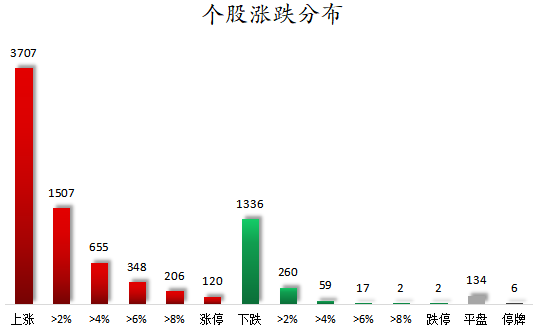
Market Overview - The Shanghai Composite Index closed at 4136.16 points, up 0.33%, with a trading volume of 1.3369 trillion yuan. The Shenzhen Component Index rose 0.79% to 14439.66 points, with a trading volume of 1.7484 trillion yuan. The ChiNext Index increased by 0.63% to 3349.50 points, with a trading volume of 822.63 billion yuan. The STAR Market 50 Index closed at 1553.71 points, up 0.78%, with a trading volume of 110.8 billion yuan. The total trading volume of both markets was 3.0853 trillion yuan, an increase of 393.5 billion yuan compared to the previous trading day [1]. Sector Performance - The market saw more sectors gaining than losing, with notable increases in power equipment, non-ferrous metals, precious metals, defense and military, steel, media, computer, environmental protection, and textile and apparel sectors. Concepts such as perovskite batteries, commercial aerospace, satellite internet, sapphire, lithium mining, cultivated diamonds, small metals, gold, and interactive short dramas were particularly active. In contrast, sectors like communication, insurance, banking, coal, and home appliances experienced declines [1]. Individual Stock Performance - A total of 3707 stocks rose, while 1336 stocks fell, with 134 stocks remaining flat and 6 stocks suspended. Excluding newly listed stocks, there were 120 stocks hitting the daily limit up and 2 stocks hitting the limit down [2]. - Among the stocks that hit the daily limit up, 23 stocks had consecutive limit-up days of 2 or more, with Fenglong Co., Ltd. leading with 18 consecutive limit-ups [3]. Capital Flow - The net capital outflow from the two markets was 4.167 billion yuan, with the ChiNext seeing a net inflow of 1.515 billion yuan. The CSI 300 index experienced a net outflow of 1.005 billion yuan, while the STAR Market saw a net outflow of 3.171 billion yuan. Out of 31 sectors, 13 sectors had net capital inflows, with the power equipment sector leading with a net inflow of 8.977 billion yuan [4][6]. - The top sectors with net inflows included non-ferrous metals (4.552 billion yuan), media (2.173 billion yuan), and defense and military (2.157 billion yuan). Conversely, the communication sector had the highest net outflow of 7.992 billion yuan, followed by electronics (6.350 billion yuan) and machinery (5.077 billion yuan) [4][6]. Notable Stocks - 191 stocks had net capital inflows exceeding 1 billion yuan, with Jin Feng Technology receiving the highest net inflow of 1.861 billion yuan. Other notable stocks included Lens Technology (1.594 billion yuan), Qian Zhao Optoelectronics (1.267 billion yuan), and Xian Dao Intelligent (1.217 billion yuan) [7][8]. - Conversely, 116 stocks experienced net capital outflows exceeding 1 billion yuan, with Xin Yi Sheng leading with a net outflow of 3.471 billion yuan, followed by Zhong Ji Xu Chuang (3.103 billion yuan) and Li Ou Shares (2.604 billion yuan) [10][11]. Institutional Activity - Institutional investors had a net selling of approximately 1.02 billion yuan, with 22 stocks seeing net purchases and 14 stocks net sales. Jin Feng Technology was the most purchased stock by institutions, with a net purchase amount of approximately 266 million yuan [13][14].

2026年人工智能领域该如何投资?
雪球· 2026-01-23 08:19
↑点击上面图片 加雪球核心交流群 ↑ 风险提示:本文所提到的观点仅代表个人的意见,所涉及标的不作推荐,据此买卖,风险自负。 作者: 围棋投研 以下文章来源于围棋投研 ,作者伟琪 围棋投研 . 业内人士,重点覆盖高端制造 来源:雪球 最近公募基金都在发布2025年四季报 , 我也翻阅着学习下 , 发现有几位人工智能领域的基金经理写得不错 , 尤其提及到三个重要问题 , 分享 给球友们 。 第一个问题 : 人工智能到底有没有泡沫 ? 很多投资者都会把这轮人工智能和当年互联网泡沫做比较 , 基金经理们从投资端和产业端分别给到了观点 : 在投资层面 , 就是看基本面和估值的匹配程度 。 一方面 , 互联网泡沫的时候 , 大部分公司都是没有盈利的 , 靠所谓的点击率和用户数讲故事 , 而现在人工智能巨头都有实实在在的业绩和现金 流 , 而且现金流大多是用来做研发再投入和资本开支 , 继续循环 ; 另一方面 , 当年互联网龙头都给到前瞻市盈率 , 就是预测次年利润再给估值 , 哪怕如此都有50倍甚至百倍PE , 而现在科技巨头普遍是30倍左 右 。 最典型就是英伟达 , 从2023年初到2025年底股价涨了10倍 , 但 ...


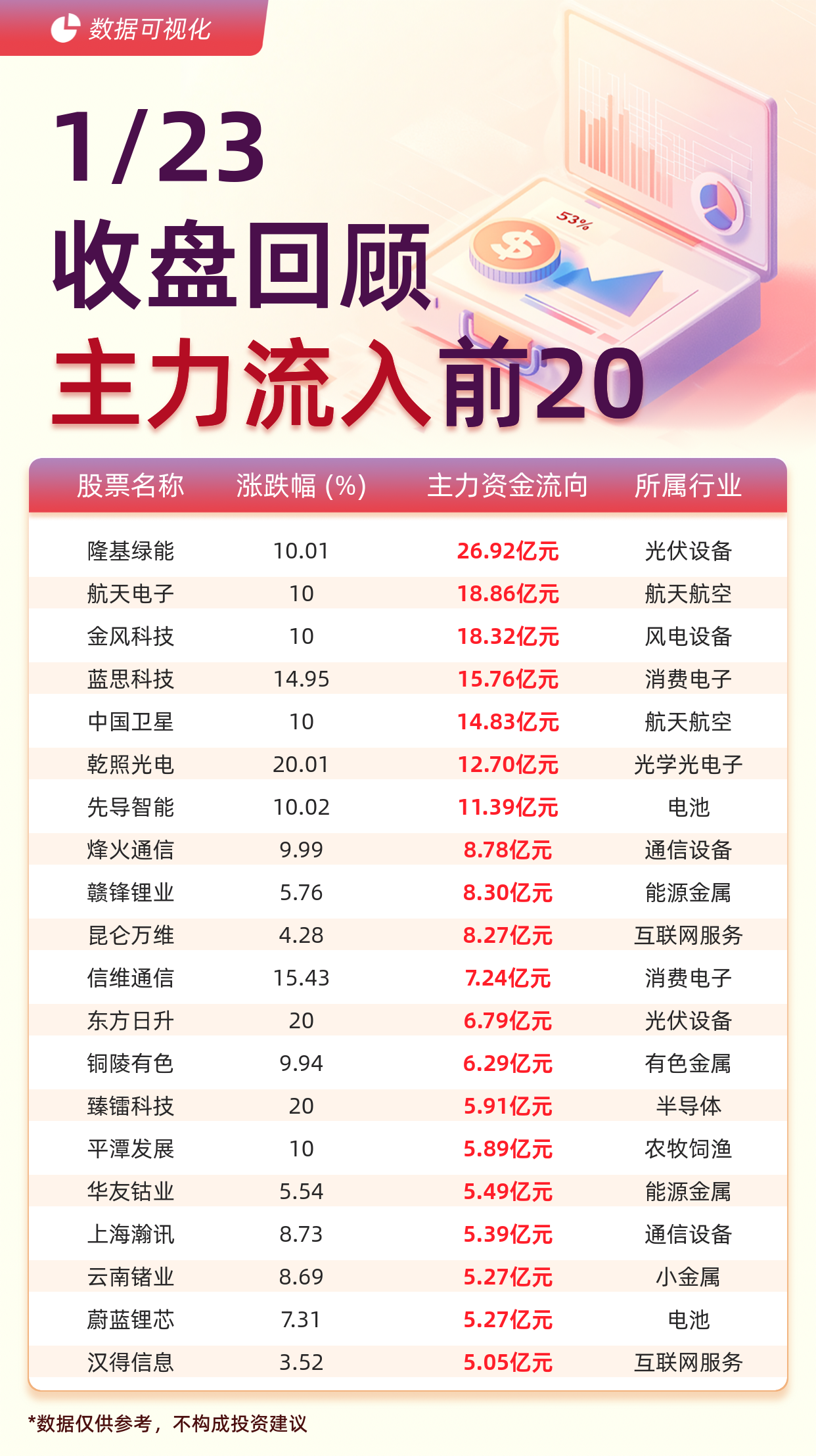
主力资金流入前20:隆基绿能流入26.92亿元、航天电子流入18.86亿元
Jin Rong Jie· 2026-01-23 07:34
Group 1 - The main stocks with significant capital inflow as of January 23 include Longi Green Energy (2.692 billion), Aerospace Electronics (1.886 billion), and Goldwind Technology (1.832 billion) [1] - Longi Green Energy experienced a price increase of 10.01% with a capital inflow of 2.692 billion [2] - Aerospace Electronics and China Satellite both saw a price increase of 10% with capital inflows of 1.886 billion and 1.483 billion respectively [2][3] Group 2 - Jin Feng Technology had a price increase of 10% and a capital inflow of 1.832 billion, indicating strong investor interest in wind energy equipment [2] - The stock of 乾照光电 (Qianzhao Optoelectronics) surged by 20.01% with a capital inflow of 1.270 billion, highlighting its performance in the optical and optoelectronic sector [2] - Other notable stocks include Yunnan Zhiye (5.27 billion) and Han's Information (5.05 billion), both showing positive capital inflows and price increases [3]





兴业证券分析师微信群不当言论引争议
Xin Lang Cai Jing· 2026-01-23 02:29
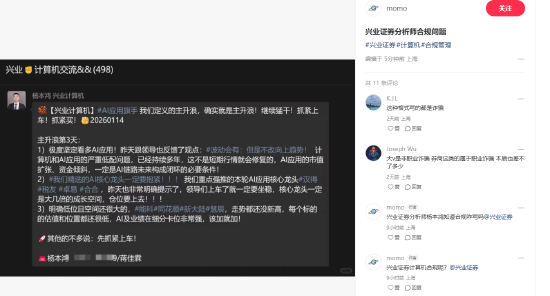
Group 1 - Analysts from Industrial Securities' computer division actively promoted AI stocks in a WeChat group, urging members to invest heavily in selected core AI leaders, including HanDe, ShuiYou, ZhuoYi, and HeHe, claiming significant growth potential [1][2] - The analysts emphasized that the current market conditions present low valuations and strong performance potential for stocks like NengKe, TongHuaShun, XinDaLu, and HuiChen, suggesting that these stocks are still below their recent highs and should be added to portfolios [1][2] - The comments from analysts have sparked controversy, with some netizens criticizing the approach as overly promotional and lacking substance, suggesting that such behavior from TMT sell-side analysts should be scrutinized [1][2]

Data+Al驱动智能决策,实现供应链协同与采购成本优化
爱分析· 2026-01-23 02:18
Investment Rating - The report does not explicitly state an investment rating for the industry. Core Insights - The equipment manufacturing supply chain is transitioning from digitalization to intelligent decision-making, marking a critical phase of smart transformation [7][11]. - The complexity of global supply chains necessitates the adoption of AI technologies for real-time collaboration and intelligent decision-making [8]. - Current digital systems have reached efficiency bottlenecks, highlighting the need for enhanced cross-enterprise collaboration and data integration [12]. Summary by Sections 1. Transition from Digitalization to Intelligent Decision-Making - The equipment manufacturing industry, particularly automotive, is undergoing structural adjustments due to de-globalization, leading to complex supply chain networks involving thousands of suppliers [7]. - Intelligent decision-making is essential to address the challenges posed by global complexity, technological integration, and intensified market competition [8]. - Existing digital systems like ERP and WMS are primarily internal, failing to achieve deep interconnectivity and collaboration across enterprises, resulting in significant efficiency challenges [12]. 2. Intelligent Agents as Key to Supply Chain Collaboration - Generative AI-driven intelligent agents are emerging as solutions to the management challenges faced in complex supply chains, transitioning from algorithmic tools to business assistants [22]. - Intelligent agents can process vast amounts of unstructured data, ensuring real-time and accurate decision support for manufacturers [24]. - They help reduce supplier management difficulties and control procurement costs by analyzing supplier quotes and identifying potential premium areas [26]. 3. Characteristics of Intelligent Agent Technology Vendors - The intelligent agent market consists of four main types of technology vendors: foundational model vendors, industrial software vendors, data intelligence vendors, and AI-native application vendors [31]. - Each vendor type has unique strengths and weaknesses, with foundational model vendors excelling in model capabilities but lacking industry-specific knowledge [31]. 4. Case Study: Yixun Technology - Yixun Technology has developed a Data Agent platform, Alaya, which focuses on data-driven decision-making in the automotive manufacturing sector [35]. - The platform addresses data silos and enhances procurement efficiency, achieving over 60% improvement in procurement processes for a German automotive company [46]. - Yixun's competitive advantage lies in its robust data processing capabilities and deep industry know-how in automotive supply chains [42]. 5. Future Outlook for Intelligent Agents in Equipment Manufacturing - Intelligent agents are evolving from single-point tools to collaborative digital employee clusters, enhancing overall supply chain efficiency [49]. - The progression of intelligent agents will lead to greater autonomy in decision-making, enabling them to perform complex tasks independently [50]. - Future developments will see multiple intelligent agents working together across various supply chain functions, creating a more resilient and agile manufacturing ecosystem [56].
GenAI系列报告之68:2026大模型幻觉能被抑制吗?
Shenwan Hongyuan Securities· 2026-01-22 08:27
Investment Rating - The report maintains a positive outlook on the industry, specifically highlighting the potential for effective control of AI model hallucinations by 2026 [2]. Core Insights - The report emphasizes that while hallucinations in AI models are inevitable, advancements in algorithms, data quality, and engineering practices can significantly reduce their occurrence. The top 25 global models have achieved a hallucination rate below 8% [5][6]. - The report identifies three key areas for investment: mature AI applications, marketing AI that is less sensitive to hallucinations, and data plus AI infrastructure [6]. Summary by Sections 1. Hallucinations - The Lower Bound of Model Capability - The report defines hallucinations as overconfident errors produced by language models, which can include fabrications, factual inaccuracies, contextual misunderstandings, and logical fallacies. For instance, GPT-3.5 had a hallucination rate of approximately 40%, while GPT-4's rate was 28.6% [14][15]. 2. Sources of Hallucinations - Hallucinations arise from several factors, including model architecture, toxic data, lack of accuracy in reward objectives, and context window limitations. Addressing these factors is crucial for controlling hallucinations [7][8]. 3. Reducing Hallucinations: From Models, Data, Engineering, and Agents - The report discusses various strategies to mitigate hallucinations, such as using larger training datasets, extending context windows, and incorporating human feedback through reinforcement learning (RLHF) [25][26]. - Engineering practices like Retrieval-Augmented Generation (RAG) are becoming standard, with Gartner predicting a 68% adoption rate by 2025 [56][57]. 4. 2B Application Penetration and Evolution - The report notes that the control of hallucinations in mainstream models has made significant progress, with the top 25 models in the Vectara HHEM ranking achieving hallucination rates below 8%. For example, the Finix model developed by Ant Group has a hallucination rate of only 1.8% [72].


GEO-AI搜索时代的流量新范式
2026-01-21 02:57
Summary of Key Points from the Conference Call Industry Overview - The document discusses the evolution of internet entry points from portals to search engines and now to AI search, indicating a significant shift in how users access information. Traditional SEO is experiencing diminishing returns, while Generative Understanding (GU) is emerging as a new marketing paradigm [1][3][4]. Core Insights and Arguments - **AI Search and GU Market Potential**: The global GU market is expected to capture 10%-20% of the ICU budget, potentially reaching a market size of tens of billions of dollars. Traditional search engine traffic is projected to decline, with AI-native search gaining market share [1][6]. - **Growth in China**: The Chinese GU market is forecasted to grow rapidly, reaching 5.24 billion yuan by 2030, indicating a nearly ninefold increase over five years [1][8]. - **Business Model Transition**: The GU business model is shifting from project-based to a subscription-based SaaS and PaaS hybrid model, with a clear path demonstrated by overseas benchmark companies [1][9]. - **High Technical Barriers**: GU technology has a higher technical threshold compared to traditional SEO, with a concentration rate of around 60% in the industry, aligning with trends in the computer software sector [1][10]. Important but Overlooked Content - **RAG Architecture**: The RAG architecture involves five key steps: knowledge base construction, vectorization and indexing, retrieval and ranking, context enhancement and generation, and dynamic updates. This framework enhances semantic relevance and authority, forming a trust engineering model [1][5]. - **Market Dynamics**: By 2028, traditional search engine traffic is expected to decline by 25%, with 80% of that traffic shifting to AI dialogue platforms. AI-native search is projected to account for 45% of the global search market by 2028 [6]. - **Company Initiatives**: Companies like MaiFudi and MingYue Technology are actively developing GU capabilities, launching products like GEO Intelligent Body, which have shown promising market feedback [2][11][12]. Company-Specific Developments - **MaiFudi**: Launched GU business in early 2025, with the GEO Intelligent Body generating 9 million yuan in revenue in December 2025, with an annualized revenue potential of 100 to 200 million yuan [11]. - **MingYue Technology**: Focused on GU since 2024, offering a comprehensive solution that includes user intent acquisition, content generation, and distribution [13]. - **Fourth Paradigm**: Their GEO solution includes strategy design, knowledge engineering, effect evaluation, and ecosystem collaboration, aimed at enhancing brand visibility in AI responses [15][16]. Future Trends in Marketing Technology - The marketing technology sector is expected to grow significantly, with a projected compound annual growth rate of nearly 30% over the next five years. Companies that adapt to new technologies will likely capture larger market shares [17]. - AI applications are anticipated to enhance digital transformation in enterprises, benefiting companies with industry-specific knowledge and comprehensive solutions [18][19]. This summary encapsulates the key points from the conference call, highlighting the evolution of GU, market potential, company initiatives, and future trends in the marketing technology landscape.
汉得信息涨2.01%,成交额10.55亿元,主力资金净流出2072.70万元
Xin Lang Cai Jing· 2026-01-21 02:34
Group 1 - The core viewpoint of the news is that Han's Information has shown significant stock price fluctuations and trading activity, with a notable increase in stock price year-to-date and recent declines in the short term [1] - As of January 21, Han's Information's stock price increased by 41.86% this year, but it has decreased by 11.21% in the last five trading days [1] - The company has a market capitalization of 27.437 billion yuan and a trading volume of 1.055 billion yuan on January 21 [1] Group 2 - Han's Information's main business includes ERP software implementation, customer support, and software outsourcing, with revenue contributions from various segments: C2M (33.82%), ERP (31.16%), GMC (23.50%), ITO (11.19%), and others (0.32%) [2] - The company is classified under the computer-IT services industry and is involved in several concept sectors, including SAAS, AI applications, and virtual digital humans [2] - As of December 31, Han's Information reported a revenue of 2.439 billion yuan for the first nine months of 2025, representing a year-on-year growth of 3.67% [2] Group 3 - Han's Information has distributed a total of 415 million yuan in dividends since its A-share listing, with 125 million yuan distributed in the last three years [3] - As of September 30, 2025, the top ten circulating shareholders include Hong Kong Central Clearing Limited and Southern CSI 1000 ETF, with notable changes in their holdings [3]
计算机行业周报:阿里千问新升级,AI应用加速赋能产业
CHINA DRAGON SECURITIES· 2026-01-19 12:24
Investment Rating - The report maintains a "Recommended" investment rating for the computer industry [2][6]. Core Insights - The AI medical sector is experiencing rapid development, with significant commercial opportunities emerging. Major players like NVIDIA and Eli Lilly are investing heavily in AI drug development, while domestic companies like Ant Group are promoting AI health management products [5][13][14]. - Alibaba's Qianwen app has transitioned into the "AI service era," integrating over 400 AI service functions and achieving over 100 million monthly active users, indicating strong user engagement and ecosystem integration [15][17]. - The report highlights the importance of AI infrastructure development in China, emphasizing the need for a self-sufficient and efficient computing foundation to support the growing demand for AI applications [16]. Summary by Sections AI Empowerment in Healthcare - The report notes that AI is reaching a commercialization inflection point in healthcare, with significant investments and partnerships forming to accelerate AI drug development and health management solutions [5][13][14]. - Key areas of growth include AI drug development, AI-assisted medical imaging, and personal health management, which are expected to see increased investment and demand [14]. Development of AI Ecosystem - Domestic tech giants are leveraging their vast user bases and data resources to build comprehensive AI ecosystems, enhancing user experience and operational efficiency [15][16]. - The integration of AI services within existing platforms is seen as a critical factor for rapid deployment and market penetration [15]. Investment Recommendations - The report suggests focusing on AI computing companies such as Cambricon (688256.SH), Haiguang Information (688041.SH), Inspur Information (000977.SZ), and Zhongke Shuguang (603019.SH) [6][17]. - It also recommends monitoring vertical AI application companies like Kingsoft Office (688111.SH), Dingjie Zhizhi (300378.SZ), and Han's Information (300170.SZ) for potential investment opportunities [6][17].