
Grab Holdings Limited

Search documents
Grab Holdings: Cautious Buy Amid Fintech Growth And Improving Unit Economics
Seeking Alpha· 2025-11-30 03:14
Core Insights - Grab Holdings (GRAB) was previously overlooked due to the evolving nature of its fintech business and lackluster growth prospects in Southeast Asia's mobility and delivery markets [1] Company Analysis - The valuations of Grab Holdings indicate a cautious outlook, reflecting the challenges faced in its core business segments [1] Market Trends - The mobility and delivery markets in Southeast Asia are currently not showing strong growth potential, which may impact investor sentiment towards Grab Holdings [1]


滴滴出海,与“中国制造”共赢
Sou Hu Cai Jing· 2025-11-29 08:45
Core Insights - Didi's Q3 2025 financial report shows a total gross transaction value (GTV) of 115.82 billion yuan, a year-on-year increase of 14.8%, marking five consecutive quarters of GTV exceeding 100 billion yuan [2] - The total order volume reached 4.69 billion, up 13.8% year-on-year, with daily orders surpassing 50 million for the first time [2] - Net profit for the quarter was 1.46 billion yuan, reflecting a 57% year-on-year growth [2] Domestic Business Performance - Didi's domestic ride-hailing business GTV was 86.02 billion yuan, a 10.1% increase year-on-year, with order volume at 3.52 billion, up 10.7% [2] - The domestic business continues to show stable growth amidst a recovering market [10] International Business Growth - Didi's international business GTV surged 31% year-on-year to 29.8 billion yuan, with order volume increasing 24.3% to 1.16 billion [2] - The international segment has achieved healthy and sustainable growth, with adjusted EBITDA turning profitable in the first three quarters [2] - Didi's food delivery service, 99Food, has been relaunched in over 30 cities in Brazil, with plans to expand to 100 cities by mid-2026 [8] Strategic International Expansion - Didi's internationalization began in 2015, focusing on strategic investments in regional ride-hailing platforms to understand local markets [5] - The company has made significant moves in Latin America, including acquiring Brazil's largest ride-hailing company, 99, and entering multiple countries in the region [5] - Didi emphasizes a strategy of "cooperation and win-win" and "localization" in its international operations, aiming to develop alongside local markets [9] Future Growth Potential - The overseas market for ride-hailing and food delivery is still in a rapid growth phase, with significant room for penetration compared to developed markets [9] - Didi's promotion of electric vehicle fleets in Mexico positions it as a leader in sustainable transportation in Latin America [9] - The company is expected to transition from a focus on scale to profitability as its international business matures and diversifies into financial technology and other services [10]


Delivery Hero Investors Said to Push for Sale, Divestments
Yahoo Finance· 2025-11-28 10:55
Core Viewpoint - Delivery Hero SE is under pressure from major shareholders to conduct a strategic review due to increasing consolidation in the food delivery industry and poor stock performance [1][2]. Group 1: Shareholder Pressure - Investors, including Aspex Management, Delivery Hero's second-largest shareholder with over 5% stake, are urging management to consider selling the company or parts of its business [2][4]. - Other investors, such as Broad Peak Investment Advisers and PSquared Asset Management, have expressed frustration over the company's lack of progress in improving its loss-making operations and shareholder value [4]. Group 2: Stock Performance - Delivery Hero's shares have decreased approximately 50% over the past year and nearly 90% from their peak in 2021 [2]. - In recent trading, shares of Delivery Hero rose as much as 15%, reaching a market value of €5.9 billion ($6.9 billion) [3]. Group 3: Strategic Options - Analysts from Barclays noted that there is a growing sentiment among investors for a strategic review and potential asset sales [5]. - Potential buyers for Delivery Hero's assets could include competitors like Meituan, Grab Holdings, or Uber, with the Korean business Baedal Minjok being particularly attractive [5]. Group 4: Governance Implications - Disgruntled investors owning over 5% of Delivery Hero could call for a shareholder meeting and potentially withdraw support for management under German regulations, which could negatively impact executive confidence [6].
为何求稳是风险最高的战略抉择?
3 6 Ke· 2025-11-26 01:02
Core Insights - Traditional risk management focused on detailed analysis and careful execution is becoming obsolete in the face of rapid digital transformation and disruptive competitors [1][2] - Companies that fail to adapt quickly to these changes risk being outpaced and potentially eliminated from the market [1][2] Group 1: Industry Transformation - The pace of change in various industries is accelerating, with new competitors leveraging advanced technologies to reshape market dynamics [1] - Companies like Airbnb, Netflix, and OpenAI are examples of how innovation is creating new value sources [1] - The retail sector is particularly affected, with traditional players losing market share to agile competitors like Ulta and TJX [10] Group 2: Executive Perspectives - A study by AlixPartners found that 65% of CEOs believe their companies face significant disruption, with 56% expecting major upheavals in the coming year [4][5] - Over 60% of executives feel their companies are not adapting quickly enough to maintain a competitive edge [6] - There is a widespread difficulty in identifying which disruptive forces to prioritize [7] Group 3: Innovation Challenges - The "innovator's dilemma" persists, with many companies underestimating the risks posed by disruptive technologies [3] - Despite recognizing the importance of innovation, less than 10% of executives are satisfied with their company's performance in this area [3] Group 4: Retail Sector Dynamics - Retailers that adopt a cautious approach to transformation are widening the gap between market demand and supply, making it difficult to catch up with more decisive competitors [9] - Traditional department stores are struggling to maintain relevance as they cling to outdated business models while new players redefine value propositions [10] Group 5: Risk Management and Action - Companies must reassess their understanding of risk, recognizing that inaction can lead to greater dangers [11] - Embracing a culture of experimentation and breaking down complex tasks into manageable parts can facilitate faster adaptation [11][12] - The key to success lies in creating higher value for customers and making bold decisions to accelerate action [12]
文远知行港股上市后首份季报:Q3营收增长144%,Robotaxi营收大涨761%
Sou Hu Cai Jing· 2025-11-25 05:09
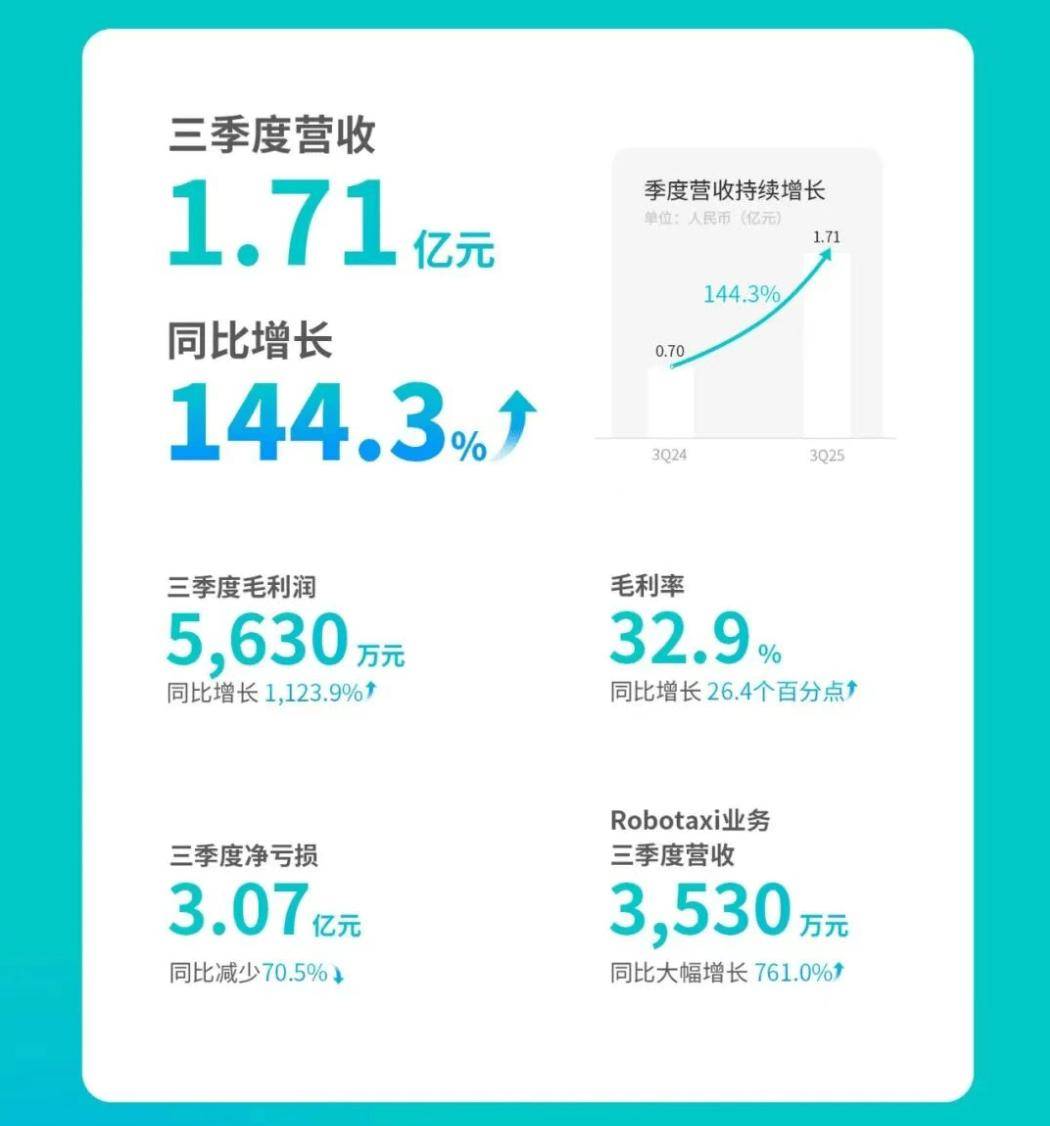
Core Insights - WeRide, known as the "first Robotaxi stock globally," successfully completed its dual listing on the Hong Kong Stock Exchange, filling a gap in the market for Robotaxi stocks in Hong Kong [1][4] - The company reported strong financial results for Q3 2025, with revenue reaching 171 million yuan, a year-on-year increase of 144.3%, and a significant growth in Robotaxi business revenue [3][5] - The company has established a robust presence in the autonomous driving market, with over 1,600 autonomous vehicles globally, including nearly 750 Robotaxis [3][8] Financial Performance - Q3 2025 revenue was 171 million yuan, marking a 144.3% increase year-on-year, the largest quarterly growth since the company's inception [3] - Robotaxi business revenue reached 35.3 million yuan, a staggering 761.0% increase year-on-year [3] - Gross profit was 56.3 million yuan, up 1,123.9% year-on-year, with a gross margin of 32.9%, an increase of 26.4 percentage points year-on-year [3] Market Position and Strategy - WeRide has secured a unique position as the only technology company with autonomous driving licenses in eight countries, showcasing significant first-mover advantages [8][14] - The company has established partnerships with major players like Uber and Grab, enhancing its market reach and operational capabilities [15] - WeRide's strategic focus on commercializing its autonomous driving technology across various applications, including Robotaxi, Robobus, and Robovan, demonstrates its commitment to diversifying revenue streams [5][17] Technological Advancements - The WeRide One autonomous driving platform and WeRide GENESIS simulation engine create high barriers to entry, ensuring reliability and safety in autonomous driving systems [6][9] - The company has maintained a leading position in safety and reliability, with over 55 million kilometers of public road testing and no regulatory penalties due to system failures [11] Global Expansion - WeRide has expanded its operations to 30 cities across 11 countries, transitioning from pilot operations to large-scale deployment [8][17] - The company has recently received approval for fully autonomous Robotaxi operations in Abu Dhabi, marking a significant milestone in its global expansion strategy [15] - The Robotaxi service is set to launch in Singapore, further solidifying WeRide's presence in key international markets [12][14] Future Outlook - The global Robotaxi service market is projected to reach $66.6 billion by 2030, with a compound annual growth rate of 196% from 2025 to 2030, positioning WeRide to benefit from significant market growth [16] - The company is expected to demonstrate the feasibility and scalability of its autonomous driving business model, paving the way for future financial performance improvements [17][18]
消费观察|绕开巨头打差异化竞争,Qpon上线一年“收割”印尼4300万用户
Sou Hu Cai Jing· 2025-11-23 16:57
"这一结构性空白为Qpon提供了差异化切入的契机"。Qpon相关业务负责人向记者表示,Qpon定位不是 单纯的外卖或内容平台,而是将线下店铺线上化经营,移植了国内成熟的"省钱+社交"玩法,并结合本 地用户习惯进行创新。例如,每日早7点准时开启的闪购活动,已成为印尼年轻人的消费习惯;基于邀 请码的社交传播机制,则有效降低了获客成本。在产品层面,Qpon融合了短视频内容、真实用户点评 与即时优惠信息,通过算法为用户智能筛选优质商家与高性价比优惠,有效缩短了从浏览、决策到消费 的路径。当前,Qpon的连锁品牌覆盖率方面达到了80%,以超过5万家有效门店覆盖数位列印尼市场第 一。 不过,Qpon的进一步发展也存在多项挑战。Qpon方面表示,比如,在到店场景,TikTok凭借内容生态 与流量优势强势渗透,外卖领域则有Gojek、Grab 等本土巨头占据主导地位,整体市场竞争日趋激烈。 同时,如何平衡补贴投入与可持续发展,并应对不同地区的消费差异,成为平台必须解决的课题。 外卖、点评、生鲜极速到家……今年以来,本地生活服务赛道竞争激烈,美团、抖音、淘宝、京东等巨 头围绕"到店 - 到家"业务展开的角逐如火如荼。在巨头之外 ...

资本跨洋互联:新交所与纳斯达克“全球上市板”的机遇与变革
Sou Hu Cai Jing· 2025-11-21 09:51
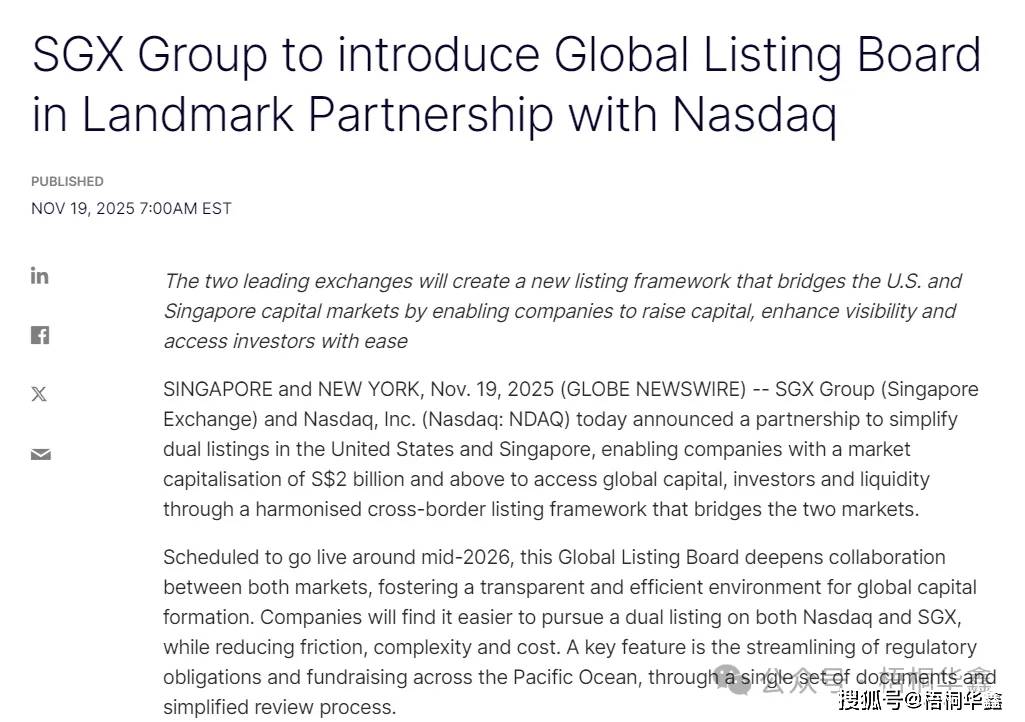
Core Viewpoint - The strategic partnership between Singapore Exchange (SGX) and Nasdaq aims to launch a "Global Listing Board" by mid-2026, facilitating cross-border listings and enhancing connectivity between US capital and Asian growth opportunities [1][3]. Group 1: Partnership Details - The collaboration focuses on regulatory standardization and process optimization to create a standardized cross-border listing solution [3]. - Companies can choose either Nasdaq or SGX as their primary listing venue, using a single prospectus to meet regulatory requirements in both jurisdictions [5]. - The new listing mechanism targets growth-oriented companies with a minimum market capitalization of SGD 2 billion (approximately USD 1.5 billion or CNY 10.9 billion) [5]. Group 2: Market Dynamics - The initiative addresses the challenges faced by SGX, including the outflow of quality listings and insufficient liquidity, as evidenced by local tech companies opting for US listings [7]. - In 2025, SGX's main board completed only 5 IPOs, while Hong Kong's stock market saw a significant increase in trading volume and IPO activity, highlighting the competitive landscape [7]. - The partnership aims to leverage SGX's position as an Asian hub to attract US capital and enhance local market liquidity, creating a "bridge" for companies targeting Southeast Asian markets [7]. Group 3: Benefits and Challenges - The new listing board is expected to reduce compliance costs for companies by 30%-50% through unified review and disclosure processes [5]. - Companies focusing on Southeast Asia may benefit from enhanced brand recognition and a regulatory environment aligned with international standards [5]. - However, companies must navigate the dual compliance requirements of maintaining standards in both markets, which could lead to increased operational burdens [5].
新交所与纳斯达克联手推出双重上市机制
Sou Hu Cai Jing· 2025-11-21 06:25
Group 1 - The core initiative involves a partnership between Singapore Exchange (SGX) and Nasdaq to launch a "Global Listing Board" aimed at simplifying the dual listing process for companies with a market capitalization exceeding 2 billion SGD (approximately 1.5 billion USD) [1][3] - The new framework will significantly streamline the listing process, allowing eligible companies to submit a single set of listing documents through a unified review process to meet the regulatory requirements of both exchanges by mid-2026 [3] - The Monetary Authority of Singapore has announced several measures to enhance market competitiveness, including a "Value Unlock" program with a budget of 30 million SGD to assist companies in improving their strategic, capital optimization, and investor relations capabilities [3] Group 2 - The backdrop for the new framework is Singapore's struggle as a major financial hub in Asia, with insufficient market liquidity leading several local tech companies, such as Grab and Sea Limited, to opt for direct listings in the US [4] - As of early November, SGX's mainboard has recorded only 5 IPOs this year, which is the best performance in recent years but still falls short compared to competitors like the Hong Kong Stock Exchange [4] - The Hong Kong stock market has seen an average daily trading volume exceeding 32 billion USD this year, doubling from the previous year, with 80 IPOs raising over 26 billion USD in the first ten months, ranking first globally in IPO fundraising [4]

新交所与纳斯达克简化两地上市流程
Bei Jing Shang Bao· 2025-11-20 16:16
Core Insights - The Monetary Authority of Singapore (MAS) announced significant measures to enhance the competitiveness of the Singapore stock market, including the establishment of a dual listing bridge between the Singapore Exchange (SGX) and Nasdaq [1][2] - A "Value Unlock" support package worth SGD 30 million was introduced, along with the appointment of a second batch of asset management companies under the Equity Market Development Plan (EQDP) [1] Group 1 - One of the core initiatives proposed in the report is to facilitate a dual listing mechanism between SGX and Nasdaq, aimed at providing quality growth companies with Asian backgrounds and global ambitions the ability to raise funds and liquidity simultaneously in both markets [2] - The plan targets companies with a market capitalization of SGD 2 billion and above, with the new framework expected to launch by mid-2026 [2] - The backdrop for this initiative is the challenges faced by Singapore's securities market, which has seen local companies like Grab and Sea Limited opting for direct listings in the US due to insufficient liquidity [2] Group 2 - As of early November, the SGX mainboard recorded only five IPOs this year, marking the best performance in recent years but still falling short compared to competitors like the Hong Kong Stock Exchange [2] - In contrast, Hong Kong's stock market has seen an average daily trading volume exceeding USD 32 billion this year, doubling from the previous year, with 80 IPOs raising over USD 26 billion in the first ten months, ranking first globally in IPO fundraising [2] - The average daily trading volume of the local stock market in Singapore reached SGD 1.53 billion in Q3 this year, the highest level since Q1 2021 [3]

SGX CEO on How New ‘Dual Listing' With Nasdaq Will Work
Youtube· 2025-11-20 03:20
Core Insights - The new cross-border listing framework aims to attract tech growth companies from Asia to the IPO market, enhancing access to global capital [2][4] - The initiative is expected to launch by mid-next year, pending regulatory approval, and is designed to streamline the IPO process for issuers [3][4] - There is a growing pipeline of over 30 companies preparing for IPOs on SGX, indicating a robust market environment [13] Group 1: IPO Market Dynamics - The IPO market has seen a turnaround recently, with $2.4 billion raised in the third quarter across various companies, including SaaS firms [8] - The framework will provide a single set of documents for issuers, simplifying the regulatory obligations [3] - Companies like Grab and Sea, which previously listed overseas, may consider returning to the local market due to this new mechanism [4] Group 2: Market Opportunities - There is significant interest from unicorns and tech companies in Southeast Asia looking to list, supported by venture capital and private equity [5][10] - The SGX is positioned to attract Chinese companies seeking to expand their footprint outside of China, leveraging multiple listing pathways [9] - The introduction of the Next 50 Index aims to enhance the representation of tech and AI companies within the market [11] Group 3: Future Growth Projections - The company anticipates revenue growth of 6 to 8% over the medium term, with plans to expand its FX business and launch new financial products [14][15] - The ongoing consultations with the ecosystem indicate a positive sentiment among companies looking to IPO, which is expected to bolster the market further [6][7] - The company is exploring acquisitions to strengthen its multi-asset platform, focusing on commodities and risk management tools [16][17]
