
邮储银行

Search documents
国有大型银行板块1月19日跌1.12%,农业银行领跌,主力资金净流出4.07亿元
Zheng Xing Xing Ye Ri Bao· 2026-01-19 08:58
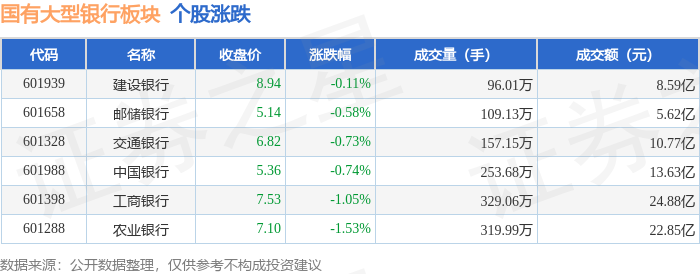
Group 1 - The core viewpoint of the news is that the state-owned large bank sector experienced a decline of 1.12% on January 19, with Agricultural Bank leading the drop [1] - The Shanghai Composite Index closed at 4114.0, up 0.29%, while the Shenzhen Component Index closed at 14294.05, up 0.09% [1] - The trading performance of individual stocks in the state-owned large bank sector showed varied results, with Agricultural Bank down 1.53% and Industrial and Commercial Bank down 1.05% [1] Group 2 - The net outflow of main funds from the state-owned large bank sector was 407 million yuan, while retail investors saw a net inflow of 539 million yuan [1] - The detailed fund flow data indicates that the Agricultural Bank had a significant net outflow of 35.37 million yuan from main funds, but a net inflow of 73.72 million yuan from retail investors [2] - The overall trend shows that while main and speculative funds are withdrawing, retail investors are increasing their positions in certain banks [2]





容百科技被证监会立案 去年三季末东方基金进前十股东
Zhong Guo Jing Ji Wang· 2026-01-19 06:17
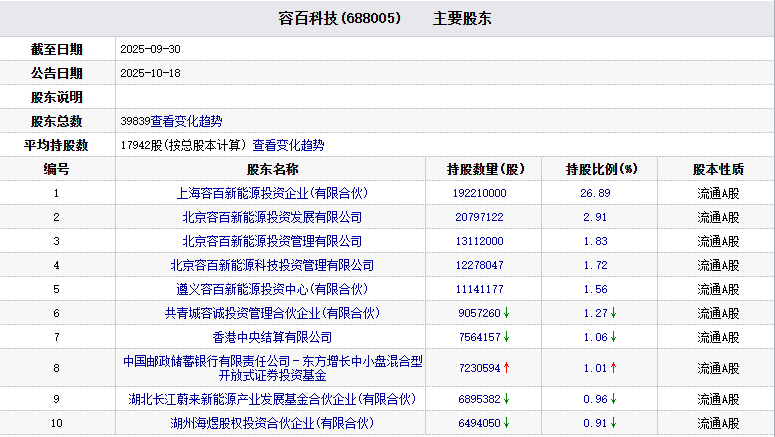
Core Viewpoint - Rongbai Technology (688005.SH) has received a notice of investigation from the China Securities Regulatory Commission (CSRC) due to alleged misleading statements regarding a major contract announcement, while the company's operations continue normally [1][2]. Group 1: Investigation and Contract Details - Rongbai Technology received the CSRC's notice on January 18, 2026, regarding an investigation into potential misleading statements related to a contract with CATL, which involves supplying 3.05 million tons of lithium iron phosphate cathode materials from Q1 2026 to 2031, with a total estimated sales amount exceeding 120 billion yuan [1]. - The company clarified that the previously disclosed "120 billion yuan contract" is an estimate, and the actual sales amount will depend on the final order quantities and raw material prices, indicating uncertainty in the sales figures [2]. Group 2: Financial Performance and Shareholder Information - As of September 30, 2025, China Postal Savings Bank holds a 1.01% stake in Rongbai Technology, making it the eighth largest shareholder [2]. - For the fiscal year 2024, Rongbai Technology reported a revenue of approximately 1.51 billion yuan and a net profit attributable to shareholders of about 295.91 million yuan, with earnings per share of 0.42 yuan [4]. - The company has raised a total of 2.532 billion yuan through two fundraising rounds, with specific allocations for projects and working capital [5][7].

银行资负跟踪20260119:降准降息还有空间
GF SECURITIES· 2026-01-19 04:26
Investment Rating - The industry investment rating is "Buy" [3] Core Viewpoints - The report indicates that there is still room for further cuts in reserve requirement ratios and interest rates, with a focus on structural monetary policy support for high-quality economic development [15][19] - The central bank has implemented a reduction of 0.25 percentage points in various structural monetary policy tool rates, signaling a supportive monetary policy stance [15][19] - The report emphasizes the importance of timing for future policy implementations, particularly in relation to government bond issuance peaks and the maturity schedule of high-interest bank deposits [15] Summary by Sections 1. Monetary Policy Adjustments - The report notes a reduction of 0.25 percentage points in structural monetary policy tool rates, with a focus on supporting key areas through increased re-lending [15] - Future attention is directed towards December economic data and January LPR [22] 2. Central Bank Dynamics and Market Rates - The central bank conducted a total of 9,515 billion yuan in 7-day reverse repos at an interest rate of 1.40%, with a net injection of 9,741 billion yuan [16] - The report highlights that the funding rates remained stable, with expectations of slight increases due to tax payments and government bond net repayments [16] 3. Bank Financing Tracking - The report indicates that the total outstanding amount of interbank certificates of deposit (CDs) is 19.09 trillion yuan, with an average issuance rate of 1.65% [20] - The report also notes that there were no commercial bank bond issuances during the period, with a total outstanding commercial bank bond size of 3.38 trillion yuan [20]



银行业周报:结构性工具降息扩容,对公贷款有望支撑开门红-20260119
Yin He Zheng Quan· 2026-01-19 03:31
Investment Rating - The report maintains a "Recommended" rating for the banking sector, highlighting the continued dividend value of bank stocks and the positive outlook for the sector [39]. Core Insights - The expansion of structural monetary policy tools and interest rate cuts is expected to support banks in stabilizing their interest margins and enhance support for key areas of the real economy [5][39]. - The report anticipates a marginal improvement in corporate financing demand, with public loans expected to continue supporting the bank's credit growth in early 2026 [5][39]. - The report emphasizes the importance of monitoring the effectiveness of policies and the potential for further monetary easing, including a projected 50 basis points (BP) reduction in reserve requirements and a 10-20 BP cut in interest rates throughout the year [8][39]. Summary by Sections Latest Research Insights - The People's Bank of China (PBOC) has reduced the interest rates on various structural monetary policy tools by 25 BP, which is expected to enhance banks' credit allocation to key sectors [7][8]. - The PBOC's measures include increasing the quotas for re-lending to small and medium-sized enterprises and expanding support for technology innovation and green financing [7][8]. Market Performance - The banking sector underperformed the market, with a decline of 3.03% compared to a 0.57% drop in the CSI 300 index [5][15]. - The report notes that only three A-share banks saw an increase in stock prices, while the majority experienced declines [15]. Investment Recommendations - The report suggests focusing on banks that are likely to benefit from the structural monetary policy changes, recommending specific banks such as Industrial and Commercial Bank of China, Agricultural Bank of China, and Postal Savings Bank of China [39]. - The report highlights the ongoing dividend appeal of bank stocks, driven by factors such as low interest rates and substantial dividend payouts [39]. Financial Data - As of December, the total social financing (TSF) showed a year-on-year increase of 8.3%, with corporate loans demonstrating a notable increase, indicating a recovery in financing demand [9][10]. - The report projects that the total new RMB loans in January 2026 will be approximately 5.5-5.6 trillion yuan, with public loans expected to perform slightly better than the previous year [12][39].


农商银行定期存款最新调整:2026年1月,全新存款利率利息解析
Sou Hu Cai Jing· 2026-01-19 02:36
Core Viewpoint - As the Spring Festival approaches, many families are seeking safe and stable savings options due to historically low deposit rates, with rural commercial banks gaining attention for their more flexible interest rates compared to state-owned banks [1][3]. Group 1: Interest Rates Comparison - In January 2026, rural commercial banks in Beijing, Shanghai, Guangzhou, Tianjin, Chengdu, and Suzhou offer varying interest rates, with Chengdu leading significantly [3][10]. - Chengdu Rural Commercial Bank offers the highest rates across all terms, with a 3-year rate of 1.85%, yielding 5,550 yuan in interest for a 100,000 yuan deposit, which is nearly 1,000 yuan more than the major state-owned banks [2][10]. - Suzhou and Tianjin banks also provide competitive rates, particularly in the medium to long term, with Suzhou offering 1.50% for 3 years and 1.55% for 5 years [4][8]. Group 2: Yield Differences - The yield differences become more pronounced with longer deposit terms; for instance, the interest for a 3-year deposit at Chengdu is 1,650 yuan higher than that of Beijing, and the gap widens to 2,750 yuan for a 5-year term [8][10]. - The interest rates for short-term deposits (3 months and 6 months) show minimal differences between rural commercial banks and state-owned banks, making the advantage less clear in those terms [10]. Group 3: Safety and Convenience - All rural commercial banks are regulated financial institutions under the supervision of the central bank, providing the same level of safety for deposits up to 500,000 yuan as state-owned banks [11]. - State-owned banks maintain a strong advantage in terms of convenience, with widespread branch networks and advanced mobile banking services, making them suitable for individuals with frequent travel needs [11].

中信行长调任邮储,邮储银行VS中信银行
数说者· 2026-01-19 00:23
Core Viewpoint - The article analyzes the comparison between Postal Savings Bank of China (PSBC) and Citic Bank, particularly in light of the appointment of Lu Wei, the former president of Citic Bank, as the president of PSBC, and discusses the potential impact of this leadership change on PSBC's operations and strategy [2]. Group 1: Background and Structure - PSBC traces its origins back to 1919 with the establishment of postal savings, and it officially became a limited liability company in 2007, transitioning to a joint-stock company in 2012 [3]. - Citic Bank was established in 1987, evolving from the banking department of the former China International Trust Investment Corporation, and was renamed in 2005 [5]. - As of September 2025, PSBC's major shareholders include China Post Group (51.87%), the Ministry of Finance (15.77%), and China Mobile (6.70%) [4]. - Citic Bank's major shareholders include Citic Financial Holdings (64.75%) and the Ministry of Finance (21.30%) [6]. Group 2: Operational Scale and Network - By the end of 2024, PSBC had 7,899 branches across China, leveraging its extensive postal network, while Citic Bank had 1,470 branches in 153 cities [8]. - PSBC's branch network is significantly larger, especially in rural areas, while Citic Bank has international branches in Hong Kong and London [8]. Group 3: Subsidiaries and Business Focus - PSBC has three major subsidiaries focused on consumer finance, wealth management, and direct banking [9]. - Citic Bank operates seven major subsidiaries, including those in international finance and asset management, indicating a broader range of services [10]. Group 4: Financial Performance - As of the end of 2024, PSBC's total assets were CNY 17.08 trillion, compared to Citic Bank's CNY 9.53 trillion, indicating that PSBC's assets are approximately twice that of Citic Bank [13][14]. - In terms of net profit, PSBC reported CNY 864.79 billion in 2024, while Citic Bank reported CNY 685.76 billion, showing PSBC's profitability advantage [13]. - PSBC's non-performing loan ratio was 0.90% in 2024, lower than Citic Bank's 1.16%, indicating better asset quality [14][37]. Group 5: Income Structure and Cost Efficiency - PSBC's operating income heavily relies on net interest income, which constituted 82.04% of its revenue in 2024, while Citic Bank's was 68.66% [13][25]. - The cost-to-income ratio for PSBC was 64.23% in 2024, significantly higher than Citic Bank's 30%, primarily due to its unique cost structure related to deposit acquisition [47][50]. Group 6: Employee and Compensation Analysis - As of 2024, PSBC employed 197,600 people, significantly more than Citic Bank's 65,500 employees, leading to lower average compensation at PSBC (CNY 324,100) compared to Citic Bank (CNY 600,000) [12][54].

关于富国天成红利灵活配置混合型证券投资基金2026年定期分红规则设定的公告
Sou Hu Cai Jing· 2026-01-18 23:14
Group 1 - The fund operates under a regular open-end structure, allowing for both closed and open periods for subscription and redemption [3][4] - The 17th open period for the fund is scheduled from January 21, 2026, to January 27, 2026, lasting for 5 working days [4] - The fund has a minimum subscription amount of RMB 1 for online transactions, while direct sales require a minimum of RMB 50,000 for the first subscription [7][8] Group 2 - The fund will distribute dividends bi-monthly, with a predetermined amount of RMB 0.015 per share, contingent on meeting distribution conditions [1] - The fund's management has the authority to adjust the dividend amount in the last distribution period if the annual distribution ratio does not meet the required 50% of realized earnings [1] - The fund's net asset value will be disclosed on the following day after each open day through specified channels [17]

海富通瑞祥一年定期开放债券型证券投资基金开放申购、赎回和转换业务的公告
Shang Hai Zheng Quan Bao· 2026-01-18 18:46
根据《海富通瑞祥一年定期开放债券型证券投资基金基金合同》(以下简称"《基金合同》")及《海富 通瑞祥一年定期开放债券型证券投资基金招募说明书》(以下简称"《招募说明书》"),本基金以定期 开放的方式运作。本基金的封闭期为自《基金合同》生效之日起(包括《基金合同》生效之日)或自每 一开放期结束之日次日起(包括该日)一年的期间。本基金的首个封闭期为自《基金合同》生效之日起 (包括《基金合同》生效之日)一年的期间。第二个封闭期为首个开放期结束之日次日起(包括该日) 一年的期间,以此类推。本基金封闭期内不办理申购与赎回业务,也不上市交易。本基金自每个封闭期 结束之后第一个工作日起进入开放期,期间可以办理申购与赎回业务。 本基金《基金合同》生效日为2017年7月28日,经过前期运作,本基金第八个封闭期为2025年1月21日至 2026年1月20日止日。根据本基金《基金合同》、《招募说明书》的规定,基金管理人决定自2026年1月 21日起(含该日)至2026年2月25日(含该日)期间的工作日,本基金接受投资者的申购、赎回、转入 及转出申请。自2026年2月26日至2027年2月25日,为本基金的第九个封闭期,封闭期内本基 ...
现金收付新规如何影响你我生活
Xin Lang Cai Jing· 2026-01-18 17:25
Core Viewpoint - The new regulations issued by the People's Bank of China, the National Development and Reform Commission, and the Financial Regulatory Bureau aim to maintain the legal status of the Renminbi, prevent the refusal of cash payments, and meet the diverse payment service needs of the public, thereby creating a conducive environment for cash circulation alongside various payment methods [1]. Summary by Relevant Sections Regulations on Cash Payment - The core objective of the new regulations is to prevent cash from being marginalized. Specific provisions have been made for different charging entities and business operators regarding cash payment behaviors [1]. - Businesses that can provide face-to-face services, such as restaurants and convenience stores, must support cash payments and ensure sufficient change is available [1]. - For self-service machines or areas with "one card" payment systems, clear signage regarding payment methods and cash conversion processes must be displayed prominently [1]. - Online service providers must publicly disclose payment methods in advance, respecting the public's right to know and choose [1]. - If a business delegates cash collection to another entity, it must do so through written agreements, ensuring that cash acceptance is mandated [1]. Requirements for Commercial Banks - Commercial banks, as key providers of cash services, are required to handle cash deposit and withdrawal services, including the exchange of damaged or old currency [3]. - Bank branches must consider the needs of special groups, such as the elderly and disabled, ensuring accessibility to cash services [3]. - Banks are responsible for ensuring that the cash they collect is clean and suitable for circulation, preventing the distribution of damaged currency [3]. Importance of Cash Payment in the Digital Age - Despite the rise of digital payments, cash remains a fundamental payment tool and a public good, particularly for rural areas and the elderly, who show a strong reliance on cash [5]. - A survey indicated that over 75% of elderly individuals frequently use cash, with 80.4% of elderly individuals in rural areas relying on it [5]. - Issues such as payment discrimination against the elderly due to their unfamiliarity with digital payments have been noted, highlighting the ongoing relevance of cash [5]. Consumer Rights and Complaints - In cases of refusal to accept cash payments, consumers are encouraged to negotiate amicably with the service provider [6]. - If negotiations fail, consumers can retain evidence and report the issue through various channels, including hotlines, for further action by the People's Bank of China and relevant authorities [6].
部分中小银行上调存款利率最高20个基点
Zheng Quan Ri Bao· 2026-01-18 16:42
Core Viewpoint - Several small and medium-sized banks have recently raised deposit rates or issued relatively high-yield deposit products in response to the ongoing decline in deposit rates across the banking sector [1][2]. Group 1: Deposit Rate Adjustments - Jianhu Rural Commercial Bank has increased its deposit rates for its "Xinyi" and "Xinyue" products, with one-year, two-year, and three-year rates set at 1.25%, 1.35%, and 1.6% for deposits under 50,000 yuan, and 1.35%, 1.45%, and 1.7% for deposits between 50,000 and 200,000 yuan [1]. - Hubei Macheng Rural Commercial Bank has adjusted its "Fuman" product rates, increasing the one-year, two-year, and three-year rates to 1.25%, 1.25%, and 1.6%, respectively, with increases of 10 basis points and 5 basis points [1]. - Shangnan Rural Commercial Bank has announced a promotional period until March 31, with three-month, one-year, and two-year rates increased by 15 basis points to 0.8%, 1.15%, and 1.2%, respectively [1]. Group 2: Strategic Insights - Analysts suggest that the recent adjustments in deposit rates by small and medium-sized banks reflect a cautious and targeted strategy to attract deposits, especially given the low net interest margins and the overall downward trend in deposit rates [2][3]. - The banks are leveraging these rate increases to meet year-end performance targets and to support their asset-liability management strategies, particularly in terms of credit issuance [2]. - The overall trend indicates that while deposit rates may continue to decline, the pace of decline may slow compared to previous years, with banks adopting varied pricing strategies based on their individual asset-liability situations [3].