
工商银行

Search documents
金融润“繁花” 信贷织“汉裳”
Jin Rong Shi Bao· 2026-02-05 02:12
Group 1: Core Insights - The city of Heze, known as the "Peony Capital of China," is experiencing a vibrant atmosphere as it prepares for the upcoming Spring Festival, showcasing its unique industries such as peony cultivation and Hanfu culture [1] - Heze Agricultural Commercial Bank has introduced flexible credit products, including an 800,000 yuan "Peony and Chinese Herbal Medicine Loan," to support local farmers in preparing for the peak sales season of peony pots and cut flowers [1] - The People's Bank of China Heze Branch has been actively promoting financial services to support local enterprises, having visited over 400 peony industry entities and established credit files for more than 200, with a total of over 50 million yuan in credit funds disbursed [2] Group 2: Industry Developments - The Hanfu industry in Heze is witnessing a surge in online sales, with a 60% year-on-year increase in sales during the New Year shopping festival, driven by live-streaming sales efforts [2] - Financial institutions in Heze, including Hengfeng Bank, have launched specialized loan products for the Hanfu industry, with loan approval times reduced to within two working days, resulting in a total credit amount of 3.647 billion yuan for the industry, a 43.28% year-on-year increase [3] - As of the end of 2025, the balance of inclusive small and micro loans in Heze reached 94.47 billion yuan, growing by 20.28%, which is significantly higher than the overall loan growth rate [4]



不足3个月,光大银行旗下村镇银行全部“清空”
Xin Lang Cai Jing· 2026-02-05 01:31
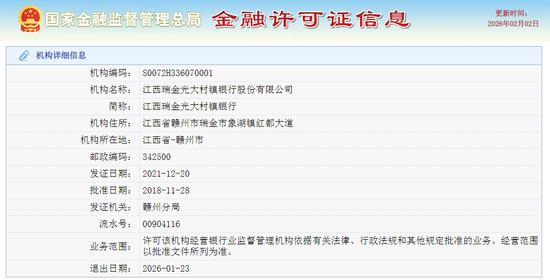
Core Viewpoint - Everbright Bank has completely exited the village bank sector, with three of its village banks shutting down within three months, marking a significant shift in its banking strategy [1][10]. Group 1: Everbright Bank's Village Bank Exits - Everbright Bank's Jiangxi Ruijin Village Bank officially exited on January 23, 2025, following the exit of its Jiangsu Huai'an Village Bank on January 20, 2025, and Shaoshan Village Bank on November 11, 2024 [1][6][10]. - The Jiangxi Ruijin Village Bank was established in November 2018, with a registered capital of 150 million yuan, and had total assets of 819 million yuan and net assets of 191 million yuan as of June 2024 [6][10]. - The exit of these banks has resulted in Everbright Bank having no remaining village banks under its management [1][10]. Group 2: Other Banks' Village Bank Exits - Other banks, including Pudong Development Bank, Huaxia Bank, Hengfeng Bank, and Minsheng Bank, have also seen village banks exit, with Pudong Development Bank having the highest number at 13 exits from July 2024 to January 2025 [1][12][15]. - As of February 2, 2025, Huaxia Bank and Hengfeng Bank each had three village banks exit, while Minsheng Bank had two [12][16]. Group 3: Industry Trends - Since 2025, a total of 335 village banks have exited the market, accounting for 75% of all exits, indicating a significant trend in the restructuring of the village banking sector [19]. - The regulatory focus has shifted towards accelerating the reform and risk management of small financial institutions, with a clear directive from the central government to promote the orderly reform and restructuring of village banks [19].


强化财政金融协同联动 合力推动经济高质量发展
Zheng Zhou Ri Bao· 2026-02-05 00:51
Group 1 - The meeting between An Wei, the Secretary of the Zhengzhou Municipal Committee, and Liu Jun, the Vice Chairman and President of the Industrial and Commercial Bank of China (ICBC), highlights the importance of collaboration for economic development in Zhengzhou [2][3] - An Wei expressed gratitude for ICBC's long-term support in the economic and social development of Zhengzhou, emphasizing the city's commitment to high-quality development and innovation-driven growth during the 14th Five-Year Plan period [2] - Zhengzhou aims to enhance its competitiveness and improve the well-being of its citizens by implementing innovative strategies and governance models, while also seeking to leverage opportunities from the comprehensive reform pilot for market-oriented allocation of factors [2][3] Group 2 - Liu Jun outlined ICBC's domestic and international business operations, reaffirming the bank's commitment to fulfilling its responsibilities as a state-owned bank and supporting high-quality economic development in collaboration with Zhengzhou [3] - The discussion included exploring new mechanisms for financial collaboration and the role of finance in empowering economic growth and efficient governance [3]
信用修复政策落地带动查询需求攀升
Xin Lang Cai Jing· 2026-02-04 23:40
Core Viewpoint - The implementation of the one-time credit repair policy in Liaoning has significantly increased the demand for personal credit report inquiries, with daily queries averaging around 8,000 and peaking over 13,000 since the policy's launch on January 1, 2025 [1][2] Group 1: Policy Implementation - The People's Bank of China introduced a one-time credit repair policy effective from December 2025, allowing individuals to have overdue information removed from their credit reports if they repay debts of up to 10,000 RMB by March 31, 2026 [1] - A comprehensive "online + offline" service system has been established in Liaoning to facilitate the implementation of this policy, ensuring coverage in key areas across the province [1] Group 2: Online and Offline Services - Online services include three main channels: the official website of the People's Bank of China Credit Center, the "Yunshanfu" mobile app, and online banking services from commercial banks [1] - Offline, there are 20 credit inquiry service windows and 312 self-service inquiry machines available throughout the province, with specific locations and contact information accessible on the official website [2] Group 3: Public Awareness and Safety - The credit repair policy is free and does not require any application or third-party involvement, with warnings issued against potential scams related to the policy [2]
上海盛剑科技股份有限公司关于2026年1月提供担保的进展公告
Zhong Guo Zheng Quan Bao - Zhong Zheng Wang· 2026-02-04 22:44
Overview of Guarantees - The company has provided guarantees for its subsidiaries, including both direct and indirect guarantees, with a total expected guarantee amount for 2026 not exceeding RMB 4 billion (including equivalent foreign currency) [6][22]. - The guarantees are aimed at improving the efficiency of applying for comprehensive credit limits from banks and meeting operational and business development needs [6][21]. Specific Guarantee Agreements - On January 20, 2026, the company's wholly-owned subsidiary, Jiangsu Shengjian Environmental Equipment Co., Ltd., signed a guarantee contract with Industrial and Commercial Bank of China, with a maximum principal debt of RMB 30 million [1][9]. - On January 27, 2026, Jiangsu Shengjian signed a maximum guarantee contract with Shanghai Bank, with a maximum principal debt of RMB 340 million [2][14]. - On the same day, the company signed a similar contract with Shanghai Bank for its subsidiary, Shanghai Shengjian Semiconductor Technology Co., Ltd., with a maximum principal debt of RMB 80 million [3][18]. - On January 28, 2026, the company signed a guarantee contract with Kunshan Rural Commercial Bank, with a maximum principal debt of RMB 200 million [4][19]. Guarantee Structure and Terms - The guarantees include various forms such as credit guarantees, collateral, and pledges, and cover both new guarantees and extensions of existing ones [7][21]. - The guarantee period for the contracts varies, with some lasting up to three years after the principal debt's maturity [13][17]. Board of Directors' Opinion - The board of directors believes that the expected guarantee amounts are reasonable and necessary for the company's and its subsidiaries' ongoing operations and development [22]. - The board has approved the guarantee amounts and submitted them for shareholder review, emphasizing that the risks are manageable and will not adversely affect the company's operations [22][21]. Cumulative Guarantee Situation - As of the announcement date, the total amount of guarantees provided by the company and its subsidiaries is RMB 4 billion, which represents 237.89% of the company's latest audited net assets [22]. - There are no overdue guarantees, and the company has not provided guarantees to controlling shareholders or related parties [22].

健康元药业集团股份有限公司 关于为控股子公司提供担保进展情况的公告
Zhong Guo Zheng Quan Bao - Zhong Zheng Wang· 2026-02-04 22:40
Core Viewpoint - The company has entered into guarantee agreements to support its subsidiaries' financing needs, ensuring operational continuity and financial stability [3][5][13]. Group 1: Guarantee Agreements - In January 2026, the company’s subsidiary, Lijuz Pharmaceutical Group, signed guarantee agreements with three banks, with total guarantee amounts of RMB 10,000 million, RMB 30,000 million, and RMB 60,000 million [3]. - The guarantees are for Lijuz Pharmaceutical's wholly-owned or controlled subsidiaries, and there are no related party guarantees involved [3]. - The company has authorized its legal representative to sign relevant documents regarding the guarantees, assuming joint liability [4][5]. Group 2: Financing Support Framework - A framework agreement was established for Lijuz Group to provide continuous financing guarantees for its subsidiary, Lijuz Monoclonal Antibody, from January 1, 2025, to December 31, 2027, with an annual limit of RMB 21,000 million [5]. - The company will provide counter-guarantees based on its equity stake in Lijuz Monoclonal Antibody, ensuring financial backing until the end of Lijuz Group's guarantee obligations [5][15]. Group 3: Financial Health and Risk Management - As of January 31, 2026, the total guarantee balance of the company is RMB 228,478.14 million, which is 15.72% of the latest audited net assets [16]. - There are no overdue guarantees as of the same date, indicating effective risk management and financial health [17].

智通ADR统计 | 2月5日





智通财经网· 2026-02-04 22:19
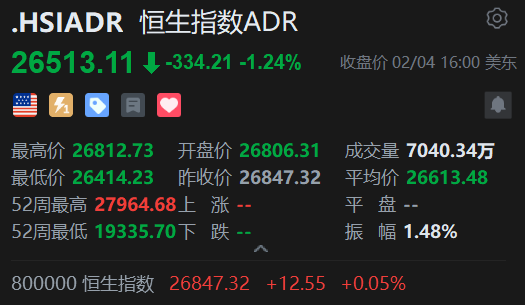
Market Overview - The Hang Seng Index (HSI) closed at 26,513.11, down by 334.21 points or 1.24% [1] - The index reached a high of 26,812.73 and a low of 26,414.23 during the trading session [1] - The trading volume was 70.4034 million shares, with an average price of 26,613.48 [1] Major Blue-Chip Stocks Performance - HSBC Holdings closed at HKD 139.704, up by 0.51% compared to the previous close [2][3] - Tencent Holdings closed at HKD 552.190, down by 1.04% compared to the previous close [2][3] - Alibaba Group (W) closed at HKD 159.500, down by 0.93% [3] - AIA Group closed at HKD 90.700, up by 1.40% [3] - Xiaomi Group (W) closed at HKD 33.960, down by 1.85% [3] - Meituan (W) closed at HKD 92.150, down by 1.13% [3] - China Ping An closed at HKD 72.050, up by 1.05% [3] ADR Performance - Tencent's ADR (TCEHY) was priced at USD 552.190, reflecting a decrease of 1.04% compared to its Hong Kong counterpart [3] - Alibaba's ADR (BABA) was priced at USD 155.411, down by 2.56% compared to its Hong Kong counterpart [3] - HSBC's ADR (HSBC) was priced at USD 139.704, up by 0.51% compared to its Hong Kong counterpart [3]
并购贷款新规落地满月:银行战略棋局浮出水面
Zhong Guo Zheng Quan Bao· 2026-02-04 20:29
Core Insights - The implementation of the new regulations for merger and acquisition (M&A) loans has prompted banks to actively expand their M&A loan business, aiming to establish competitive advantages through early entry into the market [1][2] - The new regulations have broadened the scope of M&A loans, allowing for equity acquisitions and optimizing loan conditions, which is expected to enhance banks' asset yield [2][3] Group 1: Market Dynamics - Several banks, including Industrial and Commercial Bank of China (ICBC), China Construction Bank, and Shanghai Pudong Development Bank, have entered the M&A loan market since the new regulations were introduced on December 31, 2025, initiating a "first deal competition" [1][2] - Beijing Bank successfully executed the first M&A loan under the new regulations, providing 21 million yuan to support a private technology company's acquisition of a 35% stake in another firm, with a financing ratio of 60% and a three-year term [1] Group 2: Regulatory Changes - The new M&A loan regulations have evolved from strict to more flexible frameworks, introducing three key changes: expanding the applicable scope of M&A loans, optimizing loan conditions, and setting differentiated qualification requirements for banks [2][4] - The regulations allow for a higher proportion of control-type M&A loans in relation to the total transaction value and extend the maximum loan term [2] Group 3: Strategic Importance - M&A loans are increasingly recognized for their potential to enhance banks' asset yields, especially in the context of narrowing interest margins and sluggish growth in traditional lending [3] - The M&A loan business is characterized by strong customer loyalty, high comprehensive returns, and significant barriers to entry, making it a strategic focus for banks aiming to differentiate themselves in a competitive landscape [3] Group 4: Challenges and Opportunities - Despite the growth potential, the complexity and specialization required for M&A loans present challenges for banks, which must navigate multiple stakeholders and legal relationships [4] - Banks are encouraged to develop a comprehensive ecosystem that includes M&A facilitation, financing, and post-investment management to effectively compete in the M&A finance sector [4]




业务增长新风口!银行拓展并购贷款业务
Zhong Guo Zheng Quan Bao - Zhong Zheng Wang· 2026-02-04 15:49
Core Insights - The implementation of the "Commercial Bank M&A Loan Management Measures" has created new growth opportunities for commercial banks, with several banks actively expanding their M&A loan business to build competitive advantages through case accumulation and brand development [1][4] Group 1: Regulatory Changes and Market Response - The new M&A loan regulations allow for a broader application of loans, including support for equity-based mergers, which is expected to facilitate resource optimization and transformation for traditional industries [1][4] - Banks like Shanghai Pudong Development Bank view the new regulations as a chance to enhance service capabilities and expand their service boundaries, leading to a multi-faceted growth in M&A loan business across various branches [2][3] Group 2: Initial Successes and Competitive Landscape - Since the introduction of the new regulations, banks have begun a "first deal competition," with Beijing Bank successfully providing a loan of 21 million yuan for a 35% equity stake in a private listed technology company, marking one of the first innovative practices under the new guidelines [3] - Industrial and Commercial Bank of China issued a 299 million yuan loan to support a company's acquisition of core assets, representing the first control-type M&A loan after the new regulations came into effect [3] Group 3: Growth Potential and Profitability - The M&A loan business has seen a compound annual growth rate of nearly 30% among leading banks, indicating a growing recognition of the financial value of M&A loans as a means to enhance intermediate business and overall revenue amid narrowing interest margins [4][5] - The new regulations are expected to release significant market potential, particularly in key national strategic areas such as technological innovation and manufacturing upgrades, allowing banks to rapidly scale their business [5] Group 4: Challenges and Strategic Shifts - Despite the growth potential, the complexity and specialization of M&A loans present challenges for commercial banks, necessitating a shift from being mere credit providers to offering comprehensive financial services that include financing, advisory, and post-transaction management [6][7] - Banks are encouraged to build specialized teams and enhance their understanding of industries to better match the complexity of M&A loans with appropriate risk management systems [7]

2026年信贷资源重点流向哪里?央行这场重磅会议明确
2 1 Shi Ji Jing Ji Bao Dao· 2026-02-04 14:57
Core Viewpoint - The People's Bank of China (PBOC) is focusing on enhancing structural monetary policy tools and coordinating with fiscal policies to support key areas such as consumption, technological innovation, and small and micro enterprises in 2026 [1][2]. Group 1: Structural Monetary Policy - The PBOC aims to improve the mechanisms of the "five major articles" of finance and implement structural monetary policy tools to support economic transformation [1]. - On January 15, the PBOC announced a 0.25 percentage point reduction in the interest rates of various structural monetary policy tools and increased the quotas for agricultural and small enterprise loans by 500 billion yuan [1]. - The PBOC will accelerate the implementation of recently introduced structural monetary policy tools to enhance support for key sectors [2]. Group 2: Financial Support for Consumption - Strengthening financial support for consumption is a key focus for the 2026 credit market work, as low consumer spending is a significant constraint on domestic demand [3]. - The Ministry of Commerce, PBOC, and financial regulatory authorities have issued policies to enhance collaboration between commerce and finance to boost consumption [3]. - The PBOC plans to maintain a moderately loose monetary policy to create a favorable financial environment for boosting consumption and expanding domestic demand [3]. Group 3: Financing Platform Debt Risk Management - The PBOC is committed to supporting the resolution of debt risks associated with financing platforms and guiding financial institutions to serve these platforms under market-oriented principles [6]. - As of the end of 2024, approximately 40% of financing platforms have exited the market through transformation, with their operating financial debt decreasing by about 25% compared to early 2023 [7]. - The PBOC will continue to implement policies for managing financing platform debt risks and promote the transformation and development of these platforms [7].