
泸州老窖

Search documents
泸州老窖:拟每10股派发现金红利13.58元 合计派发现金红利约20亿元
Mei Ri Jing Ji Xin Wen· 2026-01-09 10:25
每经AI快讯,1月9日,泸州老窖(000568)(000568.SZ)公告称,公司2025年中期利润分配方案为以现 有总股本14.72亿股为基数,向全体股东每10股派发现金红利13.58元(含税),合计拟派发现金红利约20 亿元(含税)。 ...

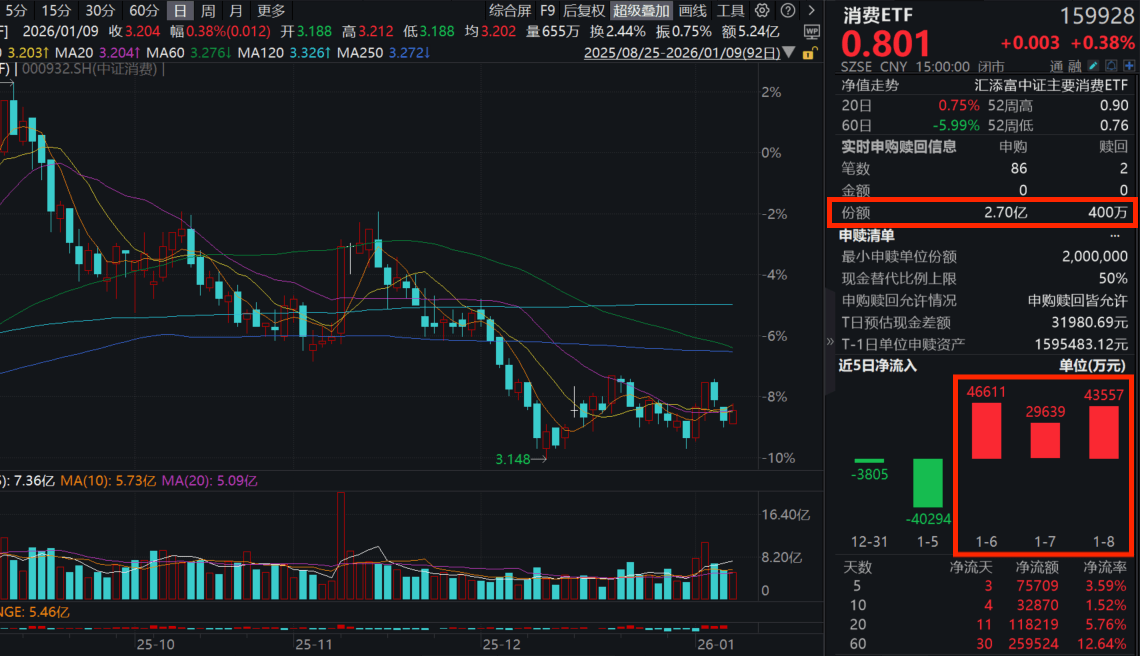
12月CPI环比由降转涨,核心CPI上涨1.2%!消费ETF(159928)再度飘红,连续第4日大举净流入超2.1亿元,累计揽金超14亿元!
Xin Lang Cai Jing· 2026-01-09 09:49
Core Viewpoint - The Chinese stock market shows positive momentum with the Shanghai Composite Index rising by 0.92% and surpassing the 4100-point mark, driven by favorable CPI data and significant inflows into consumer ETFs [1][3]. Economic Indicators - The National Bureau of Statistics reported that the Consumer Price Index (CPI) increased by 0.8% year-on-year in December, with a month-on-month rise of 0.2%. The core CPI, excluding food and energy, rose by 1.2% year-on-year [3][7]. - The Producer Price Index (PPI) saw a month-on-month increase of 0.2% but a year-on-year decline of 1.9%, indicating a mixed outlook for industrial pricing [3][6]. Market Performance - The Consumer ETF (159928) experienced a net inflow of 2.66 million units, accumulating over 14 billion yuan in total, with its latest scale exceeding 218 billion yuan, leading its peers in the same category [1][3]. - The valuation of the Consumer ETF's underlying index stands at a TTM P/E ratio of 19.29, which is in the 2.76% percentile over the past decade, indicating a favorable valuation compared to historical levels [3]. Sector Insights - The Hong Kong Stock Connect Consumer 50 ETF (159268) also saw a rise of 0.22%, with significant trading volume, highlighting investor interest in consumer stocks [5]. - The consumer sector is characterized by a "K-shaped" consumption pattern, where high-end and high-value products are favored by some consumers, while others seek high utility and low-cost options [10][11]. Investment Opportunities - The consumer ETF's underlying index is noted for its resilience across economic cycles, with top holdings including leading liquor brands and major agricultural companies, indicating strong fundamentals in the consumer sector [11].

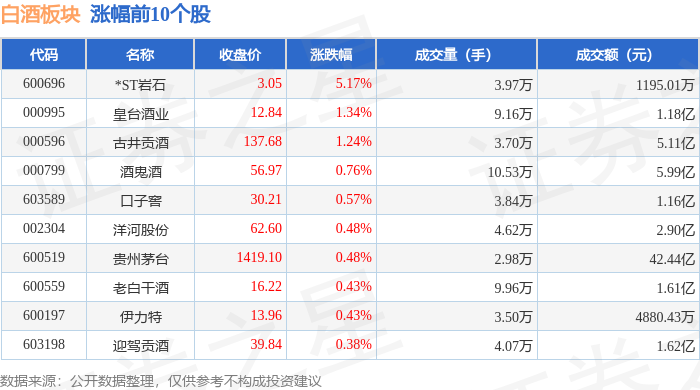
白酒板块1月9日涨0.4%,*ST岩石领涨,主力资金净流出8893.72万元
Zheng Xing Xing Ye Ri Bao· 2026-01-09 08:54
Group 1 - The liquor sector experienced a 0.4% increase on January 9, with *ST Yanshi leading the gains [1] - The Shanghai Composite Index closed at 4120.43, up 0.92%, while the Shenzhen Component Index closed at 14120.15, up 1.15% [1] - Key stocks in the liquor sector showed varied performance, with *ST Yanshi rising by 5.17% to a closing price of 3.05 [1] Group 2 - The main capital flow in the liquor sector showed a net outflow of 88.94 million yuan from institutional investors, while retail investors had a net inflow of 89.93 million yuan [2] - Individual stock capital flows indicated that Kweichow Moutai had a net inflow of 98.51 million yuan from institutional investors, despite a net outflow from retail investors [3] - Gujing Gongjiu saw a significant net inflow of 67.90 million yuan from institutional investors, while also experiencing outflows from retail investors [3]




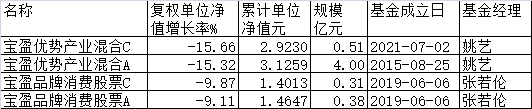
2025年宝盈基金旗下4只基金跌超9% 2只基金跌幅达15%
Zhong Guo Jing Ji Wang· 2026-01-09 08:09
Group 1 - In 2025, four funds under the management of Baoying Fund experienced a decline of over 9% [1] - The Baoying Advantage Industry Mixed C and A funds, managed by Yao Yi, fell by 15.66% and 15.32% respectively [1] - The top ten holdings of Baoying Advantage Industry Mixed fund include companies such as Bai Li Tian Heng, Heng Rui Pharmaceutical, and WuXi AppTec [1] Group 2 - The Baoying Brand Consumption Stock C and A funds, managed by Zhang Ruolun, declined by 9.87% and 9.11% respectively [2] - The Baoying Brand Consumption fund diversifies its holdings across various consumer sectors, including liquor, home appliances, and leisure food [1] - The top ten holdings of Baoying Brand Consumption fund include Kweichow Moutai, Tencent Holdings, and Haidilao [1]
每天限售6瓶仍秒光!茅台直销战略调整,藏着经济转型大信号
Sou Hu Cai Jing· 2026-01-09 07:50
Core Viewpoint - The recent launch of the iMoutai app and the rapid sell-out of the 53° Feitian Moutai at a price of 1499 yuan indicates a strategic shift by Moutai to balance high-end branding with accessibility for ordinary consumers, while also addressing issues related to scalpers and market pricing [2][20][32] Group 1: Moutai's Historical Context and Market Strategy - Moutai's reputation as "national liquor" began in 1952, but it faced challenges in 1998 due to the Asian financial crisis and policy adjustments, leading to the establishment of its marketing team [4][6] - Over the past 20 years, Moutai expanded its network of distributors from 146 to over 2000, implementing a "nine marketing" strategy to enhance brand visibility [7][9] - In 2018, Moutai began to clean up its distribution network by eliminating over 1000 non-compliant distributors, shifting focus to self-operated stores and e-commerce platforms, which laid the groundwork for the iMoutai app [9][11] Group 2: Changing Consumer Dynamics and Brand Positioning - Moutai is transitioning from being primarily a business dining beverage to a product for family gatherings, aiming to make it more accessible to everyday consumers [18][20] - The pricing strategy of 1499 yuan for the iMoutai app is a balancing act to maintain brand prestige while appealing to a broader audience [20][21] - The demand for Moutai, as evidenced by the rapid sales on the iMoutai app, suggests a significant interest from ordinary consumers [21] Group 3: Industry Trends and Competitive Landscape - The white liquor industry is undergoing significant changes, with competitors like Wuliangye and Luzhou Laojiao also reforming their distribution channels and embracing digital transformation [23][32] - Younger consumers are shifting their preferences, focusing more on taste and experience rather than brand loyalty, which presents both challenges and opportunities for Moutai [25][26] - The trend towards health-conscious drinking is influencing market dynamics, necessitating Moutai to innovate while maintaining its high-end image [26][28] Group 4: Future Outlook and Strategic Considerations - Moutai's challenge lies in balancing its high-end image with the need to cater to the mass market, ensuring that it remains valuable while being accessible [28][32] - The company must navigate the complexities of direct sales, including supply chain management and price control, to prevent scalping and maintain market integrity [28][29] - Moutai's transformation reflects broader economic shifts in China, moving from investment-driven growth to consumer-driven demand, which could serve as a model for other enterprises [32][35]

2025年度事件⑤ | 大众酒崛起
Sou Hu Cai Jing· 2026-01-09 02:46
Core Insights - The Chinese liquor industry is undergoing a restructuring phase in 2025, characterized by price fluctuations, changes in consumption scenarios, and channel model transformations, leading to a new period of value consolidation [2][4] - The rise of mass-market liquor is not merely a result of consumer downgrading but reflects a systemic value return in liquor consumption logic amid significant changes in the era [5][6] Industry Events - Event 1: "Prohibition Order" impacting consumption patterns [4] - Event 2: Liquor production recognized as a "historical classic industry" [4] - Event 3: Fluctuations in liquor prices affecting market dynamics [4] - Event 4: Collective reduction in alcohol content across products [4] Market Dynamics - The mass-market liquor segment is experiencing a significant rise, with companies launching products priced around 100-300 yuan, indicating a shift towards more affordable options [4][5] - By 2024, the overall revenue from mass-market liquor is expected to exceed 150 billion yuan, with over 70% of sales volume coming from this price range by mid-2025 [4][5] Consumer Behavior - Consumers, particularly the younger generation, are prioritizing quality over brand prestige, leading to a preference for affordable yet high-quality liquor [5][6] - The mass-market segment is becoming a necessity in daily consumption, focusing on high-frequency, essential, and cost-effective products [5][6] Industry Trends - The mass-market liquor sector is projected to maintain a growth rate exceeding 15%, driven by major liquor companies enhancing their offerings in this category [6] - The competition within the 100-300 yuan price range is intensifying, with established brands pushing for better quality and product diversity [6][7] Strategic Implications - The shift towards mass-market liquor signifies a transition from channel-driven to consumer-driven dynamics in the industry, reflecting a maturation process [7] - Companies are compelled to invest more in product innovation, quality enhancement, and consumer engagement, leading to a potential reshaping of the industry landscape [7]
ETF盘中资讯|茅台又“秒空”!“茅五泸汾洋”齐涨,食品饮料ETF华宝(515710)红盘震荡!机构:白酒板块或迎底部配置机会
Sou Hu Cai Jing· 2026-01-09 02:26
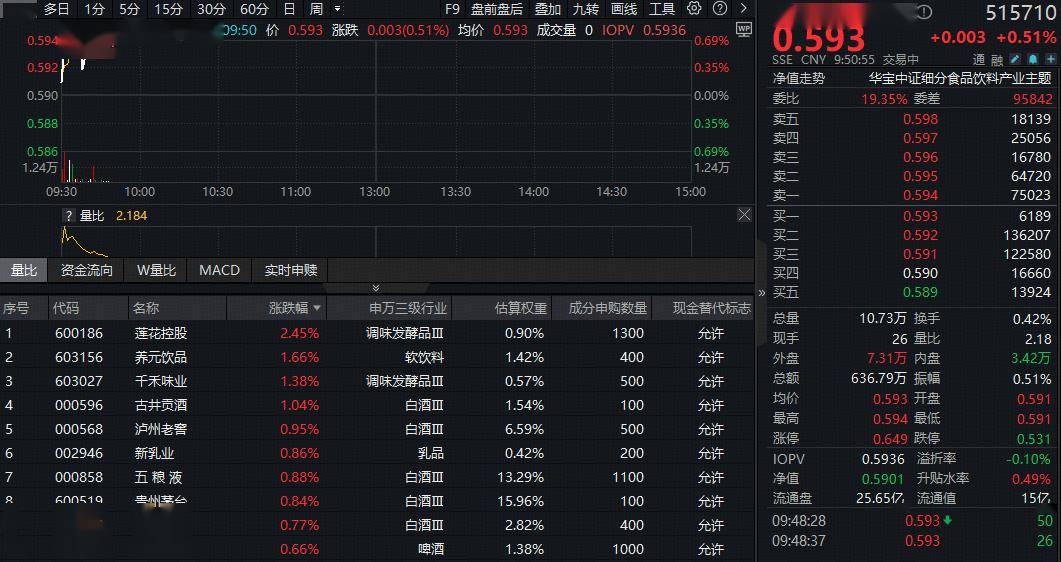
Group 1 - The food and beverage sector showed a positive trend today, with the ETF Huabao (515710) rising by 0.51% as of the report time [1] - Key stocks in the sector, including liquor and consumer goods, performed well, with Lianhua Holdings up over 2% and Guizhou Moutai, Wuliangye, and others showing slight gains [1] - The recent launch of premium Moutai products has seen strong demand, with products selling out quickly [1][3] Group 2 - Guizhou Moutai is the largest holding in the Huabao ETF, accounting for 14.89% of the portfolio as of Q3 2025 [3] - The valuation of the food and beverage sector is at a historical low, with the ETF's underlying index PE ratio at 20.16, indicating a potential opportunity for investment [3] - Historical analysis suggests that the current phase of the high-end liquor market may present a bottoming opportunity for capital market investments, especially with the upcoming Spring Festival [3] Group 3 - The Huabao ETF primarily invests in leading high-end and mid-range liquor stocks, with significant allocations to beverage, dairy, and seasoning sectors [4] - Investors can also access the core assets of the food and beverage sector through the Huabao ETF linked funds [4] - The redemption fee structure for the Huabao ETF linked funds is outlined, with varying rates based on the investment amount and holding period [5]

茅台又“秒空”!“茅五泸汾洋”齐涨,食品饮料ETF华宝(515710)红盘震荡!机构:白酒板块或迎底部配置机会
Xin Lang Cai Jing· 2026-01-09 02:06
Group 1 - The food and beverage sector showed an upward trend on January 9, with the food and beverage ETF Huabao (515710) increasing by 0.51% [1][10] - Key stocks in the sector, including liquor and consumer goods, performed well, with Lianhua Holdings rising over 2%, and Gujing Gongjiu and Yangyuan Beverage increasing over 1% [1][10] - Notable stocks such as Kweichow Moutai, Wuliangye, Luzhou Laojiao, and Yanghe also saw slight gains [1][10] Group 2 - Kweichow Moutai is the largest holding in the food and beverage ETF Huabao, accounting for 14.89% of the fund's assets as of Q3 2025 [3][12] - The fund's top holdings also include Wuliangye and Yili, with respective asset values of approximately 188.37 million and 160.59 million yuan [4][13] Group 3 - The valuation of the food and beverage sector is currently at a historical low, with the food and beverage ETF Huabao's index PE ratio at 20.16, placing it in the 5.88% percentile over the past decade, indicating a favorable long-term investment opportunity [4][12] - Analysts suggest that the current market conditions may present a good entry point for investments in the sector [4][14] Group 4 - Recent market strategies from Kweichow Moutai, Wuliangye, and Luzhou Laojiao are expected to coincide with the upcoming Spring Festival, potentially marking a turning point for the liquor industry [5][14] - The food and beverage ETF Huabao tracks the CSI segmented food and beverage industry index, with approximately 60% of its portfolio in high-end and mid-range liquor stocks [6][14]
酒价内参1月9日价格发布 精品茅台价格下跌6元/瓶
Xin Lang Cai Jing· 2026-01-09 01:37
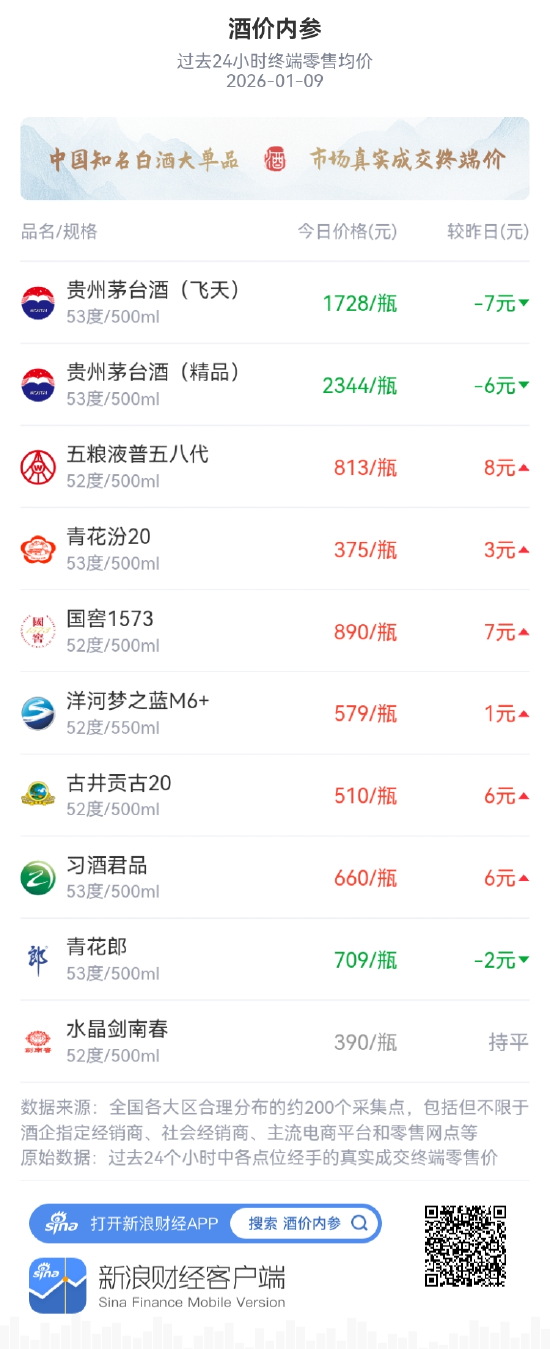
Core Viewpoint - The Chinese liquor market is experiencing a rebound in retail prices for major products after a period of decline, indicating a stabilization in market sentiment [1]. Price Trends - The average retail price of the top ten Chinese liquor products increased to 8998 yuan, up by 16 yuan from the previous day [1]. - Major products showing price increases include: - Wuliangye Pu Wuyi 8th generation: up 8 yuan per bottle - Guojiao 1573: up 7 yuan per bottle - Gujing Gong 20 and Xijiu Junpin: up 6 yuan per bottle each - Qinghua Fen 20: up 3 yuan per bottle - Yanghe Dream Blue M6+: up 1 yuan per bottle, marking five consecutive days of increases - Shuijing Jiananshun: price remained stable [1][5]. Price Declines - Products experiencing price declines include: - Feitian Moutai: down 7 yuan per bottle - Boutique Moutai: down 6 yuan per bottle - Qinghua Lang: down 2 yuan per bottle [1][4]. Market Dynamics - The market is showing signs of recovery with most brands experiencing price increases and moderate volume growth, leading to a more positive market sentiment compared to previous days [1]. - The introduction of new sales channels for Moutai products, including the iMoutai platform, is expected to influence retail prices positively [2][3].
促消费扩投资“双引擎”发力!食品饮料ETF天弘(159736)昨日获1800万份净申购居深市同类第一,机构:2026年行业将呈现弱复苏态势
2 1 Shi Ji Jing Ji Bao Dao· 2026-01-09 01:34
Group 1 - The A-share market experienced a collective decline on January 8, with the CSI Food and Beverage Index dropping by 0.37%. Notable stocks within this index included Ziyuan Food, which rose nearly 8%, Andeli, which increased over 5%, and Laiyifen, which gained over 4% [1] - The Tianhong Food and Beverage ETF (159736) recorded a trading volume exceeding 26 million yuan on January 8, with a real-time premium rate of 0.26%. It saw a net subscription of 18 million units, ranking first among similar ETFs in the Shenzhen market [1] - As of January 7, the Tianhong Food and Beverage ETF had a circulating share count of 7.89 billion units and a total market size of 5.509 billion yuan. This ETF tracks the CSI Food and Beverage Index and focuses on leading stocks in high-end and mid-range liquor, as well as key players in beverages, dairy, condiments, and beer [1] Group 2 - Reports indicate that local governments are focusing on expanding domestic demand to stimulate economic growth, with "domestic demand as the main driver" being a top priority in the 2026 economic work agenda. Efforts include subsidies to boost consumption in sectors like home appliances, dining, and film, alongside the orderly development of major projects [2] - Experts suggest that enhancing consumption and driving investment will strengthen the main driving force of domestic demand, providing support for sustained economic recovery [2] - The U.S. Department of Health and Human Services and the Department of Agriculture released significantly revised federal dietary guidelines, encouraging home cooking and reducing consumption of highly processed foods. The new guidelines recommend a protein intake of 1.2 to 1.6 grams per kilogram of body weight, up from the previous recommendation of 0.8 grams [2] Group 3 - Guosheng Securities predicts that the food and beverage industry will experience structural differentiation and a weak recovery in 2026 [3] - CITIC Securities believes that the food and beverage industry will enter a phase driven by "consumption stratification and premiumization" in 2026 [3]


