华润三九

Search documents
中药板块2月2日跌0.98%,吉林敖东领跌,主力资金净流出2.35亿元
Zheng Xing Xing Ye Ri Bao· 2026-02-02 09:15
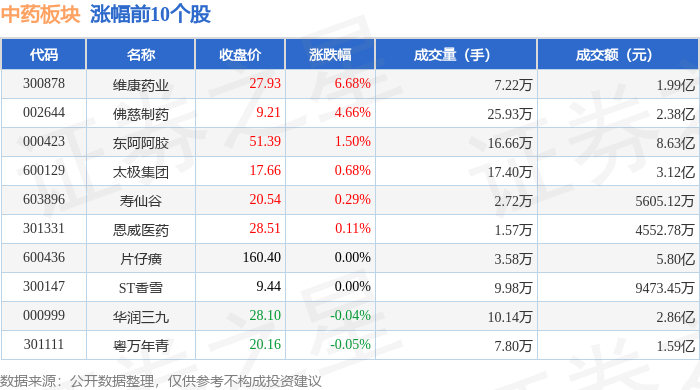
Market Overview - The Chinese medicine sector experienced a decline of 0.98% on February 2, with Jilin Aodong leading the drop [1] - The Shanghai Composite Index closed at 4015.75, down 2.48%, while the Shenzhen Component Index closed at 13824.35, down 2.69% [1] Stock Performance - Notable gainers in the Chinese medicine sector included: - Weikang Pharmaceutical (300878) with a closing price of 27.93, up 6.68% [1] - Foci Pharmaceutical (002644) with a closing price of 9.21, up 4.66% [1] - Significant decliners included: - Jilin Aodong (000623) with a closing price of 18.88, down 7.63% [2] - Datang Pharmaceutical (920433) with a closing price of 5.86, down 3.46% [2] Trading Volume and Capital Flow - The Chinese medicine sector saw a net outflow of 235 million yuan from institutional investors, while retail investors contributed a net inflow of approximately 51.97 million yuan [2] - The trading volume for Jilin Aodong reached 504,800 shares, with a transaction value of 977 million yuan [2] Individual Stock Capital Flow - Key capital flows for selected stocks included: - Dong'e Ejiao (000423) with a net inflow of 129 million yuan from institutional investors, but a net outflow of 18.04 million yuan from retail investors [3] - Foci Pharmaceutical (002644) had a net inflow of 43.42 million yuan from institutional investors, with a net outflow of 15.68 million yuan from retail investors [3]




华润三九(000999) - 董事会2026年第二次会议决议公告
2026-02-02 09:00
股票代码:000999 股票简称:华润三九 编号:2026—002 华润三九医药股份有限公司 董事会 2026 年第二次会议决议公告 本公司及董事会全体成员保证信息披露的内容真实、准确、完整,没有虚假记载、 误导性陈述或重大遗漏。 华润三九医药股份有限公司(以下简称"公司"或"华润三九")董事会 2026 年 第二次会议于 2026 年 2 月 2 日下午在华润三九医药工业园综合办公中心 107 会议室召 开。会议通知以书面方式于 2026 年 1 月 30 日发出。会议由公司董事长邱华伟先生主持, 本次会议应到董事 11 人,实到董事 11 人,公司部分高级管理人员列席会议。本次会议 的召开及程序符合《公司法》和《公司章程》的规定,会议合法有效。会议以投票方式 审议通过了以下议案,并形成决议: 特此公告。 华润三九医药股份有限公司董事会 二○二六年二月二日 表决结果:同意 11 票,反对 0 票,弃权 0 票,审议通过。 附:高级管理人员简历 颜炜先生:男,1971 年 10 月出生,中共党员,项目管理学硕士学位,研究生学历。 曾任华润三九医药股份有限公司 OTC 事业部总经理、康复慢病事业部总经理、首席营 ...

趋势研判!2026年中国妇科用药行业发展背景、产业链、市场规模、重点企业及未来趋势:妇科疾病高发促进用药需求,行业规模增至595.3亿元[图]
Chan Ye Xin Xi Wang· 2026-02-02 01:09
Industry Overview - The gynecological medication industry encompasses drugs for the prevention, diagnosis, and treatment of gynecological diseases, including traditional hormone therapies, antibiotics, analgesics, and immunomodulators [1][3] - The market for gynecological medications in China has shown rapid growth, with the market size increasing from 27.735 billion yuan in 2012 to an estimated 56.137 billion yuan in 2024, reflecting a compound annual growth rate (CAGR) of 6.05% [1][9] - By 2025, the market size is projected to reach approximately 59.53 billion yuan, driven by increasing awareness of women's health and societal emphasis on female health [1][9] Market Dynamics - The prevalence of gynecological diseases among adult women in China is high, with an estimated incidence rate between 40% and 70%, including conditions such as tumors, cysts, reproductive-related diseases, and gynecological inflammation [6] - The rise in gynecological disease rates and the growing health consciousness among women are contributing to the steady expansion of the gynecological medication market [6] Industry Chain - The gynecological medication industry chain consists of upstream raw materials, intermediates, and pharmaceutical equipment; midstream production; and downstream distribution through pharmacies, hospitals, and e-commerce platforms [6][7] Key Companies - Notable companies in the gynecological medication sector include Qianjin Pharmaceutical, Tongrentang, Kangyuan Pharmaceutical, Jiuzhitang, Yunnan Baiyao, and others, which are focusing on R&D and product differentiation [10][11] Development Trends - Future product development in gynecological medications is expected to shift towards precision and individualized treatment, utilizing diagnostic technologies to enhance treatment efficacy and reduce side effects [12] - Innovations in drug formulations and delivery methods will improve patient compliance and experience, with a focus on long-acting, user-friendly options [13] - The role of gynecological medication companies is evolving from mere drug suppliers to providers of comprehensive health management solutions for women throughout their life stages [14]




“大批中成药将退出市场”是真的吗?
Sou Hu Cai Jing· 2026-01-30 13:02
Core Viewpoint - The recent implementation of the "Regulations on the Registration Management of Traditional Chinese Medicine" by the National Medical Products Administration is expected to significantly impact the market for traditional Chinese medicine, with a potential exit of many products by 2031 due to stricter requirements for drug registration and safety information [1][2][5]. Group 1: Policy Implementation and Timeline - The new regulations took effect on July 1, 2023, providing a transition period of three years, with an actual deadline for compliance extending to 2031 due to the five-year drug re-registration cycle [1][5]. - Many companies, including leading firms like Yunnan Baiyao and Tongrentang, are already preparing to meet the new requirements by enhancing their product safety information [1][5]. Group 2: Rationale Behind the Policy - The policy aims to improve drug safety by mandating that traditional Chinese medicine products clearly state contraindications, adverse reactions, and precautions, addressing public concerns about medication safety [2][4]. Group 3: Market Impact and Industry Dynamics - The regulations are not expected to lead to a mass exit of traditional Chinese medicine products; instead, they may encourage companies to focus on their core strengths and improve product quality [4][5]. - The Chinese traditional medicine market is characterized by excessive competition, with over 4,500 production companies and approximately 2,400 traditional Chinese medicine enterprises, leading to a potential consolidation as weaker companies may exit the market [5][6]. - The policy could facilitate a shift from a fragmented market to a more robust and high-quality development phase, aligning better with consumer needs [6].

掘金顺周期-多行业系列联合会议
2026-01-30 03:11
Summary of Key Points from Conference Call Records Industry Overview - **General Economic Outlook**: The Chinese economy shows signs of stabilization, with nominal GDP growth expected to enhance corporate profits. Supply contraction outpacing demand may improve industry prices and corporate earnings, highlighting opportunities in cyclical industries [1][2][3]. Real Estate Sector - **Investment Value**: The real estate sector is deemed to have high investment value, with significant growth in second-hand housing transaction volumes and a narrowing decline in listing prices. Major cities like Beijing and Shanghai have seen listing volumes drop by over 15% [1][3]. - **Policy Catalysts**: Continuous policy support for real estate investment trusts (REITs) and other measures are expected to catalyze the market. The valuation of real estate stocks is considered to have a sufficient margin of safety, with many leading companies trading at a price-to-book (PB) ratio significantly below 1 [1][3][11]. - **Market Dynamics**: The short-term data indicates positive changes in the real estate market, with a notable decrease in listings for older urban properties, as owners prefer renting or waiting for redevelopment rather than selling at lower prices [4][5]. Travel and Transportation Sector - **Positive Outlook**: The travel industry is expected to benefit from government policies promoting tourism, with signs of recovery in duty-free and hotel sectors. The airline industry anticipates strong growth in passenger traffic, with ticket prices expected to be higher than last year [1][8][9]. - **Airline Performance**: During the 2026 Spring Festival travel period, the airline industry is projected to see a 5-6% increase in passenger traffic, with improved ticket pricing compared to 2025. The industry is entering a positive development phase, with a supply growth rate of about 4% and demand growth of approximately 5.5% [9]. Home Appliance Sector - **Investment Opportunities**: The home appliance sector is currently undervalued, presenting good investment opportunities across various segments, including kitchen appliances and white goods. Leading companies are expected to maintain stable performance and high dividend payouts [1][10][11]. Coal Industry - **Market Conditions**: The coal industry is experiencing a marginal improvement in supply-demand dynamics, with a stable price recovery expected. Supply constraints are anticipated to reduce domestic coal supply by 70 million to 100 million tons in 2026, while demand remains resilient [2][19][20]. Chemical Industry - **Future Trends**: The chemical industry is gaining attention due to increased market liquidity and expectations of positive producer price index (PPI) trends. Supply-side constraints and improved demand from global markets are expected to drive price increases [17][18]. Consumer Healthcare Sector - **Recovery Signs**: The consumer healthcare sector is showing early signs of stabilization, particularly in ophthalmology and dental services. Key players in these segments are expected to benefit from a recovering market environment [16]. Food and Beverage Sector - **Market Performance**: The food and beverage sector has seen significant price increases, particularly for premium brands like Moutai. However, potential risks include the release of pent-up supply post-holiday, which could impact prices [21][22]. Construction and Building Materials - **Market Changes**: The construction materials sector is adapting to a shift in demand from new housing to renovations of existing properties. Recent data indicates a recovery in demand for glass and other materials, with expectations of price stabilization and potential increases [24][25]. Conclusion - **Investment Strategy**: Overall, the cyclical industries, particularly real estate, travel, and home appliances, present promising investment opportunities. The focus should be on companies with strong fundamentals and favorable market conditions as the economy stabilizes [1][3][8][11].
脑机接口技术迈向产业拐点,医疗创新ETF(516820)连续10天净流入
Xin Lang Cai Jing· 2026-01-30 02:37
消息面上,民政部印发《关于进一步推进民政科技创新的指导意见》,其中提到,广泛应用人形机器 人、脑机接口、人工智能等前沿技术,开展失能失智预防和抗衰老、生活照料和康复护理、精神慰藉和 社会参与促进、安全风险监测和紧急救援、老年宜居环境建设和适老化改造等方面关键技术装备研发。 截至2026年1月30日 10:05,中证医药及医疗器械创新指数(931484)成分股方面涨跌互现,海思科领涨 2.62%,新产业上涨1.67%,华润三九上涨0.96%;片仔癀领跌。医疗创新ETF(516820)最新报价0.36元。 规模方面,医疗创新ETF最新规模达18.67亿元,创近1年新高。从资金净流入方面来看,医疗创新ETF 近10天获得连续资金净流入,最高单日获得4182.65万元净流入,合计"吸金"1.86亿元,日均净流入达 1857.56万元。(数据来源:Wind) 招商证券指出,脑机接口技术已从长期学术探索阶段进入产业拐点,在政策与需求双重驱动下,医疗成 为其核心主战场,占全球应用场景的56%;中国脑机接口产业在系统集成与应用落地方面进展显著, 2025年被正式纳入"十五五"规划中的"六大未来产业",顶层设计与地方支持同步加 ...
夹缝中的“一老一小”:莲池医院的高毛利故事,为何讲得如此艰难?
Hua Xia Shi Bao· 2026-01-29 10:09
Core Viewpoint - The private healthcare sector is facing significant challenges, with many hospitals closing, yet Lianchi Hospital in Shandong is attempting an IPO despite the downturn, showcasing a gross margin consistently above 30% [2][3] Group 1: Industry Challenges - Over 1,362 private hospitals have been closed or suspended in the first 11 months before 2025, averaging more than 7.5 closures per day, with over one-third being obstetrics and gynecology specialists [3] - Established medical device companies are divesting their hospital assets, indicating a shift in the industry landscape [2] Group 2: Lianchi Hospital's Business Model - Lianchi Hospital's business model focuses on "one old and one young," targeting both maternal and infant care and orthopedic services, which together account for over 90% of its revenue [4][10] - The maternal and infant care segment contributed 65.5% of revenue in 2024, with obstetric services seeing a 45.79% year-on-year increase [4][9] Group 3: Financial Performance - Lianchi Hospital's revenue grew from 356.43 million RMB in 2023 to 418.41 million RMB in 2024, with net profit increasing from 56.73 million RMB to 67.59 million RMB [14] - Despite the growth, the core hospitals in Qingdao and Zibo are experiencing revenue declines, with their combined revenue share dropping from 79.4% in 2023 to 60.0% in the first three quarters of 2025 [13][14] Group 4: Operational Challenges - The maternal and infant care segment is facing declining birth rates, leading to a drop in revenue and gross margin [10][11] - The orthopedic segment's revenue share decreased from 28.3% to 26.1%, with growth rates lagging behind overall revenue growth [11][12] Group 5: Financial Risks - Lianchi Hospital's goodwill has surged over 14 times from 15.09 million RMB to 231 million RMB, raising concerns about the sustainability of its high-margin business model [16][18] - The company's liquidity is under pressure, with cash on hand at 77.4 million RMB against current liabilities of 365 million RMB, indicating a potential cash flow crisis [18][19]

2026年,户外广告媒体为什么依旧值钱?
3 6 Ke· 2026-01-28 11:02
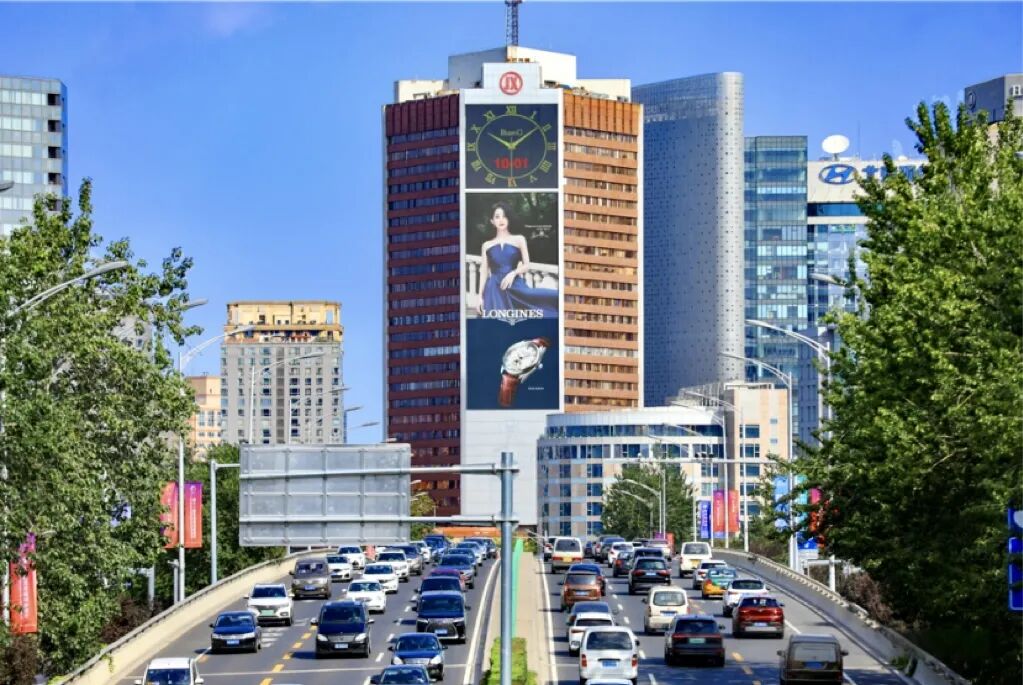
Group 1 - The core viewpoint of the article emphasizes the resurgence of outdoor advertising as a vital component of brand marketing, driven by unique characteristics and market demands [2][17]. - In 2026, the outdoor advertising market in China is projected to reach approximately 98.7 billion RMB, reflecting a year-on-year growth of about 7.1% [2]. - Outdoor advertising is regaining attention due to its ability to occupy physical space and provide a more engaging experience compared to digital ads, which can be easily dismissed [3][5]. Group 2 - The rise of "near-field consumption" and the emergence of lower-tier markets are significant trends driving the demand for outdoor advertising, as it aligns well with new consumer behaviors [8][11]. - Outdoor advertising can effectively reach decision-makers in households by integrating into daily routines, such as at bus stops and community entrances, enhancing conversion rates [11]. - The integration of AI and big data technologies is enhancing the effectiveness of outdoor advertising, allowing for real-time adjustments and measurable outcomes, thus transforming it into a precise marketing tool [14][16]. Group 3 - The article highlights that outdoor advertising is not merely a traditional medium but has evolved into a strategic tool that complements online marketing efforts and drives direct conversions [17][18]. - The unique value proposition of outdoor advertising lies in its ability to ensure information reaches consumers in a way that digital ads cannot, addressing the "last mile" challenge in marketing [17].
片仔癀连跌9日,再度刷新2020年6月以来新低!中药ETF(560080)跌超1%,近2日吸金超8600万元!关注中药2025业绩及基药目录调整进展
Xin Lang Cai Jing· 2026-01-28 08:58
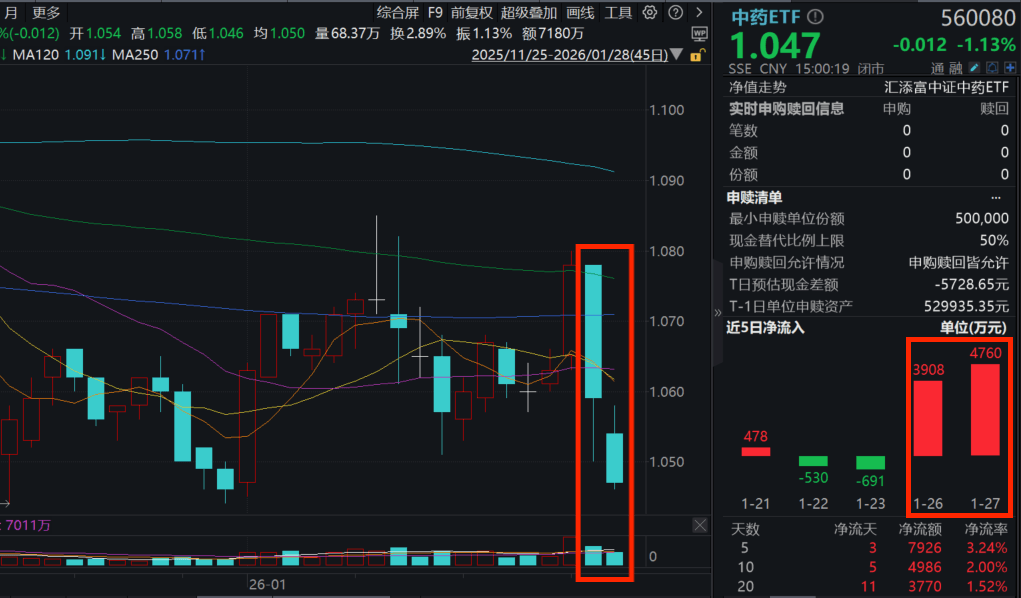
Core Viewpoint - The traditional Chinese medicine (TCM) sector is experiencing a second consecutive day of decline, with the TCM ETF (560080) dropping by 1.13% and a total trading volume exceeding 71 million yuan, indicating a potential buying opportunity as it has attracted over 86 million yuan in the last two days [1][3]. Group 1: Market Performance - The TCM ETF (560080) has seen a decline in key constituent stocks, with Yunnan Baiyao and China Resources Sanjiu both falling over 1%, while Yiling Pharmaceutical dropped over 3%. Conversely, Jilin Aodong rose over 1% [3]. - The TCM ETF's tracked index has a current price-to-earnings (PE TTM) ratio of 24.22, which is below 83.72% of the time since its inception in May 2015, indicating a favorable valuation [6]. Group 2: Earnings Forecasts - As of January 25, 2026, 11 TCM listed companies have released their 2025 annual reports and earnings forecasts, with 6 companies showing positive year-on-year net profit growth. Notably, 3 companies have growth rates exceeding 100% [7]. - The primary drivers for the earnings growth include the establishment of a "hospital + external" collaborative development model, with a focus on enhancing external market channels, particularly e-commerce [7]. Group 3: Policy and Structural Changes - The basic drug catalog has completed preliminary expert selection, with significant adjustments expected in 2026. The current catalog, last updated in 2018, includes 685 varieties, of which 268 are traditional Chinese medicines [7]. - The upcoming adjustments to the basic drug catalog are anticipated to enhance the accessibility of grassroots medications and promote a "1+X" medication model, potentially leading to rapid market expansion [7]. Group 4: Investment Themes - Three main investment themes in the TCM sector are highlighted: 1. Price governance, focusing on price reductions and market share in the context of centralized procurement and insurance negotiations [8]. 2. Consumption recovery, driven by macroeconomic improvement and increased health awareness among the aging population, benefiting TCM sales [9]. 3. State-owned enterprise reform, which is expected to yield performance improvements and investment opportunities in the TCM sector [9].

大批中成药将退出市场
2 1 Shi Ji Jing Ji Bao Dao· 2026-01-27 10:01
记者丨唐唯珂 编辑丨季媛媛 中成药淘汰赛序幕拉开!大批中成药将退出市场。 距离2026年7月1日仅剩半年时间,国家药监局《中药注册管理专门规定》第七十五条的落地进入最后窗口期。 这一被业内称为中成药"生死条款"的规定明确,自2023年7月1日施行满三年起,说明书【禁忌】【不良反应】【注意事项】任意一项仍标 注"尚不明确"的中成药,再注册申请将依法不予通过。这意味着,国内现存约5.7万个中成药有效批准文号中,超70%存在安全信息标注问题的 批文将面临淘汰,一场由监管驱动的中药产业深度出清正式进入攻坚阶段。 此次监管新政的核心,是彻底终结中成药说明书长期以来的"尚不明确"时代,倒逼药品持有人补齐上市后安全数据短板。 中国食品药品监管杂志此前研究显示,2018年版《国家基本药物目录》中268个中成药品种的465份说明书里,不良反应、禁忌、药物相互作用 的标注率仅为20.64%、30.1%和1.07%,大量品种依靠模糊表述完成上市后的市场流通。而随着再注册大考临近,这种"模糊免责"的模式已彻 底失去生存空间。 图/图虫 国家药监局的监管动作已提前落地,2025年全年发布多批中成药说明书修订公告,活力苏口服液、固肾生发 ...