
顺周期行业

Search documents
掘金顺周期-多行业系列联合会议
2026-01-30 03:11
Summary of Key Points from Conference Call Records Industry Overview - **General Economic Outlook**: The Chinese economy shows signs of stabilization, with nominal GDP growth expected to enhance corporate profits. Supply contraction outpacing demand may improve industry prices and corporate earnings, highlighting opportunities in cyclical industries [1][2][3]. Real Estate Sector - **Investment Value**: The real estate sector is deemed to have high investment value, with significant growth in second-hand housing transaction volumes and a narrowing decline in listing prices. Major cities like Beijing and Shanghai have seen listing volumes drop by over 15% [1][3]. - **Policy Catalysts**: Continuous policy support for real estate investment trusts (REITs) and other measures are expected to catalyze the market. The valuation of real estate stocks is considered to have a sufficient margin of safety, with many leading companies trading at a price-to-book (PB) ratio significantly below 1 [1][3][11]. - **Market Dynamics**: The short-term data indicates positive changes in the real estate market, with a notable decrease in listings for older urban properties, as owners prefer renting or waiting for redevelopment rather than selling at lower prices [4][5]. Travel and Transportation Sector - **Positive Outlook**: The travel industry is expected to benefit from government policies promoting tourism, with signs of recovery in duty-free and hotel sectors. The airline industry anticipates strong growth in passenger traffic, with ticket prices expected to be higher than last year [1][8][9]. - **Airline Performance**: During the 2026 Spring Festival travel period, the airline industry is projected to see a 5-6% increase in passenger traffic, with improved ticket pricing compared to 2025. The industry is entering a positive development phase, with a supply growth rate of about 4% and demand growth of approximately 5.5% [9]. Home Appliance Sector - **Investment Opportunities**: The home appliance sector is currently undervalued, presenting good investment opportunities across various segments, including kitchen appliances and white goods. Leading companies are expected to maintain stable performance and high dividend payouts [1][10][11]. Coal Industry - **Market Conditions**: The coal industry is experiencing a marginal improvement in supply-demand dynamics, with a stable price recovery expected. Supply constraints are anticipated to reduce domestic coal supply by 70 million to 100 million tons in 2026, while demand remains resilient [2][19][20]. Chemical Industry - **Future Trends**: The chemical industry is gaining attention due to increased market liquidity and expectations of positive producer price index (PPI) trends. Supply-side constraints and improved demand from global markets are expected to drive price increases [17][18]. Consumer Healthcare Sector - **Recovery Signs**: The consumer healthcare sector is showing early signs of stabilization, particularly in ophthalmology and dental services. Key players in these segments are expected to benefit from a recovering market environment [16]. Food and Beverage Sector - **Market Performance**: The food and beverage sector has seen significant price increases, particularly for premium brands like Moutai. However, potential risks include the release of pent-up supply post-holiday, which could impact prices [21][22]. Construction and Building Materials - **Market Changes**: The construction materials sector is adapting to a shift in demand from new housing to renovations of existing properties. Recent data indicates a recovery in demand for glass and other materials, with expectations of price stabilization and potential increases [24][25]. Conclusion - **Investment Strategy**: Overall, the cyclical industries, particularly real estate, travel, and home appliances, present promising investment opportunities. The focus should be on companies with strong fundamentals and favorable market conditions as the economy stabilizes [1][3][8][11].
光伏的春天又来了
猛兽派选股· 2026-01-24 03:51
Core Viewpoint - The photovoltaic (PV) industry is experiencing significant momentum, particularly in the equipment sector, with clear RSR signals indicating strong market activity [1]. Group 1: Company Performance - Jiejia Weichuang is highlighted as a key player in the industry [3]. - Maiwei Co., Ltd. is noted for leading the market with unusual trading volumes and signals of acceleration into the second phase of growth [4]. - Aotwei and Jingcheng Machinery are also mentioned as companies that have entered the second phase of acceleration [5][7]. - High Measurement Co. and Dier Laser are part of the group showing strong performance, with most companies just entering the second phase [8][10]. - The characteristics of these stocks include significant price increases of over 50% and a strong breakout above previous highs, indicating a bullish trend [12]. Group 2: Market Dynamics - The photovoltaic industry is classified as a typical cyclical industry, with performance fluctuations similar to non-ferrous metals and chemicals, driven by expectations of industry recovery and supply-side reforms [16]. - Equipment manufacturers often outperform the core industry stocks, as seen in the non-ferrous sector where mining equipment stocks have shown greater gains [16]. - Component stocks are lagging behind equipment stocks, with JinkoSolar showing potential due to its advanced technology and market position, surpassing previous leaders [18]. Group 3: Historical Context - Historical bull stocks serve as a guide for current market behavior, with current bull stocks following similar patterns of clear upward trends and compact adjustment structures [19].







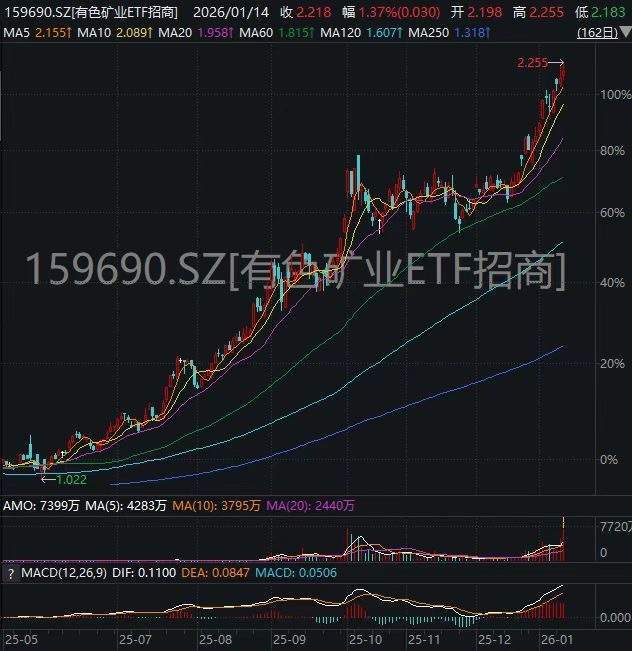
“周期放大器”有色矿业ETF招商(159690)放量涨1.23%,湖南白银涨停封板,白银有色、兴业银锡紧随其后
Sou Hu Cai Jing· 2026-01-14 06:18
Group 1 - The core viewpoint of the article highlights the strong performance of the non-ferrous metal sector, driven by solid supply and demand fundamentals [3] - The non-ferrous metal sector is experiencing a rally due to long-term constraints on the supply side, including declining ore grades and insufficient capital expenditure, compounded by geopolitical factors increasing supply uncertainty [3] - On the demand side, the rapid development of the new energy industry is driving growth in the demand for strategic metals like lithium and cobalt, while a manufacturing recovery is boosting demand for minor metals [3] Group 2 - Multiple institutions are optimistic about the resource sector, with CITIC Securities recommending an increase in positions in cyclical industries like non-ferrous metals, citing a favorable risk-reward ratio [3] - According to招商证券, 2026 is expected to see a cyclical resonance between China and the U.S., making non-ferrous metals a key focus for current investments in cyclical sectors [3] - The mining ETF (159690) is designed to focus on upstream resource sectors, covering various strategic resources such as gold, silver, copper, lithium, and rare earths, with the top three weighted varieties accounting for nearly 60% [3]


英大证券晨会纪要-20251226
British Securities· 2025-12-26 01:56
Market Overview - The A-share market showed a mixed performance with the Shanghai Composite Index supported by heavyweight sectors, while the ChiNext Index faced a pullback due to corrections in some high-valuation stocks [1][9] - The market sentiment improved as the three major indices collectively turned positive, with the Shanghai Composite Index achieving a seven-day winning streak, indicating rising expectations for the year-end market [1][9] - The upward trend in the market is attributed to favorable policies and improvements in the exchange rate, with the central bank signaling a commitment to maintaining market stability and the RMB appreciating against the USD [1][9] Policy and Economic Outlook - The central bank's fourth-quarter meeting emphasized maintaining capital market stability and proposed measures such as stock repurchase loans and exploring regular institutional arrangements [1][9] - Despite marginal improvements in macroeconomic data, a clear recovery point has not yet been established, and corporate earnings recovery requires further observation [2][10] - Incremental policy support is expected to be concentrated around the Lunar New Year, limiting short-term market upside potential [2][10] Sector Analysis - The military industry has shown significant growth, with a 25.27% increase in the sector's overall performance since the second half of 2020, and a 25.46% increase in the first half of 2025 [6][8] - The commercial aerospace sector is experiencing heightened activity due to clear top-level policies and the establishment of dedicated regulatory bodies, providing a stable development environment [7][8] - The robotics industry has seen substantial gains, with the humanoid robot sector increasing by approximately 80% since early January 2025, driven by strong internal growth and supportive government policies [8][9] Investment Strategy - Investors are advised to focus on sectors with strong earnings support, including technology growth areas (semiconductors, AI themes, robotics), cyclical industries (solar, batteries, chemicals), and dividend stocks (banks, utilities) [2][10] - Caution is recommended against high-valuation speculative stocks lacking earnings support, as the market may experience differentiation among individual stocks [2][10]
银行业2026年度策略
2025-12-08 00:41
Summary of the Conference Call on the Banking Industry Strategy for 2026 Industry Overview - The conference call focuses on the banking industry, particularly the outlook for 2026 and the valuation of bank stocks [1][2]. Key Points and Arguments 1. Valuation Improvement - 2026 is expected to be a critical year for the valuation of bank stocks, with a significant narrowing of interest margin decline anticipated to enhance bank performance, especially for large banks [1][4]. - The net interest margin (NIM) and return on equity (ROE) are expected to move in tandem, with improvements in NIM likely to drive price-to-book (PB) valuations higher [1][4]. 2. Domestic and International Valuation Discrepancies - There is a notable valuation disparity between domestic banks and those in the US and Japan, with domestic and some European banks being undervalued [5]. - Historical data suggests that banks perform well during inflationary periods and economic recoveries, even achieving excess returns post-risk exposure [5]. 3. External Environment and Recovery - The current domestic environment is stable but lacks clear signs of recovery. Drawing from experiences in the US and Japan, banks can achieve excess returns after risk clearance [6]. - Large banks like Agricultural Bank of China have room for PB improvement, supported by ongoing insurance fund purchases, despite short-term impacts from indices and geopolitical events [6]. 4. Non-Interest Income and Profit Growth - The performance of the bond market is expected to have a limited impact on future earnings expectations. Non-interest income for listed banks is under pressure in 2025 but is projected to stabilize and improve in 2026 [7]. - The overall profit growth is expected to remain steady, benefiting from positive factors related to net interest margin [7]. 5. Timing for Investment - Historical data indicates that bank stocks typically show significant excess returns in the first and fourth quarters, particularly in December and January [9]. - City commercial banks are highlighted as having substantial investment value due to their low valuations and stable profit expectations [3][9]. 6. Future Changes and Turning Points - 2026 is anticipated to be a turning point for the banking industry, with stabilized interest margins and no significant deterioration in mortgage loan delinquency rates [12]. - The current trend of declining bad debt rates suggests a favorable outlook for bank stocks in the coming years [12][14]. 7. Real Estate Market Impact - Despite falling property prices, mortgage asset quality has not significantly deteriorated, indicating a potential easing of related risks in 2026 [13]. 8. Factors Influencing Bank Stock Performance - Short-term performance may be influenced by systemic weaknesses in other sectors, with a more favorable outlook if policies become more proactive in 2026 [11]. - The allocation of insurance funds and the performance of cyclical industries are also critical factors to monitor [11]. 9. Long-Term Prospects for City Commercial Banks - High-quality city commercial banks are expected to outperform large banks, with potential returns of approximately five times over the next three to five years [24]. - These banks, such as Hangzhou Bank and Jiangsu Bank, are characterized by low price-to-earnings ratios and stable profit growth [24]. 10. Investment Selection Criteria - In the current market environment, emphasis should be placed on high-quality city commercial banks due to their profit growth potential and better asset quality [25]. - Large commercial banks are also worth considering, but individual assessments of their investment value are necessary [25]. Other Important Considerations - The overall non-performing loan ratio is expected to remain stable in 2026, with some banks potentially seeing declines [16]. - The growth rate of bank scale is anticipated to slow down compared to 2025, reflecting a long-term downward trend in China's economic growth [16]. - Fee income and investment returns are projected to stabilize and improve in 2026, although investment returns may not reach 2025 levels [17]. This summary encapsulates the key insights and projections regarding the banking industry as discussed in the conference call, providing a comprehensive overview of the anticipated trends and investment opportunities for 2026.
广发期货日评-20251118
Guang Fa Qi Huo· 2025-11-18 01:19
Report Industry Investment Rating No relevant content provided. Core Viewpoints of the Report - A-shares continue to fluctuate narrowly, with domestic stock index showing strong resilience. After the release of the third - quarter reports, A - shares are in a repricing adjustment, with limited downside risks. The bond market pricing is rather entangled and may continue to fluctuate narrowly. Precious metals maintain a weak - side fluctuation. Different varieties in other sectors have their own trends and corresponding operation suggestions [3]. Summary by Related Catalogs Financial Sector - **Stock Index**: TMT rotates upwards, and A - shares continue to fluctuate narrowly. It is recommended to wait and see mainly. If there is a deep decline on a single day, a bull spread of put options can be arranged [3]. - **Treasury Bond**: The equity market declines, and the bond futures fluctuate strongly. In the short - term, the bond market may continue to fluctuate narrowly. It is recommended to operate within the range for the unilateral strategy [3]. - **Precious Metals**: Gold prices may seek to stabilize around $4000 (925 yuan), and it is recommended to buy on dips. Silver follows the gold price, and it is recommended to try long positions on dips with a light position [3]. - **Container Shipping Index (European Line)**: The EC main contract rises and is expected to fluctuate upwards in the short - term [3]. - **Steel**: For steel, it is recommended to hold the arbitrage of going long on coking coal and short on hot - rolled coils and wait and see on the unilateral side. Iron ore fluctuates, and it is recommended to wait and see unilaterally within the range of 750 - 800. Coking coal and coke are considered to have a downward - biased fluctuation, with reference ranges of 1100 - 1250 and 1600 - 1750 respectively [3]. Non - ferrous Metals Sector - Copper fluctuates, with the main contract referring to 85000 - 87500. Aluminum oxide fluctuates at a low level, waiting for new trading drivers. Aluminum breaks through the 22000 mark and then adjusts downward, and it is recommended to short on rallies. Other non - ferrous metal varieties also have their own price ranges and operation suggestions [3]. New Energy Sector - Polysilicon futures fluctuate downward, with a price range of 50000 - 58000. Lithium carbonate has multiple contracts hitting the daily limit, and it is recommended to wait and see [3]. Energy and Chemical Sector - Different chemical products such as PX, PTA, short - fiber, etc. have their own price trends and corresponding operation suggestions, including waiting and seeing, operating within the range, and doing arbitrage [3]. Agricultural Products Sector - Different agricultural products such as soybeans, hogs, corn, etc. have their own price trends. For example, hogs are expected to fluctuate weakly, and it is recommended to hold the 3 - 7 spread arbitrage. Corn rebounds and fluctuates, and attention should be paid to the pressure level around 2200 [3].
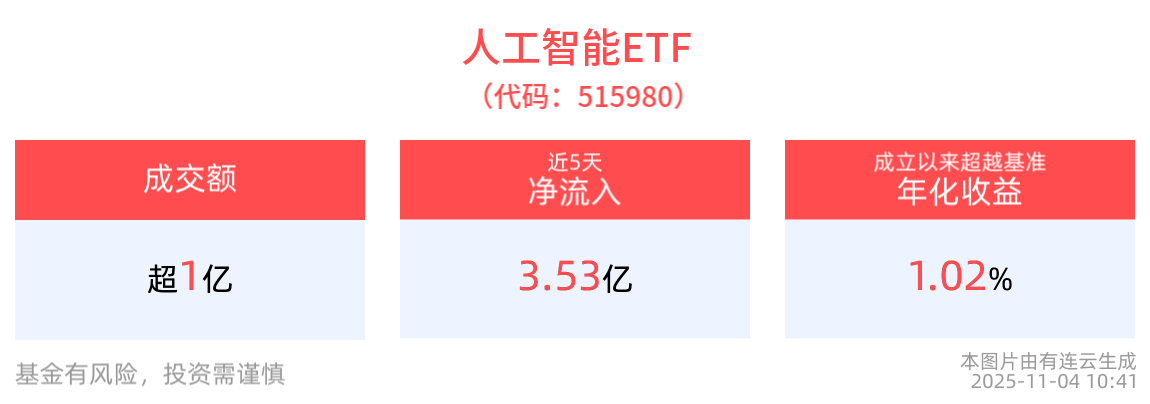
亚马逊与OpenAI签署380亿美元算力大单,人工智能ETF(515980)盘中涨超1%,近5日累计“吸金”3.53亿元
Sou Hu Cai Jing· 2025-11-04 05:06
Group 1 - Amazon's cloud computing division, AWS, has signed a $38 billion agreement with OpenAI to provide computing capacity over seven years, including the supply of hundreds of thousands of NVIDIA GPUs [1] - The agreement aims to assist in generating responses and training next-generation models for ChatGPT [1] - Following the announcement, the CSI Artificial Intelligence Industry Index fell by 0.68%, with mixed performance among constituent stocks [1] Group 2 - The AI ETF (515980) recorded a turnover of 1.87% and a half-day trading volume of 150 million yuan, with a total size of 7.965 billion yuan [2] - Over the past five trading days, the AI ETF has seen net inflows on three days, totaling 353 million yuan [2] - The AI industry index reported a revenue growth rate of 26.23% and a profit growth rate of 74.75% in Q3, marking the highest values since 2019 [2] Group 3 - Market focus is shifting towards "turnaround" industries with average current performance but expected improvement next year, alongside cyclical industries benefiting from economic stimulus [3] - The AI industry is in a valuation digestion phase, providing a rare opportunity for long-term investors to accumulate positions since April [3] - The HuaFu AI ETF (515980) covers various aspects of the AI industry, tracking the only quarterly rebalancing AI index in the market [3]


段永平捐赠大学壹万股贵茅股票,食品饮料ETF天弘(159736)近10日累计“吸金”超1.35亿元
2 1 Shi Ji Jing Ji Bao Dao· 2025-11-04 01:49
Core Viewpoint - The food and beverage sector is experiencing a positive trend, with significant inflows into related ETFs and new market developments indicating potential growth opportunities [1][2]. Group 1: ETF Performance - The Tianhong Food and Beverage ETF (159736) opened slightly lower on November 4, with a latest circulation scale of 5.677 billion yuan, ranking first among food and beverage ETFs in the Shenzhen market [1]. - Over the past 10 days, the Tianhong Food and Beverage ETF has seen net inflows on 9 occasions, accumulating over 135 million yuan [1]. Group 2: Market Developments - On October 31, Taobao launched a new convenience store brand "Taobao Convenience Store," which aims to provide a comprehensive shopping experience with 24-hour service and 30-minute delivery, leveraging Alibaba's supply chain advantages [1]. - Notably, investor Duan Yongping donated 10,000 shares of Kweichow Moutai (600519.SH) to the Jiangxi Water Conservancy and Electric Power University, valued at 15 million yuan [1]. Group 3: Industry Outlook - According to Zhongyin International, the food and beverage industry is a typical pro-cyclical sector, closely linked to the external economic environment. With coordinated fiscal and monetary policies, the consumption slowdown is expected to improve, allowing related sub-industries to emerge from the cyclical trough [2].

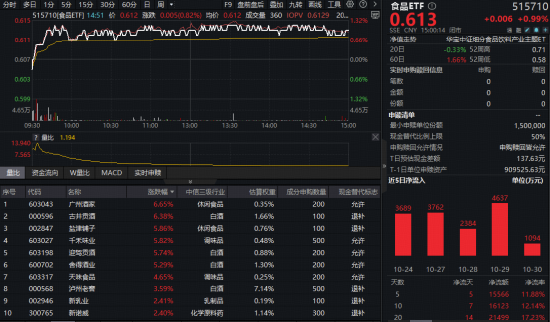
吃喝板块反攻号角吹响!食品ETF(515710)盘中涨超1%,近5日吸金1.55亿元!低位布局正当时?
Xin Lang Ji Jin· 2025-10-31 11:48
Core Viewpoint - The food and beverage sector is experiencing a significant upward trend, with the Food ETF (515710) showing a notable increase in value and attracting substantial investment in recent trading days [1][3][4]. Group 1: Market Performance - The Food ETF (515710) opened with a rapid increase, reaching a maximum intraday gain of 1.32% and closing with a gain of 0.99% [1]. - Key stocks in the sector, such as Guangzhou Restaurant and Gujing Gongjiu, saw increases exceeding 6%, while several others, including Yanjinpuzi and Qianhe Flavor, rose over 5% [1]. - The Food ETF has attracted over 155 million yuan in the last five trading days and 214 million yuan over the past 20 trading days [1]. Group 2: Industry Outlook - The food and beverage industry is characterized as a typical cyclical sector, with its performance closely tied to the external economic environment. Improved fiscal and monetary policies are expected to enhance consumer sentiment [3]. - Leading companies in the sector are demonstrating strong recovery capabilities despite a weak domestic demand environment, indicating a trend where the strong continue to thrive [3]. - The valuation of the food and beverage sector remains low, with the price-to-earnings ratio of the Food ETF's underlying index at 19.89, placing it in the lower range historically [3]. Group 3: Investment Recommendations - Analysts suggest focusing on high-quality white wine leaders and consumer goods leaders that are positioned at the bottom of the industry cycle [3][4]. - The white wine sector is showing signs of bottoming out, indicating a potential phase for investment [4]. - The Food ETF is recommended as a core asset for investors looking to gain exposure to the food and beverage sector, with a significant portion of its holdings in high-end and mid-range liquor stocks [5].





瑞银证券:在顺周期行业中,基于反内卷更看好太阳能、化学品和锂行业。
Xin Lang Cai Jing· 2025-10-21 01:05
Core Viewpoint - UBS Securities expresses a positive outlook on the solar, chemicals, and lithium industries, emphasizing a preference for these sectors based on a rebound from the trend of "involution" in cyclical industries [1] Industry Summary - The solar industry is highlighted as a key area of growth, benefiting from increasing demand and supportive government policies [1] - The chemicals sector is expected to perform well due to rising industrial activity and a recovery in global supply chains [1] - The lithium industry is positioned favorably, driven by the growing electric vehicle market and the need for energy storage solutions [1]
