瑞众人寿

Search documents
【金融头条】保险业换帅潮
Jing Ji Guan Cha Wang· 2025-08-01 14:40
Group 1 - The insurance industry is experiencing an unprecedented wave of leadership changes, with over 50 companies undergoing management transitions since 2025, reflecting a shift towards long-term operational stability [2][3][12] - In the first half of 2025, more than 40 executives received approval for their positions, surpassing the previous year's figures, indicating a trend of increased executive turnover [3][12] - The changes in leadership are driven by the need for companies to adapt to a challenging market environment characterized by declining traditional growth models and regulatory pressures [3][17] Group 2 - The management reshuffles are not limited to smaller firms; major players like China Life, China Pacific, and AIA have also seen significant personnel changes, highlighting a broader industry trend [18][19] - The leadership changes are seen as opportunities to restart strategic planning, optimize governance structures, and rebuild organizational culture [8][20] - The insurance sector is at a critical juncture, with a focus on high-quality transformation, necessitating leaders who possess strategic vision and the ability to integrate resources effectively [9][20] Group 3 - The frequent turnover in management, particularly in property and casualty insurance companies, reflects the industry's struggle with business model limitations and competitive pressures [15][17] - Companies like Qianhai Insurance have faced challenges with high executive turnover, indicating instability within their leadership [6][7] - The need for new leadership is often driven by internal pressures to align with evolving market demands and external competitive dynamics [17][20]


21次!险资举牌创五年新高,投资逻辑告别“野蛮人”
Xin Lang Cai Jing· 2025-07-28 12:28
Core Viewpoint - The recent surge in insurance capital's significant stake acquisitions in the secondary market reflects a shift towards long-term value investment strategies, driven by declining interest rates, regulatory encouragement, and asset-liability management needs [1][2]. Group 1: Insurance Capital Activity - As of July 28, 2025, insurance companies have completed 21 stake acquisitions, surpassing the total for 2024 and setting a five-year record, with major players including Ping An Life, China Post Insurance, and New China Life [1]. - Ping An Life and its affiliated asset management companies have been the primary force behind these acquisitions, triggering seven stake purchases, including three for China Merchants Bank H-shares, increasing their holding from 5% to 15% [1]. Group 2: Investment Rationale - The frequent buying of state-owned bank H-shares by insurance capital is a strategic decision based on factors such as dividend yield, tax advantages, market liquidity, regulatory requirements, and counter-cyclical attributes [2]. - Stake acquisitions allow insurance companies to optimize financial statements and mitigate the impact of market volatility by accounting for investment income using the equity method [2]. Group 3: Asset Allocation Trends - As of Q1 2025, the proportion of stocks and funds in domestic insurance capital reached a historical high of 13.3%, indicating a strong desire among insurance companies to increase equity investments due to declining yields in bonds and non-standard assets [3]. - New China Life has shown a strong commitment to increasing its equity asset ratio, which reached nearly 20% in 2024, with a further increase of 2 percentage points in the first half of 2025 [3]. Group 4: Regulatory Support - The regulatory framework is encouraging long-term equity investments by insurance capital, with a recent notice from the Ministry of Finance introducing a five-year cycle indicator for assessing the performance of insurance funds [4]. - The new assessment method adjusts the evaluation of net asset return rates and capital preservation rates to include annual, three-year, and five-year indicators, promoting stability and sustainability in long-term investments [4].

险资举牌次数创近四年新高 高股息、科技股受追捧
Zhong Guo Jing Ying Bao· 2025-07-25 18:50
Core Viewpoint - Insurance funds are showing a strong enthusiasm for allocation in the capital market, with significant increases in stock holdings and a rise in equity asset allocation ratios [1][5]. Group 1: Insurance Fund Holdings - As of the end of Q1 2025, the stock market value held by the life insurance industry reached 2.65 trillion yuan, an increase of 377.5 billion yuan from the end of 2024, representing a growth rate of 16.65% [1]. - The stock allocation ratio for insurance funds is now 8.43%, up by 0.86 percentage points from the end of 2024 [1]. - In 2025, insurance funds have made 21 stake acquisitions, surpassing the total for 2024 and marking a four-year high [1][2]. Group 2: Investment Trends - Major insurance companies have indicated plans to moderately increase their equity asset allocation in 2025, highlighting the growing importance of equity investments in a prolonged low-interest-rate environment [1][5]. - The focus of insurance funds is shifting from short-term speculation to long-term investments, acting as a stabilizing force in the capital market [5]. Group 3: Sector Focus - The banking sector has been the most frequently targeted for stake acquisitions, followed by public utilities, energy, and technology sectors [4]. - Insurance funds are increasingly interested in high-dividend and technology sectors, with a strategy that combines defensive and growth-oriented investments [8][9]. Group 4: Policy Impact - Recent policies have opened up more space for insurance funds to enter the market, including a new long-cycle assessment mechanism for state-owned commercial insurance companies [7][8]. - The adjustment in performance evaluation criteria for insurance companies aims to promote long-term stable operations and sustainable development [8]. Group 5: Research and Engagement - Over 190 insurance institutions have conducted more than 9,800 research engagements with over 1,400 A-share listed companies, indicating a significant increase in research activity compared to previous years [9][10]. - The focus of these research activities includes high-dividend sectors like banking and emerging technology sectors such as artificial intelligence and semiconductors [9][10].
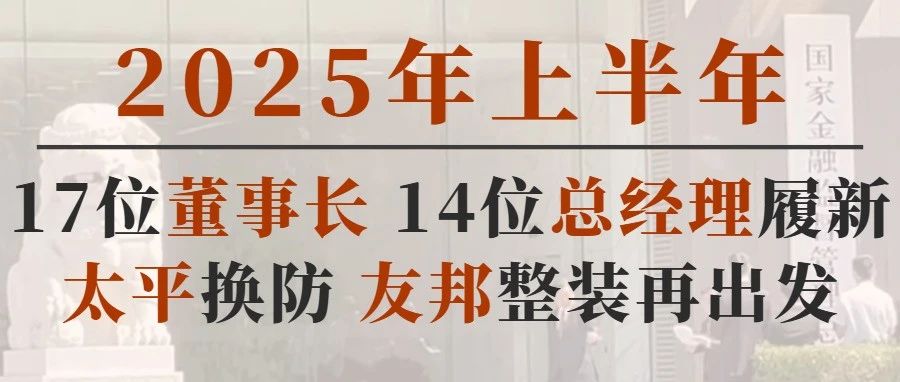
2025年上半年:17位董事长、14位总经理履新,太平、友邦等将帅齐换
13个精算师· 2025-07-24 10:33
Group 1 - In the first half of 2025, 27 insurance companies underwent significant leadership changes, including 17 chairpersons and 14 general managers [1][4] - The leadership adjustments are a response to the urgent need for transformation in the insurance industry, driven by declining interest rates and the implementation of new accounting standards [4] - Notable companies experiencing leadership changes include Taiping, AIA, and Zhongri, with some companies seeing both chairpersons and general managers replaced simultaneously [5][4] Group 2 - Taiping Group initiated a series of personnel adjustments starting from January 2025, with key appointments including Yin Zhaojun as chairman and Li Keding as general manager [6][9] - AIA Life appointed Yu Hong as general manager, following the transition of Zhang Xiaoyu to chairman [13][19] - Zhongri Life Insurance saw the promotion of Li Qi to general manager and Tian Meiai to chairman, reflecting a trend of internal promotions among executives with actuarial backgrounds [20][21] Group 3 - The establishment of Dongwu Insurance was a response to the challenges faced by Anxin Insurance, with Jiangsu State-owned Assets stepping in to support the new company [25] - Key personnel at Dongwu Insurance include Song Jifeng as chairman and Xia Weixin as general manager, both appointed by the company's shareholders [25] Group 4 - China Life Insurance saw the appointment of Li Zhuyong, a former executive from China Insurance, as a key figure in its leadership team [31] - China Ping An made significant appointments, including Xu Jing as chief compliance officer and Fu Xin as chief financial officer, aiming for a more professional and youthful management team [32][36] - China Pacific Insurance has also undergone major changes, with Su Gang appointed as vice president and financial officer, indicating a shift towards experienced professionals in leadership roles [40] Group 5 - Smaller insurance companies like Zhongxin Baicheng and Ruizhong are also experiencing leadership changes, with new appointments reflecting strategic shifts and shareholder changes [42][44] - The trend of leadership changes across the industry is seen as a way for companies to inject new energy and seek breakthroughs amid industry challenges [46]
多家银行热推红利策略产品,有的近1月年化收益率超17%!值得买吗?
Xin Lang Cai Jing· 2025-07-22 11:42
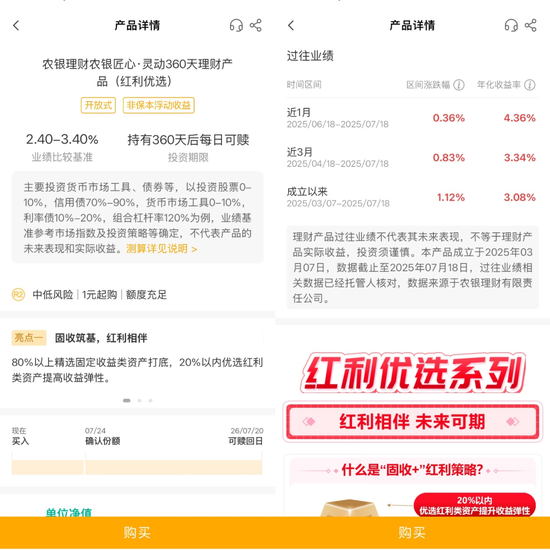
Core Insights - The low interest rate environment has led to a resurgence in dividend strategy wealth management products, with increasing demand from investors for such allocations [1][2][8] - Major banks like Agricultural Bank of China, Bank of China, and Huaxia Bank are actively promoting dividend strategy products through their apps and public accounts [2][8] Product Overview - Dividend strategy products typically have a foundation of over 80% fixed income assets, with up to 20% allocated to dividend assets to enhance returns [1][4] - For example, the "Agricultural Bank of China Wealth Management 'Agricultural Bank Craftsmanship·Dynamic 360-Day Wealth Management Product (Dividend Preferred)'" has over 80% in fixed income assets and less than 20% in dividend assets [1][4] - The "Bank of China Wealth Management Wise Wealth Equity Dividend Strategy 180-Day Holding Period A" includes 30% of the CSI Dividend Index, with a risk level of R4 and an annualized return of 17.92% over the past month [4][7] Performance Metrics - The Agricultural Bank's product has shown an annualized return of 4.36% over the past month, 3.34% over the past three months, and 3.08% since inception, with a performance benchmark of 2.4%-3.4% [4][7] - The Bank of China's product has a high annualized return of 17.92% over the past month and 7.92% year-to-date, with an inception-to-date annualized return of 9.28% [7][8] Market Trends - The dividend strategy is gaining traction as a preferred investment choice among banks, with many financial managers recommending these products for their stability and potential for higher returns compared to traditional fixed income products [9][10] - The current low interest rate environment has made dividend strategies attractive, as they offer a stable yield compared to government bonds [9][10] Investment Opportunities - In addition to dividend strategy products, other investment opportunities include high-dividend blue chips, state-owned enterprises, green low-carbon assets, and sectors related to AI and digital economy [12][13] - The market is seeing increased interest from insurance funds in high-dividend stocks, indicating a shift towards assets that provide stable cash returns [10][11]



金融IT国产化、智能化提速 腾讯云胡利明:中尾部保险和券商是增量
Zhong Guo Jing Ying Bao· 2025-07-21 09:45
Core Insights - The financial industry is at the forefront of digital technology, with significant advancements driven by AI models and domestic innovation [1] - The current IT development in the financial sector is characterized by two main trends: localization and intelligence [1] - There is a notable shift towards domestic software and hardware solutions, with many financial institutions actively transitioning to these technologies [1][2] Localization and Market Demand - The demand for domestic databases, cloud platforms, and new core systems is increasing among securities and insurance firms, with many projects currently underway [1] - Major financial institutions have entered a normalization phase for domestic construction, with banks approximately 60% complete and insurance and securities around 20% [1] - Despite a slight reduction in IT budgets, financial institutions are prioritizing investments in domestic technology architecture [1] AI Model Implementation - AI models are crucial for the intelligent transformation of the financial sector, with a focus on identifying key application scenarios [4] - There are over a hundred financial clients utilizing mixed models, with applications such as AI code assistants and intelligent customer service [5] - The "big model credit due diligence assistant" has significantly reduced the time required for due diligence reports from 10 days to 1 hour [5] Insurance Sector Developments - In the insurance industry, AI models are being used to build intelligent enterprise knowledge bases and provide training for insurance agents [6] - Companies are integrating AI models into various business scenarios, enhancing operational efficiency and addressing user pain points [6] - The approach to AI model development emphasizes embedding capabilities across a wide range of business applications, leveraging vast amounts of data for continuous improvement [6]

2024年山东保险业:多元化公益实践 传递保险温度
Qi Lu Wan Bao· 2025-07-17 00:25
Core Viewpoint - The 2024 Shandong Insurance Industry Development and Social Responsibility Report highlights the active role of the insurance industry in fulfilling social responsibilities and expanding the breadth and depth of social welfare activities in Shandong province [1]. Group 1: Social Responsibility Initiatives - Multiple insurance institutions are engaging in social welfare activities, donating over 500,000 yuan worth of elderly care equipment to various welfare institutions in Shandong through the "Yicai Qianjia" project by Taikang Life [2]. - Ping An Property & Casualty has conducted 42 events under the "Xiangfeng Wenming 100 Action" initiative, donating 1.39 million yuan and benefiting over 36,000 households to support rural revitalization [2]. - Ruizhong Life has focused on elderly and children's welfare, providing essential goods worth 63,000 yuan to 182 elderly individuals and engaging in various activities to support left-behind children [2]. Group 2: Volunteer Services - Several insurance companies, including China Life and Dadi Insurance, set up care stations during the college entrance examination to provide cooling supplies for students, parents, and traffic police [3]. - Sunshine Property & Casualty has organized 47 public welfare activities, contributing over 500 hours of volunteer service [3]. - Dehua Angu Life has initiated various public welfare projects, including a "Glow Run" and participation in global clean-up actions, mobilizing 318 volunteers to collect 107 bags of urban waste [3]. Group 3: Future Commitment - The Shandong insurance industry aims to continue enhancing its role in public welfare, contributing positively to social development and spreading warmth and care throughout the community [3].



一边举牌上市公司一边增资 险企上半年收到罚单超千张
Xi Niu Cai Jing· 2025-07-14 07:21
Group 1 - Insurance capital has initiated a new wave of "stake acquisitions" in 2025, with 19 instances recorded so far, nearing last year's total of 20 [2] - Jiangnan Water and Hualing Steel have recently been targeted for stake acquisitions by Life Insurance and Xintai Life, respectively, with Jiangnan Water seeing a 5.03% stake increase and Hualing Steel reaching 5.00% [3] - The acquisitions are based on long-term investment strategies and the companies' value propositions, with funding sourced from the insurers' own capital [3] Group 2 - Insurance capital is particularly focused on bank stocks, with 10 out of 19 acquisitions targeting banks, especially in the Hong Kong market [4] - The "Ping An system" has been notably active, accounting for 6 of the acquisitions, including Postal Savings Bank and China Merchants Bank [4][5] - Ping An Group's CEO indicated that the investments in high-dividend bank stocks were made in anticipation of a declining interest rate cycle [5] Group 3 - In 2025, 13 insurance companies have announced capital increase plans, totaling approximately 50 billion yuan, with Ping An Life accounting for nearly half of this amount [7] - Ping An Life plans to increase its registered capital from 33.8 billion yuan to 36 billion yuan through a capital increase of about 19.999 billion yuan [7] - Other companies, such as Zhongyou Insurance, have also received approval for capital increases, indicating a trend of strengthening capital positions across the industry [7] Group 4 - Issuing bonds has become a significant method for insurers to supplement capital, with several companies, including Ping An Life and Taikang Life, actively participating in the bond market [8][9] - In June, Ping An announced plans to issue 11.765 billion HKD in zero-coupon convertible bonds, attracting market attention [9] Group 5 - The insurance industry has faced increased regulatory scrutiny, with over 1,000 penalties issued in the first half of 2025, reflecting a tightening of oversight [10][11] - Notable penalties include a 1.115 million yuan fine against China People's Insurance for multiple violations, highlighting the regulatory environment's impact on major players [11] - The second quarter saw continued enforcement, with penalties primarily related to improper benefits and financial reporting inaccuracies [12]



北京“两区”建设五周年,五大重点园区实现跨越式发展
Xin Jing Bao· 2025-07-11 02:11
Core Insights - The five-year development of key parks under the "Two Zones" initiative in Beijing has led to significant advancements in industrial upgrading, open innovation, and urban transformation, positioning these parks as core engines for high-quality development in the capital [1] Group 1: Financial Sector Developments - Xicheng Financial Street has seen 208 financial projects included in the municipal "Two Zones" initiative, with a total investment exceeding 620 billion yuan, accounting for over 80% of the district's project total [2] - By 2024, the financial sector's added value in Xicheng is projected to reach 279.7 billion yuan, representing approximately 34.3% of the city's total [2] - The asset scale of financial institutions in Xicheng is expected to reach 156 trillion yuan by 2024, making up 70.3% of the city's total [2] Group 2: Innovation and Technology in Financial Services - Fengtai District's Lize area has increased the number of resident enterprises from 572 to over 1,300, with annual tax revenue growth maintaining double digits [4] - Lize has pioneered multiple digital currency application scenarios and established over 50 innovative financial products, including the first carbon reduction index swap transaction in the market [4] - The establishment of the Lize Cross-Border Financial Alliance aims to enhance cross-border service chains [4] Group 3: Industrial Transformation and Urban Development - Shijingshan's Shougang Park has transformed from an industrial rust belt to a vibrant urban showcase, attracting 941 enterprises and achieving an annual output value exceeding 73 billion yuan [6] - The park has become the first national sci-fi industry cluster, with 138 enterprises in the sci-fi metaverse sector, and has hosted nearly 1,000 international events [7] - The park's innovative management system has been recognized nationally for integrating industrial heritage protection with urban functional upgrades [7] Group 4: Green Energy and High-End Manufacturing - Fangshan District has been recognized for its high-end manufacturing base, focusing on green energy, and has been ranked among the top in the "Two Zones" evaluation for three consecutive years [8] - The district is home to the largest hydrogen fuel supply base in North China and is advancing a major green hydrogen transportation project [9] - Fangshan plans to invest 4.1 billion yuan in 11 pilot energy storage projects, enhancing communication resilience in mountainous areas [9] Group 5: Low-Altitude Economy and Technological Innovation - The Zhongguancun Yanqing Park has established itself as a hub for the low-altitude economy, with a 47.7% increase in output value and a 50.2% rise in revenue last year [10] - The park has developed a low-altitude flight management platform and launched the first regular drone delivery route, enhancing tourism and service delivery [10] - Future plans include deepening innovation in low-altitude technology and establishing a high-level open platform to support the capital's high-quality development [10]
浦发银行涨超34% 郑州银行逆势下跌
Nan Fang Du Shi Bao· 2025-07-08 23:16
Core Viewpoint - The banking sector in China has shown significant performance, with the China Securities Banking Index achieving a 34.7% increase in 2024, leading all industry indices, and a further 13% rise in the first half of 2025, driven by improved fundamentals and market preferences for stable investments [4][6]. Group 1: Performance Metrics - The China Securities Banking Index had a dividend yield of approximately 5.2% as of June, contrasting with declining deposit rates [8]. - In the first half of 2025, the banking sector saw a 17.6% increase, with the share prices of major banks like Shanghai Pudong Development Bank and Qingdao Bank rising over 30% [6][7]. - Among the six major state-owned banks, Agricultural Bank of China led with a 12.7% increase, while Postal Savings Bank lagged with only a 1% rise [5]. Group 2: Investment Trends - Insurance funds have become a significant source of investment in bank stocks, with 23 A-share listed banks having insurance capital as major shareholders [9]. - Analysts suggest that the high dividend yields of bank stocks continue to attract stable capital inflows, despite some recent volatility in stock prices [4][10]. - The market is currently evaluating the sustainability of high dividend yields, focusing on profitability, valuation, and dividend stability [10]. Group 3: Market Dynamics - The banking sector has experienced internal differentiation, with state-owned banks showing varied performance; while some have maintained strong growth, others have seen declines [4][6]. - The recent increase in capital for state-owned banks has led to concerns about short-term impacts on dividend yields and earnings per share [5]. - The overall sentiment in the market remains cautious, with investors weighing the benefits of high dividends against potential valuation pressures [9][10].