
Vivo

Search documents
每周观察 | 2Q25前五大企业级SSD品牌厂营收;二季度全球智能手机生产总数达3亿支;Micro LED芯片市场;牵引逆变器…
TrendForce集邦· 2025-09-13 02:04
Group 1: Enterprise SSD Market - The revenue of the top five enterprise SSD brands reached over $5.1 billion in Q2 2025, showing a quarter-over-quarter increase of 12.7% [2][3] - Samsung led the market with a revenue of $1,899 million, holding a market share of 34.6%, although it experienced a slight increase of 0.5% compared to the previous quarter [3] - SK Group (SK hynix + Solidigm) saw significant growth with a revenue increase of 47.1%, reaching $1,461.7 million and capturing a market share of 26.7% [3] Group 2: Smartphone Production - Global smartphone production reached 300 million units in Q2 2025, reflecting a quarter-over-quarter increase of approximately 4% and a year-over-year increase of 4.8% [4][5] - Oppo and Transsion brands contributed to the recovery in production after inventory adjustments, indicating a positive trend in the market despite ongoing economic challenges [4] Group 3: Micro LED Technology - The penetration of Micro LED technology in consumer electronics is accelerating, with significant products like the Garmin Fenix 8 Pro smartwatch expected to adopt this technology by 2025 [7] - The Micro LED chip market is projected to grow to $461 million by 2029, driven by the introduction of key products in various sectors [7] Group 4: Electric Vehicle Inverter Market - The global installation of electric vehicle traction inverters reached 7.66 million units in Q2 2025, marking a year-over-year increase of 19% [10] - Battery Electric Vehicles (BEVs) accounted for 52% of the installed inverters, surpassing hybrid vehicles for the second consecutive quarter [10]



集邦咨询:受季节性需求带动 第二季全球智能手机生产总数达3亿支 季增约4%
Zhi Tong Cai Jing· 2025-09-12 05:40
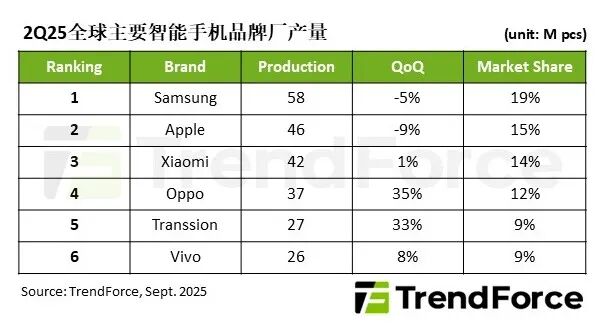
Core Insights - Global smartphone production is projected to reach 300 million units in Q2 2025, driven by seasonal demand and recovery in brands like Oppo and Transsion after inventory adjustments, reflecting a quarter-on-quarter increase of approximately 4% and a year-on-year increase of 4.8% [1] - Despite ongoing economic challenges affecting consumer spending, traditional peak seasons and e-commerce promotions in the second half of the year are expected to support a gradual increase in production throughout the year [1] Production and Market Share - Samsung remains the largest producer with 58 million units, experiencing a quarter-on-quarter decrease of 5%, holding a market share of 19% [2][4] - Apple produced 46 million units, down 9% quarter-on-quarter, but up 4% year-on-year, maintaining a market share of 15% [2][4] - Xiaomi's production totaled 42 million units, showing a slight increase of 1% quarter-on-quarter, with a market share of 14% [2][4] - Oppo's production surged to 37 million units, reflecting a significant quarter-on-quarter increase of 35%, capturing a market share of 12% [2][4] - Transsion produced over 27 million units, marking a 33% increase quarter-on-quarter and a year-on-year growth of 15.7%, with a market share of 9% [2][5] - Vivo's production reached 26 million units, up 8% quarter-on-quarter, also holding a market share of 9% [2][5] Market Dynamics - The Chinese smartphone subsidy policy has temporarily boosted sales of mid-range products and aided in inventory reduction, but its overall impact on annual sales for 2025 is expected to be limited due to constraints on subsidy amounts and product coverage [1] - The top six brands collectively maintain a stable market share of around 80% [4]
研报 | 库存调整结束,2Q25全球智能手机生产总数达3亿支,季增约4%
TrendForce集邦· 2025-09-12 03:52
Core Viewpoint - The global smartphone production is expected to reach 300 million units in Q2 2025, driven by seasonal demand and recovery in production from brands like Oppo and Transsion, despite ongoing economic challenges affecting consumer spending [2]. Group 1: Market Overview - The global smartphone production is projected to increase by approximately 4% quarter-over-quarter and 4.8% year-over-year in Q2 2025 [2]. - The Chinese market's subsidy policy has temporarily boosted sales of mid-range products, aiding inventory reduction, but its overall impact on 2025 sales is expected to be limited due to constraints on subsidy amounts and product coverage [2]. Group 2: Brand Performance - Samsung remains the largest producer with 58 million units, experiencing a 5% decrease quarter-over-quarter, holding a 19% market share [3][5]. - Apple produced 46 million units, down 9% from the previous quarter, but up 4% year-over-year, reflecting growth driven by the new iPhone 16e [5][6]. - Xiaomi's production totaled 42 million units, a 1% increase quarter-over-quarter, maintaining a 14% market share [3][6]. - Oppo's production surged by 35% to 37 million units as inventory adjustments concluded, securing a 12% market share [3][6]. - Transsion produced over 27 million units, a 33% increase quarter-over-quarter, with a year-over-year growth of 15.7%, capturing a 9% market share [3][6]. - Vivo's production rose by 8% to 26 million units, also benefiting from the Chinese subsidy policy, maintaining a 9% market share [3][6].
战略上藐视印度,战术上重视印度
3 6 Ke· 2025-09-11 11:36
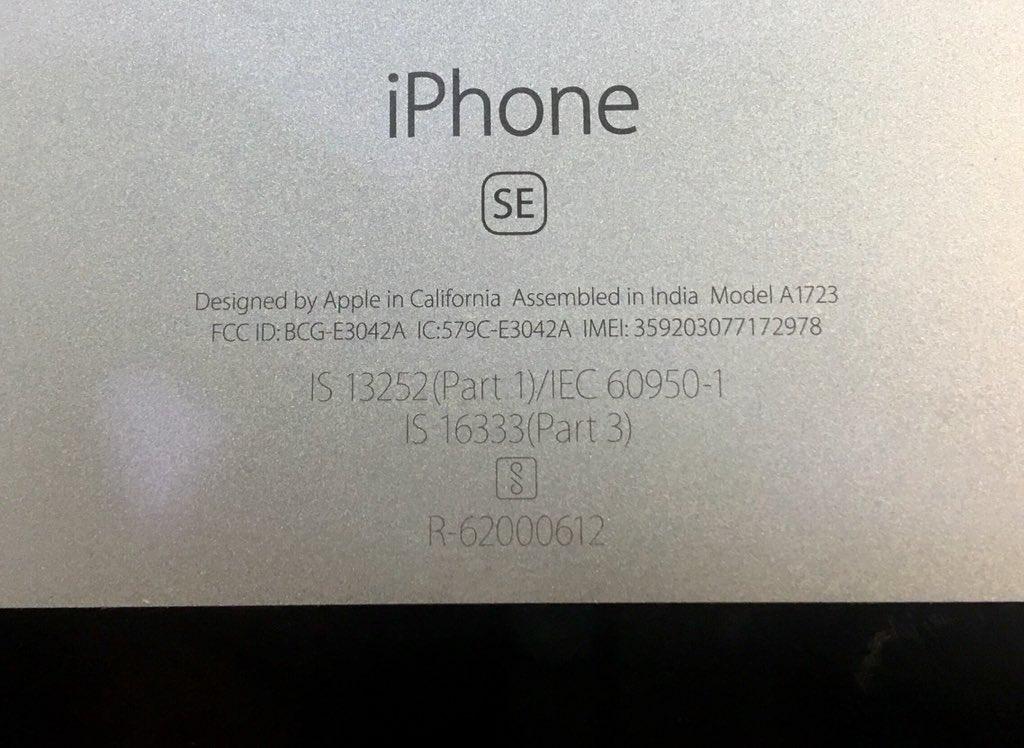
Core Viewpoint - The recent shift in iPhone production from China to India signifies a potential threat to China's manufacturing dominance and raises concerns about India's growing manufacturing capabilities, which could have implications for both economic and security aspects [5][6][28]. Group 1: Manufacturing Shift - The phrase "Assembled in India" has started to replace "Assembled in China" in the U.S. market, indicating a significant change in Apple's supply chain strategy [3][2]. - This shift has resulted in a loss of production share for Chinese companies, which previously dominated iPhone manufacturing [5]. - The transition of iPhone production to India may enhance India's manufacturing technology and management experience, potentially benefiting its military-industrial complex in the long run [5][6]. Group 2: Comparative Analysis - In terms of electricity consumption, China is projected to use approximately 10 trillion kilowatt-hours in 2024, with industrial use accounting for 6.3 trillion, while India's total electricity generation is below 2 trillion kilowatt-hours [12]. - India's railway expansion is significantly lagging, with only a few hundred kilometers added annually compared to China's 3,000 kilometers, which includes a majority of high-speed rail [13][14]. - India's industrial exports in 2024 are estimated at $254.63 billion, which is comparable to the export levels of Jiangsu Province, while Guangdong Province alone exported over $540 billion in machinery and electrical equipment [17][18]. Group 3: Strategic Perspective - The confidence in China's manufacturing capabilities is rooted in its historical development and the extensive efforts made over decades to build a robust industrial base [19][22]. - India's industrialization faces numerous structural challenges, including social issues and inadequate infrastructure, which hinder its ability to compete with China's manufacturing prowess [21][23][28]. - The comparison of India's industrialization to China's early development phases suggests that India has yet to resolve fundamental issues necessary for a competitive manufacturing sector [22][28]. Group 4: Tactical Awareness - Despite the strategic confidence in China's manufacturing, there is a need for tactical vigilance regarding India's advancements in specific sectors, particularly in consumer electronics [29]. - The low labor costs in India, with assembly workers earning less than 1,000 RMB per month, are attractive to companies like Apple, prompting a shift in production [30]. - The presence of major Chinese smartphone brands in India indicates a growing local supply chain that could enhance India's manufacturing capabilities in the consumer electronics sector [31][30]. Group 5: Future Considerations - The article emphasizes the importance of maintaining a competitive edge by advancing technology and innovation within China while managing the transition of certain manufacturing processes to India [36][38]. - The strategy of allowing India to handle lower-end manufacturing while retaining high-value processes in China is suggested as a way to balance the competitive landscape [36].
趋势研判!2025年中国智能手机行业发展全景分析:产品更新换代速度加快,市场换机需求提升,随着技术的不断创新,Al手机成为主要创新方向[图]
Chan Ye Xin Xi Wang· 2025-08-31 00:00
Core Insights - China has become the world's largest mobile phone producer and consumer, with a projected smartphone production of 1.25 billion units in 2024, maintaining over 70% of total mobile phone production for several years [1][4] - The smartphone industry is now in a mature phase, with a continuous decline in shipment volumes observed in recent years. The expected smartphone shipment for 2024 is 294 million units, a year-on-year increase of 6.5%, accounting for 63% of total mobile phone shipments [1][6] - The rapid pace of product updates has shortened the average usage cycle of smartphones, leading to increased market demand for replacements. AI smartphones are emerging as a key innovation direction [1][11] Industry Overview - The smartphone industry is defined as mobile devices with independent operating systems that allow users to install third-party applications and access wireless networks [2] - The industry has evolved from personal digital assistants (PDAs) to smartphones, which have become essential in daily life, driven by the growth of mobile internet [4] Current Market Situation - In 2024, the total mobile phone production in China is expected to reach 1.67 billion units, with a year-on-year growth of 7.26%. The smartphone production is projected at 1.25 billion units, consistently representing over 70% of total production [4] - The smartphone shipment volume in 2023 was 276 million units, with a 4.8% year-on-year increase, while the 2024 projection is 294 million units, reflecting a 6.5% growth [6] Industry Chain - The smartphone industry chain includes upstream components such as chips, PCBs, memory, operating systems, displays, power supplies, and cameras. The midstream involves manufacturing (ODM, OEM/EMS, brand owners), while the downstream includes operators, service providers, and end-users [6] Competitive Landscape - The Chinese smartphone market is characterized by high concentration and significant competition among domestic brands. In 2024, domestic brands are expected to ship 269 million units, a 16.3% increase, capturing 85.6% of the market [9] - Major players include Vivo, Huawei, Apple, Honor, and OPPO, with Vivo leading the market share at 17.2% and Huawei regaining its position among the top five brands [9] Future Trends - The smartphone market in China is expected to see a shift in consumer demand due to the early release of national subsidy policies, increasing the number of new models and enhancing consumer choices [10] - The competition for young consumers is intensifying, with brands increasing marketing investments and focusing on AI innovations [11]


一个赌气移民,一个驻华40年:他们如何躲过日本“失去的30年”?
虎嗅APP· 2025-08-29 10:10
Core Viewpoint - The article discusses the changing dynamics of the job market and emphasizes the importance of adapting to new opportunities, particularly in emerging markets, as traditional career paths become more challenging [4][18]. Group 1: Historical Context and Lessons from Japan - The article references Japan's "lost 30 years," highlighting how government actions during economic downturns affected workers, leading many to face challenges such as the "high-education trap" and "dispatch internal competition" [4][8]. - It shares stories of Japanese workers who successfully navigated these challenges by seizing opportunities in China, illustrating the potential for career growth in emerging markets [5][9]. Group 2: Identifying Opportunities in Emerging Markets - The article outlines various Chinese companies that have successfully expanded internationally, including sectors like consumer electronics, new energy vehicles, and cross-border e-commerce [23][24]. - It emphasizes the need for workers to research and identify lesser-known but promising companies that are expanding globally, rather than focusing solely on well-known brands [28][30]. Group 3: Strategies for Job Seekers - The article suggests that job seekers should enhance their skills and knowledge, particularly in international markets, to improve their chances of securing overseas positions [34][35]. - It highlights the importance of language skills and cultural understanding in building relationships and succeeding in foreign markets [36][37]. - The article recommends exploring internal transfer opportunities within companies as a pathway to international roles, as many firms offer such options [39][40]. Group 4: Actionable Steps for Career Development - The article encourages job seekers to create a LinkedIn profile and utilize various international job platforms to increase visibility and access to opportunities [46]. - It advises individuals to conduct thorough research on target companies, including their market position and growth potential, to better position themselves for job applications [48]. - The article suggests considering emerging markets in Southeast Asia and Africa for job opportunities, as these regions are projected to experience significant economic growth [50][53].

Are you bored with your phone? #Vergecast
The Verge· 2025-08-27 15:01
Market Trends & Consumer Behavior - Boredom with phones is driving consumers to seek alternatives like foldables or phones with unique designs [1] - Foldable phones offer a different user experience, potentially reducing screen time or providing a tablet-like experience [2] Product & Technology - Foldable phones are considered the best option for a significantly different phone experience [2] - "Nothing" phone brand offers a unique design as an alternative to traditional phones [1][2] Regional Differences - High-end Android phones from Chinese OEMs (Xiaomi, Honor, Oppo, Vivo) feature advanced camera technology and designs not found in US iPhones [3] - US market (Samsung, Google, Apple) favors more modest camera designs and impressive camera performance [3]

二手机做到行业第三的闪回科技IPO:年销10亿为何仍然难盈利?
Hua Er Jie Jian Wen· 2025-08-20 01:36
Core Viewpoint - The second-hand mobile phone market in China is rapidly evolving, with significant potential for growth driven by the increasing number of idle phones and the emergence of companies like Flashback Technology, which is seeking to capitalize on this opportunity through innovative business models and partnerships [1][2]. Market Overview - Over the past five years, China has generated more than 400 million discarded mobile phones annually, with approximately 54.2% remaining idle and only about 5% entering professional recycling channels [1]. - Flashback Technology holds a 1.3% market share in the mobile phone recycling market, ranking third behind major players like Aihuishou and Zhuanzhuan [1]. Business Model - Flashback Technology primarily operates a B2B model, sourcing used devices through partnerships with retail stores and telecom operators rather than directly from consumers [4][6]. - The company has implemented a real-time auction mechanism to enhance operational efficiency, with around 80% of its sales completed through this method in 2024 [8]. Financial Performance - Flashback Technology reported a revenue of 1.3 billion yuan in 2024, with a compound annual growth rate (CAGR) of 20.1% over three years [8]. - Despite revenue growth, the company's gross margin has declined from 8.2% in 2021 to 4.8% in 2024, leading to a net loss of 31.22 million yuan [12][13]. Strategic Partnerships - The company has established partnerships with major brands like Xiaomi and Samsung, which are crucial for sourcing used devices [9][10]. - Flashback Technology's reliance on Xiaomi is significant, with 41.5% of its procurement coming from this partner, highlighting the competitive dynamics in the market [10][11]. Future Plans - Flashback Technology plans to expand its operations in regions like Liaoning, Hebei, and Guangdong to enhance its market presence [14]. - The company aims to improve its profitability by increasing its sales of mid-to-high-end products, having recently established partnerships with Apple distributors [19][20]. Operational Efficiency - The company has streamlined its procurement process, reducing the number of active partners and improving cash flow, achieving a net inflow of 44 million yuan [17]. - Flashback Technology is also focusing on enhancing its online presence and marketing efforts to reach consumers directly, which could improve profit margins [23].
MiMedia and ADG China Sign Agreement to Help Accelerate MiMedia's Business Development Within Smartphone OEM Ecosystem in Asia
Newsfile· 2025-08-06 12:15
Core Viewpoint - MiMedia Holdings Inc. has partnered with ADG China to enhance its business development within the smartphone OEM ecosystem in Asia, aiming to expand the distribution of its consumer cloud platform [1][3]. Company Overview - MiMedia Holdings Inc. offers a next-generation consumer AI cloud platform that secures personal media in the cloud, accessible across devices and operating systems. The platform features rich media experiences, organization tools, private sharing capabilities, and content re-engagement features, servicing millions of engaged users globally [5]. Partnership Details - ADG China has a strong track record in bridging Western technology companies with Chinese distribution channels, having signed over 75 cross-border technology deals since 2001. The firm has integrated numerous companies onto hundreds of millions of devices from leading Chinese smartphone OEMs such as Vivo, Xiaomi, and Oppo [2][4]. - The partnership is expected to accelerate MiMedia's ability to sign new OEM partners, leveraging ADG's extensive network and experience in the Chinese market [3]. Market Context - The timing of the partnership is seen as favorable, with smartphone OEMs looking for solutions like MiMedia's to capture new recurring revenue streams, reduce churn, and differentiate themselves in a competitive market [3].

龙旗科技(603341):“1+2+X”持续推进,ODM龙头打开成长空间
Changjiang Securities· 2025-08-04 05:23
Investment Rating - The report assigns a "Buy" rating for the company, marking its first coverage [10]. Core Insights - The company is positioned as a leading ODM in the smartphone sector, with a strategic focus on expanding its product offerings and customer base, aiming to become the world's largest smartphone ODM by 2024 [4][8]. - The "1+2+X" strategy is being effectively implemented, with the company diversifying its product lines to include tablets, smart wearables, AIPC, AI glasses, and automotive electronics, which are expected to drive significant revenue growth [6][20]. - The demand for AI-enabled devices is anticipated to sustain high growth, with AI smartphones and AI glasses emerging as key growth areas, benefiting the company's market position [7][51]. Summary by Sections Company Overview - The company has over 20 years of experience in the ODM industry, evolving from IDH for feature phones to a comprehensive ODM model for various consumer electronics [6][20]. - The company has established a solid foundation in smartphone manufacturing, contributing to 78% of its revenue, while AIoT and tablets are becoming significant revenue streams [20]. Strategic Development - The "1+2+X" strategy focuses on smartphones as the core, while expanding into tablets and AIoT, with successful ventures into AIPC and AI glasses [6][20]. - The company aims for a revenue CAGR of approximately 10% and a net profit CAGR of around 20% from 2025 to 2028, reflecting confidence in its growth trajectory [29]. Market Position and Trends - The ODM industry is characterized by increasing technical barriers and a concentration of market share among leading players, with the company expected to benefit from these trends [7][8]. - The AI glasses market is projected to experience exponential growth, with the company positioned to capitalize on this trend through partnerships with major clients [62][68]. Financial Performance - The company experienced a significant revenue increase of 71% in 2024, although net profit declined by 17.21% due to rising raw material costs and intensified competition [33]. - The gross margin is expected to recover as raw material prices stabilize, with a projected gross margin of 7.45% in Q1 2025, indicating a positive trend [35]. Industry Dynamics - The ODM sector is witnessing a shift towards AI-enabled products, which are expected to drive demand and enhance the competitive landscape for leading ODM firms [51][55]. - The report highlights the importance of cost management and supply chain efficiency in maintaining profitability amid fluctuating raw material prices [78][81].